Where Alhama de Granada sits, and why water named it
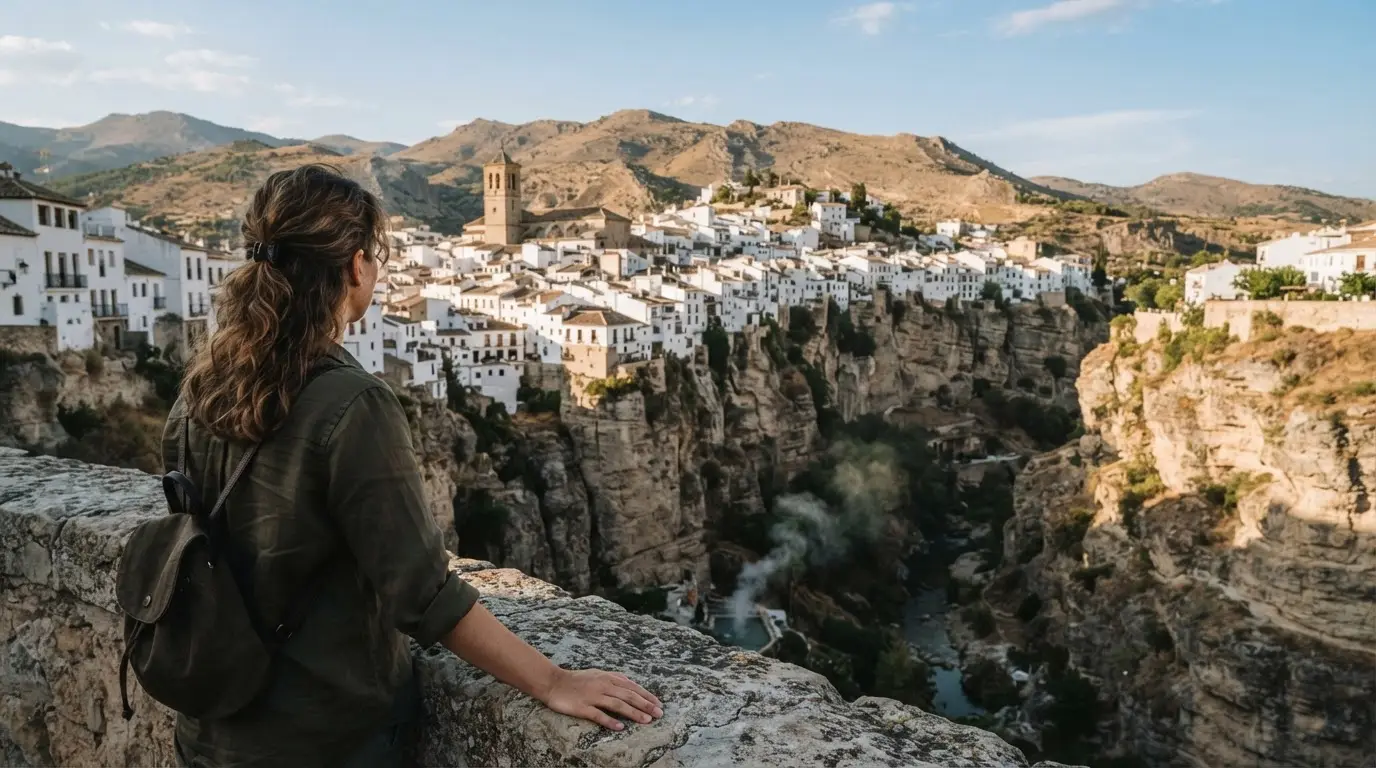
The river Alhama has cut a gorge fifty metres deep, and the town runs right up to its edge, so the streets themselves are the best viewing platform[3]. Alhama sits at about 895 m[4], in a steep mountain setting of white houses[1], which means a day here is mostly climbing, descending and looking, not a flat stroll.
Roman springs, Almohad bath house
The water story has three layers, and they overlap rather than replace one another.
- Roman setting: use of the springs is attested[8], the town carried the Roman name Artigi[9], and a Roman bridge of the 1st century BC leads to the baths[10].
- Almohad bath house, 12th century: the one preserved in the spa is Almohad in style and a good example of Arab bath construction[11].
- The join: horseshoe arches stand over the remains of Roman construction, under a vault pierced by star-shaped openings that let daylight filter in[12].
Who built the first bath is the open question. It was long believed that the Arabs built the thermal baths, though the local historian Salvador Raya Retamero argues the earliest baths are Roman[13]. Spanish scholarship on Arab baths treats a stacking of thermal practice from Roman times to the late Middle Ages as plausible in at least some regions[14], and arches built on Roman remains fit that picture.
Explore nearby · Monument
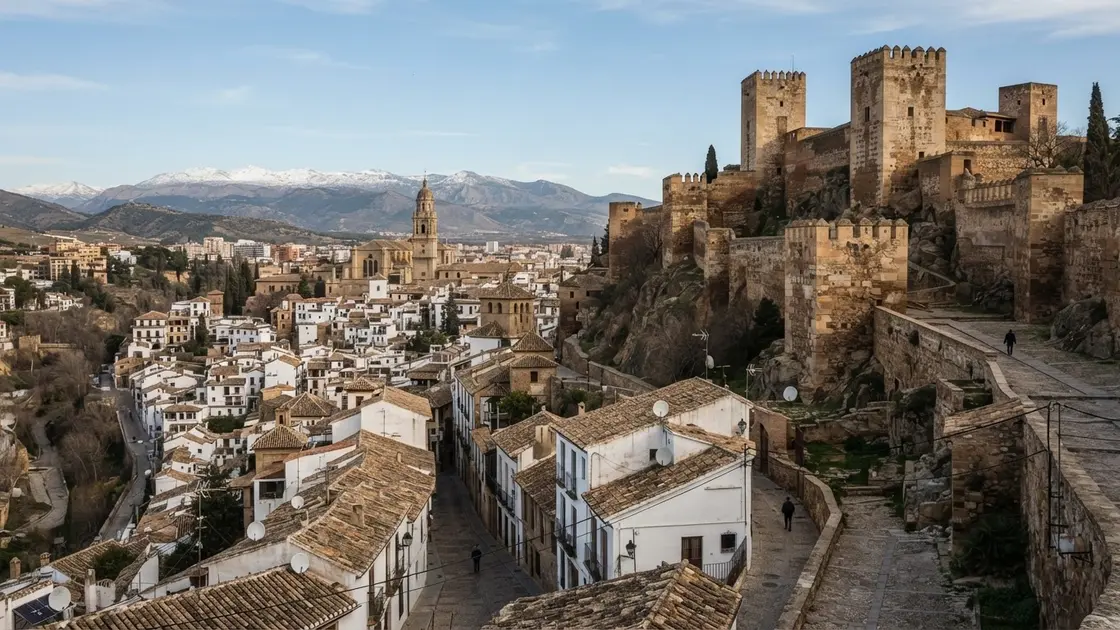
Alcazaba, Granada
Granada's oldest fortress and the military core of the Alhambra, built in 1238. Its Watch Tower delivers panoramic views of the Albaicin and Sierra Nevada.
Alhama's bath house is the country cousin of the Bañuelo, the bath in Granada city that anchors the city's Arab bath tradition. The bath house sits inside the spa, and no opening hours or prices are given here because they change; ask the town hall or tourist office in Alhama before you go.
A Nasrid stronghold on the Málaga road
Alhama mattered for where it stood. It lay on the main route between the emirate's capital and Málaga and Vélez-Málaga, through the Boquete de Zafarraya[15], which made it a stronghold of the Nasrid kingdom with a real part in the Granada War[16]. Walls and baths together gave it a name as a town of renown under the Nasrids[17].
The 14th-century historian Ibn al-Khatib described the city and its baths thoroughly[18]. He is the one contemporary voice in this story; the ballad comes much later.
Castile's move followed a Nasrid one. Zahara was lost by surprise on the night of 27 December 1481, and the assault on Alhama was the first Christian counterstroke[19]. The road, not the water, made the town worth the risk.
Late February 1482: Alhama falls to the Marquis of Cádiz
The chronicler Mosén Diego de Valera titled his chapter on the episode as the Marquis of Cádiz, Rodrigo Ponce de León, taking the city by scaling ladders[20]. The expedition the Catholic Monarchs sent was captained by the royal assistant in Seville, Diego de Merlo, together with the marquis[21].
Castile held Alhama from late February 1482 and, by holding it, cut the main route between Granada and its western territories[22]. For the Nasrids it was the loss of a fortress and of the road to the coast in one blow.
A Granadan siege followed. The Duke of Medina Sidonia, forgetting an old enmity with the marquis who had led the assault, came with reinforcements and lifted it[23]. Castilian magnates could hate one another and still turn up when a hard-won town was at risk.
Royal endorsement of the seizure is usually taken as the formal beginning of the Granada War[2], a war that ended with the fall of Granada.
Ay de mi Alhama: the ballad and what it can prove
English readers know the lament through Byron. His 'A very Mournful Ballad on the Siege and Conquest of Alhama' opens with the Moorish king riding up and down through Granada's royal town[25], while letters tell him how Alhama's city fell[26].
Byron's text appeared in 1818, and the ballad as a whole was not known to students of Spanish literature before his translation[27]. It is a cento of three or more ballads that appear in Ginés Pérez de Hita's Guerras Civiles de Granada, published at Saragossa in 1595[28], more than a century after the events. The lament is a retelling from a later age, not a record from 1482.
Byron's own note repeats the tradition that the original ballad, said to exist in both Spanish and Arabic, was forbidden to be sung by the Moors on pain of death within Granada[29]. Treat that as the tradition it is. The refrain in the Spanish text is Ay de mi Alhama, 'woe for my Alhama', and the comma in Byron's printed English line is a printer's or reader's error[30].
The phrase itself entered Spanish as an exclamation of regret[31]. Tradition puts the first cry in the mouth of Sultan Abu l-Hasan after the loss, which is a better story than a source.
What you can still see in Alhama today
The church of the Encarnación went up over the remains of an old mosque after the Christian conquest[32], founded by the Catholic Monarchs with the master Rodrigo Hernández involved in its design[33]. It is the plainest built record of how 1482 turned out.
In the old Arab quarter the watchtower of Torresolana survives from the Arab period, and the Roman bridge leads down to the baths[10]. Walk both in one loop and you pass from the Roman crossing, through the Nasrid quarter, to the Castilian church.
Deep dive · Article
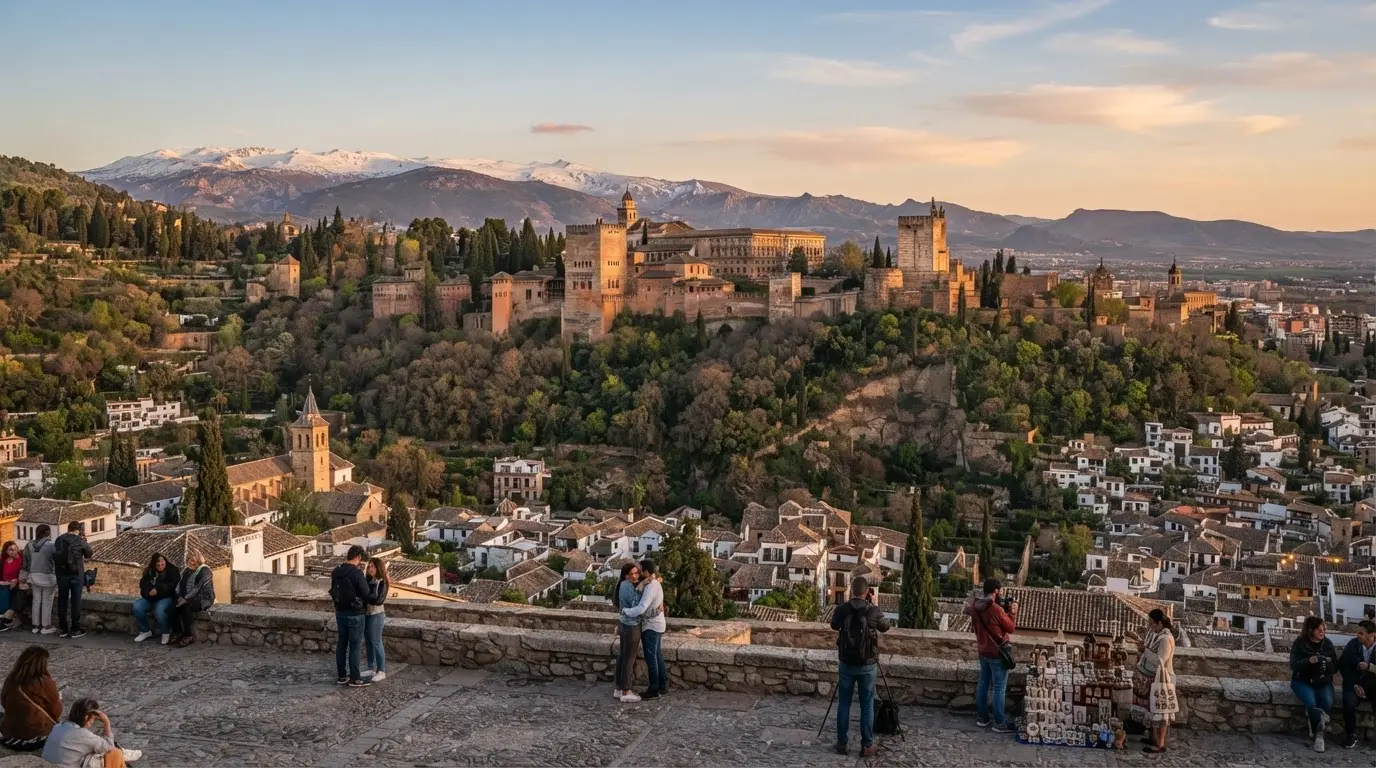
20 Interesting Facts About Granada, Spain
Interesting facts about Granada Spain that guidebooks skip: disputed etymologies, the soldier who saved the Alhambra, and a river buried under Plaza Nueva.
Recommended tours
Tours are selected for quality, not commission. We earn a small fee if you book — at no extra cost to you.
The town has later stories too. The surgeon in Eleno de Céspedes, the Alhama surgeon tried by the Inquisition belongs to it, and the 1884 earthquake hit Alhama harder than any other community[34].
Planning your visit to Alhama de Granada
Alhama is 58 km from Granada city[1], so it works as a long day trip. Opening hours, prices and booking for the spa and the church of the Encarnación are not given here because they change; ask the town hall or the tourist office in Alhama before you set out, and check road and bus options locally.
- Thermal pools: the public pools are free to use in any season[35], and the walk from town takes no more than 30 minutes[36]. The Balneario is a separate affair, 3 km from town[37], with individual access to its facilities[38].
- Gorge viewpoints: the town itself is the best place to see the gorge[3], and the balconies and viewpoints look over willows, elms and wicker[39].
- Camino de los Ángeles: a short, low-difficulty medieval path through the Tajos de Alhama Natural Monument, suitable for most people[40].
- Also in town: the Casa de la Inquisición, the former prison and the Velutti Ethnographic Museum[41].
- Eat and sleep: Hotel Balneario combines hotel and thermal spa in one building[42]; Hospedería El Ventorro offers cave-house stays and its own spa[43]; Asador Pato Loco roasts meat in a wood-fired oven or over embers[44].
The old town is a tangle of narrow, steep streets, so wear shoes with grip and leave time for the climbs.