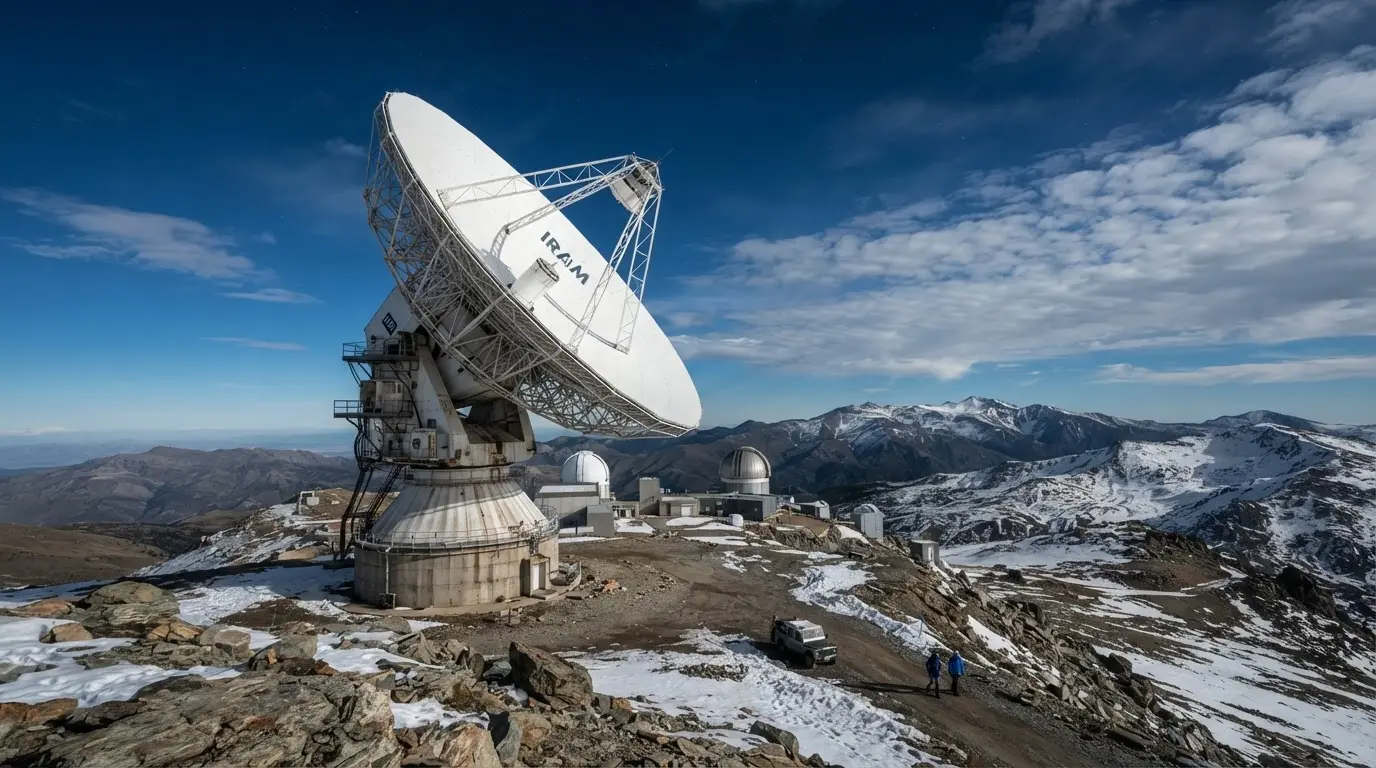

What is the IRAM 30-metre telescope?
This is a millimetre-wave radio telescope, tuned to wavelengths between 0.8 and 3 millimetres, the band where cold interstellar gas and dust glow faintly, invisible to any optical instrument.[5] The dish sits at 2,850 metres, just below the Pico Veleta summit.[1] That summit, roughly 550 metres higher, is better known for the shrinking ice in its shaded cirque: read about the Corral del Veleta glacier for that side of the mountain.
It is run by IRAM, the Institut de radioastronomie millimétrique, an institute whose consortium partners are the French CNRS, the German Max Planck Society, and Spain's own Instituto Geográfico Nacional (IGN).[6]
IGN's own astronomy pages give the site's altitude as 2,800 metres, a small variance from IRAM's own figure of 2,850 m. Neither number is wrong; they are simply two institutions measuring, or rounding, slightly differently.[7]
More than 250 astronomers travel here every year to run their own observing programmes, and demand outstrips capacity by a wide margin: only around a third of submitted proposals are ever scheduled.[4]
Inside the dish: an instrument built to hold its shape
The antenna weighs about 800 tonnes. IRAM's own comparison: it is "more than an Airbus A380 (which weighs about 618 tons) or a Boeing 747 (which weighs about 300 tons)."[3]
Moving that mass without losing precision is the real engineering problem. The dish's parabolic surface is machined to an accuracy of 55 microns, which IRAM describes as "the width of a human hair."[8] Put the two numbers side by side and the point sharpens: a surface accurate to 55 millionths of a metre is what it takes to focus a wavelength as short as 0.8 millimetres without the signal scattering into noise.
Things to do · Activity
Alpujarras Hiking and Trekking Day Trip
Guided day hike through the Poqueira gorge linking Pampaneira, Bubión and Capileira on ancient Moorish paths. From €45 per person. Spring and autumn are ideal.
The reflecting surface is built from 420 aluminium panels mounted on a honeycomb back-structure, sitting on an alt-azimuth mount of steel on a concrete pedestal.[9] IRAM notes the antenna "can turn over 400 degrees to follow the night sky," with "several kilometers of cables... housed in a spiral construction inside the antenna to prevent the cables from getting tangled."[10]
None of this idles: unlike a monument that closes at dusk, this facility is staffed and observing around the clock, 365 days a year, with a resident crew whose living quarters sit alongside the control room where the antenna is actually pointed.[11]
IRAM and OSN: two observatories, one mountain, no relation
Granada has two working observatories on the same high massif, and it is easy to conflate them. The IRAM dish observes in millimetre radio waves; the Observatorio de Sierra Nevada, on the same massif, observes in visible and infrared light. Read that guide for the tourism side of the mountain's night sky, guided sessions included; this telescope has no comparable public programme.
The institutional split runs deeper than the spectrum. OSN is run by the Instituto de Astrofísica de Andalucía (IAA-CSIC), an Andalusian research body. IRAM's Spanish partner is a different institution entirely: the Instituto Geográfico Nacional, the national mapping agency, alongside its French and German counterparts.[6]
The telescope is also registered as part of Spain's network of Singular Scientific and Technical Infrastructures (ICTS), a status given to a handful of the country's most significant research facilities, and it observes for the international community every day of the year.[12]
The Event Horizon Telescope and the first images of a black hole
The 30-metre dish is one of the stations of the global Event Horizon Telescope (EHT): a network of radio dishes linked using Very Long Baseline Interferometry (VLBI) to act as a single Earth-sized telescope. Wikipedia notes it works "together with IRAM's other facility, the NOEMA observatory," as part of that network.[13] In the 2017 observing campaign that produced the first image of a black hole, it was, in Wikipedia's words, "the only station in Europe to participate."[14]
The precision that makes this work is hard to picture. ESO's own comparison: VLBI gives the EHT "an angular resolution of 20 micro-arcseconds — enough to read a newspaper in New York from a café in Paris."[15] Achieving it depends on atomic clocks precise to the nanosecond, used to synchronise signals arriving from telescopes on four continents.[16]
Deep dive · Article
Corral del Veleta Glacier: Europe's Southernmost Ice
Corral del Veleta held Europe's southernmost glacier — active until 1913 at 37°N. Relict ice and permafrost still cling on in Sierra Nevada, shrinking fast.
Eight telescopes, one European station
Eight telescopes made up the 2017 array, spanning from the Atacama Desert to the South Pole — a reach wide enough to turn the whole planet into a single lens.[17] Only one of the eight, the IRAM dish above Granada, sat anywhere in Europe; the rest were split between the Americas and Antarctica. Without that lone European station, the 2017 baseline would have had no anchor on this side of the Atlantic.
The single biggest contributor was ALMA, in Chile's Atacama Desert: ESO calls it "the most sensitive facility in the EHT," with 66 high-precision antennas central to the network's success.[18] If Pico Veleta is the European end of that chain, ALMA is the anchor at the other. Our sister site Dark Skies Atlas has a full explainer on how the Atacama observatories work.
Four petabytes, two black holes
The data volumes involved explain why the results took nearly two years to process. The 2017 campaign alone recorded around four petabytes of data, enough that couriering hard drives between sites beat uploading it online.[19] The reward, released on 10 April 2019, was the first image of a black hole: the supermassive object at the centre of the galaxy M87, 55 million light-years away, with a mass 6.5 billion times that of the Sun.[2] On 12 May 2022, the collaboration turned the same technique on our own galaxy's centre: Sagittarius A*, some 27,000 light-years away, roughly two thousand times closer than M87's black hole.[20]
None of this was IRAM's first brush with the Milky Way's black hole. In 1995, IRAM notes, the 30-metre telescope "produced the first high-resolution radio observations of the heart of the Milky Way galaxy and its black hole named Sagittarius A*," together with NOEMA, 27 years before the world saw a picture of it.[21] Between them, IRAM's two facilities have also helped identify roughly a third of all interstellar molecules known to science, the chemical inventory of the clouds where stars and planets are born.[22]
Getting close without getting in: the access reality
You cannot simply drive up to the IRAM telescope. Wikipedia describes it plainly: the road "has since been closed to general traffic beyond Hoya de la Mora, just above the ski station," though it "is still used by ski station employees, national park rangers, observatory staff, cyclists and walkers, and by a microbus service which takes hikers up to Posiciones del Veleta, a viewpoint 3,100 metres above sea level."[23] Read the history of Sierra Nevada's ski resort road: it predates the observatory by decades.
Reaching the telescope itself, outside IRAM's own transport schedule, requires a special permit from the Sierra Nevada Natural Park.[24] In winter, visiting astronomers are barred from arranging their own transport at all — IRAM cites the risk from "fog, wind, ice, snow-slips etc." at a high-mountain site, a restriction that applies even to people who work there.[25]
Winter access is restricted
Independent transport to the telescope requires a special permit from the Sierra Nevada Natural Park, and outside IRAM's own schedule, visiting astronomers cannot arrange their own transport in winter at all: fog, wind, ice and snow-slips make the high-mountain approach too dangerous, even for people who work there.[25]
For the astronomers who do stay, room and board at the telescope has historically cost 66.50 euros a day, drinks included, a rate published on IRAM's own visitor-information page and last updated in 2007. Treat it as a decades-old benchmark, not today's price.[26]
Wikipedia notes that IRAM "offers guided tours through the observatory and public talks during the summer months," with "a virtual tour... provided on IRAM's website": the closest thing to public access the facility offers.[27] Neither IRAM's nor IGN's own pages confirm how these are booked or how often they run, so treat it as a lead worth calling ahead about, not a fixed schedule.
What you can do without a permit is get close. A Sierra Nevada day trip from Granada covers the drive up the A-395 past Hoya de la Mora, with the telescope's dome visible on the ridge above for anyone who knows where to look. In winter the same road serves the pistes rather than the summit: our guide to skiing in Sierra Nevada covers that season. For the wider massif, where to stay and which villages anchor each side of the range, start with the Sierra Nevada guide.