Val del Omar, the Granada filmmaker behind tactile vision: from Pedagogical Missions projectionist to Aguaespejo granadino, and where to meet him today.
Sections of Aguaespejo granadino are tinted green, a colour associated with Granada, and the water running through them is the Alhambra's.[1] José Val del Omar, born in the city in 1904, built a theory of cinema around touch, which he called PLAT, and the Alhambra is the easiest place to feel what he meant.[2][3] He is a poor fit for anyone who wants a ticket-and-tick sight; his Granada is a thread through places you may already be visiting.
Also the 'apanoramic overflow' beyond the screen[4]
MoMI New York exhibition
2023
First major US gallery show of his installations[5]
In this article
Jump to a section
⌄
A Silver Age contemporary with a projector
José Val del Omar was a contemporary and comrade of Federico García Lorca, Cernuda, Renau and Zambrano, part of the Silver Age of Spanish culture that the Civil War interrupted.[6] Cernuda called him an "extraordinary camera artist", a judgment formed through their shared commitment to the Pedagogical Missions during the Republic.[7]
The Missions were the Second Republic's most important project of cultural democratisation, and Val del Omar joined as a documentary-maker and film projectionist.[8] That detail is worth carrying into his later films. Before the 1944 diaphonic-sound patent[24] and the PLAT laboratory, his public job was to put films in front of audiences.
It shows in what came later. An artist whose first public role was running the projector went on to rethink how the screen, the sound and the room reach the viewer.
Tactile vision, PLAT and the mecha-mystic
By 1928 he had anticipated the "apanoramic overflow of the image" beyond the limits of the screen, and the concept of "tactile vision".[4] That same year, according to the Reel Suspects collection notes, he used the specialised press to publicise ideas for a variable-angle lens, concave screens and relief effects through lighting.[25] PLAT, his name for the whole programme, stood for Picto-Luminic-Audio-Tactile: a cinema addressed to more than the eyes.
In plain terms, tactile vision is pulsatory tactile lighting, which he first used in Fuego en Castilla.[26] In the Reina Sofía installation that film fills the entire space with blinking light and percussive sound.[27] Overflow is the same impulse seen from the screen's edge: his innovations strove to explode the limits of the screen.[28]
The Reina Sofía dossier lists Screen Overflow, enveloping diaphonic sound and tactile vision among ideas he made public between 1928 and 1944.[9][29] The Diaphonic System dates from 1944, an electro-acoustic system that went beyond conventional stereo,[30] and in September 1955 he prepared a typescript, The theory of tactile vision; Diaphony and reasons for its existence in television, for the UNESCO experts' meeting on film and television held in Tangier from 19 to 30 September.[31] When New York's Museum of the Moving Image mounted his installations in 2023, its press release said they anticipated what later became known as "expanded cinema".[5]
He also coined words, and they tell you how he saw himself. "Mecha-mystics", mechanics plus mystics, was his term for the universe of machines, which he approached as he approached reality, with a mystical attitude.[10] A man who talks that way is not describing gadgets. The question the rest of his career asks is what happens when a mystic gets hold of a projector.
Aguaespejo granadino: the Alhambra as water and light
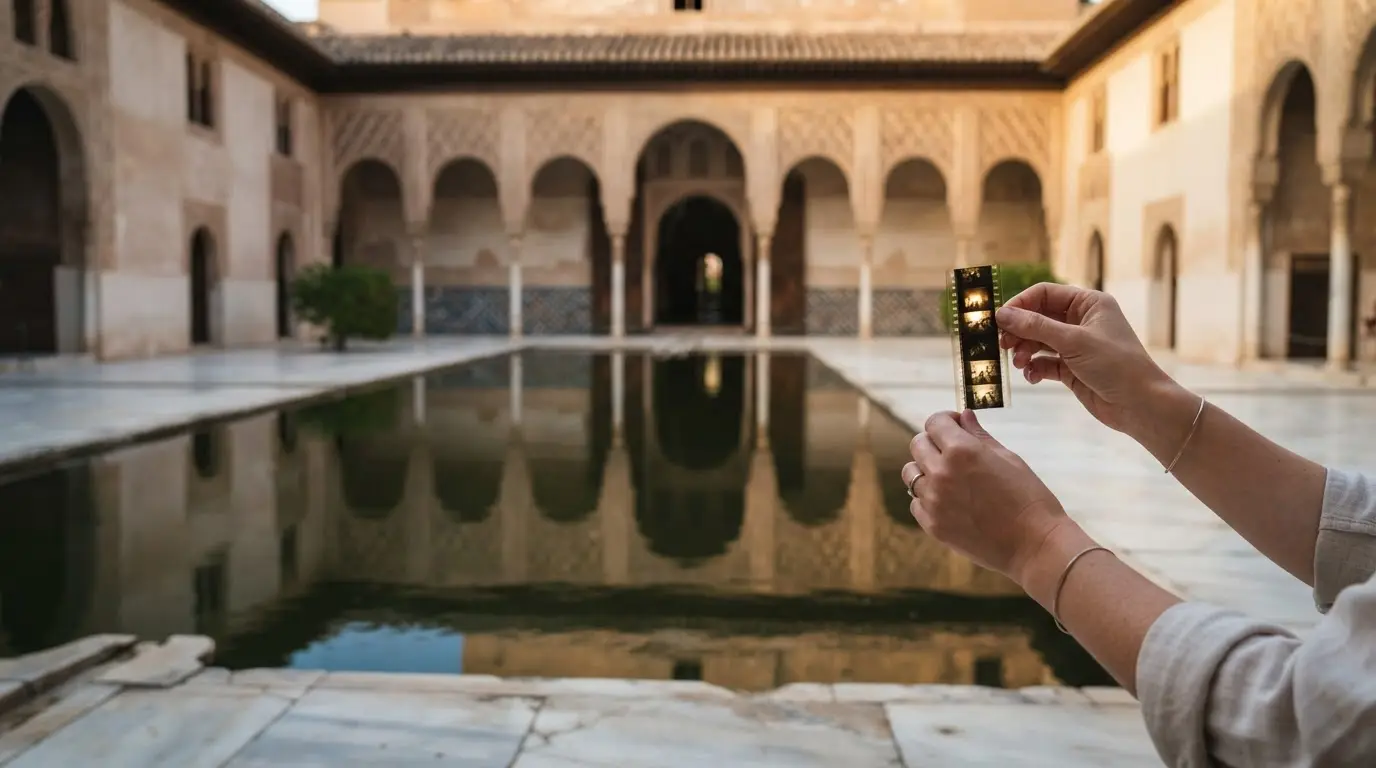
Granada is where the theory touches ground. In Aguaespejo granadino, Val del Omar sets the Alhambra, its architecture and the water of its canals, fountains and gardens, to the rhythm of siguiriyas.[11]
The canals and fountains in the frame belong to the Alhambra's water system, and anyone who has stood beside them knows the effect: the water moves slowly and talks constantly. Val del Omar's green tint and his sound are an attempt to make a viewer feel that, not merely see it.
What reads as postcard material, the arches, ponds and fountains of the Alhambra and the Sierra Nevada, changes under the poem that runs through the film.[12] The same material would be a travelogue without it.
Granada was never a single visit for him. The Reina Sofía's curators trace the fluidity of his later lyrical cinegraphs back to Vibración de Granada, made in 1935.[13]
The triptych, Cannes and the order he wanted
Aguaespejo granadino (1953 to 1955) is the first panel of a triptych that continues with Fuego en Castilla (1958 to 1960) and Acariño Galaico, which was not finished until after his death.[14]
Fuego en Castilla was presented at Cannes in 1961 and received a Special Mention for its lighting,[15] a fitting prize for a man so preoccupied with light. Yet he wanted audiences to see the three films in reverse: enter through Galicia, cross Castile and leave through Granada.[16] Granada, in other words, is the last place the viewer sees.
Timeline
1904
Born in Granada
1928
Tactile vision anticipated
Also the apanoramic overflow of the image.
1935
Vibración de Granada
An early Granada film, listed by the Reina Sofía as 1934-35.
1953–1955
Aguaespejo granadino
The Alhambra, its water and its gardens.
1961
Cannes
Fuego en Castilla wins a Special Mention for lighting.
1974–1982
The PLAT laboratory
His last, unfinished workshop.
1982
Dies in Madrid
2010–2011
Reina Sofía exhibition
Granada, then Madrid.
2023
Museum of the Moving Image
First major US gallery show of his installations.
The PLAT laboratory and a late rediscovery
Val del Omar spent his last years inside the project he never closed. El PLAT (1974 to 1982) concentrates his last works, an unfinished project in constant mutation.[17] The Reina Sofía dossier lists the gadgets from the workspace, among them his bionic cyclotactile optics, a tetraprojector adiscope for picto luminics and modified Enoscope transparency projectors.[32] He preferred a word of his own for his trade: "cinemist", meant to combine the activity of the alchemist with that of the film-maker.[18]
The world was slow to notice. His work did not begin to be rediscovered until shortly before his death, though the rediscovery has since drawn followers.[19] The Reina Sofía's 2010 exhibition was built around his sin fin, the words that close some of the few films he finished.[20]
In 2023 the Museum of the Moving Image in New York gave his immersive installations their first major gallery exhibition in the United States, running from 10 March to 1 October.[5]
Meeting Val del Omar in Granada today
Treat him as a thread through places you will visit anyway. Three starting points:
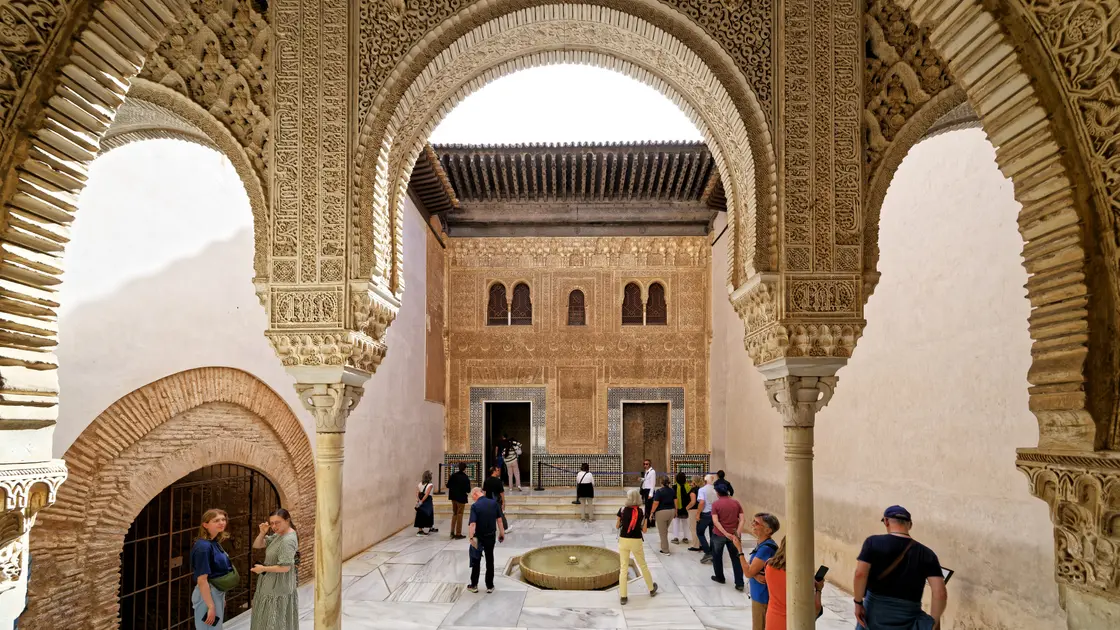
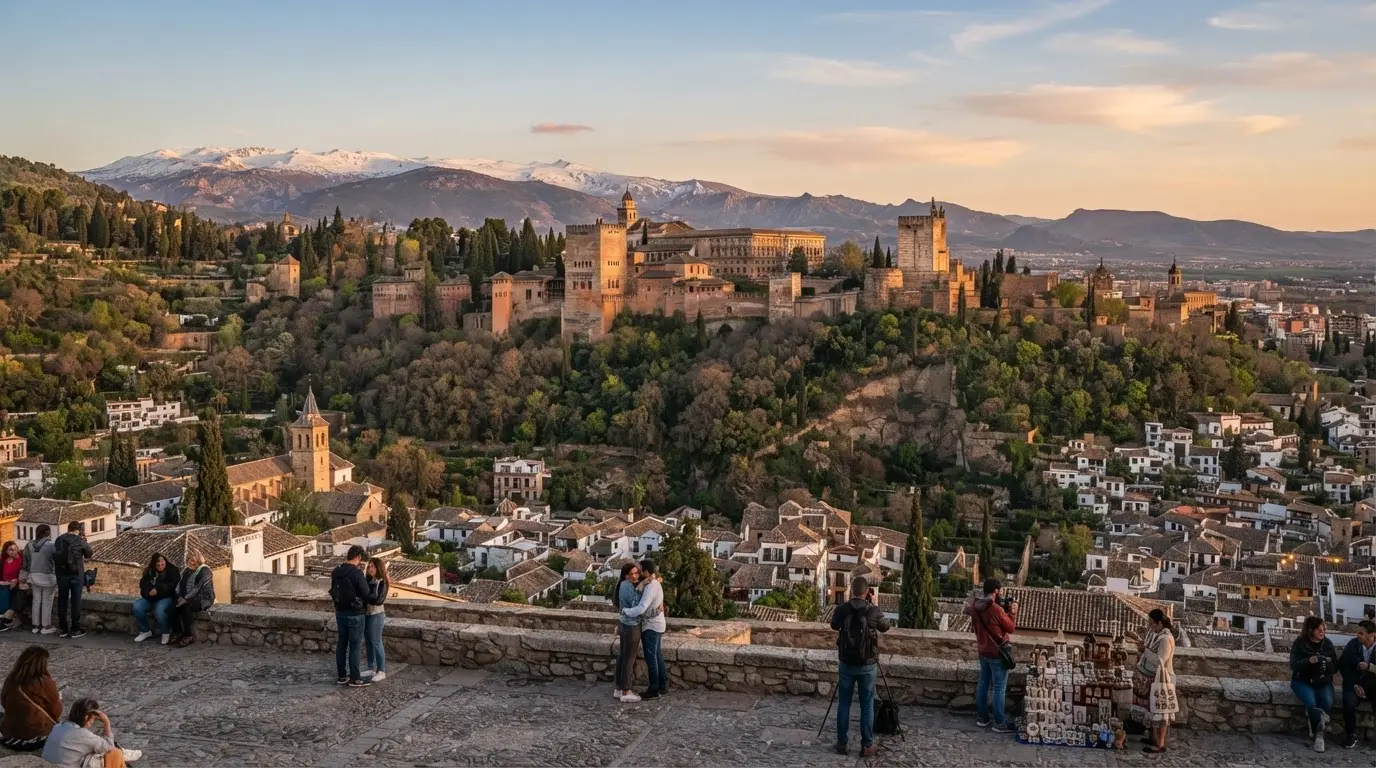
The Alhambra and the Generalife: the water, arches and fountains of Aguaespejo granadino. Walk the channels with the film in mind.
Centro José Guerrero: his exhibition opened in Granada here, in the Crypt of the Palacio de Carlos V, from 13 May to 4 July 2010.[21]
Those were events, not standing displays, so ask each venue what is on before you build a day around him. Then walk out to the water: the Alhambra's channels and fountains are still the best place to understand why a man who wanted cinema to be tactile pointed his camera at them.
Frequently asked questions
Who was Val del Omar, the Granada filmmaker?
José Val del Omar was born in Granada in 1904 and died in Madrid in 1982. A Silver Age contemporary of Lorca and Cernuda, he worked on the Pedagogical Missions, developed ideas such as tactile vision and PLAT, and made the Alhambra film Aguaespejo granadino.
What is tactile vision?
It is the concept Val del Omar anticipated in 1928 alongside the "apanoramic overflow of the image" beyond the screen. It belongs to PLAT, his Picto-Luminic-Audio-Tactile idea of a cinema that addresses more than the eyes.
What is Aguaespejo granadino about?
It sets images of the Alhambra, including its architecture and the water of its canals, fountains and gardens, to the rhythm of siguiriyas. Sections are tinted green, a colour associated with Granada. It is the first panel of his Elemental Triptych of Spain.
Where can I see Val del Omar's work in Granada?
The Alhambra and Generalife are the places he filmed. His work has also reached the city through events: the Centro José Guerrero hosted his exhibition in 2010, and the Centro Federico García Lorca screened Aguaespejo granadino in May 2025. Check each venue for current programming.
What was the Val del Omar exhibition at the Reina Sofía?
Desbordamiento de Val del Omar, curated by Eugeni Bonet, ran at the Edificio Sabatini in Madrid from 5 October 2010 to 28 February 2011. It opened earlier in Granada, at the Centro José Guerrero.
Did Val del Omar film anywhere besides Granada?
Yes. His Elemental Triptych of Spain was shot between 1953 and the mid 1960s in Granada, Castile and Galicia. Fuego en Castilla received a Special Mention for lighting at Cannes in 1961.
What did Val del Omar mean by cinemist?
"Cinemist" was his own word for his trade, intended to combine the activity of the alchemist with that of the film-maker. He used a similar coinage, mecha-mystics, for his mystical approach to machines.
“Val del Omar was a ''believer in cinema'' inspired by new horizons that he formulated in the term PLAT – representing the totalizing concept of a ''Picto-Luminic-Audio-Tactile'' art”
“In 1928 he anticipated various of his most characteristic techniques, including the ''apanoramic overflow of the image'' beyond the limits of the screen, and the concept of ''tactile vision''.”
“the first major gallery exhibition in the United States to feature the immersive cinematic installations of José Val del Omar, from March 10–October 1, 2023.”
“apart from being a contemporary and a comrade of Lorca, Cernuda, Renau, Zambrano and other figures of a Silver Age of the Spanish culture, interrupted by the Civil War.”
“was described as an “extraordinary camera artist” by Luis Cernuda, who knew him through their shared commitment to the Pedagogical Missions during the Republic.”
“beginning with his participation in the Pedagogical Missions –the most important cultural democratisation project carried out under the Second Republic –, as a documentary-maker and film projectionist”
“Another neologism (mechanics + mystics), with which the Granada-born artist referred to the universe of machines, which he approached in the same way as reality, with a mystical attitude”
“Granada, the gardens, the arches, ponds and fountains of the Alhambra, Sierra Nevada, the calm... images that, seen through the poem that accompanies them, take on a new meaning.”
“His preference was for viewers to watch the films in reverse chronology, as presented in this program: entering through Galicia, crossing Castilla, and leaving through Granada.”
“did not begin to be rediscovered until shortly before his death, though it has constituted the beginning of a renaissance that continues to draw followers.”
“El próximo miércoles 14 de mayo a las 20:00, el Centro Federico García Lorca acogerá la proyección de Aguaespejo granadino (1955), obra cumbre del cineasta granadino José Val del Omar.”
“in 1944 he registered the first patent for a diaphonic or binaural sound system, a forerunner of the surround-sound systems that go beyond mere stereo effects”
“In 1928 he used the specialized press to publicise his astonishingly precocious ideas for a variable-angle lens, for concave screens and for achieving relief effects by means of lighting”
“It fills the entire space with blinking light and percussive sounds that are the result of a memorable collaboration with dancer Vicente Escudero from Valladolid.”
“They include Screen Overflow and the quest for acoustic and visual cubism using enveloping diaphonic sound and tactile vision, with its blinking, pulsating light.”
“Water-Mirror of Granada utilized the Diaphonic System (Sistema Diafónico) that Val del Omar created in 1944, an electro-acoustic sound system that transcended the conventional stereophonic method, anticipating the structure of surround sound.”
“These gadgets include his bionic cyclotactile optics, his tetraprojector adiscope for picto luminics, various modified Enoscope transparency projectors”