Arab Bath Tradition Granada: From Bañuelo to Hammam
Granada had 21 public hammams at its Nasrid peak. From El Bañuelo's 11th-century star skylights to Philip II's 1567 ban and the modern Albaicín revival.
Seven years resident in Granada. Specialist in Nasrid architecture, Al-Andalus history, and Andalusian walking routes.
Updated Published
Granada's Arab bath tradition runs from the 11th century to the present in a nearly unbroken thread, broken only by Philip II's 1567 decree that closed every hammam in the city. El Bañuelo on the Carrera del Darro is what one looks like when it has survived: low vaulted ceilings, star-shaped holes punching light through the masonry, marble floors that once sat above a wood-fired furnace. At Nasrid Granada's peak, there were around 21 public baths like it scattered across the medina.
In this article
Jump to a section
⌄
El Bañuelo: the bath that survived by becoming a laundry
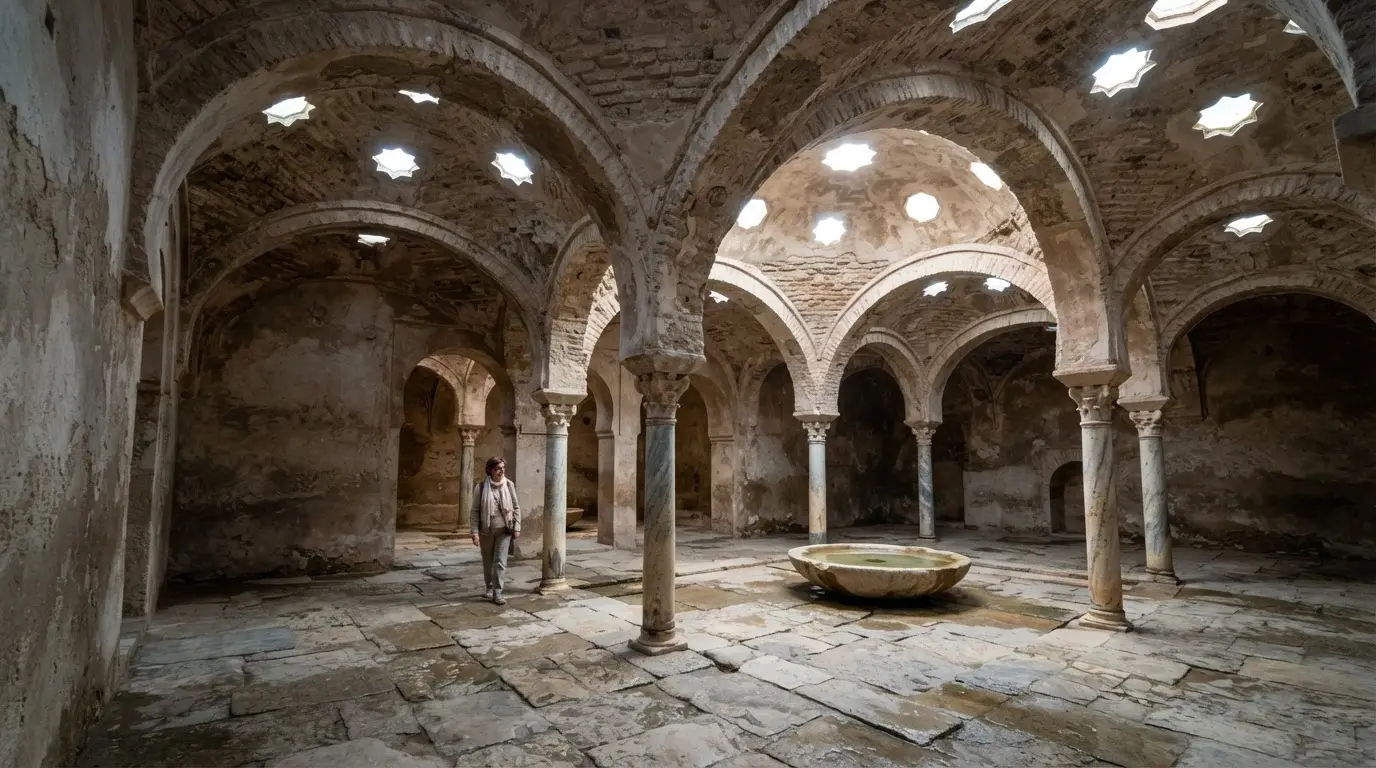
The bathhouse at Carrera del Darro 31 is the oldest surviving example of Islamic hammam architecture in Granada. It was built in the 11th century during the Zirid period, financed by Samuel Ibn Nagrela, the Jewish vizier to King Badis and one of the most powerful men in the Granada of his time.[1] That the building has survived at all is a function of its post-conquest career: after 1492 the Catholic Monarchs repurposed it as a public laundry, and the conversion kept the structure too useful to demolish. It was declared a National Monument in 1918.[1]
What you see inside is the logic of the three-chamber hammam made visible. The cold room (al-bayt al-barid) greeted you at the entrance — a smaller space with a basin of cold water where bathers stripped and acclimatised before moving inward. The warm room (al-bayt al-wastani) was the main hall, the most elaborately decorated space with horseshoe arches and a central open area. The hot room (al-bayt al-sajun) came last, the innermost chamber, where two basins poured cold and hot water side by side.
El Bañuelo also had a vestibule (al-bayt al-maslaj) before the cold room, making it technically a four-room structure. The sequence was not arbitrary: thermal transition was built into the architecture, each chamber a step further from the street and further from ambient temperature.
Above the warm and hot rooms, the ceiling is barrel-vaulted with star-shaped and octagonal skylights pierced through the masonry. These served two purposes: natural light in rooms that would otherwise be entirely dark, and steam ventilation when servants opened the covers to regulate temperature. The marble floors above the hot room were heated from below by a hypocaust system — a wood-fired furnace (al-furn) pushing heat through channels under the floor. The thick-soled wooden clogs that bathers wore were not ceremonial; the floors were genuinely hot.[1]
The building is open as a public museum. Entry is free, the rooms are small and uncluttered, and the star skylights are worth five minutes of just looking up.
How the hammam worked: architecture, ritual, and hypocaust heating
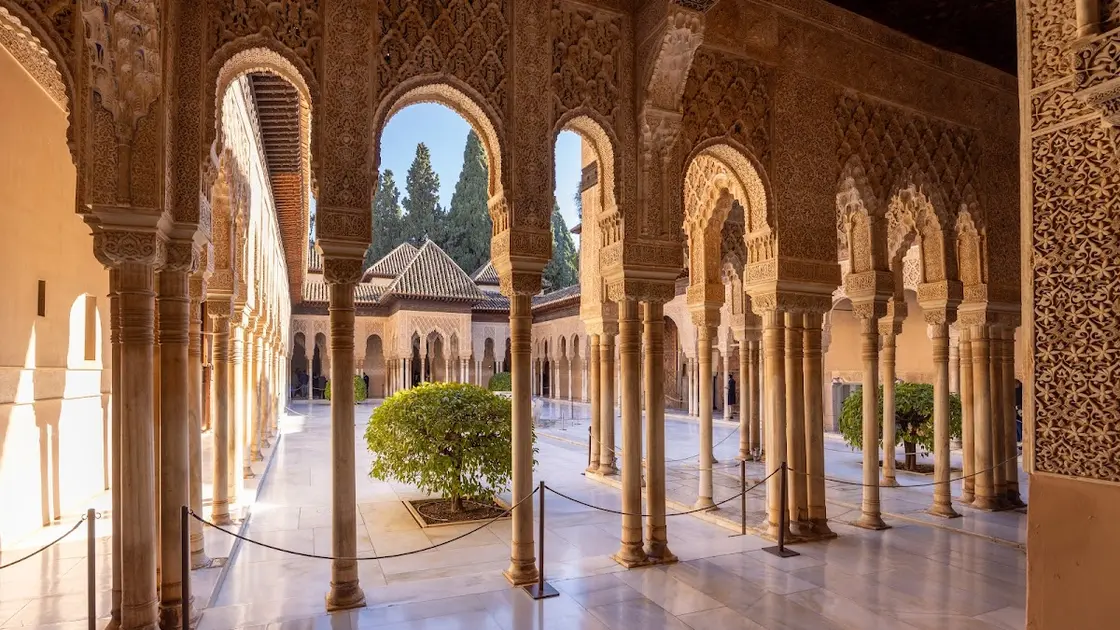
Nasrid Granada took the three-chamber hammam and refined it across roughly 250 years of construction. The Comares Bath in the Alhambra — built for the royal court, not the public — is now considered the only Islamic medieval bath in Western Europe that is practically fully preserved.[2] It sits between the Comares and Lions palaces, near the royal chambers, and shows the same spatial logic as El Bañuelo at higher architectural resolution.
The Comares Bath's ceilings have conical skylights in lobed and star shapes. Marble floors contain embedded pipes through which hot water circulated. Multiple chambers step from cold to hot in the same sequence, but at palace scale — the warm room is tall enough to feel ceremonial, the proportions calculated to make thermal bathing feel like deliberate ritual rather than mere hygiene.
The hypocaust underfloor heating was the critical technical achievement. Under the bayt al-sajun, a boiler room fed hot air through channels cut beneath the floor slabs. The furnace (al-furn) required a constant woodshed and stokers working in shifts. This infrastructure was invisible to bathers but consumed significant fuel — one reason hammams were businesses that charged fees rather than free public services.
~21–23 hammams
At Nasrid Granada's peak, the city had roughly 21–23 public baths serving a population concentrated in the Albaicín medina. El Bañuelo was one of them. After Philip II's 1567 Pragmática, all were either demolished, converted, or sealed.[3]
Heat management extended to the skylights. Servants could adjust the apertures from above to control steam density and temperature in each room independently. A cold-room skylight was kept open; the hot-room skylights were opened only briefly to clear steam. The thermal gradient across the three chambers was maintained precisely, because the whole system depended on bathers moving gradually between temperatures rather than plunging from cold to hot.
For an article on the water engineering that supplied all of this — cisterns, channels, the Acequia Real — the Alhambra water system article covers the hydraulics that made Granada's bath culture possible at scale.
Ritual purity and social life: why hammams mattered
The hammam had a function the Christian bath-house never did. In Islamic religious practice, ghusl — full-body ritual ablution — is required after specific states of ritual impurity, and before Friday prayer. The related practice of wudu (washing the face, hands, and feet) could be performed at a mosque fountain, but ghusl required full immersion in clean water. In a city without domestic plumbing, the hammam was the only practical space for this.[4]
This made the hammam spiritually essential in a way that had no Christian equivalent. A mosque without a hammam nearby was harder to use. The clustering of baths near mosques throughout the Albaicín was not coincidental: the map of hammam locations in medieval Granada largely mirrors the map of neighbourhood mosques.
Beyond the religious requirement, the hammam was the primary social space for women in particular. Men and women bathed at separate times, mornings and afternoons assigned by gender with the schedule posted on the door, and the women's hours became a regular gathering point that had no equivalent in the public life of the street. Business was discussed, marriages arranged, and community decisions made in the warm-room steam.
Recommended tours
Tours are selected for quality, not commission. We earn a small fee if you book — at no extra cost to you.
For men, the hammam served as meeting ground between the mosque, the market, and the home. Barbers often operated inside or just outside, since the heat softened hair. Tea and sweet pastries were available. Visits typically lasted two to three hours.
The Convivencia article covers the broader question of how Muslim, Jewish, and Christian communities shared Granada's infrastructure — the hammam is peripheral to that story in one sense — Jewish and Christian minorities also used the city's baths, albeit on different schedules.
Philip II's 1567 Pragmática and the destruction of the bath culture
On 1 January 1567, Philip II issued the Pragmática Sanción, a decree that prohibited Moriscos — the nominally converted descendants of Granada's Muslim population — from using Arabic language, wearing Moorish dress, taking Arabic names, reading Arabic books, performing Arabic songs, or using public hammams.[5] The hammam prohibition was not incidental: bathing in the Islamic manner was explicitly classified as evidence that conversion to Christianity was false.
The reasoning followed from earlier Inquisition interrogations, which had established that Moriscos who bathed ritually, prayed in the Islamic manner, and maintained Arabic customs had not genuinely converted. The 1567 decree tried to remove the physical infrastructure that made this maintenance possible. Without hammams, ghusl was impractical. Without ghusl, Islamic ritual practice was severely disrupted. The logic was cultural erasure by architectural demolition.
The immediate response was the Rebellion of the Alpujarras, which broke out in the Sierra Nevada villages in 1568 and lasted until 1571.[5] Granada's Morisco population rose against the decree, with the most intense fighting in the mountain villages of the Alpujarras. The rebellion was suppressed, and in its aftermath Philip II ordered the forced dispersal of Granada's remaining Morisco population across Castile. The community that had built the Alhambra and the Albaicín's bath network was scattered across a dozen Castilian cities, forbidden to return.
The hammams themselves were not all demolished immediately. Some were converted to other uses that took advantage of their heating infrastructure. Bakeries were the most common conversion: a hammam's furnace and heat-distribution system could bake bread as efficiently as it had heated marble floors. Others were used as warehouses or stables before eventually collapsing. Of the 21 or so public baths that had served Nasrid Granada at its peak,[3] only El Bañuelo survived in anything approaching its original form.
The Moriscos in Granada article covers the broader story of what happened to the community after 1567 and after the final expulsion of 1609–1614.
Timeline
11th century
El Bañuelo built
Financed by Samuel Ibn Nagrela under Zirid King Badis. One of at least 21 public hammams in Islamic Granada.
1238–1492
Nasrid peak
The Nasrid dynasty builds the Comares Bath in the Alhambra and expands the city's public bath network to roughly 21–23 hammams.
1492
Christian conquest
Ferdinand and Isabella take Granada. Initial toleration of Morisco customs begins to erode under pressure from the Church.
1 January 1567
Philip II's Pragmática
Decree bans hammams, Arabic language, Moorish clothing and names. El Bañuelo converted to laundry; most hammams demolished or repurposed as bakeries.
1568–1571
Rebellion of the Alpujarras
Morisco uprising in the Sierra Nevada villages in response to the 1567 decree. Suppressed; survivors forcibly dispersed across Castile.
1918
El Bañuelo declared National Monument
Recognition of the only surviving 11th-century hammam in Granada after four centuries of use as a laundry.
Late 1990s
Hammam Al Ándalus opens
First modern hammam in Granada, in a renovated Albaicín building on a site where ancient cisterns were found during renovation. The Arab bath tradition returns to the city after roughly 430 years.
What survives: the Comares Bath and what the Alhambra kept
The Alhambra palace complex was not subject to the same demolition pressures as the city's public baths. The palaces themselves were converted to royal residences and administrative buildings, and the hammams within them were preserved as architectural curiosities rather than functioning baths. The Baños de Comares (Comares Bath) benefited from this: it survived the conquest period, the Habsburg rebuilding campaigns, and the 19th-century romantic tourism wave largely intact.
The bath is positioned between the Comares and Lions palaces, near the royal apartments, which indicates its role as a private royal facility rather than a public space.[2] Each major Alhambra palace had its own associated hammam — the scale of bathing infrastructure in the Alhambra was deliberately generous, because ritual cleanliness was tied to the Sultan's religious authority as much as to personal hygiene.
The Comares Bath's star-shaped and lobed skylights set the formal vocabulary that spread through Andalusian bath architecture. Looking at El Bañuelo's simpler punched-hole skylights, then at the more elaborate lobed forms in the Comares Bath, you can trace 200 years of refinement within a single architectural element. The Alhambra Patronato, which manages the complex, has documented the Comares Bath as the only Islamic medieval hammam in Western Europe that is practically fully preserved.[2]
Jerónimo Münzer, a German traveller who visited Granada in 1494, two years after the conquest, wrote about the Alhambra baths in terms that suggest they were still being shown to visitors as technical marvels. The French painter Henri Matisse visited in 1910 and was captivated by the atmosphere and quality of light in the bath's vaulted chambers.[2]
For the wider architecture of the Alhambra complex — how the muqarnas, zellige tilework, and water features relate to each other — the Nasrid architecture article has the systematic treatment.
The modern revival: Hammam Al Ándalus and what it recovered
The first modern hammam in Granada opened in the late 1990s at the foot of the Alhambra, in a renovated building in the Albaicín neighbourhood.[6] The operators of Hammam Al Ándalus had discovered ancient water cisterns during renovation, suggesting the building sat on or near an original Nasrid bath site. Whether the cisterns were from a hammam specifically, or simply from the dense hydraulic infrastructure that ran under every Albaicín building, remains uncertain — but the association shaped the project's identity.
The design was modelled directly on the Alhambra palace baths: marble floors with underfloor heating, vaulted rooms with star skylights, the same cold-warm-hot chamber sequence. The operation runs today as a commercial wellness facility, but the architecture is pedagogically accurate. Visiting Hammam Al Ándalus after El Bañuelo puts the historic bath in lived context — the temperature gradients, the low light punctured by star-shaped holes, the weight of the vaulted ceiling above the warm pool are all present in both.
The gap between the two is roughly 430 years — from Philip II's 1567 decree closing every hammam in the city to the late-1990s reopening. That is a long silence. Several smaller hammam businesses have opened across Granada since, most in the Albaicín, some near the cathedral quarter. The format has found a steady market among visitors who want something between a spa day and a history lesson.
For practical booking details, schedules, and prices at Granada's current hammam operations, the Hammam Al Ándalus Granada activity page has the current logistics — this article is the history, not the booking guide.
The revival also sits within a broader cultural recovery of Andalusi heritage in Granada. The cisterns that stored and distributed water to the public bath network were themselves a form of public works at a scale the city has not matched since.
Frequently asked questions
What is El Bañuelo in Granada?
El Bañuelo (Carrera del Darro 31) is an 11th-century Islamic hammam built during the Zirid period, financed by Samuel Ibn Nagrela, Jewish vizier to King Badis. It is the oldest surviving Arab bath in Granada and one of the best-preserved in Spain. The building has four rooms — vestibule, cold, warm, and hot — with original star-shaped skylights and a hypocaust underfloor heating system. Entry is free. It was declared a National Monument in 1918.
How many hammams did medieval Granada have?
At the peak of the Nasrid period (13th–15th centuries), Granada had roughly 21–23 public hammams serving the city's population, concentrated in the Albaicín medina. They were located near mosques because Islamic ritual requires full-body ablution (ghusl) before prayer. After Philip II's 1567 Pragmática banned public baths, most were demolished, converted to bakeries using the furnace infrastructure, or fell into disuse. Only El Bañuelo survives in recognisable form.
Why did Philip II ban hammams in Granada?
Philip II's Pragmática of 1 January 1567 banned public hammams alongside Arabic language, Moorish dress, Arabic names, and Arabic books. The reasoning was that Moriscos who bathed in the Islamic manner, performed ghusl, and maintained Arabic customs had not genuinely converted to Christianity. The ban was intended to remove the physical infrastructure that enabled continued Islamic practice. It triggered the Rebellion of the Alpujarras (1568–1571), and in its aftermath Granada's Morisco population was forcibly dispersed across Castile.
What is ghusl and why did it require a hammam?
Ghusl is full-body ritual ablution required in Islamic practice after specific states of ritual impurity and before Friday prayer. It requires washing the entire body, not just face, hands, and feet (wudu). In medieval Granada, where domestic plumbing did not exist, the public hammam was the only practical space for ghusl. This made the hammam spiritually essential — a mosque without a nearby hammam was significantly harder to use. The clustering of hammams near mosques throughout the Albaicín reflects this religious function.
Where is the Comares Bath and can you visit it?
The Baños de Comares (Comares Bath) is inside the Alhambra palace complex, positioned between the Comares and Lions palaces near the royal apartments. It is considered the only Islamic medieval hammam in Western Europe that is practically fully preserved, with original star-shaped skylights, marble floors with embedded heating pipes, and multiple chambers intact. It is included in the general Alhambra ticket. Visit timing depends on the Alhambra slot you book — the bath is on the main Nasrid Palaces circuit.
Can you visit a working hammam in Granada today?
Yes. Hammam Al Ándalus near the Albaicín was the first modern hammam to open in Granada, in the late 1990s. It operates with the traditional three-chamber layout — cold, warm, and hot pools — with star-shaped skylights and marble floors modelled on the Alhambra palace baths. Several smaller hammam businesses have since opened across the city. Prices, schedules, and booking details for current operations are on the Hammam Granada activity page.
How did Islamic hammam architecture work?
The standard hammam had three chambers: the cold room (al-bayt al-barid), warm room (al-bayt al-wastani), and hot room (al-bayt al-sajun). Bathers moved through them in sequence, allowing gradual thermal transition. Star-shaped skylights in the barrel-vaulted ceiling admitted light and vented steam. The hot room floor sat above a hypocaust system — a wood-fired furnace (al-furn) pushing heat through channels under the marble slabs. Servants regulated temperature by opening or closing the skylight covers from above. The entire system required constant fuel and staff to maintain the temperature gradient across all three rooms simultaneously.
What happened to Granada's hammams after the Christian conquest in 1492?
After 1492, Granada's hammams continued to operate for several decades under an initial policy of toleration toward Morisco customs. The decisive break came with Philip II's Pragmática of 1567, which banned public baths entirely. Most hammams were converted to other uses, with bakeries being the most common — the furnace infrastructure that had heated floors could heat ovens just as efficiently. El Bañuelo survived because it was repurposed as a public laundry. The remaining examples collapsed over the following centuries. Only the Comares Bath inside the Alhambra was preserved, as an architectural feature of the palace complex rather than a functioning bath.