Granada was Roman Iliberis for over 700 years before the Moors arrived. The Council of Elvira, c. 306 AD, was the earliest church council in all of Hispania.
Seven years resident in Granada. Specialist in Nasrid architecture, Al-Andalus history, and Andalusian walking routes.
Updated Published
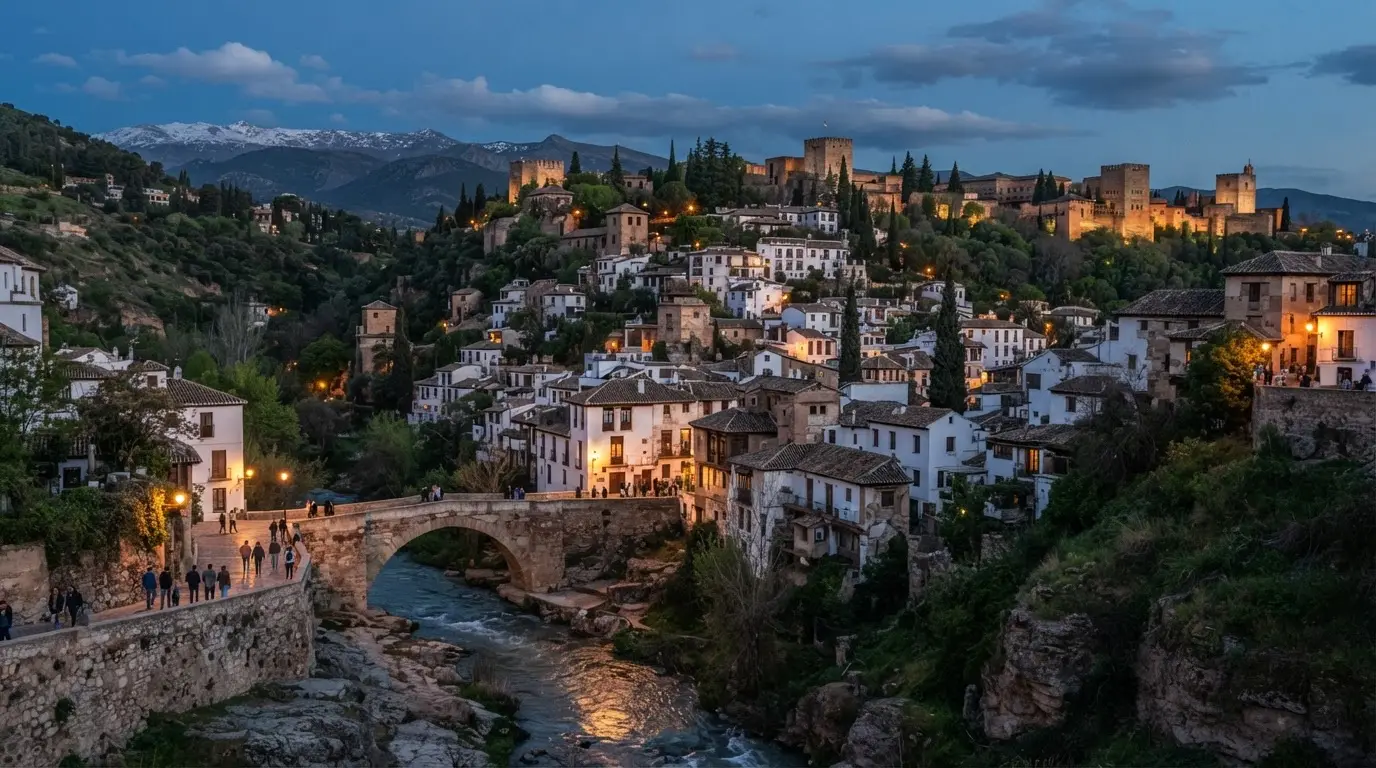
Most visitors to Granada know roughly two time periods: the Alhambra (Moorish) and 1492 (Castilian). But the hill now called the Albaicín was already an inhabited city a thousand years before Muhammad I built his first palace wall. The Romans called it Florentia Iliberritana, and before them the Bastetani Iberian tribe called it Iliberis. In around 306 AD, Christian bishops from across the province gathered here for a council that would reverberate through church law for centuries.
In this article
Jump to a section
⌄
Bastetani origins: Iliberis before Rome
The hill above the Río Darro was inhabited long before Roman surveyors arrived. The Bastetani, an Iberian tribe that occupied the eastern Andalusian interior from modern Guadix to the coast, had their settlement there, on the same promontory that later became the Albaicín.[1] The name Iliberis is pre-Roman and of uncertain etymology; it appears in Pliny, Strabo, and Ptolemy with slight variations (Iliberri, Illiberis), all pointing to the same site.
The Bastetani were not a minor group living in huts. By the late Iron Age, Iberian settlements in this region had established trade networks reaching the Phoenician and Greek ports on the southern coast. Pottery styles, silver working, and writing in the Iberian script show a culture capable of administrative organisation well before Roman intervention. Iliberis, sitting at the head of a valley with the Sierra Nevada behind it, controlled access routes between the coast and the interior. That geography was the reason someone built a city there, and the reason every subsequent ruler (Roman, Visigoth, Arab, Castilian) kept one there.
Rome moved into Hispania Baetica gradually during the 2nd and 1st centuries BC, following the Second Punic War. The Bastetani came under Roman influence not through a single conquest but through a long process of administrative absorption. Iliberis became a Roman town while remaining inhabited by the same population, following the standard pattern of Romanisation in Hispania Baetica: local elites adopted Latin, entered Roman civic structures, and the settlement was reclassified within the Roman administrative hierarchy.
Timeline
c. 5th–3rd century BC
Bastetani Iliberis
The Bastetani Iberian tribe occupy the Albaicín hill, trading with Phoenician and Greek coastal settlements.
Late 1st century BC
Roman municipium
Iliberis is elevated to Municipium Florentinum Iliberritanum under Augustus, with a Forum and full Roman civic infrastructure.
c. 306 AD
Council of Elvira
Nineteen bishops gather near Iliberis for the first known church council in Hispania, producing 81 recorded canons.
c. 5th–6th century
Visigothic Elbira
The Visigoths inherit the city, which they call Elbira. It becomes a diocese and administrative centre for the region.
711 AD
Arab conquest
Forces under Tariq ibn Ziyad take the peninsula. The settlement is renamed Gharnata; nearby Medina Elvira becomes the regional capital.
1013 AD
Zirid move to the hill
The Zirid dynasty shifts the capital from Medina Elvira to the Albaicín hill, completing the city's westward drift.
Municipium Florentinum Iliberritanum: Roman civic life on the Albaicín
Under Augustus, Iliberis was elevated to Municipium Florentinum Iliberritanum, the full name that appears in inscriptions and Roman administrative records.[2] Municipal status was a formal grant of Roman legal standing: the city could hold elections, maintain its own treasury, administer justice according to Roman law, and construct the standard public buildings that Roman civic life required.
The Forum was the centre of this world. Every Roman municipium of any ambition had one: a rectangular open space surrounded by porticoes, with the basilica (for law courts and commerce), the curia (for the local senate), and the main temple at its head. No Roman-era Forum has been excavated intact in Granada, but inscriptions, foundation stones, and scattered column fragments recovered over centuries confirm that the infrastructure was there. The Museo Arqueológico de Granada, housed in the Casa de Castril on the Carrera del Darro, holds the material evidence: pottery, amphorae, coins, and epigraphic inscriptions from Florentia Iliberritana, most pulled from the Albaicín hill and the surrounding vega during later construction work.[3]
Municipium
The full official Roman name of Granada, conferred under Augustus in the late 1st century BC. Inscriptions bearing this name have been recovered from the Albaicín hill and surrounding areas, and are now held at the Museo Arqueológico de Granada on Carrera del Darro.[2]
The amphorae tell an economic story. Roman olive oil was transported in standardised ceramic containers, and fragments recovered from the Granada area include examples that were circulating regionally in the 1st and 2nd centuries AD. The city was part of a provincial economy that stretched from the oil-producing estates of the Baetis (Guadalquivir) valley to the Mediterranean ports. Iliberis was not a frontier outpost; it was a functioning node in the most productive province of the western empire.
Epigraphy is the other key source. Inscriptions on funerary monuments, civic dedications, and milestones preserve names, titles, and dates that no other source records. Several inscriptions from the Granada area show the names of local magistrates and their Roman citizenship, confirming that by the 1st century AD the local Bastetani elite had been fully integrated into the Roman civic system. The process had taken perhaps two generations.
The Council of Elvira: the first church council in Hispania
Around 306 AD (the exact year is disputed between 305 and 306), bishops from across Hispania Baetica gathered near Iliberis for what became the first recorded church council on the Iberian Peninsula.[4] The assembly is known to history as the Synod of Elvira, or the Council of Elvira.
Nineteen bishops attended, along with 26 presbyters, deacons, and laymen.[4] The gathering was relatively local: the attendees came mostly from Baetica, the Roman province corresponding roughly to modern Andalusia. Hosius of Córdoba (also written Osius) is thought to have instigated the council; Felix of Accitum (Guadix) presided.[5] Hosius would go on, two decades later, to play a central role at the Council of Nicaea in 325 AD, making him the single figure who connects these two foundational moments of early Christian organisation.
81 canons survive in the record, though scholars now believe only the first 21 or so were originally promulgated at the council itself; the remainder were added over time by later ecclesiastical copyists and compilers.[5] The canons that were passed address a range of concerns that tell you something about what the church in Hispania was worried about circa 306 AD:
Clerical celibacy: early rules restricting marriage for clergy in senior orders
Relationships with Jews and pagans: extensive regulations about social contact, marriage between Christians and non-Christians, and participation in pagan civic life
Prohibition of religious images: Canon 36 forbids paintings in churches — one of the earliest recorded statements on the subject in Christian history
Penitential discipline: severe multi-year penances for apostasy, adultery, and other transgressions, some extending to deathbed communion only
Recommended tours
Tours are selected for quality, not commission. We earn a small fee if you book — at no extra cost to you.
The Council of Elvira predates Nicaea by roughly twenty years. It was not an ecumenical council (no bishop from outside Hispania attended), but alongside the Council of Arles (314 AD) and the Council of Ancyra (314 AD), it was one of the three major pre-ecumenical councils of the early Western church.[4] What makes it significant for canon law is partly the range of its 21 original decrees, partly the survival of the document, and partly the timing: it shows a church in Hispania organising itself administratively before Constantine's Edict of Milan in 313 AD had made Christianity legal.
The precise location of the council is not known with certainty. "Elvira" in Roman-era sources refers to the settlement near Iliberis, which scholars associate with the Albaicín area.[5] The name persisted: Puerta de Elvira, the Almohad-era gate still standing on the northern edge of the Albaicín, takes its name from this Roman and Visigothic city.
Visigothic continuity: Elbira after Rome
The Western Roman Empire's effective collapse in the 5th century did not empty Iliberis. The Visigoths, who moved into Hispania after the empire fragmented, inherited Roman administrative structures rather than replacing them. The city that Romans called Iliberris or Florentia, they called Elbira: a name derived directly from the Roman-era toponym, not a replacement. The diocese established there continued.
Visigothic Granada presents a problem for historians: the physical evidence is thinner than for the Roman period. The Visigoths built in wood and repurposed Roman structures rather than constructing on a new scale, which means the archaeological signal is weak compared with the inscriptions and pottery that survive from the Roman centuries. What does survive comes largely from church records: episcopal lists, council attendance records (Elvira's bishops appear in later Visigothic synods), and the administrative correspondence that the church maintained when secular record-keeping had become inconsistent.
The Council of Toledo held in 589 AD is one reference point.[8] It records the conversion of the Visigothic king Reccared from Arianism to Nicene Christianity, the single most important religious-political event of Visigothic Spain, and its attendance lists include bishops from the diocese of Elvira. The diocese had, by this point, existed for roughly 280 years since the Elvira council of 306 AD.
Medina Elvira — the Arabicised form of the name — was where the regional administrative centre sat during the early Islamic period after 711 AD, which implies that the Visigothic-era town in that location was substantial enough to serve as a capital rather than being abandoned. The name itself is testimony to continuity: Elvira runs from the Roman Iliberris through Visigothic Elbira into Arabic Medina Elvira without a break.
Arab conquest and the birth of Gharnata
In 711 AD, Tariq ibn Ziyad crossed the Strait of Gibraltar with an Umayyad force, and within two years the Visigothic kingdom had collapsed. The takeover of what would become Granada was part of a rapid sweep through the southern peninsula rather than a prolonged siege. The local Visigothic population, a mixture of the Germanic ruling class and the Romano-Hispanic majority they had governed, faced a choice of resistance, flight, or accommodation. Most, in most towns, accommodated.
The Arabic name the conquerors gave to the Jewish quarter of the settlement, Gharnata, is the origin of Granada. The etymology is debated: one theory links it to the Arabic for pomegranate (rumman, though the phonetic fit is inexact); another derives it from Karnattah, which may relate to the hill's shape. A detailed examination of all four competing theories for Granada's name weighs the Berber, Latin, biblical, and pomegranate etymologies side by side. What is not debated is the coexistence, in the early centuries of Islamic rule, of two adjacent settlements: Gharnata on the Albaicín hill, inhabited partly by a Jewish community that had been there since late Roman or Visigothic times, and Medina Elvira slightly to the northwest, which served as the regional administrative capital and retained the old Roman-Visigothic name in Arabicised form.
This coexistence lasted roughly three centuries. The decisive shift came in 1013 AD, when the Granada's Zirid dynasty, Berber rulers who had taken control of the taifa of Granada after the collapse of the Córdoba Caliphate, moved their capital from Medina Elvira to the Albaicín hill. From that point, Gharnata became the primary settlement and Medina Elvira gradually declined. By the time the Nasrid-era Granada founded its emirate in 1232, the old Roman-Visigothic town had essentially been absorbed or abandoned.
The Puerta de Elvira, the horseshoe-arched gate at the northern boundary of the Albaicín, is the most visible monument to this long transition. Its current form is Almohad, built in the 11th or 12th century, but it stands on an ancient access route into the hill settlement and its name has preserved Elvira — the Roman and Visigothic city name — through more than a thousand years of subsequent history. When you walk through it today, heading up into the Albaicín, you are using an entrance that Bastetani traders, Roman magistrates, Visigothic bishops, and the first Arab settlers all used before you.
What survives: the Museo Arqueológico and the Puerta de Elvira
Most of Roman and pre-Roman Granada is invisible at street level. The Albaicín hill has been continuously inhabited for at least two thousand years, and each layer of construction has disrupted the one below. Unlike Córdoba, where the Roman temple on Calle Claudio Marcelo was uncovered in 1951 as scattered column shafts and capitals beneath city offices — later reconstructed into the standing colonnade visible today — Granada has not produced a single showpiece Roman structure that you can walk up to and inspect. What it has instead is a very good museum.
The Museo Arqueológico de Granada occupies the Casa de Castril, a 16th-century mansion on the Carrera del Darro, the riverside road at the foot of the Albaicín hill.[3] The building itself is worth stopping to look at: the Renaissance facade is one of the finer examples of Plateresque stonework in the city. Inside, the Roman collection draws on finds from across the Granada province, including pottery, amphorae, bronze vessels, coins, and funerary inscriptions from Florentia Iliberritana. The inscription stones are the closest thing available to direct documentary evidence of the Roman city: they record names, offices, and dates in the formal Latin that the civic administration used.
Also in the museum: Iberian-period material from the Bastetani sites of the region, including ceramic pieces that predate the Roman municipium by several centuries.[7] The sequence from Bastetani settlement through Romanisation to late imperial period is legible if you spend time with the collection rather than passing through quickly. Admission is free for EU citizens; a small charge applies for non-EU visitors. The museum is closed Mondays.[6]
The Puerta de Elvira stands at the top of Calle Elvira, about ten minutes on foot from the cathedral. It is the only surviving gate of the medieval Albaicín walls and takes its name directly from the old Roman-Visigothic city. The horseshoe arch is Almohad in its current form, probably 11th or 12th century, but the site has been an entrance to the Albaicín settlement since at least the Roman period. The gate is not a museum: you walk through it on a live street, with cars using the same passage. That ordinariness is appropriate. The continuity of use across twenty-odd centuries is the point.
For the Council of Elvira specifically, there is no monument or museum display in Granada dedicated to it. The council left no physical trace in the city. Its significance is in the written record: the 81 canons (21 originally promulgated) that circulated in the Western church, influencing everything from clerical celibacy rules to early Christian attitudes toward religious images. Scholars working on the council draw on the manuscript tradition rather than on archaeology. The University of Granada has published research on the subject, and the relevant inscriptions and background material are in the Museo Arqueológico, but a visitor looking for a marker or interpretation panel at the council's supposed location will not find one.
Frequently asked questions
What was Granada called before it was Granada?
Before the Arab conquest of 711 AD, the site was called Iliberis by the Bastetani Iberian tribe, then Municipium Florentinum Iliberritanum (also known as Florentia Iliberritana) under Roman rule. The Visigoths called it Elbira. The Arabic name Gharnata — the origin of Granada — referred initially to the Jewish quarter of the Albaicín hill settlement, while the wider administrative centre was called Medina Elvira. The Zirid dynasty moved the regional capital to the Albaicín in 1013 AD, after which Gharnata became the dominant name.
When did the Romans found Granada?
The Romans did not found Granada from scratch. They absorbed an existing Bastetani Iberian settlement called Iliberis on the Albaicín hill. The town was elevated to full Roman municipal status — Municipium Florentinum Iliberritanum — in the late 1st century BC under Augustus. The process of Romanisation had been underway for a century before that, as Rome extended its control over Hispania Baetica following the Second Punic War.
What was the Council of Elvira?
The Council of Elvira was the first known church council on the Iberian Peninsula, held near Iliberis (present-day Granada) around 306 AD — about twenty years before the Council of Nicaea. Nineteen bishops attended, mostly from Hispania Baetica, with Hosius of Córdoba thought to have organised it and Felix of Accitum presiding. Eighty-one canons survive in the record, though scholars believe only the first 21 were originally promulgated. The canons addressed clerical discipline, clerical celibacy, Christian interactions with Jews and pagans, and one of the earliest recorded prohibitions of religious images in churches.
What are the oldest ruins in Granada?
The best place to see pre-Islamic material from Roman and Bastetani Granada is the Museo Arqueológico de Granada in the Casa de Castril, on the Carrera del Darro. The museum holds pottery, amphorae, coins, bronze objects, and funerary inscriptions from Florentia Iliberritana, along with Iberian-period material from Bastetani sites across the Granada province. There is no single Roman ruin in Granada comparable to Córdoba's reconstructed temple or Seville's surviving walls, but the museum sequence from Bastetani through Roman to Visigothic is clear.
Who ruled Granada before the Moors?
The sequence of rulers before the Arab conquest of 711 AD runs as follows: the Bastetani Iberian tribe (several centuries BC), then Roman administrators from the late 1st century BC under Augustus, then the Visigoths from the 5th century AD onwards. The Umayyad forces under Tariq ibn Ziyad took the peninsula in 711 AD. No group held the site for a single uninterrupted stretch; each layer built on the administrative and physical infrastructure left by the previous one.