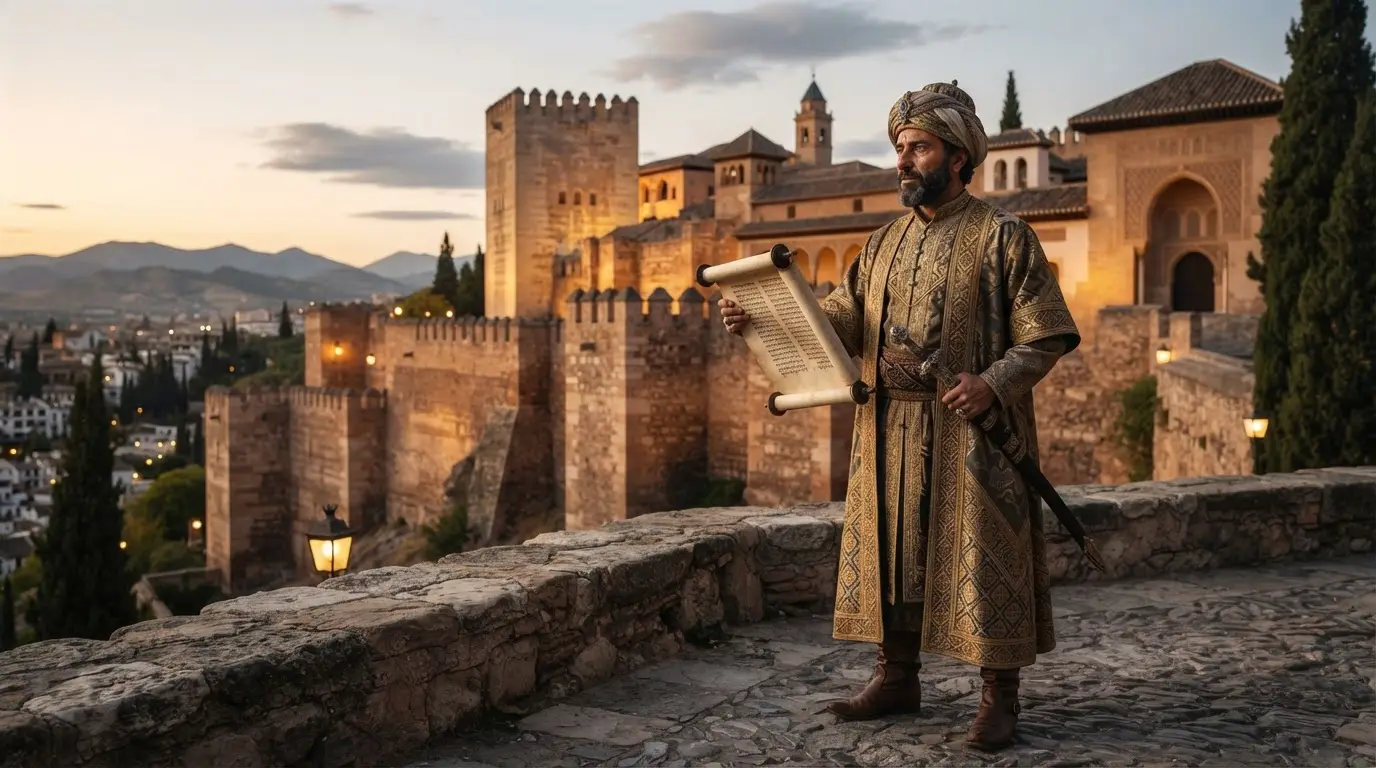

From Córdoba's collapse to a Málaga spice shop
Sources differ on where Samuel was actually born, Córdoba itself or Mérida, his family's ancestral home, but every account agrees he grew up in Córdoba during the last years of a caliphate that once ran from the Atlantic to the Pyrenees. That world ended in 1013, when Berber forces stormed the city amid the fitna that tore the Caliphate of Córdoba apart. Samuel joined the exodus and settled in the Mediterranean port of Málaga, then part of Granada's territory, where he started over as a small trader while continuing the Talmudic study he had begun as a boy[4].
The kingdom he arrived in was one of a dozen small successor states, or taifas, that had split off from the caliphate's wreckage. Granada's, ruled by the Berber Zirid dynasty, would become one of the wealthiest of them, though nobody arriving as a refugee in 1013 could have known that yet.
He opened a spice shop that happened to stand near the residence of Granada's vizier, Abu al-Qasim ibn al-Arif[5]. Refugee status did not stop him practicing what he already knew: fluent Arabic, careful bookkeeping, and a scholar's patience with texts most merchants never touched.
A servant in the vizier's household needed help with correspondence and brought letters to Samuel to draft. Those letters reached ibn al-Arif's own desk, and their calligraphy, precise and fluent, stopped him mid-read. He asked who had written them. When he learned it was the spice merchant down the street, he made Samuel his private secretary.
It is an unusual opening for one of medieval Iberia's most consequential political careers: not a battle, a marriage, or a royal favour, but a servant's errand and a steady hand with a pen.
Vizier of Granada: from secretary to statesman
As private secretary, Samuel handled Ibn al-Arif's Arabic correspondence and, over the following years, took on more of the state's real business: tax collection, then diplomatic correspondence with neighbouring courts. Habbus al-Muzaffar, the Zirid king of Granada, came to rely on him directly.
The role he grew into combined what a modern reader would split across several ministries: protocol, treasury, and eventually the army, a concentration of power unusual for any advisor, let alone one barred by religious law from holding it at all.
When Ibn al-Arif lay dying, around 1027, he told King Habbus something the court had likely already suspected: his own successes as vizier had really come from his Jewish secretary's counsel. Habbus raised Samuel to the rank of vizier himself and put him in charge of Granada's diplomacy and military affairs[6].
That same year, at thirty-four, Samuel was also named Nagid, head of Granada's Jewish community, the first person in al-Andalus to hold the title[7]. The community he now led governed itself from the hillside quarter later known as the Realejo, with its own courts, synagogues, and a professional class of physicians and translators the Zirid court depended on.
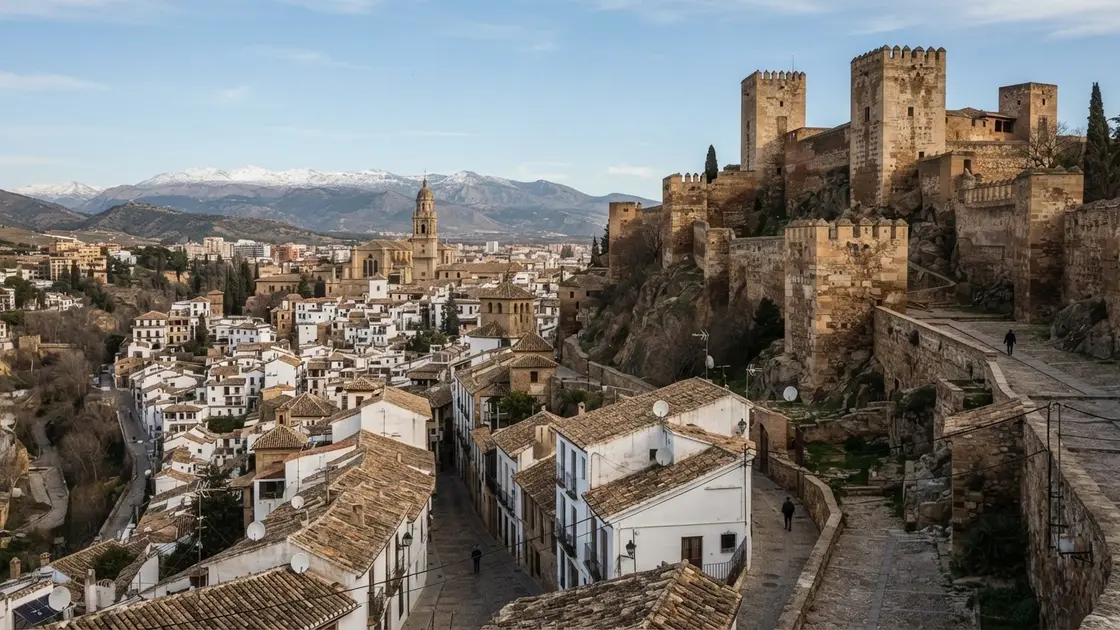
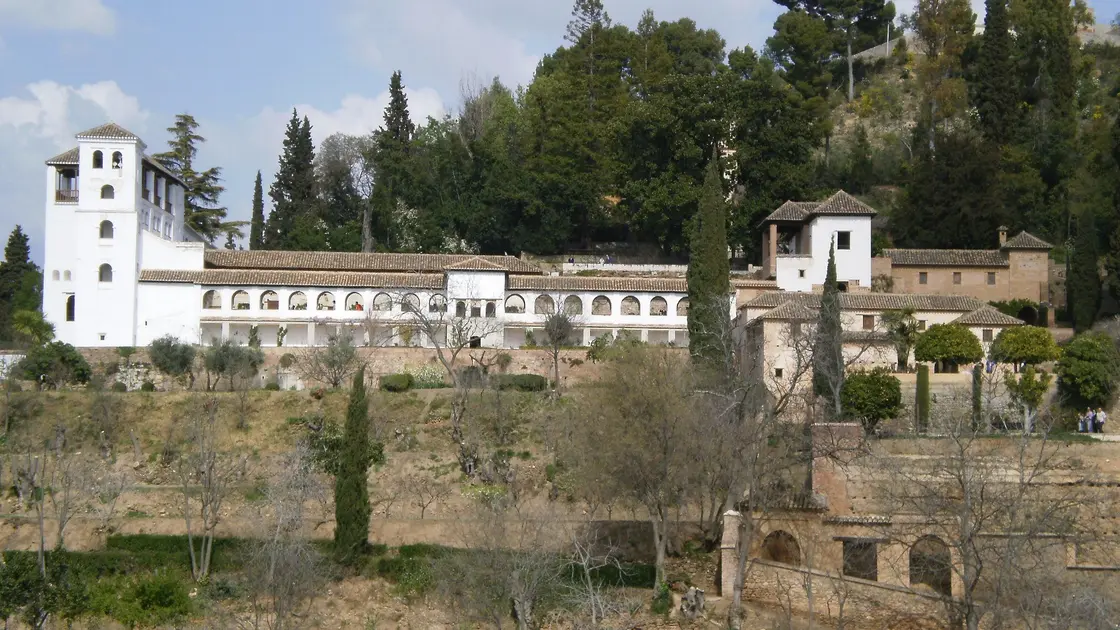
The government Samuel now ran operated from the Zirid citadel on the hill above the Darro, centuries before the Nasrids built the Alhambra and raised their own fortress on the ruins of that earlier stronghold.
Explore nearby · Monument
Alcazaba, Granada
Granada's oldest fortress and the military core of the Alhambra, built in 1238. Its Watch Tower delivers panoramic views of the Albaicin and Sierra Nevada.
The Jewish general: Badis's wars
None of this should have been possible under Islamic law. The Pact of Umar generally barred dhimmis, protected non-Muslim subjects such as Jews and Christians, from holding public office in Islamic states. For a Jew to become vizier was already exceptional; for one to then command a Muslim army in the field was almost unheard of[8].
Taifa Iberia was a landscape of small kingdoms fighting each other more often than they fought outside enemies, and Granada's neighbours, Almería, Seville, Málaga, were exactly that: rivals as much as threats.
When Habbus died in 1038, Samuel backed the claim of his son Badis over Badis's brother Bulukkin. Badis kept him on and expanded his role: vizier and army commander both, now for a king who owed him the throne.
Samuel then spent sixteen of the next eighteen years leading Granada's forces into the field, serving as commander when he rode with the army and running its military administration when he did not. His campaigns ran against:
The victories became poems almost as often as they became territory: after routing an allied army from Seville, Málaga, and Berber forces at Ronda on 8 September 1047, he wrote of his own survival as one deliverance layered on the ones before it.
What that record adds up to is unusual enough that the literary historian David William Foster has called Zirid Granada under Samuel's influence "a Jewish kingdom in all but name"[10], though Badis remained the throne's legal occupant throughout, and the phrase describes influence, not a change in who ruled. It sits inside a longer, three-century pattern of coexistence between Granada's three faiths that this single career illustrates better than most.
Poet of the Golden Age: the diwan
Samuel wrote as prolifically as he governed. His collected poetry forms a three-part diwan: Ben Tehillim (After Psalms), Ben Mishlei (After Proverbs), and Ben Qohelet (After Ecclesiastes), titles that echo the biblical books credited to King David, a comparison Samuel made about himself directly. The verse itself borrowed technical devices from Arabic poetry, metre and formal structure, and applied them to biblical Hebrew at a scale barely attempted before him.
Ben Tehillim is the most personal of the three, built from poems written across his career, including verses about his own battles. Ben Mishlei works in the register of proverb and observation. Ben Qohelet, the last, turns toward mortality: piercing epigrams and descriptions of the natural world, written by a man who had spent thirty years watching people die around him, on and off the battlefield.
Recommended tours
Tours are selected for quality, not commission. We earn a small fee if you book — at no extra cost to you.
Almost none of this survived in circulation. Nearly 2,000 of his poems, the bulk of his known output, disappeared for centuries and turned up only by chance, in a crate of manuscripts found in 1924, not published in a form ordinary Hebrew readers could use until the 1950s[3]. Modern scholars had known him mostly by reputation until then.
Contemporaries rated him just as highly as later rediscovery would. The poet Moshe Ibn Ezra praised his color, his craftsmanship, and the clarity of his rhetoric, remarkable praise from a rival poet, and it has held up. For a very different court poet writing three centuries later in the same city, see Ibn Zamrak, the Alhambra's court poet. For a woman poet of later Granada, see Hafsa bint al-Hajj.
Death, and a son who inherited the danger, not the caution
Samuel died in 1055 or 1056, sources differ by a year, reportedly worn out after decades of campaigning. He died of natural causes, not violence, a claim worth stating clearly, since a later, uncorroborated tradition sometimes conflates his death with his son's, which was violent[11].
What held the whole arrangement together for three decades was Samuel's own judgment about exactly how visible a Jewish minister could be before it became a provocation. Contemporary and later writers treated the combination as remarkable enough to record repeatedly: a court favourite who never overreached in thirty years of holding exactly the kind of position most likely to invite disaster.
His eldest son, Joseph ibn Naghrillah, inherited his titles, vizier, Nagid, the whole delicate balancing act, but not, by most accounts, his father's political instinct. Joseph held the position for roughly a decade before a secret plot he arranged with a neighbouring Taifa was discovered, and Granada's Zirid dynasty turned on him. He was killed in December 1066, and the violence that followed did not stop with him[12]. What happened next, the 1066 Granada massacre that ended al-Andalus's Jewish Golden Age in a single day, is its own story, and a much darker one than his father's.
Deep dive · Article
Alhambra Decree 1492: Granada's Jewish Expulsion Explained
The Alhambra Decree (Edicto de Granada) expelled Spain's Jews in 1492. Learn why it happened, what else happened in Spain that year, and where exiles went.
Samuel's own ending was quieter: a natural death, a completed diwan, and thirty years in which a refugee's handwriting had reshaped what seemed possible for a Jew in Muslim Spain, right up until it wasn't, one generation later.