San Juan de Dios: The Saint Who Built Granada's Hospitals
Before sainthood, Juan Ciudad was a soldier, a beggar, and an asylum inmate in Granada — until a 1537 breakdown founded a hospital order still running today.
Seven years resident in Granada. Specialist in Nasrid architecture, Al-Andalus history, and Andalusian walking routes.
Published
Juan Ciudad Duarte was a soldier, then a beggar, then an inmate in Granada's madhouse — and only after all three did the city let him become the saint who reshaped how it treated the sick and poor. The order that grew out of what looked, at the time, like a total breakdown still runs hospitals across dozens of countries. The Baroque basilica built to hold his relics is the clearest measure of how seriously Granada took that turnaround.
Juan Ciudad was born João Duarte Cidade in Montemor-o-Novo, Portugal, on 8 March 1495[4]. He vanished from his hometown at around eight years old, kidnapped, or lured off by a visiting cleric; nobody is quite sure which. The disappearance broke his family: his mother reportedly died of grief soon after, and his father entered the Franciscan Order[5]. What happened to the boy in the years between is unrecorded; what surfaces next is a young man already serving as a soldier, a trooper who spent roughly eighteen years fighting across various parts of Europe[6].
The soldiering ended on Saint Sebastian's Day, 20 January 1537, when Juan, then forty-two, heard a sermon by the preacher John of Ávila and underwent what witnesses at the time called an acute mental breakdown[7]. He tore at his clothes, beat his chest, and ran through Granada's streets begging forgiveness for a wasted life. The city's answer was to lock him up: he was confined in the ward Granada's Royal Hospital reserved for the mentally ill, where the period's treatment meant being segregated, chained, flogged, and starved[8].
A vision, a street cry, and the House of God
Tradition holds that inside the asylum, a vision of the Infant Jesus bestowed on him the name by which history remembers him, and told him to make Granada his life's work; he was already there[9]. Once discharged, he walked to the shrine of Our Lady of Guadalupe in Extremadura on pilgrimage, where a second vision, this one of Mary herself, is said to have fixed the direction the rest of his life would take: work with the poor, and don't stop[10].
By 1539 he had opened his own hospice on Calle Lucena, a rented house he called simply the House of God; that same year the Archbishop of Granada gave him the religious habit and formally confirmed the name the street already used for him, John of God[11]. He begged for the hospice's upkeep on the same streets that had once watched him break down, calling out to passersby with the phrase "Fate bene, fratelli" (brothers, do good), a cry that stuck so hard his followers were known in Italy as the Fatebenefratelli long before that name meant anything in Granada itself[12].
His first two disciples arrived by an unlikely route. Antonio Martín and Pedro Velasco had been bitter enemies whose public quarrels once scandalized the whole city; John's preaching converted both of them, and together they formed the nucleus of what would become a religious congregation[13].
A death that founded an order
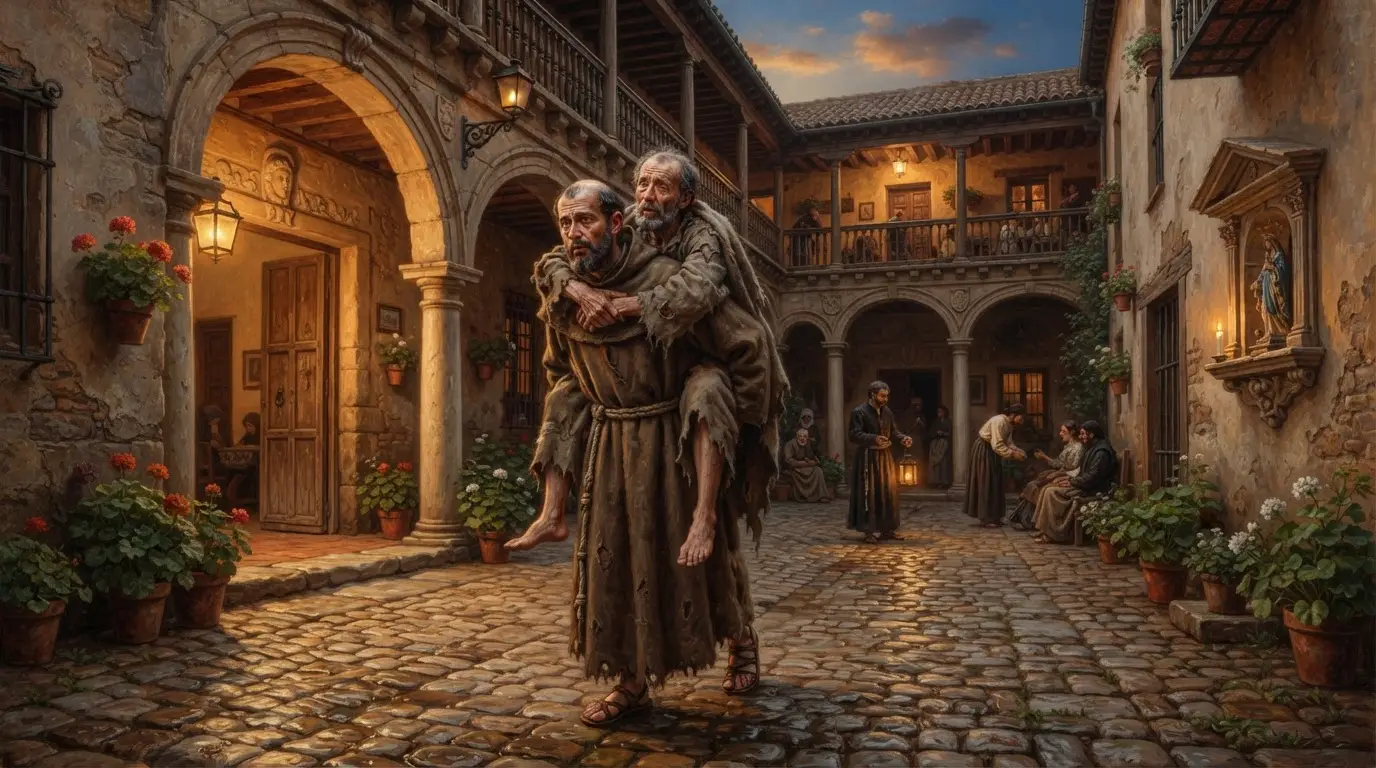
The best-attested of his miracles, commemorated every year in the liturgical office for his feast day, is a fire at Granada's Royal Hospital, the same building that had once chained him: John is said to have walked in and out of the flames carrying patients, coming out unburned each time[14].
He died the way he had lived, mid-rescue: in 1550 he waded into a river trying to save a young man from drowning, and caught pneumonia from the exposure. He died of it in Granada on 8 March, the same calendar date as his birth, fifty-five years apart[15][1].
On his deathbed, he named Antonio Martín, the same convert from the scandalized-enemies story, to lead the small community he was leaving behind[16].
Timeline
1495
Born João Duarte Cidade
Montemor-o-Novo, Portugal
1537
Conversion in Granada
Saint Sebastian's Day, 20 January
1539
Founds the House of God
A rented hospice on Calle Lucena
1550
Dies in Granada
8 March, aged 55
1572
Order formally approved
Pope Pius V, Rule of St Augustine
1690
Canonized
Pope Alexander VIII, 16 October
1759
Basilica opens in Granada
Built to hold his relics
His remains did not stay in one place either. First interred in the Church of Our Lady of the Victories, they were moved in 1664 to the Hospitallers' own hospital church, then again in 1757 to a newly finished church built specifically to hold them[17]. Unlike the Catholic Monarchs a few streets away in the Royal Chapel, whose tombs found a permanent home relatively quickly, John's own relics took two centuries to settle — in the building that today, elevated to a basilica, is the one visitors mean when they say Granada's Basilica de San Juan de Dios[17].
From a rented house to 46 countries: the Brothers Hospitallers
The scattered community John left behind took over two decades to become a formally recognized religious order. Pope Pius V approved the Order of the Brothers Hospitallers in 1572, placing it under the Rule of St Augustine, the same rule that already shaped Augustinian communities across Europe, now adapted to a group whose entire purpose was nursing rather than contemplation[18].
In 1584, Pope Gregory XIII gave the Brothers a hospital on Rome's Tiber Island, the Hospital of St John Calybita, and it became the order's motherhouse, the administrative centre from which everything else was governed[19]. It also fixed the name history remembers them by: Fatebenefratelli, echoing the same street cry John had used decades earlier in Granada.
Royal patronage carried the order to new cities fast:
Madrid, funded by the generosity of King Philip II of Spain[20]
None of that expansion has stopped. Today, by one recent count, the Hospitaller Order of St John of God runs 389 centres and services across 46 countries. It is a footprint that started with one rented house on Calle Lucena and a man nobody in Granada expected to amount to anything[3].
Canonization, patronage, and the basilica built to hold his relics
Sainthood took a while. John was declared a saint on 16 October 1690 by Pope Alexander VIII, a hundred and forty years after his death[2].
Papal recognition kept arriving long after canonization[21]:
1886: Pope Leo XIII proclaimed him patron saint of hospitals and the sick
1930: Pope Pius XI made him patron of nurses
1940: Pope Pius XII declared him Granada's second patron saint
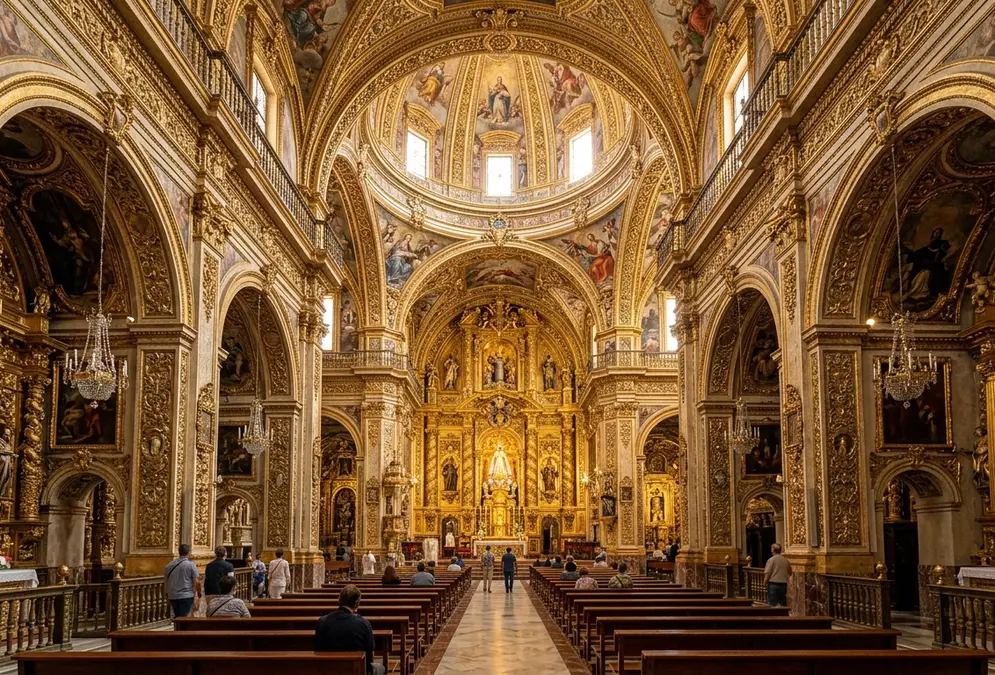
Granada didn't wait for Rome's paperwork to start building. Fundraising for a dedicated church began in 1737, and the doors opened on 27 October 1759, twenty-two years later[22]. The project was commissioned by prior Fray Alonso de Jesús y Ortega and designed by architect José de Bada y Navajas, who also gave the city its Sagrario church[23]. The gilded Baroque retablo mayor was carved by José Francisco Guerrero, and the ceiling frescoes narrating the saint's life came from Diego Sánchez Sarabia, who also sculpted the figures inside the altarpiece itself[24].
Behind the altar, a domed camarín chapel holds a solid silver urn displaying the saint's wooden cross, his molars, and other personal relics, the closest a visitor gets to the man himself[25]. Pope Benedict XV elevated the church to the rank of basilica by papal bull in December 1916[26], though the building had already survived worse than a change of title: Napoleonic troops stripped part of its artworks during the French invasion, and 19th-century disentailment forced the Hospitaller Order out of both church and hospital for years before it reclaimed the temple for worship[27]. The Basilica de San Juan de Dios still stands on that site today. Every 7 March, Granada's children still carry paper lanterns to its door in a custom known as the Camino de los Faroles, a tradition with nothing to do with any papal decree and everything to do with a city that decided long ago this man belonged to it. It sits inside the loop covered by Granada's Baroque and Renaissance architecture walk, which is the fastest way to see where this story physically ended up.
Frequently asked questions
Who was San Juan de Dios?
San Juan de Dios, born João Duarte Cidade in Montemor-o-Novo, Portugal, in 1495, was a soldier for eighteen years before a religious conversion in Granada in 1537 sent him into the city's asylum for the mentally ill. He recovered to found a hospice for the sick and poor, and the disciples who gathered around him became the Brothers Hospitallers, a religious order still active in dozens of countries today.
Why is San Juan de Dios famous in Granada?
He is famous locally as the man whose public breakdown in Granada's streets led, within two years, to a working hospice on Calle Lucena, and eventually to a religious order that spread across Europe and beyond. Pope Pius XII named him Granada's second patron saint in 1940, and the Basilica de San Juan de Dios was purpose-built to hold his relics.
What did Saint John of God do for the sick and poor of Granada?
After his conversion, he begged in the streets to fund a rented house he called the House of God, where he personally cared for the sick, the poor, and people with mental illness, the same population that had, not long before, treated him as a patient rather than a caretaker. He was still doing that work when he died rescuing a drowning man in 1550.
When was Saint John of God canonized, and who declared him patron saint of hospitals?
Pope Alexander VIII canonized him on 16 October 1690, a hundred and forty years after his death. Pope Leo XIII named him patron saint of hospitals and the sick in 1886, Pius XI made him patron of nurses in 1930, and Pius XII declared him Granada's second patron saint in 1940.
What is the Order of the Brothers Hospitallers (Fatebenefratelli)?
It is the religious order that grew out of the small community John gathered in Granada, formally approved by Pope Pius V in 1572 under the Rule of St Augustine. Its popular Italian name, Fatebenefratelli, comes from John's own street cry for alms ("brothers, do good") and stuck after the order took over a hospital on Rome's Tiber Island in 1584. Today it runs hundreds of centres and services across roughly 46 countries.
What is the Basílica de San Juan de Dios, and why was it built?
It is the Baroque church the Hospitaller Order raised specifically to hold John's relics, built between 1737 and 1759 under prior Fray Alonso de Jesús y Ortega and architect José de Bada y Navajas. Behind its gilded main altar, a domed camarín chapel displays his wooden cross and other personal relics in a solid silver urn. Pope Benedict XV elevated it to basilica status in 1916.
Where did San Juan de Dios die in Granada?
He died in Granada on 8 March 1550, from pneumonia caught after wading into a river to try to save a drowning young man, the same calendar date as his 1495 birth, fifty-five years apart.
What relics of San Juan de Dios are kept in the basilica's camarín?
The camarín chapel behind the basilica's main altar holds a solid silver urn displaying his wooden cross, his molars, and other personal relics, objects that survived both a Napoleonic-era spoliation and a period when the Hospitaller Order was forced out of the building entirely.
“One day, when John was eight years of age, he disappeared. Whether he had been deliberately kidnapped, or whether he had been seduced from his home by a cleric who had been given hospitality in the home, is not clear. According to his original biography, his mother died from grief soon after this, and his father joined the Franciscan Order.”
“Cidade experienced a major religious conversion on Saint Sebastian's Day (January 20) of 1537, while listening to a sermon by John of Ávila, a leading preacher of the day who was later to become his spiritual director and would encourage him in his quest to improve the life of the poor. At age 42, he had what was perceived at the time as an acute mental breakdown.”
“He was incarcerated in the area of the Royal Hospital reserved for the mentally ill and received the treatment of the day, which was to be segregated, chained, flogged, and starved.”
“he is said to have been granted the vision of the Infant Jesus, Who bestowed on him the name by which he was later known, John of God, also bidding him to go to Granada.”
“he made a pilgrimage to the shrine of Our Lady of Guadalupe in Extremadura, where it is said he experienced a vision of Mary, who encouraged him to work with the poor.”
“In 1539, he founded his first hospital on Via Lucena, called “House of God”, where he offered hospitality to anyone. Along with his first companions, he provided assistance to those in need. In the same year, he received the religious habit from the Archbishop of Granada, who also gave him the name, John of God, which had already been attributed to him by the people.”
“His original approach in asking for charity, in which he invited people “to do good to yourselves! Fate bene fratelli (Brothers, do good)”, attracted many volunteers and benefactors.”
“The saint's first two companions, Antonio Martin and Pedro Velasco, once bitter enemies who had scandalised all Granada with their quarrels and dissipations, were converted through his prayers and formed the nucleus of a flourishing congregation.”
“the most famous is the one commemorated in the Office of his feast, his rescue of all the inmates during a fire in the Grand Hospital at Granada, he himself passing through the flames unscathed.”
“The former advanced so far on the way of perfection that the saint on his death-bed commended him to his followers as his successor in the government of the order.”
“His body was initially buried in the Church of Our Lady of the Victories, belonging to the Minim friars, and remained there until November 28, 1664, when the Hospitaller Brothers had his relics moved to the church of their hospital in the city... On October 26, 1757, they were transferred to that church, now protected by the Knights of Saint John of God.”
“In 1584, Pope Gregory XIII called some of the Brothers to Rome and gave them the Hospital of St. John Calybita, Fatebenefratelli Hospital, located on an island in the Tiber, which then became the motherhouse of the whole order.”
“Thanks to the generosity of King Philip II of Spain, a hospital was founded at Madrid, another at Córdoba and several others in various Spanish towns... The first hospital of the order in France was founded in Paris, in 1601, by Queen Marie de Medici.”
“He was proclaimed Patron Saint of hospitals and the sick by Leo XIII in 1886, Patron Saint of nurses and their associations by Pius XI in 1930, and second Patron Saint of Granada by Pius XII in 1940.”
“Para ello comenzó a administrar, desde 1737, las aportaciones voluntarias que hicieron los fieles devotos. El 27 de Octubre de 1759 la iglesia abrió sus puertas.”
“La construcción del templo en honor a San Juan de Dios, fue promovido por el fraile Alonso de Jesús y Ortega, a principios del siglo XVIII... El diseño del templó estuvo a cargo de José de Bada y Navajas, autor de otras insignes obras de Granada, como la iglesia del Sagrario, la portada de la iglesia de Justo y Pastor, y el camarín de la Virgen del Rosario de la Iglesia de Santo Domingo.”
“El retablo de la Capilla Mayor fue realizado por José Francisco Guerrero, autor también de los demás retablos, púlpito, cancel y sillería del coro. Las esculturas, que alberga el retablo mayor, fueron realizadas por Diego Sánchez Sarabia. Artista que pintó también la bóveda de la iglesia, en la que se relatan escenas de la vida de San Juan de Dios.”
“La culminación de la basílica es el camarín, una pequeña capilla tras el altar, que custodia objetos personales de San Juan de Dios. Una urna de plata sólida exhibe la cruz de madera del santo, muelas y otras reliquias para la veneración.”
“Durante la invasión francesa la Iglesia de San Juan de Dios sufrió el expolio de parte de sus obras. Con la desamortización, la orden tuvo que abandonar la iglesia junto con el hospital.”