
A Berber family and a nickname from a literary salon
Hafsa was born in Granada to al-Hajj ar-Rukuni, a Berber of a noble and wealthy family who left almost no trace among the biographers.[5] Nobody recorded her birth date either, so the usual biographical scaffolding is missing before she is an adult. That gap is the first reason her life has to be told in ranges.
The name she goes by, al-Rakuniyya, was not simply inherited. A University of Granada text traces it to 1158, when she was sent with other Granadan poets and notables to meet the caliph Abd al-Mu'min in Rabat and took the nickname there, from rakuna, a kind of literary salon.[6] Before she was known for a love affair, then, she was already counted among the Granadans worth presenting to the new Almohad ruler.
Her Berber background was not unusual in a city the Zirid dynasty had made a Berber kingdom in the eleventh century. What had changed was the master. The Almohads who now held Granada came from across the Strait, with a stricter reformist creed and a capital at Marrakech, and a family like hers had to find a place under them.
The affair with Abu Ja'far ibn Sa'id
Around 1154, when the Almohads came to power, Hafsa seems to have begun a relationship with the poet Abu Ja'far Ahmad ibn Abd al-Malik ibn Sa'id.[7] The scholars' hedge, seems, is honest: the affair survives mainly in poems, and poems are not diaries.
The triangle has three corners:
- Hafsa, the Granadan poet from a noble Berber family.
- Abu Ja'far, a poet who served as a prominent court secretary to the Almohad governor of Granada, Abu Sa'id Uthman.[8]
- Abu Sa'id Uthman, the governor himself, who held power in the city and would later order Abu Ja'far's death.
Their courtship was public. Hafsa was known as Abu Ja'far's lover, and the poetic dialogue between them was widely read at court.[9] In a society that policed women's reputations, a published affair is a bold move, and the exchange gave later readers a rare chance to hear both sides of an Arabic love affair.
Accounts of the triangle diverge. The Academy of American Poets says the governor began falling in love with Hafsa, which eventually pushed Abu Ja'far to flee and join Ibn Mardanish's rebellion against Almohad rule.[21] Spain Then and Now tells it the other way round: Hafsa, perhaps tired of Abu Ja'far's disloyalty, became the governor's lover.[22] Both versions agree on the outcome, which is why this affair did not end the way courtly love poems usually do.
Execution, elegies and an unmarried poet
Abu Ja'far was executed, on Spain Then and Now's account, because he rebelled against Almohad authority, was captured and was summarily put to death in Málaga.[23] The majority dating is 1163, at the hands of Abu Sa'id Uthman, the Almohad governor of Granada and a son of Abd al-Mu'min, the same man he had served as secretary.[10] One source puts his capture and execution in 1165.[11] The place and manner are also told two ways: one account has him imprisoned and crucified in Málaga after rebelling against the governor, while others say only that he was put to death there.[12]
Hafsa's reply was public. She grieved, wrote elegies praising Abu Ja'far, and does not appear to have married.[13] She wrote in praise of the man the governor had killed, and the governor ruled the city she lived in.
She wrote in praise of the man the governor had killed, and the governor ruled the city she lived in.
Elegy was an established Arabic genre, which gave her a respectable form for an unrespectable grief. The conventions let her speak of loss as praise, and praise of a condemned rebel was exactly what a governor's court did not want to hear.
Marrakech and the caliph's pupils
Hafsa eventually withdrew to Marrakech, where she began her teaching career by educating the daughters of the caliph Abu Yusuf Ya'qub al-Mansur.[14] One account dates the invitation to 1184 and has al-Mansur asking her to educate the Almohad princes, in some versions princesses.[15] Who sat in her classroom is therefore unsettled, but the position is not: she taught inside the Almohad court, in the capital, on the caliph's invitation.
Courts that wanted learned women were not unique to the Almohads. Granada's later Nasrid court produced its own, as the women of the Alhambra show, but Hafsa belongs to the earlier generation that made such a career thinkable.
Explore · Neighbourhood
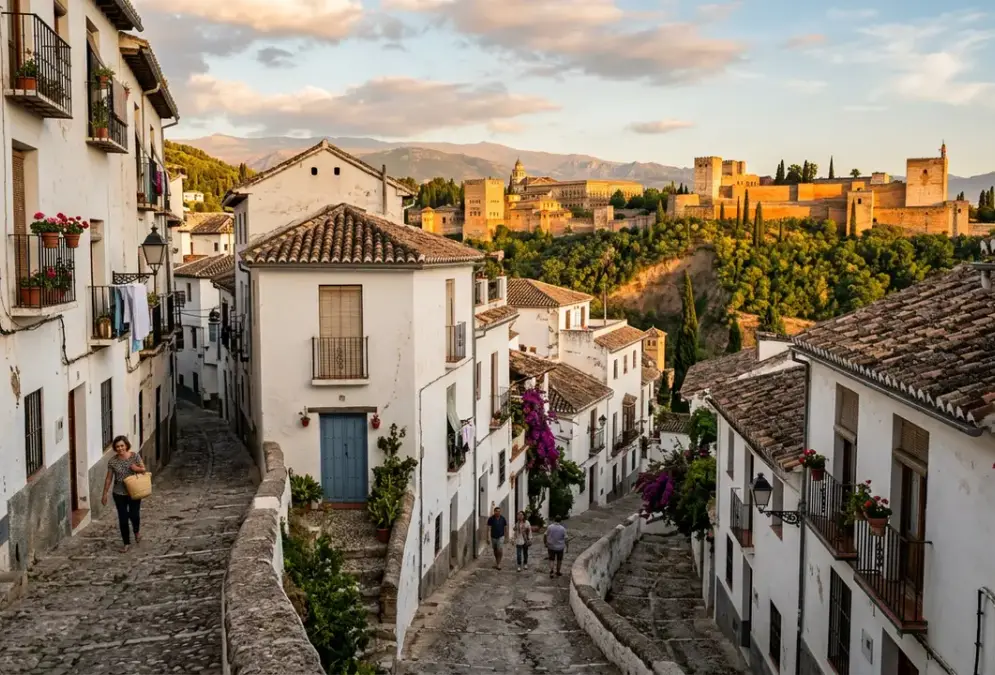
Albaicín
Granada's oldest neighbourhood: the Albaicín holds a UNESCO-listed maze of whitewashed lanes, Moorish cármenes, and the finest Alhambra views in the city.
She died in Marrakech in 1190 or 1191.[16] The ending is quiet for a life that began with a public love affair: a Granadan poet, dead in the Almohad capital, with the year of her death uncertain by one.
What survives of her poetry, and where to find it
The most accessible English reading is Will Pewitt's 2020 translation of five poems in the Columbia Journal,[20] where one poem opens, in his words, "Speak to lightning, a memento of my beloved".[24] Any line of hers you meet in English is a translator's choice, so note whose.
Some 60 lines of her verse survive, spread across 19 poems.[17] Other references give about seventy lines, but either figure would fill only a couple of printed pages.[18] Most of what we know of her comes through that thin corpus and through the reputation it earned.
Ibn al-Khatib, the fourteenth-century Nasrid vizier and historian, later called her ustadhat waqtiha, the professor of her time,[19] a title that suggests her fame rested on teaching as much as on verse. The same Ibn al-Khatib would shape the literary world of the next dynasty.
Deep dive · Article
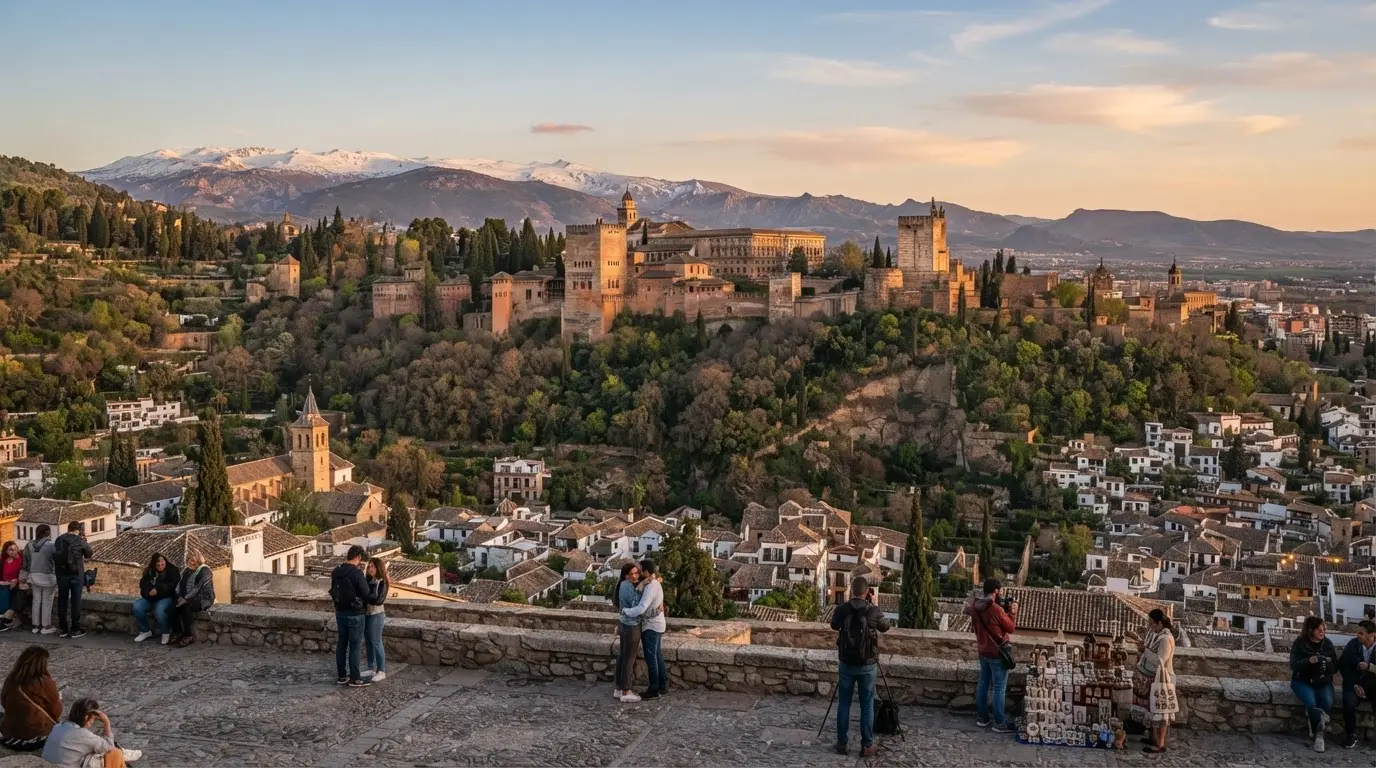
20 Interesting Facts About Granada, Spain
Interesting facts about Granada Spain that guidebooks skip: disputed etymologies, the soldier who saved the Alhambra, and a river buried under Plaza Nueva.
Recommended tours
Tours are selected for quality, not commission. We earn a small fee if you book — at no extra cost to you.




Granada's best-known poetry on display is Nasrid, composed about two centuries after her death by Ibn Zamrak, whose verses fill the Alhambra's palaces. If you visit after reading her, hold the two apart: Hafsa belongs to the earlier, quieter Granada, and she reaches readers through anthologies and translation rather than through any building.