Where Boabdil died, and why the record is thin
Boabdil surrendered the Alhambra to Ferdinand and Isabella on 2 January 1492. That story, and the year he spent afterward in the Alpujarras, is told in full in Boabdil: Last Moorish King of Granada. What this piece asks is narrower: where did he end up, and where is he actually buried? He probably settled in Fez. There, the nickname el rey chico mocked a king with no kingdom left to rule[4].
Explore nearby · Monument
Alhambra
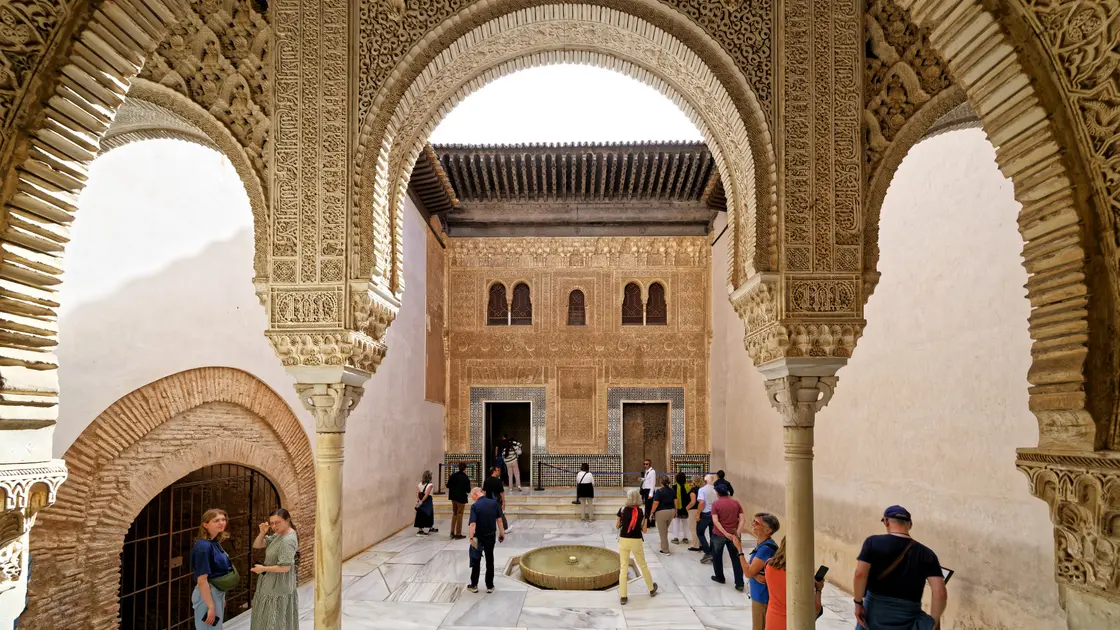
The Alhambra is Granada's UNESCO fortress-palace: Nasrid Palaces, Alcazaba and Generalife gardens. Tickets sell out weeks ahead; book via the Patronato site.
Sources disagree sharply on when he died. An older tradition places his death in Algeria in 1494[5]. The account that has displaced it, tracing back to the 17th-century North African historian Ahmad al-Maqqari, gives 1533 in Fez and states plainly that he was buried there[1], though some versions give 1518[20]. Scholarship leans toward the Fez account, though Al-Maqqari was writing about a century after the fact, and both dates still circulate. Al-Maqqari reportedly met Boabdil's descendants in Fez in the early 17th century[15].
The Algeria tradition has a physical anchor: an inscribed slab that ended up in Tlemcen's town museum[16], translated in the late 19th century by the Arabist M.C. Brosselard[16]. His reading dates the death to a Wednesday at the new moon of Sha'ban in the year 899 of the Hijra, roughly 1494[21], and gives the age as about forty[22]. The slab had been reused as a doorstep in a house near Tlemcen's Sidi-Ibrahim mosque[23].
Brosselard admitted his transcription still had gaps and possibly faulty readings[24], and credited the Tlemcen mufti Si-Hammou-ben-Rostan for his help deciphering it[25]. He conceded the objection that the epitaph might fit El Zagal[26], yet judged his reading of age and parentage very nearly certain[27]. Some later historians reject his interpretation[17], and the mix-up may stem from Boabdil's uncle El Zagal, who also died in North African exile[18], in Tlemcen in May 1494[19]. It is a documented identification, and a contested one.
Al-Maqqari's account: a shrine outside Bab Mahrouk
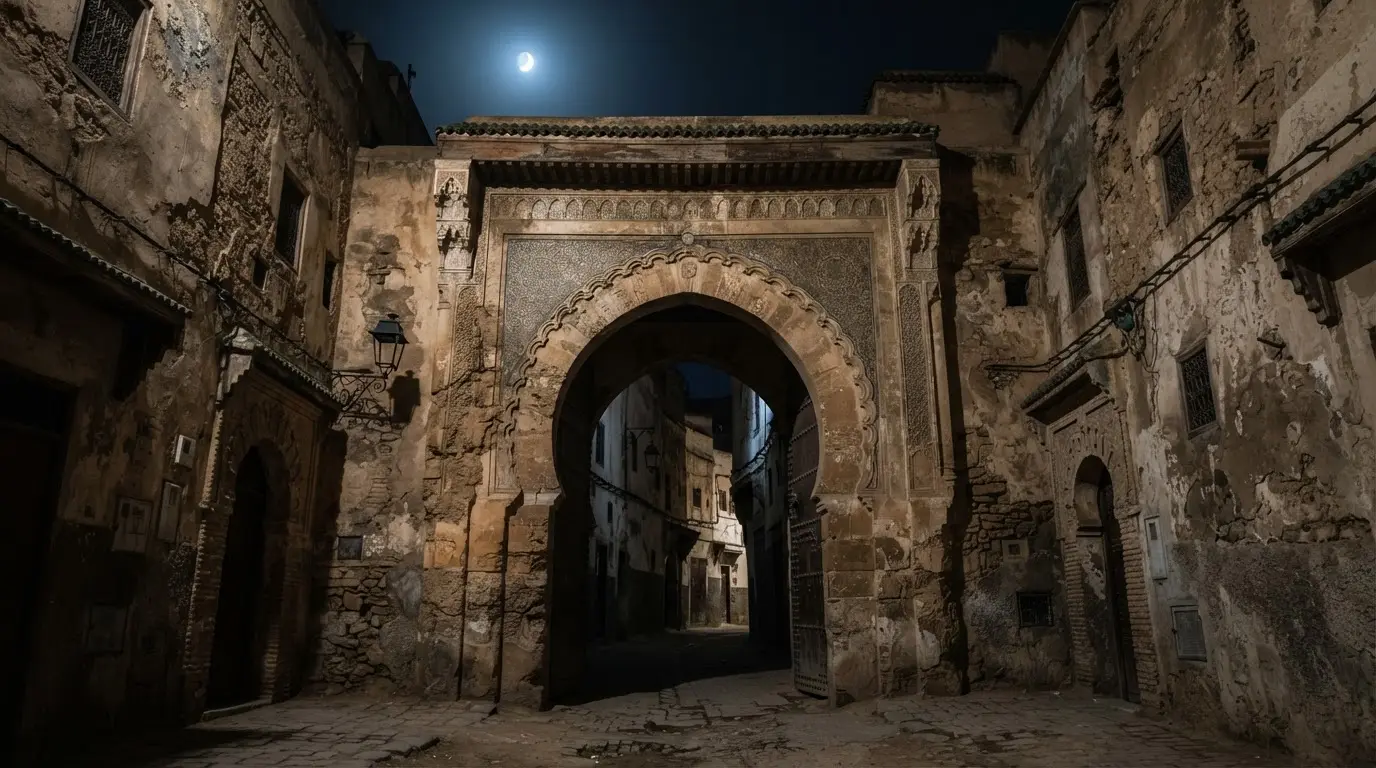
Al-Maqqari was an imam at Fez's Qarawiyyin Mosque who compiled a vast history of Muslim Spain, Nafh al-Tib, in the early 17th century, about a century after Boabdil's death. His account names the burial site as a musalla, a small open-air prayer ground, beside a gate in the old medina wall of Fes el Bali. That gate is now called Bab Mahrouk, but it may not always have carried that name.
The gate was built in 1204 under the Almohad ruler Muhammad al-Nasir, part of a broader rebuilding of Fez's walls[3]. It may once have been called Bab ash-Shari'a, the Gate of Justice or Law, but became known as Bab Mahrouk after a rebel's body was burnt there in 1203-04[6]. Granada has its own Puerta de la Justicia at the Alhambra, also translated as the Gate of Justice; the two share a name and a theme of judgment, nothing more, and no historical connection.
The domed tomb itself, a small qubba, sits next to a musalla still used for prayer outside Bab Mahrouk[7]. How far outside is disputed: that account gives no distance, while Spain's Instituto Cervantes in Fez puts the shrine almost two kilometres from the gate[8]. The honest answer is that the shrine sits somewhere in the district beyond Bab Mahrouk, not that its exact distance is settled.
The saint who came after him
The shrine doesn't carry Boabdil's name today. It's known locally as the Tomb of Sidi Bel Kacem, after Sidi Ibrahim al-Shakdani, a local saint buried above Boabdil once his remains had already decayed[9]. A grave gets renamed to whoever visits it last, in effect; Boabdil's own burial left no marker durable enough to hold his name against a more locally venerated one.
By 2021, one account described the shrine's floor and inner walls as covered in refuse, used as a shelter by homeless people and by drinkers[10]. It is not maintained as a historical site. Whatever is buried beneath it has been treated as an ordinary neighbourhood tomb rather than the resting place of the last Nasrid sultan.
The 2013 search: what a scan found, and where it stopped
In 2013, a Spanish-Emirati research team ran a geo-radar scan across the shrine floor[2], hoping to establish, without digging, whether anything consistent with Al-Maqqari's account lay beneath it. The scan detected two tombstones and, deeper down, two sets of skeletal remains[11].
That is where the physical evidence stops. The team proposed an excavation to recover and examine the remains, but permission to dig was denied[12]. No bone has been dated. No DNA has been compared. One of the two skeletons is theorised to be Boabdil's; neither has been confirmed as anyone's.
It is worth being precise about what 'found' means here. A geo-radar scan reads density contrasts in the ground; it does not read names. A later saint's grave laid over an older one is exactly the kind of layering a scan can detect and an excavation could untangle, but only an excavation. Until one happens, 'Boabdil's tomb has been found' is a claim the evidence does not yet support.
Why the mystery may never close
Cambridge researcher Elizabeth Drayson's work on Boabdil surfaced this story for English-language readers, framing the shrine as a genuine open question rather than a settled discovery[13]. Spain's cultural institute in Fez, the Instituto Cervantes, is equally direct: the location of Boabdil's tomb, it states, remains unknown[14]. Both descriptions, from a Cambridge academic and a Spanish state institution operating in Fez itself, agree that identification and confirmation are not the same claim.
What would change that? Permission to excavate, followed by carbon-14 dating of the bones and a DNA comparison against a documented Nasrid descendant, if one can be found and agrees to testing. Cambridge's coverage of Drayson's research reported experts hoping to do exactly that[5]. For now, the last Nasrid sultan of Granada is buried somewhere in or near a shrine outside a gate in Fez that no longer carries his name, under a claim nobody has been allowed to test.
Deep dive · Article
1066 Granada Massacre: When the Jewish Golden Age Ended in a Day
The 1066 Granada massacre killed Joseph ha-Nagid and thousands of the city's Jews in a single day, ending three decades of Jewish power under Samuel ha-Nagid.
For visitors following his story from the other end, the Nasrid Palaces in the Alhambra are where that story starts: the throne rooms he inherited, then handed over intact. What happened afterward, in the Alpujarras and then in Fez, is where the trail runs out, under a shrine floor nobody has been allowed to open.