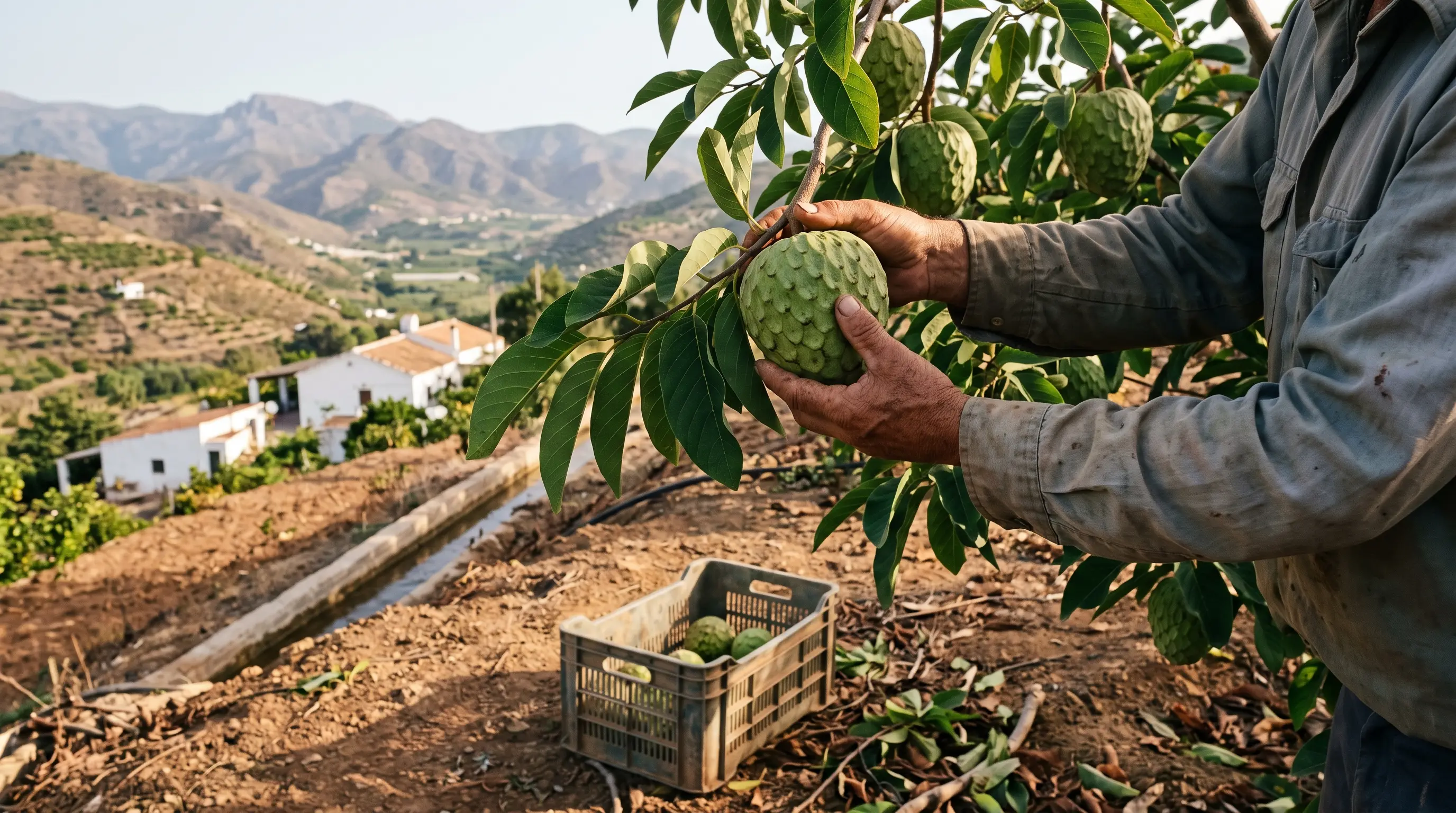
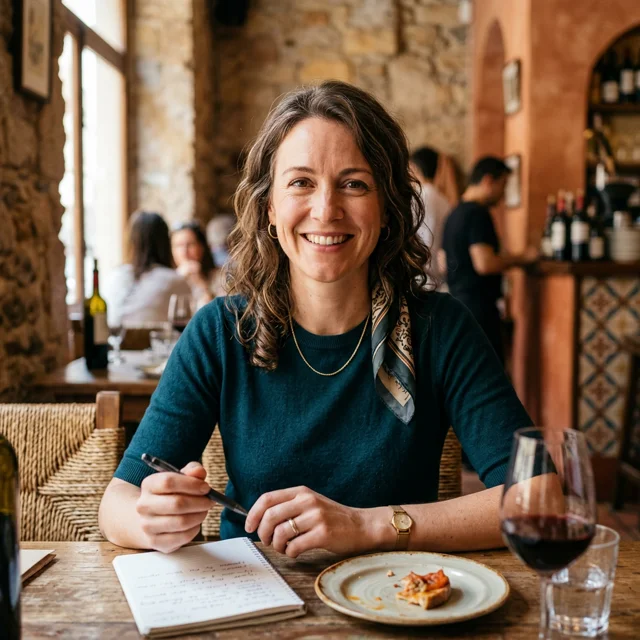
How to buy a chirimoya: season, label and ripeness
Start with the calendar, because it is wider than most visitors assume. The Junta de Andalucía's monitoring notes say the Andalusian subtropical harvest starts in September, with chirimoya the first crop in, and that the chirimoya season runs to March.[4]
The fruit can be harvested in autumn or in spring, according to a Junta report on tropical crops.[5] A producer interviewed in the trade press says new pruning techniques now let the company supply fruit until May, where it used to stop in December.[6] So a chirimoya in a Granada shop in April is not necessarily old stock, and one in October is not necessarily the best of the year. Ask which crop it is.
For a visitor the practical reading is simple. October and November, the old main season,[2] are the safest window for fresh fruit, and spring supply depends on the late crop. A trade report puts the whole campaign at about nine months.[7]
Then read the label. PDO fruit must carry a numbered label or back-label supplied by the Consejo Regulador.[8] Packaging must show the PDO name prominently,[9] and only registered firms may use the name on labels, back-labels or advertising.[10] A fruit sold as PDO without that numbered label is a reason to ask questions.
To judge ripeness, use your thumb. A local information site says a chirimoya that is slightly soft to the touch is ripe.[11] A 1990 University of Granada study describes the fruit as ripening in a typically climacteric way, with a sharp ethylene peak that leads to rapid senescence.[12] Translation: the window between ready and past it is short, so buy for the next day or two.
If you are on the coast in early October, Torrecuevas, a neighbourhood of Almuñécar in the valley leading up to Jete and Otívar,[13] holds its Fiesta de la Chirimoya around 12 October.[14] A local information site lists the 54th edition for 9 to 12 October 2026, with a subtropical fruit contest and a custard-apple dessert competition. It is not a municipal source, so confirm the dates with Almuñécar town hall before planning around it.
The Granada markets guide is the place to start for finding local fruit in the city.
Pair it with the coast's savoury side. The boquerones of the Costa Tropical are the obvious seafood order, and a chirimoya at the end of the meal is the local way to close it.
An Andean fruit with a disputed birthplace
Annona cherimola belongs to Andean valleys between 1,500 and 2,200 metres above sea level, and from there it spread across much of South and Central America.[15] Anyone eating one on the Granada coast is eating a mountain fruit that Spanish growers have spent decades persuading to live at sea level.
Where exactly it began is argued over. The explorer Wilson Popenoe placed its origin in the inter-Andean valleys of Peru, along the Marañón river, and in the mountains of Loja province in Ecuador.[16] Other historians stretch the range to Bolivia, Chile and Colombia, and some argue for Central America instead.
The name is probably Quechua as well. Spanish writers have proposed chiri moya, "cold seed", or chiri moyu, "cold bosom".[17] Both are proposals, not settled etymology, so take the tidy "cold seed" explanation on a market stall with a pinch of salt.
The origin dispute matters less than it sounds. Nobody claims the species as Spanish. What Granada can claim is the farming and the local selections, and that distinction is exactly what the protected name later pinned down. The Andean origin explains the fruit; the coast explains the crop.
From a 1757 mention to a coastal crop
Spain's first references to the chirimoya date to 1757.[18] Cultivation did not gain real weight until the middle of the 20th century, which leaves a gap of close to two centuries between a first mention and the first serious orchards. That is a long time for a crop to sit on the sidelines.
When it did take off, it took ground from older crops. On the Río Verde plain at Jete it replaced some orange and sugar-cane plots.[18] The sources do not say why growers made the swap, and I would distrust any tidy account of disease or prices that claims to know.
The orange-grove replacement was also partial. Cane had been this coast's dominant product since the mid-19th century, and the rapid collapse is dated to after 1970, a generation after chirimoya began taking plots at Jete.[19] The two crops overlapped for decades, so the switch at Jete was a local start, not a clean handover.
Then the numbers moved fast. Plantings rose from about 400 hectares, roughly 71,000 trees, in the early 1980s to about 2,500 hectares in 1987.[20] That is more than a sixfold jump in a few years. The Junta de Andalucía's report for the 2014-15 campaign puts the crop at about 3,000 hectares, so most of that area was already in the ground by the late 1980s, if the two counts are comparable.[1]
Do the arithmetic on the early figures. Some 71,000 trees on 400 hectares is about 178 trees a hectare, a planting density that tells you these were orchards, not scattered garden trees.[20] The timing also rhymes with the cane story: the decline began after 1970 and the chirimoya boom ran through the 1980s.[19] The sources never connect the two, so the sequence is all that can be said.
Why a highland fruit suits the Costa Tropical
Geography does most of the work. The valleys run north to south close to the coast, and the east-west Penibaetic range behind them shelters them from the north winds.[21] Andalucía's tourism board adds the headline numbers: 320 sunny days, a mean annual temperature of 20 degrees and 73 kilometres of coastline.[22]
The kayaking along the Costa Tropical is the easiest way to see how the mountains drop to the sea, which is the whole microclimate argument in one view. Climate gets the credit, but it is only half the story.
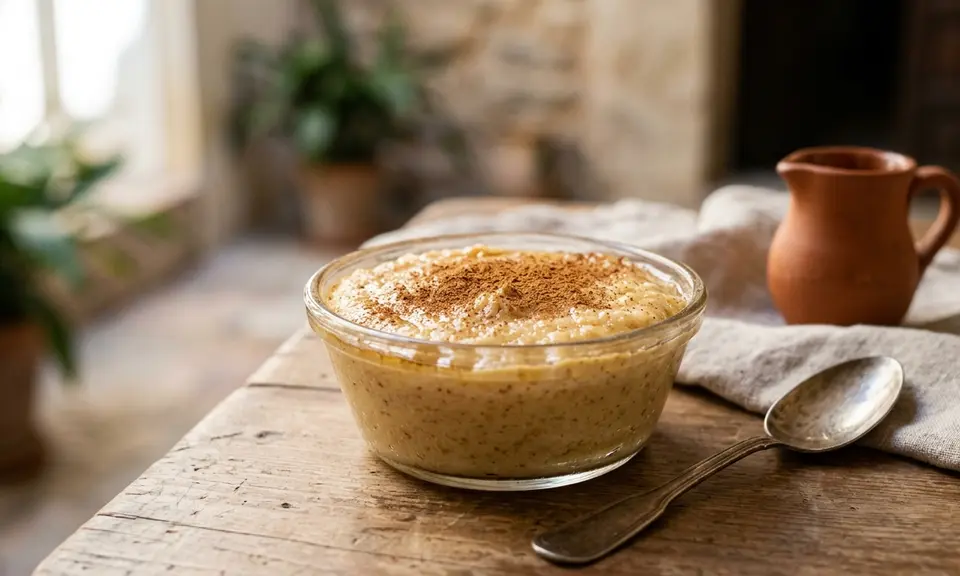
Taste of Granada · Dish
Bienmesabe Granadino
Granada's thick cold almond cream: blanched almonds, egg yolks, cinnamon and lemon zest. A convent sweet sold from monastery turn-boxes since the 15th century.
The tree also needs people. Hand pollination is standard practice in Andalusian orchards, so this is a labour crop as much as a sunshine crop.[23]
One variety carries most of the weight. Fino de Jete is the main variety grown and the most productive under Spanish conditions.[24] The flip side is stated plainly in an agricultural fact sheet: dependence on a single variety adds vulnerability to the crop.[25] In plain terms, a shared risk for every grower on the coast.
Shelter stands in for height. The Andes offer altitude between 1,500 and 2,200 metres; the Costa Tropical offers protection from the north winds at the water's edge.[15][21] The sunshine and temperature figures above are averages for the whole coast, so read them as the climate's character, not a promise for every valley.
The variety even carries a place name. Jete is the town in the Río Verde plain where the crop replaced some orange and sugar-cane plots in the mid-20th century, and it appears again in the PDO's list of municipalities.[18] Place, variety and protection all point at the same few valleys, which is why the legal map in the next section is so compact.
What the PDO actually protects
The paper trail is short and public. The Junta de Andalucía approved the regulation by an order of 4 October 2002.[26] The Ministry of Agriculture ratified it by order APA/3120/2002 of 27 November, published in the BOE on 11 December.[27] The European Commission then entered the name in its register of protected designations by Regulation (EU) No 260/2010 of 25 March 2010.[28] Eight years separate the two.
The regulation names ten Granada municipalities:[29]
- Motril
- Salobreña
- Vélez de Benaudalla
- Los Guájares
- Molvízar
- Itrabo
- Otívar
- Lentejí
- Jete
- Almuñécar
The registered name is longer, Chirimoya de la Costa Tropical de Granada-Málaga, because the zone also reaches into Málaga province. Granada is the side that matters here. Only two varieties qualify, Fino de Jete and Campas, and the regulation ties both to a selection made in the municipalities of Jete and Almuñécar.[30] The protection is a short list of towns and two named cultivars, not a vague regional claim.
Fruit must also reach at least 15º Brix of soluble sugar.[3] You cannot test that at a market stall, so the numbered label and the variety name are your practical check. The rules add that picking is by hand, which means people touch the fruit at pollination and again at harvest.[31] Granada province has a second protected-food story at altitude: the Jamón de Trevélez carries an IGP, not a DOP, and the difference is worth knowing.
Read the dates as a sequence. The crop became relevant in the mid-20th century, plantings jumped in the 1980s, Spain wrote the rules in 2002 and Brussels registered them in 2010.[20] The protection arrived after the boom, not before it, which makes the PDO a defence of an established product rather than a launch pad for a new one.
Behind a protected label, the rules guarantee four things:
How big the crop is, and what growers earn
Scale is easy to underestimate. The Junta report for the 2014-15 campaign that gives about 3,000 hectares also gives about 50,000 tonnes a year, mostly from the Granada Costa Tropical.[1] That works out at roughly 17 tonnes a hectare, a sizeable yield for a fruit that is pollinated and picked by hand. Treat both figures as the scale of that campaign, not a current statistic.
People are part of that volume. A produce-trade report on the crop quotes the sector at around 30,000 direct and indirect jobs.[32] Set against roughly 3,000 hectares, that is about ten jobs a hectare, a crude but telling measure of how labour-hungry the fruit is. The jobs figure is undated and the hectares come from 2014-15, so the ratio is a rough guide only.
Money is thinner. In the 2019-20 campaign the average price at origin ran between 0.70 and 0.80 euros a kilo, while production costs ran between 1 and 1.10 euros, according to the PDO council president quoted by FreshPlaza.[33] On those averages growers sold 20 to 40 cents a kilo below cost.
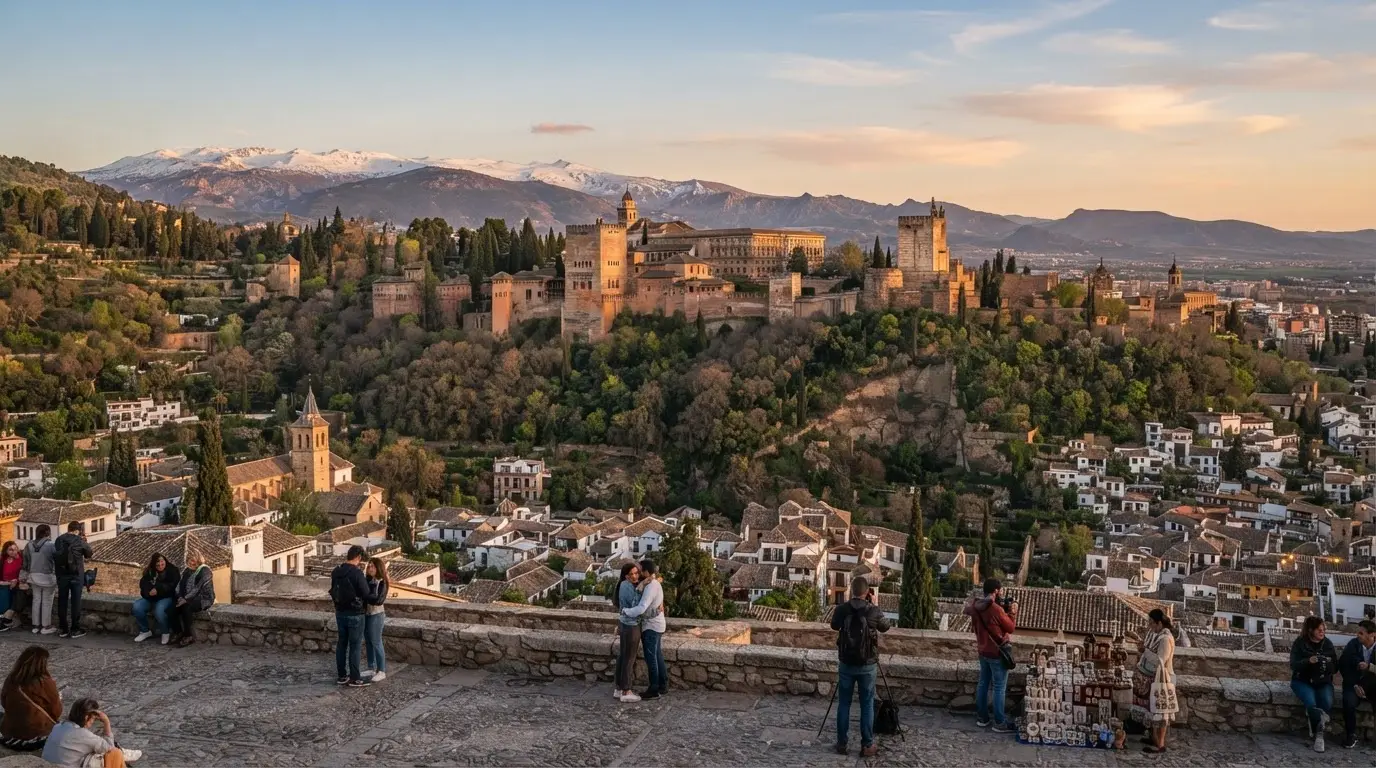
Deep dive · Article
20 Interesting Facts About Granada, Spain
Interesting facts about Granada Spain that guidebooks skip: disputed etymologies, the soldier who saved the Alhambra, and a river buried under Plaza Nueva.
The same report says only about 20% of production was marketed under the PDO seal.[34] These are farm-gate figures for one campaign, not what you pay in a shop, and no dated retail price or PDO premium has been found, so do not read them as one.