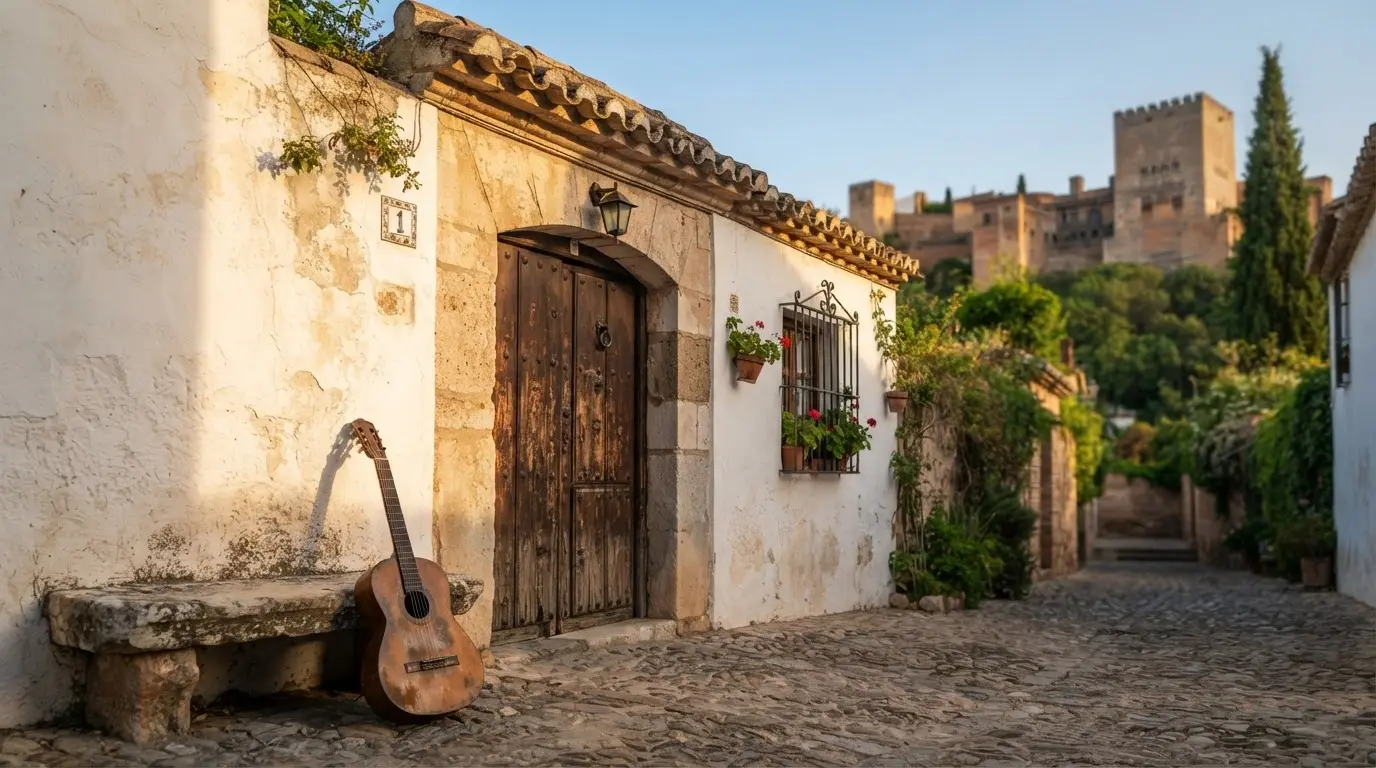
El Polinario: the house on Calle Real
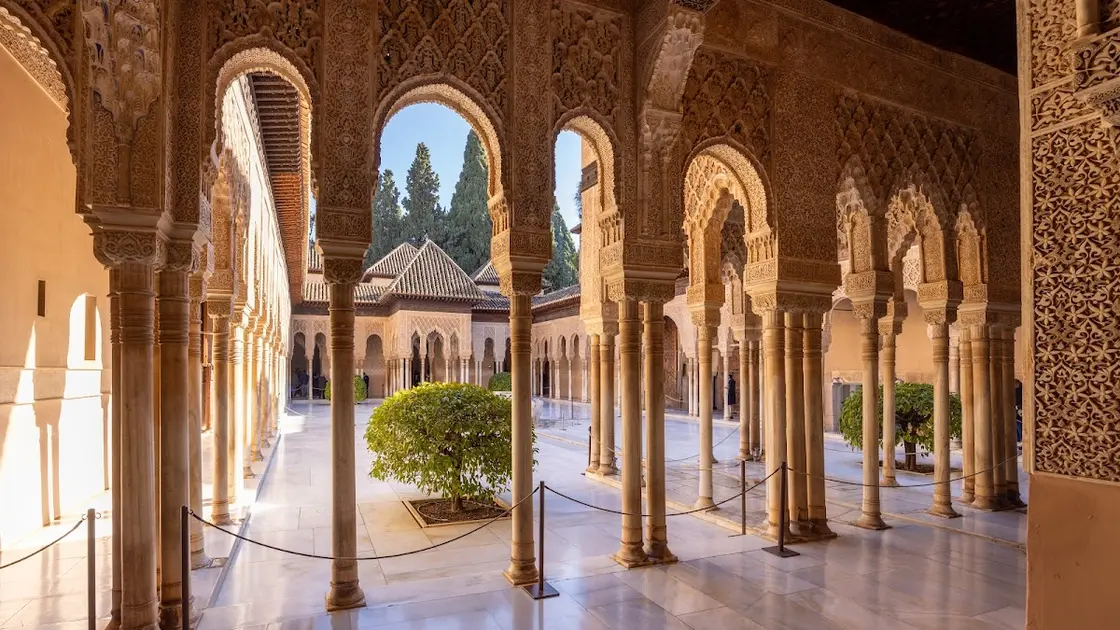
The best portrait of the house comes from the English critic John Trend, whom Falla took there to meet the family. Ángel sat with his guitar on his knees, collar off and entirely at ease, and improvised beside the courtyard fountain.[5] His father, the old Polinario, sang cante flamenco, and Falla pencilled down the melodies that pleased him or that could be written down at all.[6]
That father was Antonio Barrios Tamayo, a painter and art collector[7] who also sang the flamenco Falla was copying. The nickname passed to the house itself, which sold goods of every kind and doubled as a place to drink and talk.[2] The painter Santiago Rusiñol lived there, and in 1909 a scroll signed by visiting artists named Antonio Barrios "Ambassador of Art in the Alhambra".[8]
The word for what happened under that roof is tertulia: an informal circle of talk, music and company rather than a club with members and a rulebook. Trend's visit shows it at work, with the host's son playing, the host singing and a composer taking notes.
Falla, Albéniz and the Trío Iberia
Barrios was no amateur strumming in his father's tavern. His Trío Iberia was a plucked-strings group: Barrios on guitar, Cándido Bezunartea on lute and Ricardo Devalque on bandurria.[11] It kept a packed concert schedule with many appearances in France and England,[12] and toured Europe in 1909.[13] His maestro was Isaac Albéniz, who played a key part in persuading Manuel de Falla to settle in Granada.[14] When Falla came, the Barrios family became part of his daily arrangements.
Falla stood godfather to Ángel's daughter Ángela[15] and rented from him, taking the carmen de Santa Engracia on Calle Real, one of the family's properties, before moving to the Antequeruela Alta carmen that is now his museum.[16] For a while the composer had a landlord who was also his compadre, which is a more domestic arrangement than the monument-sized Falla of the guidebooks suggests.
The surviving proof of the friendship is a dedication. By April 1921 Falla had inscribed a score of El sombrero de tres picos to Ángel as "compadre, compañero e inquilino", which is co-parent, companion and tenant in three words.[17]
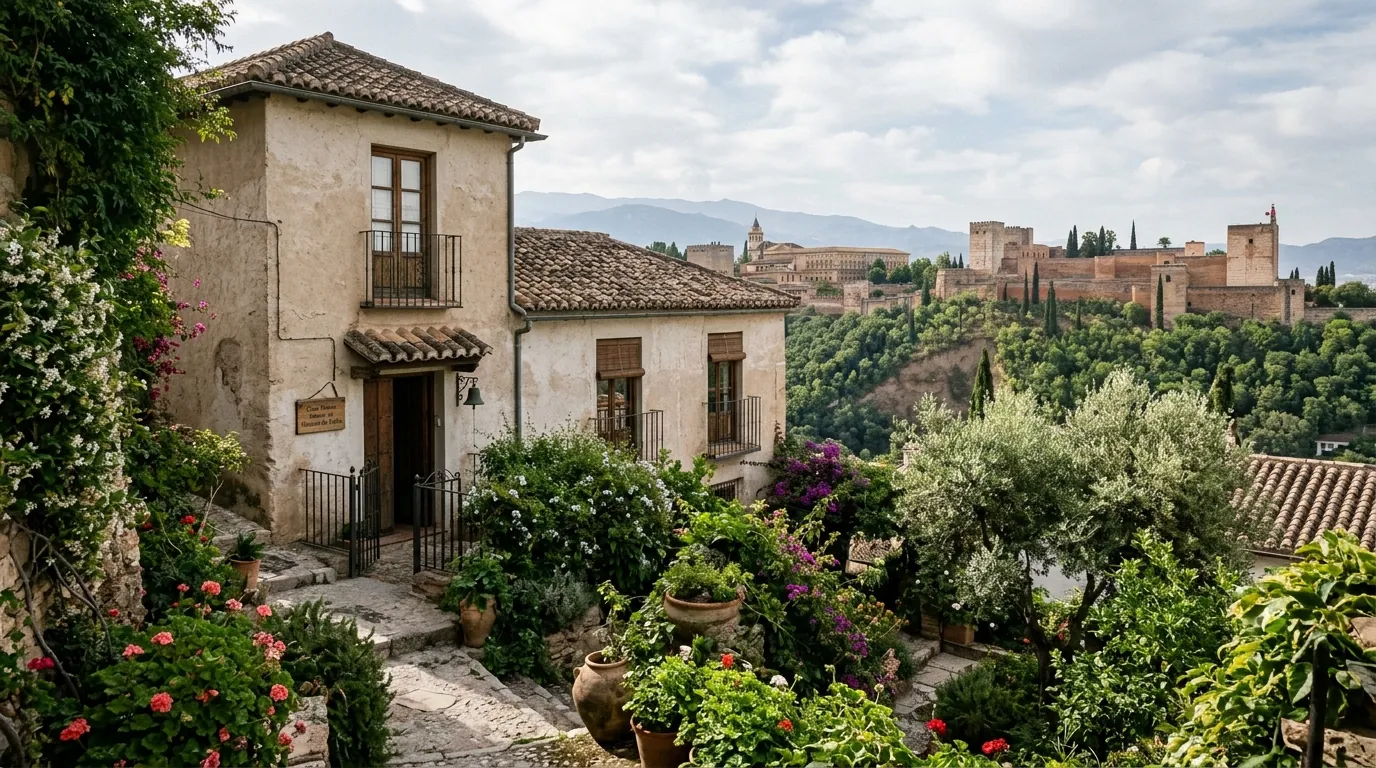
Explore nearby · Museum
Casa-Museo Manuel de Falla
Manuel de Falla's Granada home from 1921 to 1939, preserved as he left it. His piano, manuscripts, gifts from Picasso, and garden views of the Sierra Nevada.
The friendship outlasted the neighbourhood. In December 1945, with Falla living in Argentina, Barrios wrote to him recalling the nativity scene Falla had built in the little house at the Alhambra.[18] It is a small detail, and a telling one: a man best known for the music he wrote, remembered by his landlord for a crib.
The tertulia, Machado and the Silver Age
Barrios belonged to the El Rinconcillo tertulia, the circle that met at the Café Alameda, and knew the artists and intellectuals of Granada's Silver Age.[19] That was the city's public conversation. The one up the hill, at his father's house, was the private one.
The poet Manuel Machado became a frequent visitor to the Alhambra and to the Polinario tertulia through his friendship with Barrios.[3] The curator of the Alhambra's 2014 exhibition on him argued that Barrios matters as much for the ambience he lived in as for his music, naming Falla, Lorca, Turina and Conrado del Campo among the artists and intellectuals he gathered around him.[20]
Federico García Lorca belongs to the same wider circle, and the evidence is specific. On reaching Madrid, Lorca was reunited with two friends from Granada who had moved there before him, José Mora Guarnido and Ángel Barrios, who introduced him to the capital's literary circles; the Centro Federico García Lorca dates this to 1919.[21]
The documented link is friendship and an introduction. It is a smaller claim than the legends of Lorca at the tavern table suggest, and the safer one to repeat.
Conservatory, council chamber, composing desk
His piano piece Guajiras won the Centro Artístico y Literario de Granada prize in 1910, an early sign that the city's cultural institutions had noticed him.[22] The opera El Avapiés, written with Conrado del Campo and first performed in Madrid on 18 March 1919, placed him among Spain's best-known composers.[23] La suerte, with a libretto by the Álvarez Quintero brothers, premiered in 1924, and the same chronology lists the zambra En el Albayzín and the zarzuela Seguidilla gitana.[24] The Alhambra's own biography calls him a successor of Albéniz's style, turning folklore and flamenco into refined, delicate music.[25]
Public posts followed, and they reached further than a guitarist's reputation would suggest. In the autumn of 1923 he was appointed teniente de alcalde (deputy mayor) of Granada and chairman of the festivities committee,[26] a post that ran from 1923 to 1928.[27] In 1927 the Calderón mystery play El gran teatro del mundo was revived in Granada by a team that included Falla and Barrios, in an effort to bring back Baroque works,[28] and Barrios conducted the performance of 27 June in the Plaza de los Aljibes.[29]
From 1928 to 1939 he directed the Victoria Eugenia Conservatory in Granada.[30] His score for La Lola se va a los puertos, drawn from the Machado brothers' comedy, won a national prize.[31]
- 1882
Born in Granada
4 January.
- 1909
The Trío Iberia tours Europe
- 1909
His father is named Ambassador of Art in the Alhambra
A scroll signed by visiting artists.
- 1910
Guajiras wins the Centro Artístico prize
- 1919
El Avapiés is first performed
18 March, in Madrid.
- 1921
Falla signs him "compadre, compañero e inquilino"
- 1927
Conducts El gran teatro del mundo in the Alhambra
27 June, Plaza de los Aljibes.
- 1928-1939
Directs the Victoria Eugenia Conservatory
- 1964
Dies in Madrid
26 November.
Read together, the record shows a man who held the local posts at the moments they mattered, and the story of how a tavern-keeper's son became the city's conservatory director is easy to lose behind Falla.
Recommended tours
Tours are selected for quality, not commission. We earn a small fee if you book — at no extra cost to you.
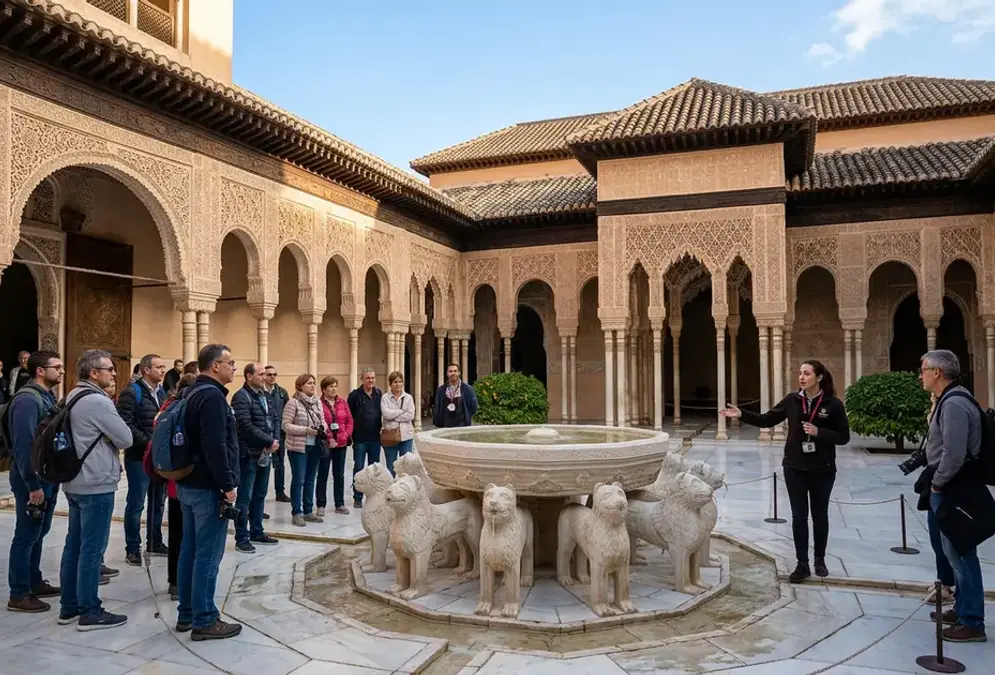
What survives of Barrios in the Alhambra today
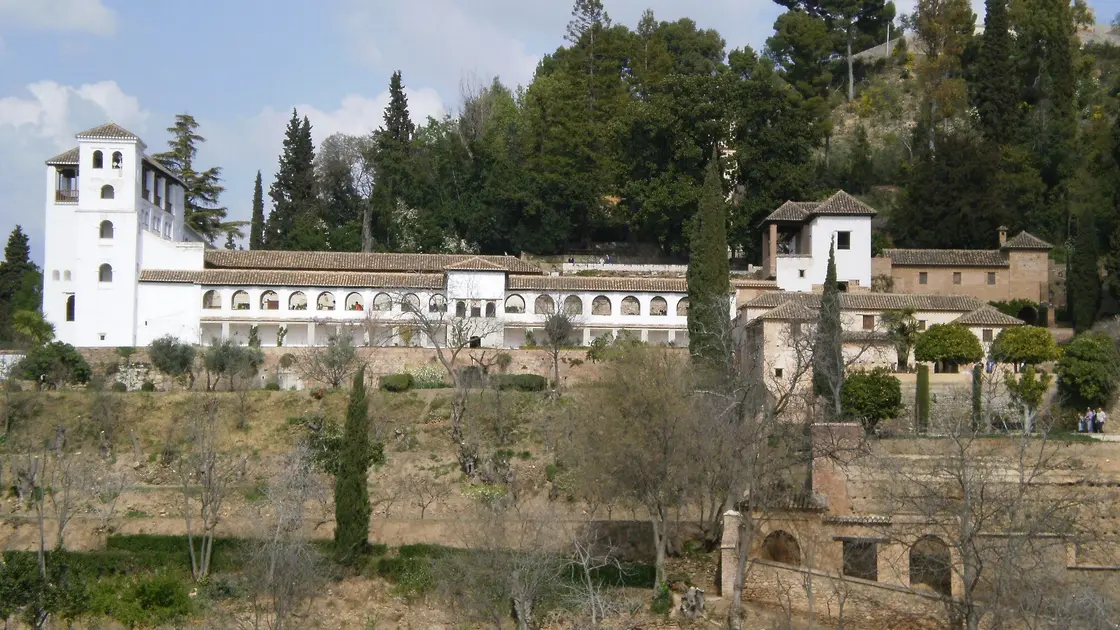
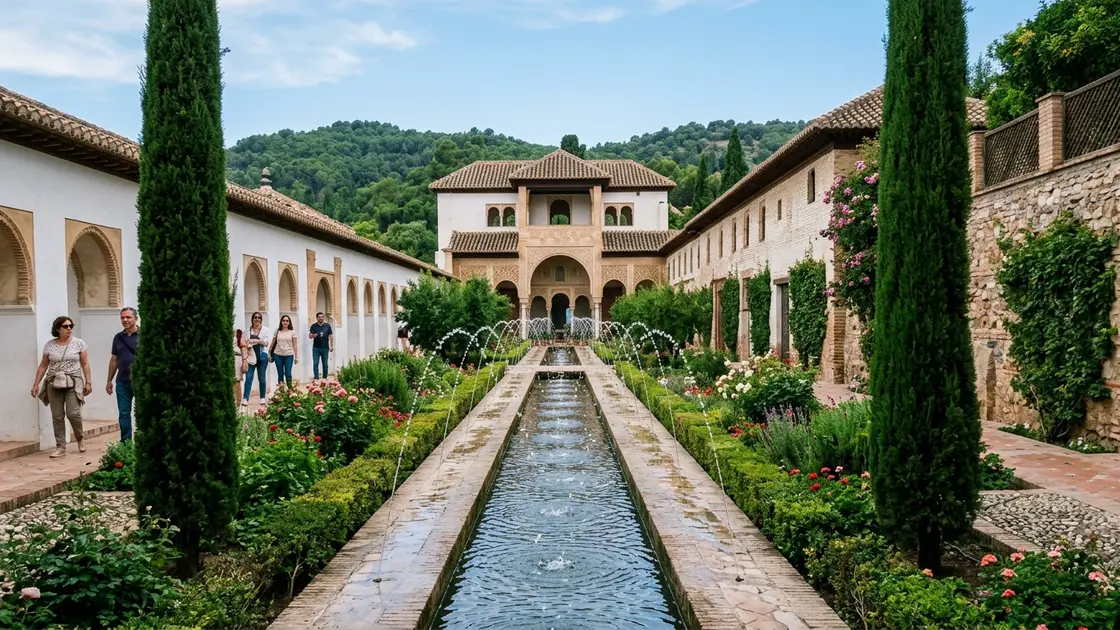
The family left Calle Real in the early 1930s, but the street is where his story still reads best. Calle Real is the main street of the palace-city, and the Barrios family lived on it for decades.[32]
His daughter Ángela donated his legacy to the Patronato de la Alhambra in 1975 to set up the Ángel Barrios Museum on Calle Real,[33] and it reopened in 2015 after renovation as the Ángel Barrios House.[34] It occupies a building in the Bath of the Mosque, beside an archaeological garden,[35] and measures 86 m².[36] Hours are Wednesday to Saturday 8:30 to 20:00 in summer (to 18:00 in winter) and Tuesday and Sunday 8:30 to 14:30, with Mondays closed.[4] It also closes on 1 January and 25 December.[37] Her own summary of him fits everything above: "a very simple modest man who lived and died thinking about what he loved most, the Alhambra and Granada".[38]
Check before you go
The 2014 anniversary exhibition of almost 100 pieces closed on 7 September that year, so it is not the permanent display.[39] The legacy museum on Calle Real is separate and open to visitors, but check the Alhambra board's page for current hours before you go, since seasonal times change.
A short route that follows his footprint:
- Calle Real de la Alhambra: the palace-city's main street and the Barrios family's address for decades.
- Plaza de los Aljibes: where he conducted Falla's El gran teatro del mundo on 27 June 1927.[29]
- Casa-Museo Manuel de Falla: the Antequeruela Alta carmen Falla moved to after renting from Barrios.[16]
- The Barrios legacy museum: 86 m² on Calle Real, open Tuesday to Sunday, so plan around the Monday closure.
Barrios survives through the rooms he lived in and the people who wrote to him: a legacy museum, a dedication to a tenant, a letter about a crib. They are small things, and they are why this hill felt like a household and not only a monument.