
The elevation gap: why altitude explains Granada's cold
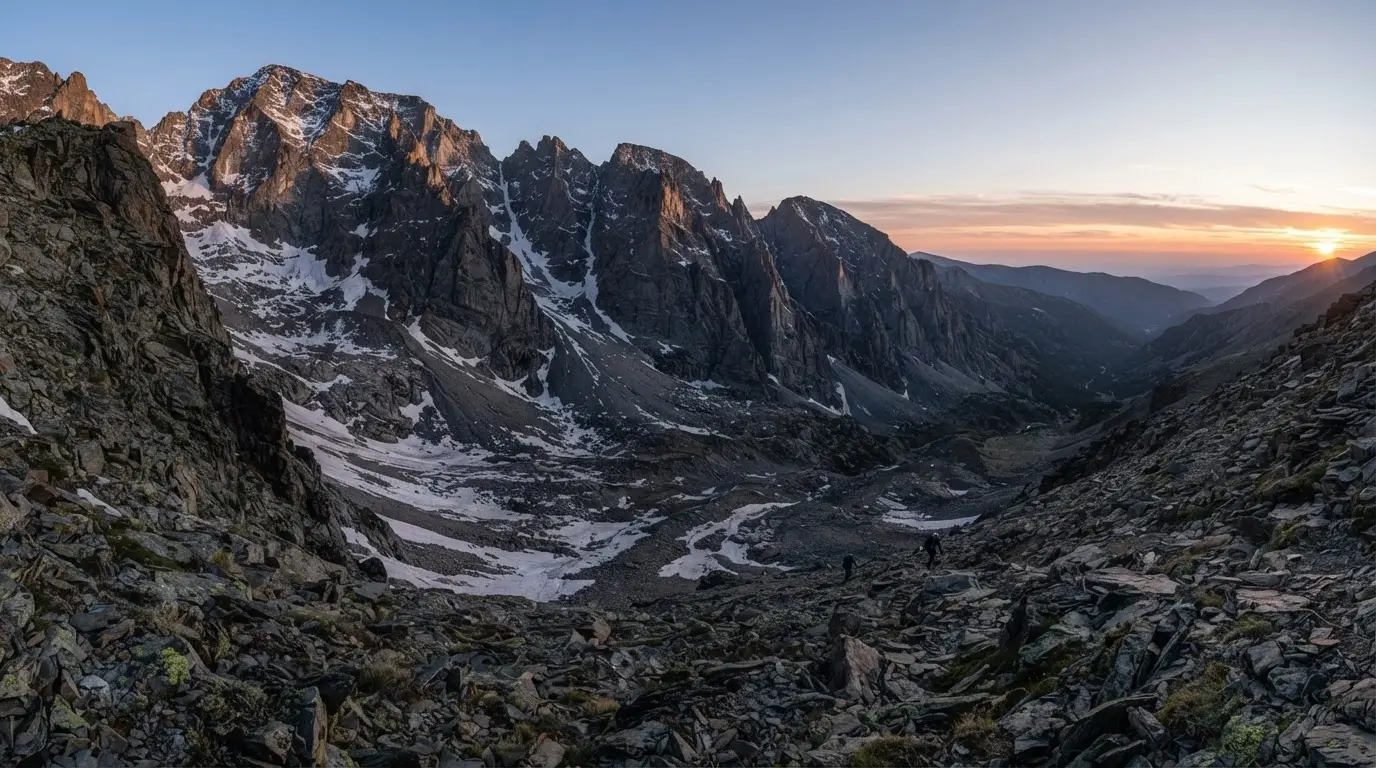
Most visitors arrive in Granada expecting the blast-furnace heat that postcard Andalusia promises, and the city does deliver that in July. What catches people off guard is the rest of the year. The explanation stands directly south of the city: the Sierra Nevada, whose highest point, Mulhacén, reaches 3,479 metres, mainland Spain's tallest summit.[2] A shrinking glacial remnant, one of Europe's southernmost, still survives in a shadowed cirque nearby, a reminder of how much colder this range once ran.
Granada itself is no lowland city. At 738 metres above sea level, it sits far higher than the Guadalquivir valley cities to its west.[1] That altitude alone would trim a few degrees off any Mediterranean average. Combined with the mass of the Sierra Nevada immediately behind it, the effect compounds: cold air drains downhill off the peaks overnight and pools in the basin where the city sits, a textbook case of the orographic effect, mountains reshaping the climate of everything around them. The same basin is also a seismically active one, as the account of Granada's earthquakes and the 1884 quake explains.
The result is a Mediterranean-continental hybrid rather than the straightforward coastal warmth of Málaga or Almería. Granada is close enough to the sea to avoid true continental extremes, but far enough inland, and high enough, that its winters behave more like a mountain town's than a beach city's.
How cold does it actually get? The numbers behind the chill
January is Granada's coldest month, and by the official record it averages 7.6°C, technically a mild figure by European standards, though one that undersells the extremes either side of it.[5] On the coldest nights, temperatures typically fall to around -2.5°C, and history has produced worse: in January 2005 the thermometer in Granada dropped to -10°C.[3]
-10 °C
What makes the cold feel sharper than the average number suggests is the swing between day and night. Granada's dry, high-altitude air holds heat poorly after dark, so a bright, jacket-off afternoon can slide toward freezing within a few hours of sunset, the kind of diurnal temperature range that coastal Andalusian cities, cushioned by the sea's thermal mass, rarely experience.
A few numbers worth carrying into a winter visit:
Snow on the skyline: how close the Sierra Nevada really is
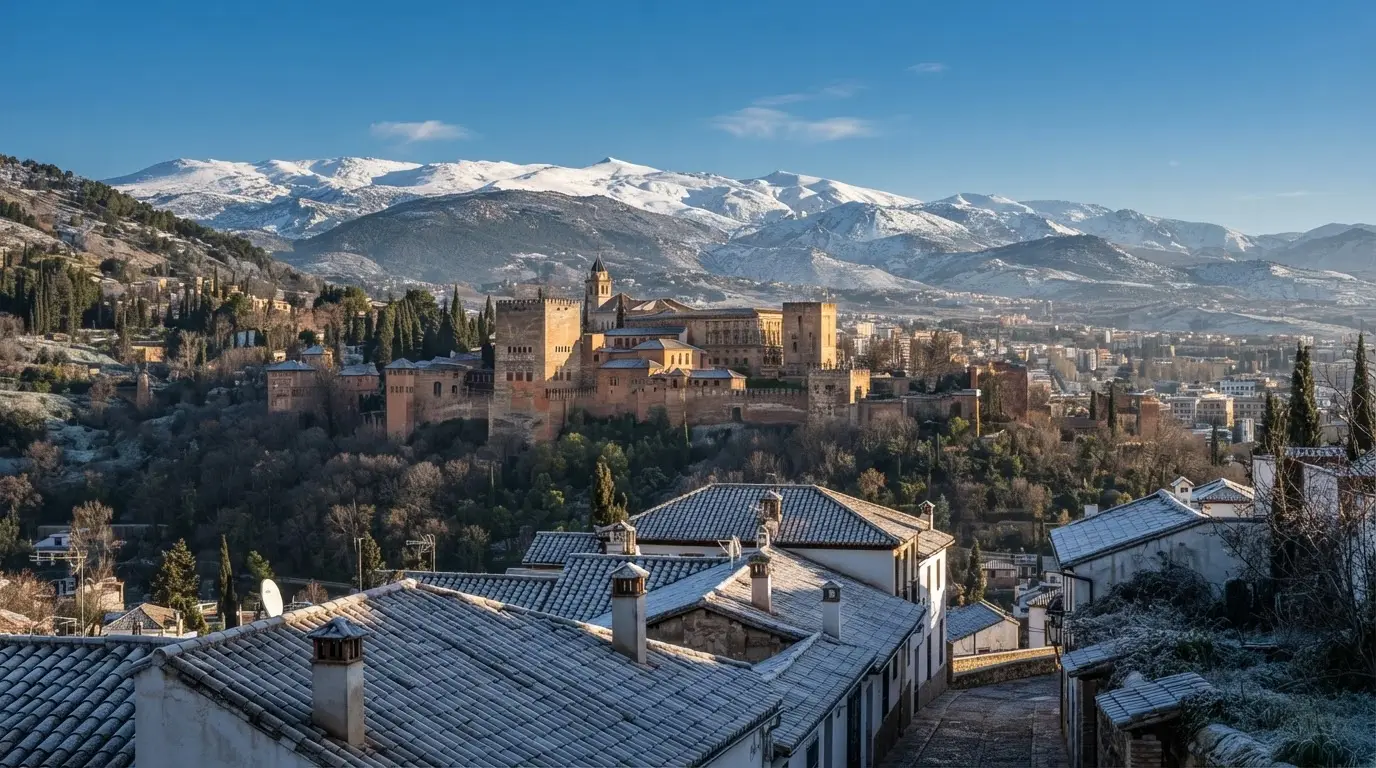
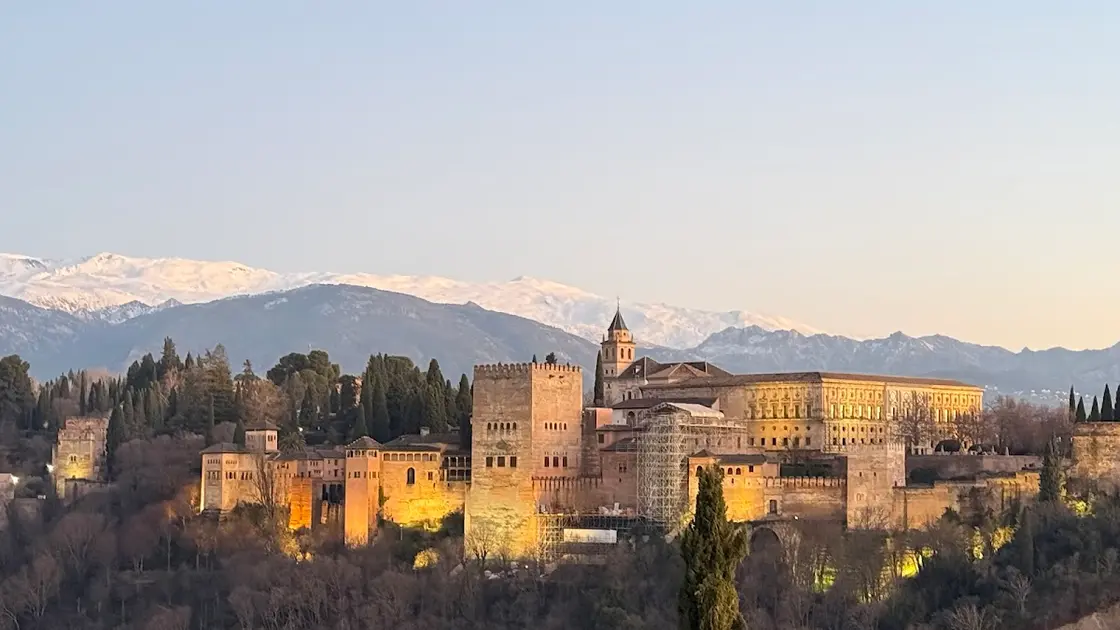
From certain corners of the Albaicín and from the terraces of the Alhambra, the Sierra Nevada is not a distant backdrop; it's close enough that a hiker leaving the city at dawn can be on snow before the museums open. Snow covers the range's upper slopes from November through April[6], visible on clear winter mornings from the Mirador de San Nicolás, the viewpoint where visitors gather at sunset for exactly this contrast: a Nasrid palace in the foreground, snow-covered peaks behind it.
Explore nearby · Monument
Mirador de San Nicolás
Free 24-hour viewpoint in the Albaicín with unobstructed Alhambra views and the Sierra Nevada as backdrop. Crowds peak at sunset; early morning is far quieter.
I've stood at that mirador in January wrapped in a coat against wind coming straight off the range, then walked down into the Albaicín twenty minutes later and needed to take it off. That swing between the viewpoint and the valley floor isn't a line guides use for effect; it's the daily reality of a city built where a mountain range meets a river basin.
The Sierra Nevada ski station, Europe's southernmost ski resort, sits just 27 kilometres from Granada's city centre and runs its season from late November into early May.[7][4] Its pistes climb high enough into the range that snow holds long after the city below has moved into short sleeves. The skiing at Sierra Nevada guide has lift prices and season details for anyone planning to clip into a pair of skis.
Granada vs. the rest of Andalusia: why it runs colder
Andalusia's stereotype is uniform heat, but Granada breaks the pattern more than any other provincial capital in the region. Seville sits at an average of just 7 metres above sea level, and Córdoba's city proper averages roughly 125 metres, both squarely in the low, flat Guadalquivir valley.[10][11] Granada, at 738 metres, sits in a basin ringed by mountains instead, with genuinely continental characteristics: dry air, sharp diurnal swings, and a defined cold season its western neighbours barely register.[1]
The same elevation that punishes Granada in January rewards it in August. Summer daytime highs top out around 34°C.[8] The Sierra Nevada itself runs cooler again: in May, while Granada averages 24°C, the resort area up at altitude sits nearer 4°C.[9]
| Location | Jan character | Jul character | Defining trait |
|---|---|---|---|
| Granada city (738m) | Cold nights, mild days | Hot, dry, up to 34°C | Sharp day-night swing |
| Sierra Nevada resort (high altitude) | Far colder than the city | Cool even in midsummer | Snow Nov to May |
| Andalusian coast | Mild, rarely frost | Warm, humid | Sea buffers the extremes |
That's not two climates loosely connected by a road. It's one weather system with an altitude dial, and Granada's position on that dial, high enough to feel the mountain, low enough to keep the valley's warmth, is what makes it genuinely unlike anywhere else in the region.
Visiting Granada in the cold: what to pack and when to go
Anyone packing for Granada based on the word "Andalusia" alone will arrive underdressed. December through February calls for a proper coat, not a light jacket: mornings and evenings sit close to freezing, even if midday sun makes the plazas feel deceptively warm. Layers work better than one heavy garment. The Alhambra's exposed courtyards catch wind that the sheltered lanes of the Albaicín do not, and the temperature difference between the two, a ten-minute walk apart, can be several degrees.
For travellers chasing the mountain view rather than the palace, the clearest Sierra Nevada mornings tend to follow a cold, cloudless night; check the forecast the evening before rather than the morning of. The ski season runs from late November to early May, though January and February are the most dependable months for snow, before spring sun starts softening the lower runs.[7]
A short packing list for a winter visit:
Deep dive · Article
Corral del Veleta Glacier: Europe's Southernmost Ice
Corral del Veleta held Europe's southernmost glacier — active until 1913 at 37°N. Relict ice and permafrost still cling on in Sierra Nevada, shrinking fast.
- A genuine winter coat, not a city jacket
- Layers for the midday sun-to-shade swing
- Solid shoes for cobbled, sometimes icy, uphill streets in the Albaicín
- Sunglasses: winter light off snow-capped peaks is sharper than it looks
None of this makes Granada a cold-weather destination the way the Pyrenees are. It makes it a city where the cold is specific, predictable, and worth planning around rather than being surprised by.