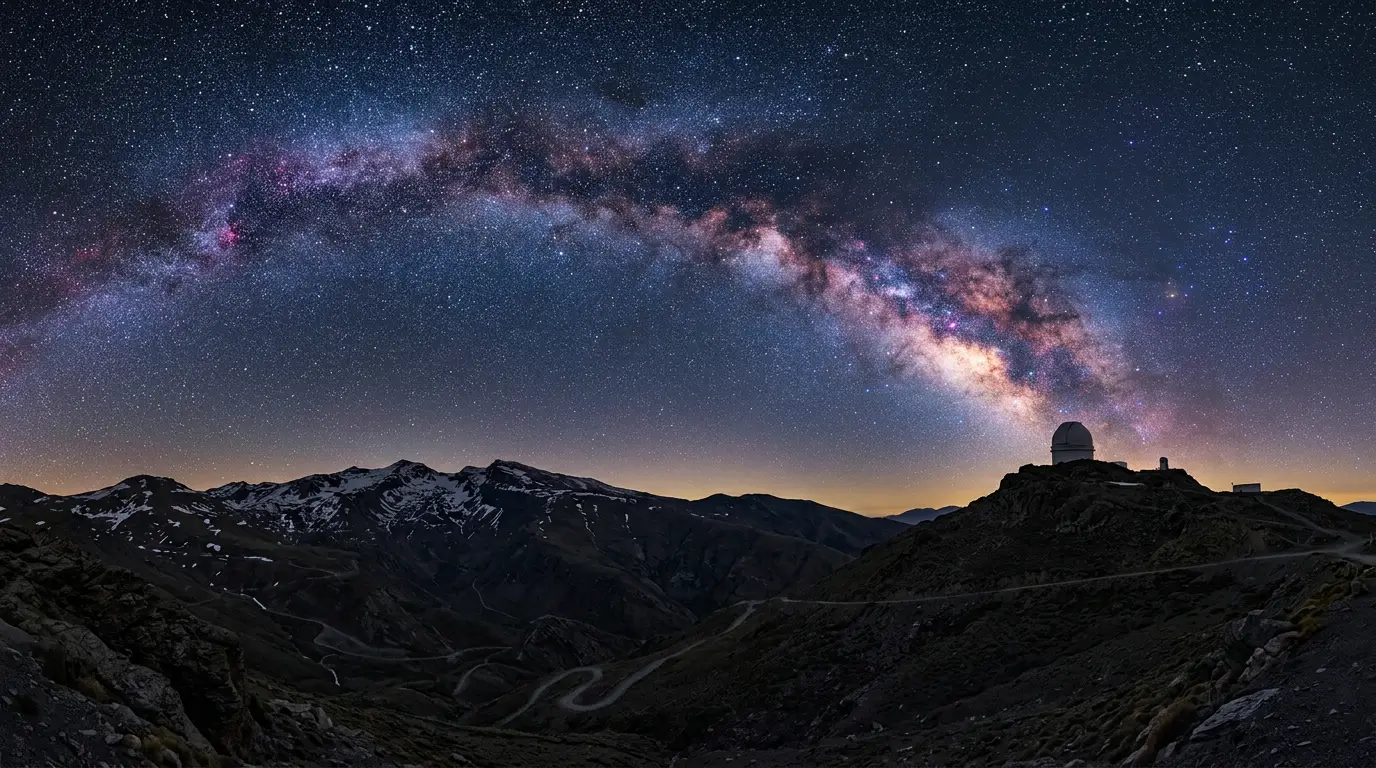

Why the Sierra Nevada Observatory isn't where you go stargazing
Search for stargazing near Granada and the Observatorio de Sierra Nevada usually comes up first: a serious astrophysics research station perched high above the city. That creates a genuine mix-up. The OSN's public program is a guided daytime visit[1] through telescope domes and control rooms, not a night spent under a dark sky. If your plan is to actually see stars, the observatory itself isn't the destination. The mountain around it is.
It would be convenient if Granada had a Nasrid-era astronomy legend to hang this guide on, the way Córdoba can point to Caliphate-era scholars charting the heavens for the court. It doesn't, and forcing that comparison would be dishonest. Ibn al-Khatib, Granada's most celebrated Nasrid vizier and polymath, is remembered for history, medicine, philosophy, and poetry[2]. Astronomy isn't among the fields his own biographers credit him with. The city's real astronomy story starts centuries later, a few kilometres higher up the mountain.
That story begins in 1981, when the Instituto de Astrofísica de Andalucía (IAA-CSIC) established a research station in the Sierra Nevada[3]. What it built there, and why it still can't help you spot the Perseids, is worth understanding before you plan a night on the mountain.
The Observatorio de Sierra Nevada: a research station, not a night-tour venue
The OSN sits at 2,896 metres on the Loma de Dilar, deep in the Sierra Nevada range[4]. That's high enough that the thin, still air above Granada's light dome is exactly what a professional observatory needs, and exactly what makes the site impractical as a casual night stop. Getting there isn't something you do on a whim after dinner. The road up to Loma de Dilar climbs through the same high terrain covered in our guide to the Corral del Veleta glacier, Europe's southernmost surviving ice.
Two Nasmyth telescopes, with mirrors of 1.5 and 0.9 metres, do the actual science[5]. The Instituto de Astrofísica de Andalucía (IAA-CSIC) operates, maintains, and supplies the whole station[6], Spain's national astrophysics institute, not a tourist observatory with a gift shop attached. Researchers run photometry and spectroscopy programs through the night, and the public program is offered as a separate guided daytime visit[1] rather than folded into that overnight research schedule. A working telescope schedule and a queue of camera-toting visitors don't share the same dome.
2,896 m
- Altitude: 2,896 m[4] at Loma de Dilar
- Telescopes: 1.5 m and 0.9 m Nasmyth apertures
- Operator: IAA-CSIC, Spain's national astrophysics institute
- Public access: a guided daytime visit of the domes and facilities, separate from any night-sky programme
None of this makes the OSN a poor visit. It makes it a different visit from the one most people searching for stargazing near Granada actually want.
Where people actually stargaze after dark in Sierra Nevada
The real stargazing near Granada happens well below the OSN's summit, in the same range but a different world after sunset. Pradollano, the Sierra Nevada ski-resort base, sits around forty minutes from Granada by road[7], close enough that a night-sky trip doesn't have to eat your whole evening. From there, the resort's own chairlift network reaches Borreguiles, a plateau higher up the mountain where the city's light pollution thins out fast.
Structured after-dark programmes run through the summer: guided telescope sessions led by astronomers, a moon-observation night timed to the lunar calendar rather than a fixed date, and a dedicated Perseids night each August that uses the resort's own chairlift to get visitors up to Borreguiles before the meteor shower peaks, usually with time built in for a picnic while the sky darkens. Summer is the season that matters here, and mid-August, when the Perseid meteor shower is at its most active, is the single best window on the calendar[8].
Recommended tours
Tours are selected for quality, not commission. We earn a small fee if you book — at no extra cost to you.
Go prepared for a temperature swing that catches most first-timers out. Granada in July can sit in the mid-30s°C by day; after dark at Borreguiles, that same evening can drop to around 10°C[9]. Pack a proper layer, not the cardigan you brought just in case. The mountain doesn't care what the valley felt like at six in the evening. It's the same elevation effect that keeps Granada's own winters colder than the rest of Andalusia, just running in reverse up here after dark.
Capileira and the real dark-sky certifications near Granada
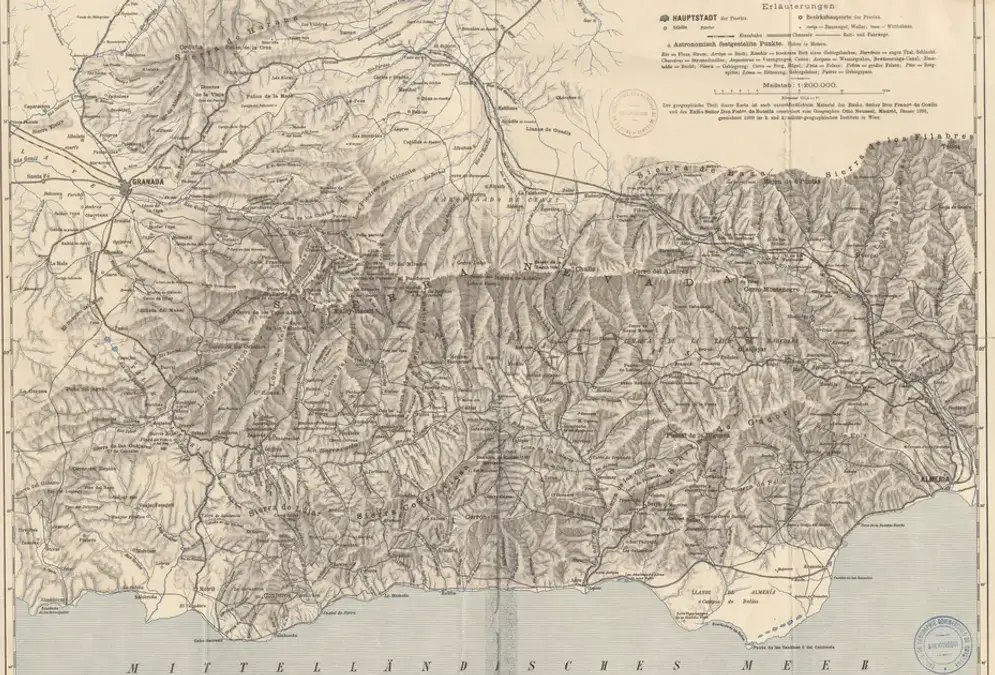
Sierra Nevada as a whole doesn't currently hold a Starlight Reserve or Starlight Destination certification. It remains a candidate area in an ongoing certification project, grouped alongside the Sierra de los Filabres in neighbouring Almería province[10]. That distinction matters if you're chasing an actual certified dark-sky designation rather than just a good view of the stars.
Things to do · Activity
Sierra Nevada Day Trip from Granada
Spain's highest mountain range, 27km from Granada. Ski 124 pistes in winter, hike to Mulhacén (3,479m) in summer. Public bus from €6, guided tours from €60.
Capileira: recognised as a Paraje Starlight
One place in the range has already crossed that line. Capileira, one of the Alpujarras villages inside Sierra Nevada National Park at 1,436 metres, has been recognised as a Paraje Starlight (Starlight Place)[11], the only settlement in Sierra Nevada with that formal status today. It sits on the range's southern slopes, a different approach road from the Pradollano ski-resort side, and makes a natural base if you want to combine stargazing with a night in the Alpujarras rather than a day trip from Granada city.
The Granada Geopark: a separate certification route
Don't confuse Sierra Nevada with the Granada Geopark, a separate protected area out toward Guadix and Baza to the northeast. It's a different dark-sky story on a different track entirely, and a different drive from the city than anything in this guide. Worth knowing about, not worth a detour, unless the wider Geopark itself is what draws you to this part of Andalucía rather than Sierra Nevada specifically.
Same mountain, two seasons: skiing in winter, stargazing in summer
Sierra Nevada is Europe's southernmost ski resort, and the same road that carries skiers up to Pradollano in January carries stargazers up in August[7]. It's the same lifts, the same base village, just a completely different reason to be on the mountain depending on the month.
Winter turns the range into a ski destination running roughly November to May, weather depending. The skiing at Sierra Nevada season and the stargazing season barely overlap. By the time snow clears from the lower slopes, the nights are warm enough to stand outside in a jacket rather than a full ski kit, and the upper road opens further toward Borreguiles and the OSN access route.
The handover between the two isn't instant. Spring brings a shoulder period when the lower trails clear while the high peaks still hold snow, and the guided programmes on the mountain shift accordingly, from ski lessons toward walking routes before the night-sky season properly starts. Whichever season brings you up here, the altitude changes things faster than a forty-minute drive from Granada suggests. Bring a layer you can add or shed, and build in enough slack that a delayed chairlift or a closed upper road doesn't wreck the day.
| Season | What the mountain offers |
|---|---|
| Winter (Nov–May) | Skiing at Pradollano's piste network, cold and often snow-covered |
| Summer (Jun–Sep) | Guided night-sky programmes, Perseids in mid-August, warm days with a sharp temperature drop after dark |
For anyone weighing a Granada trip against the calendar, this is worth knowing before you book flights. The same mountain gives you two entirely different reasons to visit, six months apart.
Planning your night under Sierra Nevada's skies
Book a guided night-sky programme rather than freelancing your way up the mountain after dark. Sierra Nevada's tourism office organises the telescope nights, the moon-observation night, and the Perseids night with chairlift access directly. These run through the summer season and fill up around the August peak, so book ahead rather than turning up on the night. The Sierra Nevada day trip guide covers the wider range beyond either season, useful if stargazing is one stop on a longer visit rather than the whole point of the trip.
Bring warm layers regardless of what Granada's forecast says, a torch with a red-light setting if you have one, since it preserves night vision without ruining anyone else's, and a car or a confirmed seat on a tour bus. Public transport doesn't run up to Borreguiles after dark. If you'd rather stay in the city and still see something after sunset, the Alhambra night visit is a completely different kind of after-dark experience: monuments rather than meteors, but worth knowing about if the mountain drive isn't for you that particular evening.
Deep dive · Article
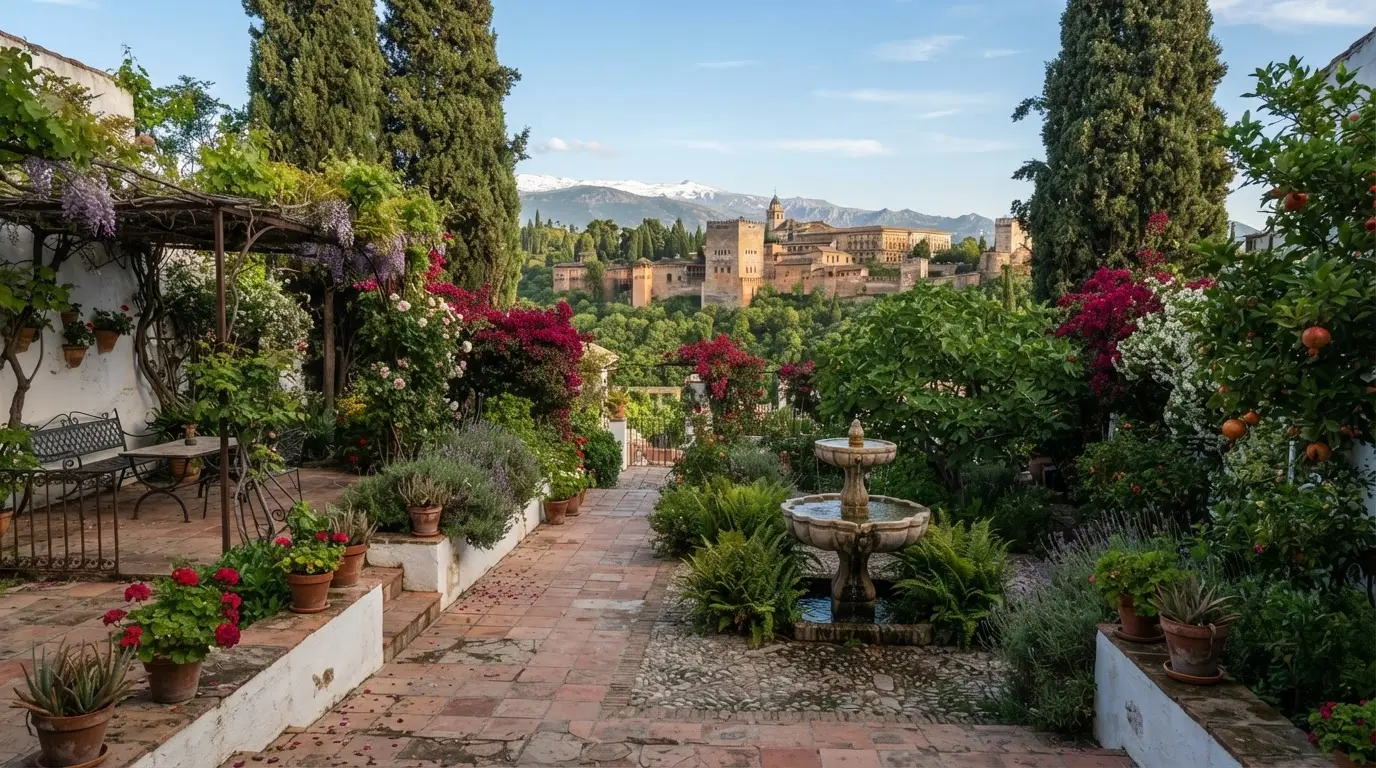
Cármenes of the Albaicín: Granada's Walled Garden Houses
Granada's cármenes are walled garden villas from Arabic karm (vineyard). Found across the Albaicín since the Nasrid period, two are open free to visitors.
And if Sierra Nevada's summer skies leave you wanting something darker still, the honest answer is that Granada isn't where you'll find it. La Palma, in the Canary Islands, is the world's first UNESCO-recognised Starlight Reserve, its Roque de los Muchachos ridge home to one of the most important observatory complexes on the planet[12]. darkskiesatlas.com's La Palma stargazing guide is the deepest planning resource we've found for it, and it's the natural next trip for anyone who leaves Sierra Nevada wanting darker skies than a forty-minute drive from Granada can offer.