Written by James Walker
Modern Granada · 1808–today
  • 5 min
  • 33 sources

Why Fray Leopoldo Still Draws Crowds to a Granada Crypt

Fray Leopoldo de Alpandeire begged for Granada's poor for decades. Why his crypt draws pilgrims, what the visitor claims really show, and how to visit it.
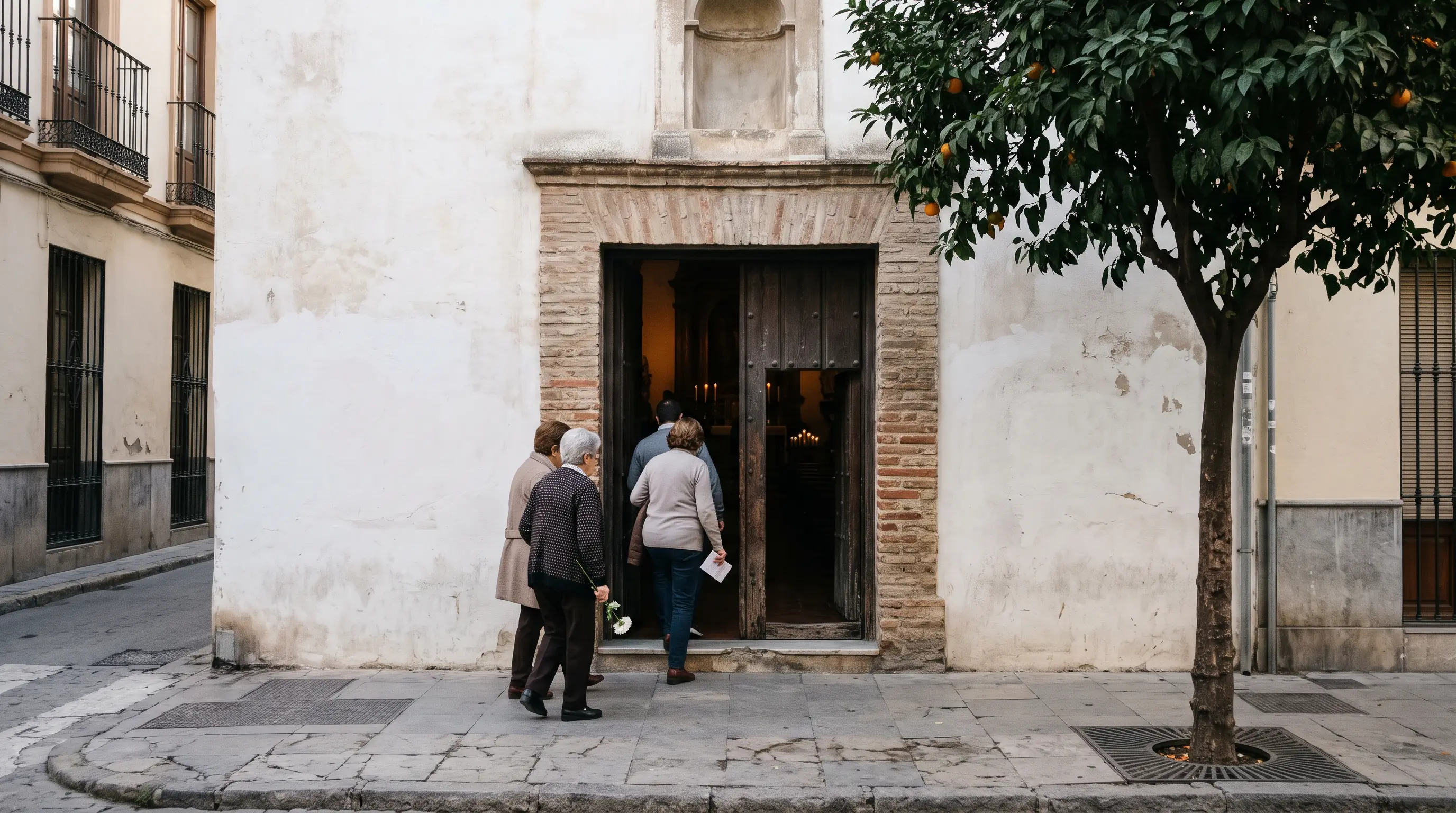
Fray Leopoldo Granada: elderly Capuchin lay brother in a brown habit and sandals walking a sunlit Granada street in the 1940s, warm low light, painterly realism

Fray Leopoldo died in Granada on 9 February 1956, aged 91; his tomb in the Capuchin crypt is visited on the ninth of every month.

Fray Leopoldo de Alpandeire begged through Granada's streets for decades, and his tomb lies in the Capuchin crypt at Avenida Divina Pastora 11, 18012 Granada, where devotees gather on the ninth of every month and on 9 February.[30][26] The claim that this crypt is the city's second most visited place rests on Archdiocese figures of 2,000 visitors a day, not on an independent count.[21][23] Go for the pilgrimage, not for a ranking you can check.
Date of death
9 Feb 1956
He was 91 when he died[32]
Beatification Mass
12 Sep 2010
Armilla Air Base; attendance estimates differ twofold[17][18]
Claimed crypt visitors
2,000+/day
Archdiocese estimate, undated, no independent count[21]

A lay brother from the Serranía de Ronda

Fray Leopoldo de Alpandeire was born Francisco Tomás Márquez Sánchez in Alpandeire, a white village in the Serranía de Ronda, province of Málaga, in 1864.[1] The Vatican's letter of beatification gives the day as 24 June, while an article from the University of Granada says 4 June and describes a humble family; both give 1864.[2] The day is a small discrepancy. The year is not in doubt.
He came to the Capuchins late. Seville admitted him as a postulant on 16 November 1899, when he was already 35,[3] and from 21 February 1914 he was assigned to Granada for good.[4] Thirty-five is late for a vocation. Granada would be his city for more than four decades.[4][10]
Alpandeire sits in the Serranía de Ronda, in the province of Málaga, a long way from the pilgrim crowds of Granada.[1] The village and the city are the two ends of his story: the place that gave him his name and the place that gave him a following.

Four decades of begging for Granada's poor
A limosnero was a friar who begged rather than gave alms: Fray Leopoldo asked for them in the street, as a mendicant would.[6] He travelled all over Granada calling for help for those who had been socially excluded.[5]
To the people he met he offered a greeting and one request, to pray three Hail Marys.[7] Not everyone welcomed it. Cardinal Angelo Amato said in the beatification homily that the friar was often insulted and stoned, and that he was once on the point of being lynched.[8]
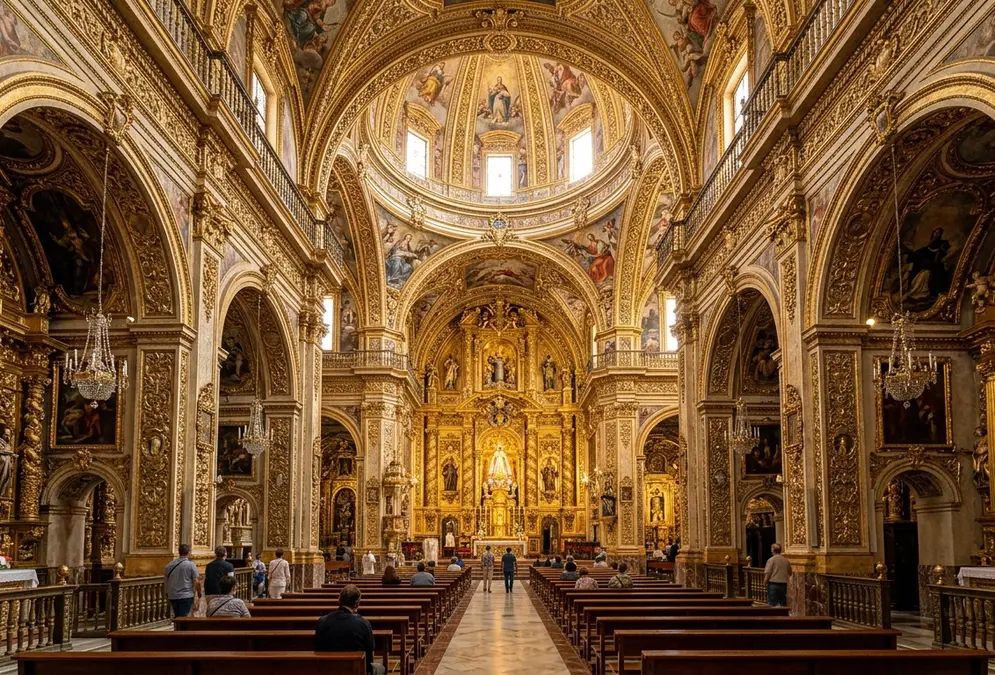
Interior of the Basilica of San Juan de Dios in Granada, gilded baroque altarpiece and gold-leaf ceiling under a 50-metre dome

Explore nearby · Monument

Basilica of San Juan de Dios

Built in 1737, Granada's most opulent baroque church hides gold leaf on every surface, 190 mirrors, and the relics of St John of God kept in a silver urn.

The request was small and the setting was a city street. A friar who stops you to ask for money and then for three prayers is asking twice, and the people of Granada, judging by what followed, gave both.
A saying recalled in Granada ran Tenemos en Granada a un santo en la calle, a saint in the street.[9] The fall came three years before his death: he tumbled down a flight of stairs and fractured a femur,[11] and he died on 9 February 1956,[10] aged 91.[32]

From a tomb to the altars: the road to 2010

Fray Leopoldo de Alpandeire was beatified on 12 September 2010, fifty-four years after his death.[16] The road there began when the Archbishop of Granada, whose seat is Granada Cathedral, opened the informative process on his reputation for holiness in 1975.[12] Accounts of when the cause started disagree, and the Vatican's own letter is the date to trust.
The Congregation for the Causes of Saints issued its decree on his heroic virtues on 15 March 2008, which made him Venerable.[13] The miracle accepted for beatification was the healing of Helena Martínez del Valle, and the decree recognising it was published on 19 December 2009.[14][15]
Timeline
  1. 1864

    Born in Alpandeire

    Francisco Tomás Márquez Sánchez, Serranía de Ronda.[1]

  2. 16 Nov 1899

    Admitted as postulant

    Capuchins of Seville, at 35.[3]

  3. 21 Feb 1914

    Assigned to Granada

    Definitively posted to the city.[4]

  4. 9 Feb 1956

    Dies aged 91

    Pilgrims return to the tomb each year on this date.[10]

  5. 1975

    Informative process opened

    The Archbishop of Granada begins the inquiry into his holiness.[12]

  6. 15 Mar 2008

    Declared Venerable

    Decree on heroic virtues.[13]

  7. 19 Dec 2009

    Miracle decree

    Healing of Helena Martínez del Valle.[15]

  8. 12 Sep 2010

    Beatified in Granada

    Rite held at Armilla Air Base.[16]

The Mass was held at the Armilla Air Base, where the Archdiocese counts more than 60,000 people from across Spain.[17] The vice-postulator's biography puts the crowd at more than 120,000, at a ceremony led by Cardinal Amato on the Pope's behalf.[18] Neither is an independent count, and the two differ by a factor of two.
Pope Benedict XVI called his life a song of humility and trust in God.[20] Beatification is not canonization, and he remains Blessed: nothing published by the Archdiocese, the vice-postulator or the Vatican records a second miracle or a canonization decree since 2010.

Is the crypt really Granada's second most visited place?

The crypt of Fray Leopoldo is ranked second among Granada's most visited places, though the ranking comes with no figure and no date.[23] The only numbers belong to the Archdiocese, which says more than 2,000 people visit the tomb every day and more than 60,000 a month, on a page that carries no date.[21]
The two figures are one estimate, since the monthly total is the daily one carried across a month rather than a second count. El Independiente de Granada repeated the claim in September 2016, on the sixth anniversary of the beatification, as 2,000 visits a day and second only to the Alhambra, attributing it to data the Archdiocese handles.[22]
The figure is easy to repeat because it is round, comes from a church body with every reason to be proud of the crypt, and cannot be disproved without a counter at the door.
Cardinal Amato drew the same comparison at the beatification: if Granada is known worldwide for the Alhambra, he said, it is also known for the many devotees of Fray Leopoldo.[19] A ticketed monument such as the Royal Chapel counts visitors by sales, and no comparable ledger has been published for the crypt. Treat "second after the Alhambra" as devotion's own estimate: believable as a pull, unproven as a statistic. The devotion is documented; the ranking is not.

Visiting the crypt on Avenida Divina Pastora
The crypt of Fray Leopoldo lies inside the parish church of La Inmaculada on Avenida Divina Pastora, which also houses the Capuchin convent.[24] The present convent and the church of the Divina Pastora date from 1967, and the crypt chapel is decorated with landscapes charting the friar's life.[25][23] The convent standing today went up eleven years after he died, so the walls around the tomb postdate the friar himself.
Father Hugolino's graphite fresco in the crypt chapel is his only work in Spain.[28] Pilgrims go to the tomb on 9 February, the anniversary of his death, and on the ninth of every month;[26] a University of Granada anthropologist describes that monthly visit as a romería whose shrine and destination is the tomb.[27]
1066 Granada massacre scene in Jewish history: a mob attacking the Jewish quarter of Nasrid-era Granada at dusk, the Alhambra hill silhouetted in the background, smoke rising over whitewashed rooftops, sombre red and amber tones

Deep dive · Article

1066 Granada Massacre: When the Jewish Golden Age Ended in a Day

The 1066 Granada massacre killed Joseph ha-Nagid and thousands of the city's Jews in a single day, ending three decades of Jewish power under Samuel ha-Nagid.

A few practical points for the visit:
  • Choose the ninth of a month or 9 February to see the devotion at its busiest.
  • Call the crypt on 958 275 352 before you travel: opening hours and any admission charge are not published on the tourist board's page.[29]
  • Check whether Mass is under way before you walk in, and keep your voice down: the crypt is a place of prayer first.
  • Pair the visit with a morning in Centro, where Granada Cathedral and the Royal Chapel stand.
  • To set the friar beside the city's grander religious monuments, read about the cathedral's Renaissance architecture.
What survives on site is modest next to the Alhambra: a tomb, a fresco and a convent church from 1967. The draw is the people around it, which no ranking measures.

Frequently asked questions

Who was Fray Leopoldo de Alpandeire?

Fray Leopoldo de Alpandeire was a Capuchin friar born Francisco Tomás Márquez Sánchez in 1864 in Alpandeire, Málaga,[1] who begged alms in Granada until 1953[33] and died there on 9 February 1956.[10]

Is Fray Leopoldo's crypt really the second most visited place in Granada?

Fray Leopoldo's crypt is described as second only to the Alhambra, but the figure of more than 2,000 daily visits comes from the Archdiocese and has no independent count behind it.[21][22]

Where is Fray Leopoldo's crypt in Granada and is it free to visit?

Fray Leopoldo's crypt is inside the parish church of La Inmaculada on Avenida Divina Pastora, which also houses the Capuchin convent.[24] Its address is Avenida Divina Pastora 11, 18012 Granada,[30] and opening hours and any admission charge are not published on the tourist board's page, so call 958 275 352 before travelling.[29]

What happens at Fray Leopoldo's tomb on the 9th of each month?

Devotees visit Fray Leopoldo's tomb on the ninth of each month and on 9 February, the anniversary of his death.[26] A University of Granada anthropologist describes the monthly gathering as a romería ending at the crypt.[27]

When and where was Fray Leopoldo beatified?

Fray Leopoldo was beatified on 12 September 2010 at Armilla Air Base in Granada.[16][17] The Archdiocese counts more than 60,000 attendees, while the vice-postulator's biography says more than 120,000.[17][18]

Will Fray Leopoldo be made a saint?

Fray Leopoldo is Blessed, one step short of sainthood, and nothing published by the Archdiocese, the vice-postulator or the Vatican records a canonization decree since 2010. A canonization would normally need a further approved miracle.

What is a limosnero?

A limosnero, in Fray Leopoldo's case, was a friar who begged alms in the street rather than handing them out.[6]

Sources

33 references Show
  1. vatican.va (opens in a new tab)

    “die XXIV mensis Iunii anno MDCCCLXIV natus est Alpandeire provinciae Malacitanae”

  2. ugr.es (opens in a new tab)

    “el 4 de junio de 1864, en el seno de una familia humilde”

  3. frayleopoldogranada.org — Biografia (opens in a new tab)

    “Francisco fue admitido como postulante en la Orden Capuchina en Sevilla el 16 de noviembre de 1899. Tenía ya 35 años”

  4. frayleopoldogranada.org — Biografia (opens in a new tab)

    “A partir del 21 de febrero de 1914, Fray Leopoldo quedó destinado definitivamente a Granada.”

  5. turismo.granada.org (opens in a new tab)

    “His main concern was collecting alms, and he travelled all over Granada calling for help for those who had been socially excluded.”

  6. frayleopoldogranada.org (opens in a new tab)

    “Por limosnero ha de entenderse, no que diera limosnas, que también, sino que las pedía como mendigo”

  7. frayleopoldogranada.org — Biografia (opens in a new tab)

    “A quienes encontraba, les saludaba con ternura y les invitaba a rezar tres Avemarías.”

  8. ewtnnews.com — Mas de 60 mil personas en beatificacion de fray leopoldo en espana (opens in a new tab)

    “con frecuencia recibía insultos y apedreamientos, y una vez a punto estuvo de que lo lincharan”

  9. frayleopoldogranada.org (opens in a new tab)

    “Tenemos en Granada a un santo en la calle”

  10. frayleopoldogranada.org — Biografia (opens in a new tab)

    “Murió el 9 de febrero de 1956, a los 92 años de edad”

  11. elindependientedegranada.es (opens in a new tab)

    “Tres años antes de su muerte cayó rodando por unas escaleras y sufrió fractura de fémur”

  12. vatican.va (opens in a new tab)

    “Archiepiscopus Granatensis Processum Informativum de sanctitatis fama virtutibusque anno MCMLXXV incoharet”

  13. vatican.va (opens in a new tab)

    “Congregatio de Causis Sanctorum Decretum ederet super virtutibus die XV mensis Martii anno MMVIII”

  14. vatican.va (opens in a new tab)

    “Pro beatificatione sanatio est exhibita dominae Helenae Martínez del Valle”

  15. vatican.va (opens in a new tab)

    “ut Congregatio de Causis Sanctorum die XIX mensis Decembris anno MMIX Decretum evulgaret”

  16. vatican.va (opens in a new tab)

    “ut beatificationis ritus Illiberi die XII mensis Septembris anno MMX celebraretur”

  17. archidiocesisgranada.es (opens in a new tab)

    “La beatificación de Fray Leopoldo de Alpandeire congregó a más de 60.000 personas de toda España en la Base Aérea de Armilla en Granada el día 12 de septiembre de 2010.”

  18. frayleopoldogranada.org — Biografia (opens in a new tab)

    “más de 120.000 personas asistieron a la ceremonia presidida por el cardenal Angelo Amato en nombre del Papa”

  19. ewtnnews.com — Mas de 60 mil personas en beatificacion de fray leopoldo en espana (opens in a new tab)

    “si Granada es conocida en todo el mundo por la Alhambra, también lo es por muchos devotos de Fray Leopoldo”

  20. ewtnnews.com — Vatican prelate remembers holiness of blessed leopold (opens in a new tab)

    “whose life Pope Benedict XVI called “a song of humility and trust in God.””

  21. archidiocesisgranada.es (opens in a new tab)

    “Más de 2.000 personas visitan diariamente la tumba del Beato Fray Leopoldo, donde numerosos fieles dejan sus plegarias. Son más de 60.000 personas al mes.”

  22. elindependientedegranada.es (opens in a new tab)

    “es el lugar más visitado en Granada después de la Alhambra, con más de 2.000 visitas diarias a su tumba, según los datos que maneja la Archidiócesis de Granada”

  23. turismo.granada.org (opens in a new tab)

    “The crypt of Friar Leopoldo, ranked second amongst the most visited places in Granada, is decorated with landscapes charting the life of the religious brother.”

  24. elindependientedegranada.es (opens in a new tab)

    “La cripta está ubicada en el interior de la parroquia de La Inmaculada, en la Avenida Divina Pastora, que a su vez alberga el convento de franciscanos capuchinos de Granada.”

  25. turismo.granada.org (opens in a new tab)

    “The current Capuchin convent and the Church of the Divina Pastora date back to 1967”

  26. turismo.granada.org (opens in a new tab)

    “On 9 February, the devout visit his tomb to commemorate his death, and also on the ninth day of each month”

  27. ugr.es (opens in a new tab)

    “cuyo santuario y meta es la tumba de Fray Leopoldo de Alpandeire, en la cripta de la iglesia de los capuchinos”

  28. en.andalucia.org (opens in a new tab)

    “His only work in Spain is the graphite fresco in the Fray Leopoldo Crypt Chapel, in the church of Los Padres Capuchinos in Granada.”

  29. frayleopoldogranada.org — Contacto (opens in a new tab)

    “Avda. Divina Pastora, 11 - 18012 Granada”

  30. elindependientedegranada.es (opens in a new tab)

    “la afluencia de gente que pasa por la cripta es mayor y constante todos los días”

  31. vatican.va (opens in a new tab)

    “sic die IX mensis februarii anno MCMLVI, nonagesimum alterum agens annum obiit”

  32. vatican.va (opens in a new tab)

    “Anno post Illiberim repetiit ut sacristae et mendicantis officium ageret usque ad annum MCMLIII.”