Ibn Tufayl and the Island Novel That May Have Inspired Crusoe
Ibn Tufayl, traditionally said to be from Guadix, wrote Hayy ibn Yaqdhan, the island novel often tied to Robinson Crusoe. What the evidence for the link says.
Ibn Tufayl served as personal physician to the Almohad caliph Abu Ya'qub Yusuf from 1163 until the caliph's death in 1184.
In this article
Jump to a section
A Guadix native, perhaps, born in an uncertain year
From Guadix to the Almohad court in Marrakesh
Hayy ibn Yaqdhan: the boy, the gazelle and 49 years
Explore nearby · Monument
Alcaicería
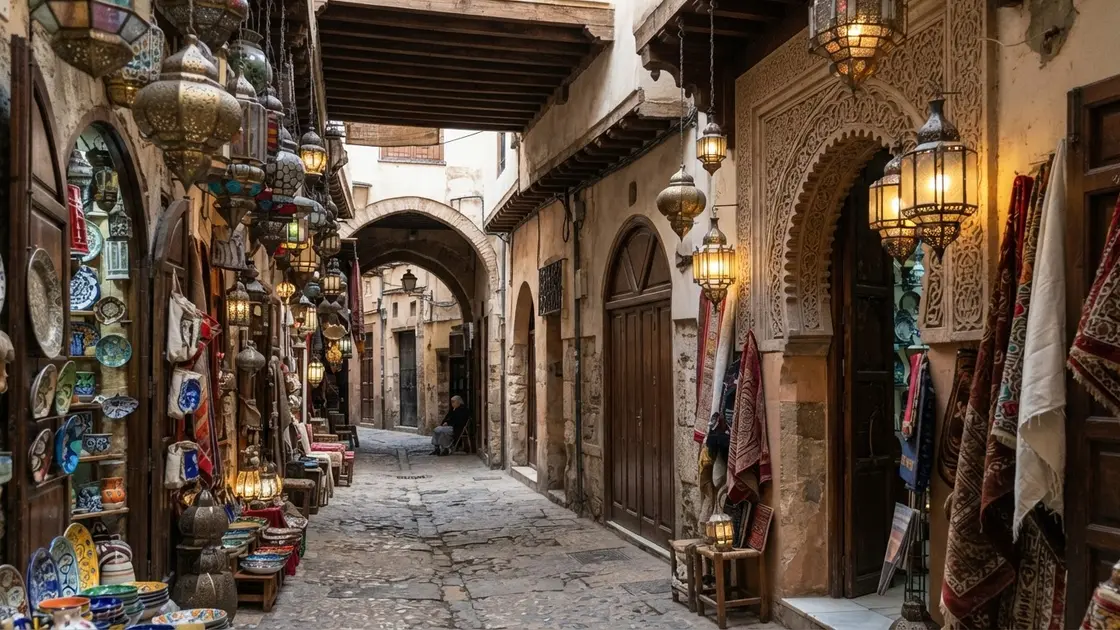
Granada's historic silk market, rebuilt after 1843 in Neo-Moorish style. Small shops sell ceramics, taracea woodwork, spices, and leather goods. Free to enter.
How an Arabic novel reached English readers
- 1671: Pococke's Arabic-Latin edition of the book is published at Oxford.[20][21]
- 1674: the Scottish Quaker George Keith uses that edition to make the first English translation, reading the book as an illustration of the Quaker "Inner Light".[21][41]
- 1708: Simon Ockley's translation, the first made directly from the Arabic, appears in London as The Improvement of Human Reason, a title some reference works shorten to The Improvement of Reason.[3][22][23]
Deep dive · Article
1066 Granada Massacre: When the Jewish Golden Age Ended in a Day
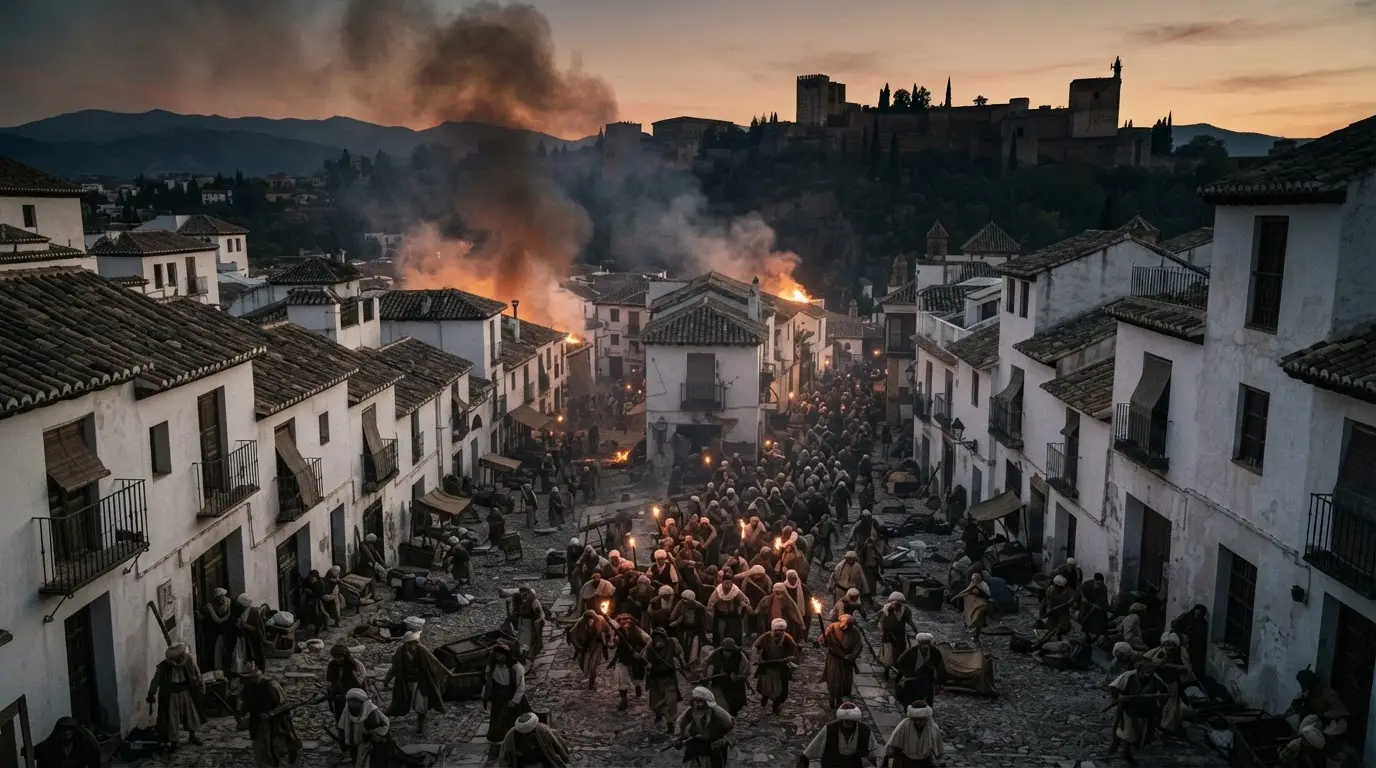
The 1066 Granada massacre killed Joseph ha-Nagid and thousands of the city's Jews in a single day, ending three decades of Jewish power under Samuel ha-Nagid.
Robinson Crusoe: a possible link, not a proven one
What Guadix keeps of him
- Distance: Guadix lies about an hour's drive northeast of Granada.[28]
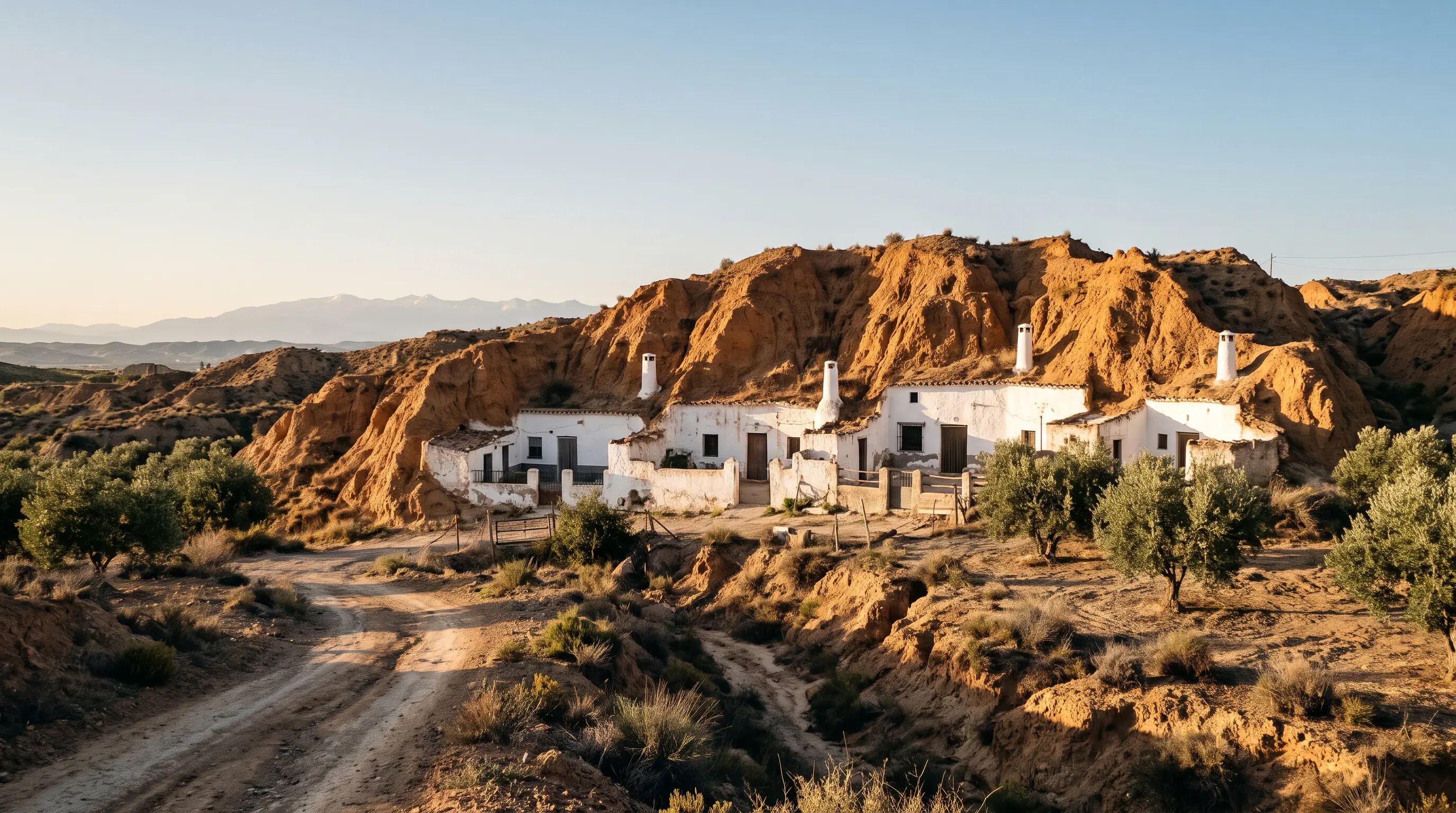
- Landscape: the hills of the Guadix region have been dotted with cave dwellings since at least the eighth century.[29]
- Local memory: Aramco World describes a monthly Abentofail Poetry Workshop in the town, Abentofail being the form of his name used in Spanish.[30] In the town council's notices it is the Aula Abentofail de Poesía y Pensamiento, directed by the writer Antonio Enrique,[54] and listed as meeting on the last Friday of each month at the Teatro Mira de Amescua.[52][53] The notice is undated, so check the council's current listings before planning around it.
Recommended tours
Tours are selected for quality, not commission. We earn a small fee if you book — at no extra cost to you.
Frequently asked questions
What is Ibn Tufayl's Hayy ibn Yaqdhan about?
Where was Ibn Tufayl born?
Did Hayy ibn Yaqdhan inspire Robinson Crusoe?
Who first translated Ibn Tufayl's Hayy ibn Yaqdhan into English?
What happens when Hayy ibn Yaqdhan meets other people?
Who introduced Ibn Rushd to the Almohad court?
Can you visit Guadix to follow Ibn Tufayl?
Sources
54 references Show Hide
- archive.aramcoworld.com (opens in a new tab)
“After al-Mu’min’s death in 1163, Ibn Tufayl returned to the court as a personal physician for the succeeding caliph, Abu Ya’qub Yusuf, a post he held until the caliph’s death in 1184.”
- archive.aramcoworld.com (opens in a new tab)
“Ibn Tufayl divides the story of Hayy’s autodidacticism into seven seven-year segments, up through age 49.”
- archive.aramcoworld.com (opens in a new tab)
“or Ockley’s, published in 1708, 11 years prior to the publication of Robinson Crusoe.”
- archive.aramcoworld.com (opens in a new tab)
“Ibn Tufayl’s first big break came in 1147—he would have recently turned 30—when he traveled to Marrakesh with Ibn Milhan, former ruler of Guadix.”
- rep.routledge.com (opens in a new tab)
“his only extant work, Hayy Ibn Yaqzan (The Living Son of the Vigilant), a philosophical treatise in a charming literary form”
- encyclopedia.com (opens in a new tab)
“Few details are known about the life of Ibn Ṭufayl, who was born at Guadix in the province of Granada and died in Morocco.”
- islamsci.mcgill.ca (opens in a new tab)
“Born Guadix, Purchena, or Tíjola (Spain), beginning of the 12th century”
- historia-hispanica.rah.es (opens in a new tab)
“nació en Tíjola (Tāŷula), a comienzos del siglo XII, quizá antes de 1110.”
- universalis.fr (opens in a new tab)
“Né à Wādi Ash (Guadix) et mort à Marrakech, Abū Bakr Muḥammad Ibn Ṭufayl”
- archive.aramcoworld.com (opens in a new tab)
“A descendant of the prominent Qais tribe that harked back to the Arabian Peninsula, Ibn Tufayl was born around 1116.”
- universalis.fr (opens in a new tab)
“l'homonymie du surnom latin d'Abubacer donné à Ibn Ṭufayl avec celui du philosophe de Saragosse, également appelé par les scolastiques Abubacer (Avempace), a été à l'origine d'une confusion”
- lareviewofbooks.org (opens in a new tab)
“had established its rule in Marrakesh by 1147.”
- archive.aramcoworld.com (opens in a new tab)
“Under the Almohads, philosophy was, in general, frowned upon.”
- islamsci.mcgill.ca (opens in a new tab)
“He then became court physician and counselor to the caliph Ab ū Ya ʿqūb Y ūsuf, a sovereign who loved and supported science and thought.”
- lareviewofbooks.org (opens in a new tab)
“He managed to introduce the young Ibn Rushd (Averroes) to the court where he too flourished for a time (and embarked on his great commentaries on Aristotle).”
- islamsci.mcgill.ca (opens in a new tab)
“Died Marrakech (Morocco), 1185/1186”
- lareviewofbooks.org (opens in a new tab)
“He is sheltered by a tribe of gazelles, one of whom becomes his adoptive mother.”
- universalis.fr (opens in a new tab)
“Ce livre, bien qu'empruntant ses personnages à un conte symbolique excessivement aride d'Ibn Sīnā (Avicenne), peut être regardé comme une œuvre parfaitement originale.”
- rep.routledge.com (opens in a new tab)
“The story also seeks to show that, while religious truth is the same as that of philosophy, the former is conveyed through symbols”
- archive.aramcoworld.com (opens in a new tab)
“Among the scraps of such knowledge was a book published in Oxford in 1671.”
- archive.aramcoworld.com (opens in a new tab)
“Scotsman George Keith used Pococke’s Arabic-Latin edition to produce the first English translation”
- Wikipedia (opens in a new tab)
“First direct translation from the original Arabic”
- encyclopedia.com (opens in a new tab)
“Ibn Ṭufayl's Ḥayy ibn Yaqẓān has been translated by S. Ockley as The Improvement of Reason (London, 1708)”
- archive.aramcoworld.com (opens in a new tab)
“scholars believe that English author Daniel Defoe looked to Ibn Tufayl’s book along with accounts of real-life castaways for inspiration”
- archive.aramcoworld.com (opens in a new tab)
“there is in fact no hard evidence that he owned a personal copy”
- lareviewofbooks.org (opens in a new tab)
“There is a certain superficial similarity: both deal with individuals stranded on islands and compelled to make their way unaided.”
- encyclopedia.com (opens in a new tab)
“Ibn Ṭufayl's novel is not an anticipation of Robinson Crusoe; each external episode must be understood on a spiritual level.”
- archive.aramcoworld.com (opens in a new tab)
“embrace the city of Guadix, an hour’s drive northeast of Granada”
- archive.aramcoworld.com (opens in a new tab)
“the hills of Ibn Tufayl’s native Guadix region have been dotted with cave-dwellings since at least the eighth century.”
- archive.aramcoworld.com (opens in a new tab)
“founder of Guadix’s monthly Abentofail Poetry Workshop”
- lareviewofbooks.org (opens in a new tab)
“It is only at this point that Hayy learns to use human language, that indispensable concomitant of reason; all his knowledge has come to him by mute inference.”
- archive.aramcoworld.com (opens in a new tab)
“As scholar Samar Attar observed in 2007 in The Vital Roots of European Enlightenment: Ibn Tufayl’s Influence on Modern Western Thought, both men are adrift on desert islands”
- archive.aramcoworld.com (opens in a new tab)
“Mahmoud Baroud of the Islamic University of Gaza and author in 2012 of The Shipwrecked Sailor in Arabic and Western Literature: Ibn Tufayl and His Influence on European Writers.”
- archive.aramcoworld.com (opens in a new tab)
“Attar and Baroud suggest that Defoe may have consulted one of these editions because Crusoe is sustained by, among other creatures, a herd of goats.”
- archive.aramcoworld.com (opens in a new tab)
“Most of these modern studies trace their pedigrees back to Antonio Pastor’s The Idea of Robinson Crusoe, published in 1930.”
- archive.aramcoworld.com (opens in a new tab)
“Nawal Muhammad Hassan, author of Hayy Bin Yaqzan and Robinson Crusoe: A Study of an Early Arabic Impact on English Literature, pointed out, both Rycaut’s Criticon and another Ockley title, A History of the Saracens, were on Defoe’s library shelf.”
- lareviewofbooks.org (opens in a new tab)
“Kukkonen dismisses these apparent affiliations as “breezy references.” I think that he is right.”
- lareviewofbooks.org (opens in a new tab)
“Ibn Tufayl: Living the Life of Reason by Taneli Kukkonen. Oneworld Publications, 2014. 160 pages.”
- encyclopedia.com (opens in a new tab)
“Henry Corbin (1967)”
- encyclopedia.com (opens in a new tab)
“For literature on Ibn Ṭufayl, see Henry Corbin, Histoire de la philosophie islamique, Vol. I (paperback, Paris: Gallimard, 1964), pp. 327–337”
- link.springer.com (opens in a new tab)
“In his translation of 1674, Scottish Quaker George Keith envisioned the text as a theological illustration of the “Inner Light” which was at the core of the Quaker doctrine.”
- link.springer.com (opens in a new tab)
“Dublin printers would normally choose editorial successes and print cheaper and smaller versions.”
- link.springer.com (opens in a new tab)
“in 1733, in the catalogue of Charles Bruce, Earl of Ailesbury, in 1742, in the catalogue of “a late eminent Serjeant of Law,” Dr. Edmund Halley”
- Wikipedia (opens in a new tab)
“Ibn Tufail borrows from Ibn Sina, using the title of one of his allegories and drawing inspiration from his Floating Man thought experiment”
- encyclopedia.com (opens in a new tab)
“All it owes to Avicenna are the names of the dramatis personae : Ḥayy ibn Yaqẓān (Vivens filius Vigilantis ), and Salamān and Absāl”
- universalis.fr (opens in a new tab)
“Abdelkader BEN CHEHIDA : docteur de troisième cycle, chargé de cours à l'université de Paris-I”
- archive.aramcoworld.com (opens in a new tab)
“Both an able administrator and a skilled engineer, Ibn Milhan had been summoned by the Almohad caliph ‘Abd al-Mu’min to supervise construction of the irrigation system for the royal gardens.”
- archive.aramcoworld.com (opens in a new tab)
“Why Ibn Tufayl tagged along is unclear, but while at court, he impressed the caliph, who appointed him personal secretary to his son Abu Sa’id.”
- islamsci.mcgill.ca (opens in a new tab)
“He seems to have worked for local rulers till he became secretary to the governor of Ceuta and Tangier”
- historia-hispanica.rah.es (opens in a new tab)
“Compuso panegíricos en honor de los gobernantes de Guadix y Baza.”
- lareviewofbooks.org (opens in a new tab)
“the 12th-century Andalusian Muslim scholar known as Ibn Tufayl (1105–1185)”
- elaccitano.com (opens in a new tab)
“(siempre el último viernes de cada mes)”
- elaccitano.com (opens in a new tab)
“El acto tendrá lugar este viernes 25 de septiembre a partir de las ocho de la tarde en el Teatro Mira de Amescua con acceso libre”
- elaccitano.com (opens in a new tab)
“Aula Abentofail de Poesía y Pensamiento de Guadix dirigida por el escritor Antonio Enrique”