Written by James Walker
Modern Granada · 1808–today
  • 6 min
  • 42 sources

Emilio Herrera Designed a Space Suit in 1935, Then War Came

Emilio Herrera, born in Granada in 1879, designed a pressurised stratospheric suit in 1935. The Civil War cancelled the balloon ascent it was built for.
Emilio Herrera space suit of 1935: a layered wool, rubber and canvas stratospheric pressure suit with a round helmet and accordion joints, standing in a workshop in warm low light beside an open balloon basket

Herrera's 1935 suit was built from layers of wool, rubber and canvas, with accordion-shaped joints reinforced by steel cables.

On 18 July 1936 the military engineer Emilio Herrera, born in Granada, was in Santander to present a plan to rise into the stratosphere in an open balloon basket.[1] The pressurised suit he had designed in 1935 for that ascent is why he is remembered,[2] but the war thwarted the project before it could fly.[3] The design is documented; the NASA stories that grew around it are much harder to pin down.
Born Granada, died Geneva
1879-1967
13 February 1879 to 13 September 1967[4]
Planned ascent altitude
22,000 m
Planned ascent in an open-basket balloon, per one biography[5]
Strait of Gibraltar by air
14 Feb 1914
Nieuport VI flown from Tetuán to Tablada by Herrera and José Ortiz[6]

A boyhood of balloons and arc lamps

Emilio Herrera Linares was born in Granada on 13 February 1879 and died in Geneva on 13 September 1967.[4] His father, the military officer Emilio Herrera Ojeda,[7] brought new technology to the city, including the first balloon ascents and the night lighting of the Alhambra with arc lamps.[8] Picture the towers lit by electric arcs and balloons rising over the rooftops. No wonder the boy kept looking up.
Herrera grew into one of Spain's leading aeronautical engineers. He worked with Juan de la Cierva, the inventor of the autogiro, and with Leonardo Torres Quevedo, and he is credited with coining the Spanish term espacio aéreo, airspace.[9] On 14 February 1914 he and José Ortiz flew a Nieuport VI monoplane from Tetuán to Tablada, in Seville, which the Spanish Air Force's account records as the first crossing of the Strait of Gibraltar by air.[6][10] Herrera was no showman.
His father's generation had treated the sky as a spectacle, with balloon ascents staged for the Granada public. Herrera treated it as a laboratory: the ascent he planned in the 1930s was meant to measure cosmic radiation, not to entertain a crowd.[5] The distinction mattered. A spectacle needed an audience; a scientific ascent needed a pressure suit, instruments and a clear sky.

What the 1935 suit was built to survive

The escafandra estratonáutica Herrera designed in 1935 was a layered garment: wool, rubber and a third layer of heavy canvas, with accordion-shaped joints reinforced by steel cables so the pilot could still move.[11] It was meant for an open-basket balloon, where the suit itself, not a sealed gondola, had to keep the wearer alive in thin air and in a cold that a 1935 press caption put at 70 degrees below zero.[12] Nothing else stood between the pilot and the stratosphere.
Herrera designed the garment against extreme temperatures, low pressure and lack of oxygen.[13] It supplied oxygen from a bottle with more than two hours of autonomy,[14] and a layer of polished aluminium and silver cloth over the cylindrical helmet and the suit reflected sunlight to avoid overheating.[15] Oxygen alone was not enough: earlier Spanish high-altitude attempts had carried a bottle but failed because the cold froze the carbon dioxide from breathing and blocked the system,[16] and Herrera devised a method to remove that gas while supplying oxygen.[17]
The complete kit weighed 127 kg, and the helmet carried a radiotelephone and triple unbreakable glass.[18] NASA's own figures for a full Extravehicular Mobility Unit with its life-support backpack are about 124.7 kg for the Shuttle-era version and about 145 kg for the ISS version,[19][20] so Herrera's kit sat between the two.
Herrera was already advertising the outfit in print. In 1935 he told readers of the magazine Madrid Científico that this would be the attire of the navigators of future stratosphere trips, brilliant and dazzling to behold.[21] It was an engineer's answer to a physiological problem, and it existed on paper and in cloth before it ever met the sky.
The ascent it served was a scientific one, and the sources disagree on its altitude. A 1935 press caption says the suit could reach up to 18,000 m,[12] the ENAIRE Foundation's dossier says more than 20,000 m,[22] and the biography that calls it Herrera's most ambitious project gives more than 22,000 m and calls that above the altitude record of the day.[5]
That record claim holds against the Soviet balloon Osoaviakhim, which probably reached about 72,000 ft in January 1934,[23] but not clearly against Explorer II, whose world record of 22,066 m on 11 November 1935 a target of just over 22,000 m would only have matched.[24] Piccard's sealed gondola had reached 15,777 m in 1931 and about 16,764 m in 1932,[25][26] so Herrera's open basket and suit proposed a different way into the stratosphere.[27]

The ascent the war cancelled

The Spanish Civil War cancelled Herrera's ascent: he was in Santander on 18 July 1936, at a Menéndez Pelayo University course, to present the project when the military rising began.[1] Granada, his native city, fell to the rebels in the July 1936 coup as the rising spread. The plan did not survive it.
He had been preparing the ascent since 1933, and it had drawn international interest.[3] In 1936, when the balloon and the suit were finally ready for the ascent, the outbreak of the Civil War swept the whole project away.[30] The suit was destroyed and the balloon fabric was made into winter coats for Republican soldiers.[31] Science gave way to survival.
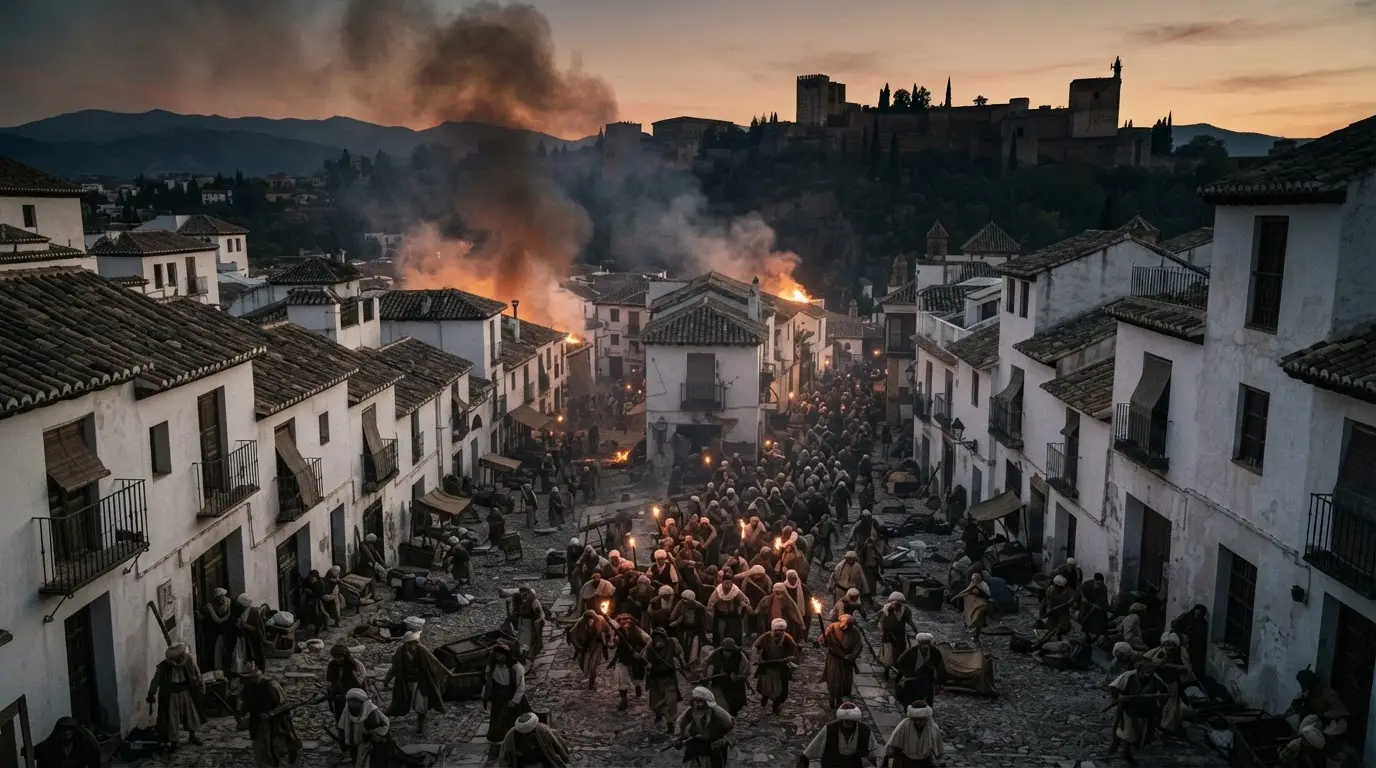
1066 Granada massacre scene in Jewish history: a mob attacking the Jewish quarter of Nasrid-era Granada at dusk, the Alhambra hill silhouetted in the background, smoke rising over whitewashed rooftops, sombre red and amber tones

Deep dive · Article

1066 Granada Massacre: When the Jewish Golden Age Ended in a Day

The 1066 Granada massacre killed Joseph ha-Nagid and thousands of the city's Jews in a single day, ending three decades of Jewish power under Samuel ha-Nagid.

The plan was ambitious by the standards of 1936: a climb in an open-basket balloon rather than a sealed gondola.[5] Everything therefore rested on the suit, which is why its three layers and steel-cabled joints mattered more than any instrument in the basket.

From a Chilean embassy to a government in exile

Herrera, newly promoted to general, was chosen by Indalecio Prieto in 1938 for the embassy that represented the Spanish Republic at the inauguration of Chile's new president, Pedro Aguirre Cerda.[32] The posting was meant as a diplomatic errand; it became a lifelong exile, because he never went back to Spain.[32]
He stayed loyal to the Republic, and on 9 May 1960 he took over the presidency of the VI Government in Exile at the request of Diego Martínez Barrio,[33] who held the Republic's own presidency in exile, as interim president, until his death in 1962.[34] Franco's regime, for its part, withdrew his medal from the Royal Academy of Sciences for political reasons.[35] Loyalty abroad, an honour withdrawn at home.
He was not the only figure tied to Granada to end his life abroad. The composer Manuel de Falla is the best known of the others, though Herrera, who died in Geneva in 1967,[4] belongs to the same generation of exiles. Exile scattered the people of that generation across Europe and the Americas, and few of them left behind a design as concrete as his.

What survives: an archive, a reproduction and a Granada detour
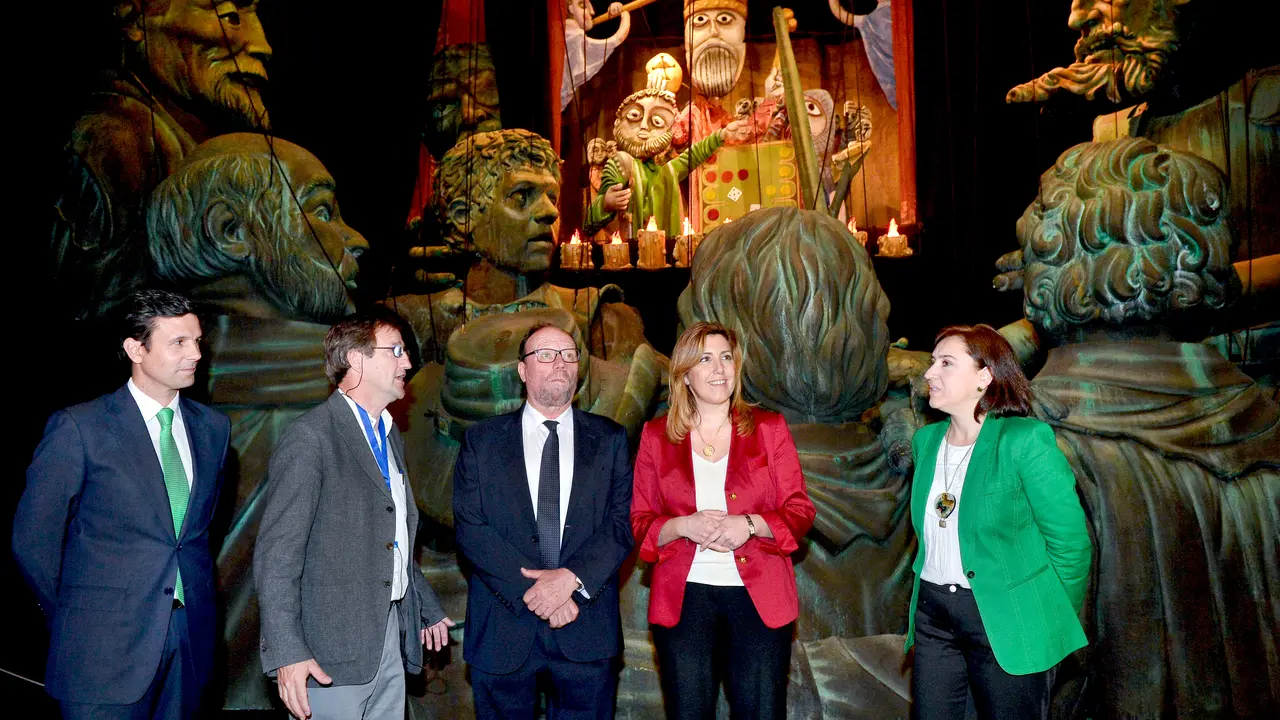
Herrera's legacy is now kept mostly on paper: in December 2025 the Spanish Government delivered a Declaration of Recognition and Personal Reparation to his family, and his personal archive was deposited with the Air and Space Force's historical service, SHYCEA, while the ENAIRE Foundation sponsors its digitisation.[36] The International Civil Aviation Organization has confirmed a permanent exhibition on Herrera, and Spain's proposal for it includes a reproduction of the stratonautical pressure suit.[37] It is a modest afterlife for an engineer who once crossed the Strait of Gibraltar by air, but a documented one.
The 1935 suit itself never flew on a space mission, though its development was a pioneering step.[38] The stories that go further are unproven: Herrera's assistant Antonio García Borrajo asserted years later that NASA called Herrera in and that he refused,[39] the ENAIRE Foundation's sponsorship dossier tells a blank-cheque version, with a Spanish flag on the Moon as his condition, without naming a source,[40] and the historian Atienza gives another reason, that Herrera did not want to leave Spain, expecting exile to be short.[41] The dated record is the 1935 design, the cancelled 1936 ascent and the exile. The documented Herrera is the better story: an engineer who put a pressurised suit on paper in 1935 and watched the war consume it.[2][31] For a Granada visit built around that story, three stops carry it:
Exterior of Parque de las Ciencias Granada with the white science museum buildings and outdoor sculpture garden

Explore nearby · Museum

Parque de las Ciencias

Andalusia's largest science museum: 70,000 m² of interactive exhibits, a planetarium, BioDomo greenhouse, and observation tower. Adult €7. Allow 3–4 hours.

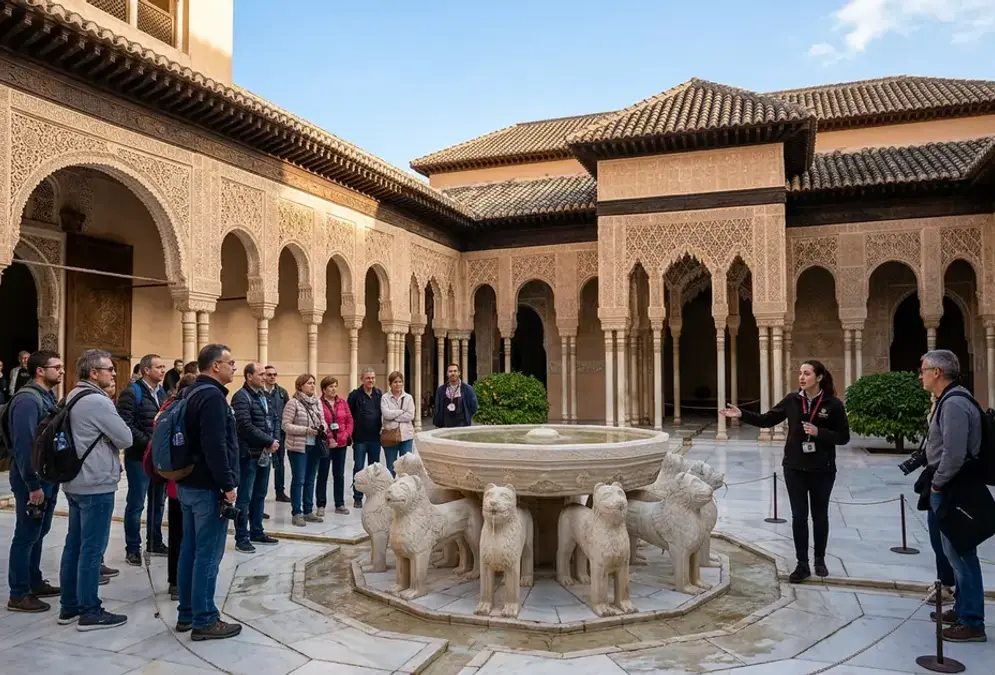
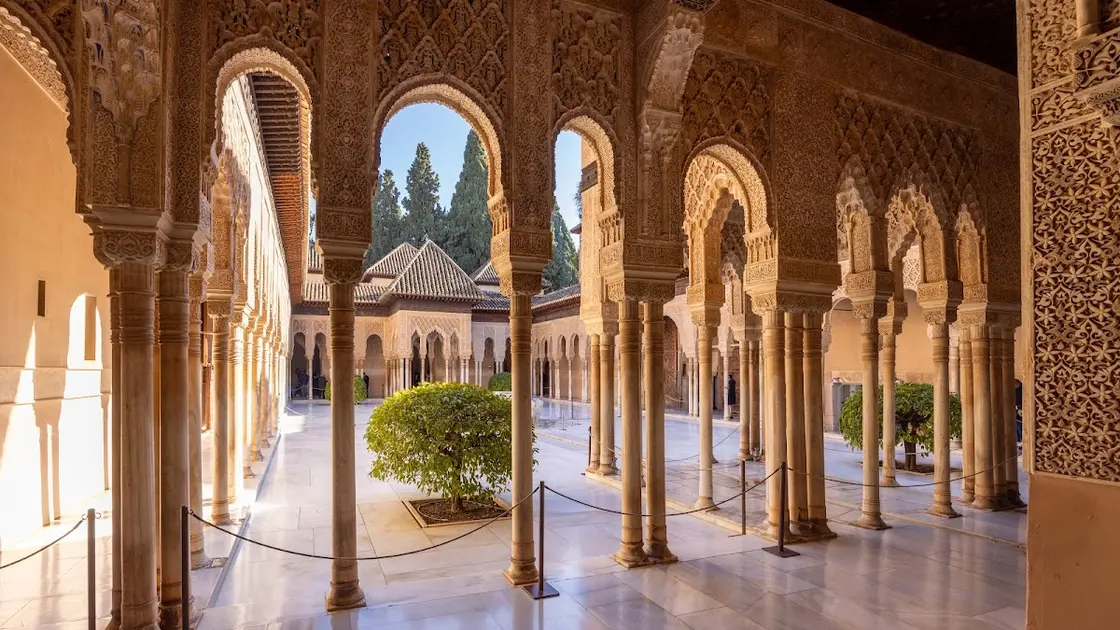
  • The Alhambra, the monument his father lit at night with arc lamps.[8]
  • The Parque de las Ciencias, Granada's science museum and the natural companion for flight, space and the stratosphere. It is not a Herrera exhibit, so go for the theme rather than the man.
  • The digitised archive, once the SHYCEA collection is online.[36]

Frequently asked questions

What was the Emilio Herrera space suit?

The Emilio Herrera space suit was the escafandra estratonáutica, a pressurised suit he designed in 1935 for an open-basket stratospheric balloon ascent.[2] It was built from layers of wool, rubber and heavy canvas, with accordion-shaped joints reinforced by steel cables.[11]

Was Emilio Herrera born in Granada?

Emilio Herrera was born in Granada on 13 February 1879 and died in Geneva on 13 September 1967.[4] His father, the military officer Emilio Herrera Ojeda, staged some of the city's first balloon ascents.[7][8]

Why was Herrera's stratospheric balloon flight never made?

The Civil War thwarted Herrera's project, and he was in Santander on 18 July 1936, presenting it, when the rising began.[1][3]

How high was Herrera's suit meant to go?

Herrera's suit was planned for ascents of between 18,000 m and more than 22,000 m, depending on the source: a 1935 press caption says up to 18,000 m,[12] and a later biography says more than 22,000 m.[5] The flight never took place, so each is a design target.[3]

Did NASA copy Emilio Herrera's space suit?

Whether NASA drew on Emilio Herrera's design is unproven: a Spanish science minister has recalled that the Apollo 11 suits were "partially" based on it,[42] and Herrera's assistant Antonio García Borrajo asserted years later that NASA invited him to work with it.[39] The 1935 suit itself was never used on a space mission.[38]

Where is Emilio Herrera's space suit now?

Emilio Herrera's suit was reportedly destroyed in 1936, and the balloon fabric was made into coats for Republican soldiers.[31] The permanent exhibition on Herrera that ICAO has confirmed will include a reproduction of the suit.[37]

What office did Emilio Herrera hold in the Spanish Republic in exile?

Emilio Herrera headed the VI Government in Exile from 9 May 1960, a post distinct from the Republic's presidency in exile, which Diego Martínez Barrio held as interim president until his death in 1962.[33][34] Herrera had left Spain in 1938 on an embassy to Chile and never returned.[32]

Sources

42 references Show
  1. generacionesdeplata.fundaciondescubre.es (opens in a new tab)

    “El 18 julio de 1936 Herrera se encontraba en Santander en un curso de la Universidad Menéndez Pelayo para presentar su proyecto de ascensión a la estratosfera.”

  2. enaire.es — Ndp fundacion enaire reivindica ingeniero emilio herrera digital (opens in a new tab)

    “diseñó en 1935 la escafandra estratonáutica, precursora de los trajes presurizados utilizados en la exploración espacial.”

  3. generacionesdeplata.fundaciondescubre.es (opens in a new tab)

    “A tal fin proyectó una ascensión que despertó el interés internacional y diseñó el que podríamos considerar el primer traje espacial. La guerra frustrará el proyecto.”

  4. horizontevcentenario.ugr.es (opens in a new tab)

    “Granada, 13 de febrero de 1879-Ginebra, 13 de septiembre de 1967”

  5. generacionesdeplata.fundaciondescubre.es (opens in a new tab)

    “Su proyecto más ambicioso, aunque frustrado, fue la ascensión a más de 22.000 metros de altitud –por encima del récord de altura del momento– en un globo de barquilla abierta.”

  6. ejercitodelaireydelespacio.defensa.gob.es (opens in a new tab)

    “tomaba tierra en Tablada, procedente de Tetuán (África), el monoplano militar Nieuport VI nº 6 pilotado por los capitanes de ingenieros Emilio Herrera y José Ortiz”

  7. historia-hispanica.rah.es (opens in a new tab)

    “Su padre, también militar, Emilio Herrera Ojeda (Ávila de los Caballeros, Ávila, 12 de marzo de 1828-Granada, 22 de febrero de 1897)”

  8. historia-hispanica.rah.es (opens in a new tab)

    “Algunas de ellas las introdujo en Granada con notable éxito, como la que le permitió la iluminación nocturna de la Alhambra con focos de arcos fotovoltaicos, o las primeras elevaciones de globos aerostáticos.”

  9. enaire.es — Ndp fundacion enaire reivindica ingeniero emilio herrera digital (opens in a new tab)

    “Colaboró con figuras como Juan de la Cierva y Leonardo Torres Quevedo, contribuyó a la terminología aeronáutica internacional (por ejemplo, acuñó el término ‘espacio aéreo’)”

  10. ejercitodelaireydelespacio.defensa.gob.es (opens in a new tab)

    “tras atravesar por vez primera el Estrecho de Gibraltar y lanzar una Bandera española sobre la roca”

  11. generacionesdeplata.fundaciondescubre.es (opens in a new tab)

    “El traje contaba con tres capas, una de lana, una de caucho y una tercera de lona muy resistente. La zona de las articulaciones estaba diseñada como un acordeón reforzado con cables y tirantes de acero para dar libertad de movimiento al piloto.”

  12. artsandculture.google.com (opens in a new tab)

    “with which he will be able to reach up to 18,000 meters of altitude in an open basket balloon and withstand temperatures of 70º degrees below zero Celsius.”

  13. generacionesdeplata.fundaciondescubre.es (opens in a new tab)

    “La escafandra del espacio era una vestimenta diseñada por Herrera para protegerse de las temperaturas extremas, la baja presión y la falta de oxígeno de la estratosfera.”

  14. publico.es (opens in a new tab)

    “permitía total movilidad, protegía de la radiación solar, resistía los cambios de temperatura y las presiones extremas, y suministraba oxígeno gracias a una botella con autonomía para más de dos horas.”

  15. generacionesdeplata.fundaciondescubre.es (opens in a new tab)

    “Una capa de aluminio pulimentado y una tela de plata recubrían en el casco cilíndrico y el traje para reflejar los rayos solares y evitar el recalentamiento.”

  16. generacionesdeplata.fundaciondescubre.es (opens in a new tab)

    “Aunque llevaban una bombona, no contaron con que el frío a estas alturas congela el dióxido de carbono producido en la respiración y obstruye el sistema.”

  17. generacionesdeplata.fundaciondescubre.es (opens in a new tab)

    “Herrera ideó un método para eliminar este compuesto a la vez que aportaba oxígeno.”

  18. publico.es (opens in a new tab)

    “En total, el equipo completo ideado por Herrera pesaba 127 kilos, tan solo tres kilos menos que los trajes que llevan los astronautas de la NASA desde 1982”

  19. nasa.gov (opens in a new tab)

    “weighs approximately 275 lb (124.7 kg)”

  20. nasa.gov (opens in a new tab)

    “weighs approximately 319 lb”

  21. generacionesdeplata.fundaciondescubre.es (opens in a new tab)

    “Este será el atuendo de los navegantes que en los futuros paseos por la estratosfera podremos admirar brillantes y deslumbradores”

  22. emilioherrera.fundacionenaire.es (opens in a new tab)

    “Diseñada para ascender a más de 20.000 metros en globo, contaba con visor térmico, micrófono y sistema de respiración autónoma.”

  23. nature.com (opens in a new tab)

    “The previous record was held by the ill-fated Russian balloon Osoaviakhim which probably reached a height of 72,000 feet on January 30, 1934.”

  24. airandspace.si.edu (opens in a new tab)

    “Explorer II carried Captain Albert Stevens, Captain Orvil Anderson, and an assortment of instruments to a world record altitude of 22,066 meters (72,395 feet).”

  25. encyclopedia.com (opens in a new tab)

    “In 1931, Swiss physicist Auguste Piccard and his colleague, Paul Kipfer, became the first humans to reach the stratosphere in Piccard's balloon, achieving an altitude of 51,762 feet (15,777 m).”

  26. encyclopedia.com (opens in a new tab)

    “The following year, Piccard broke his record with an ascent to nearly 55,000 feet (16,764 m)”

  27. encyclopedia.com (opens in a new tab)

    “By designing and ascending in a pressurized gondola, Piccard showed that the stratosphere was survivable.”

  28. publico.es (opens in a new tab)

    “En 1935, cuando Herrera hizo las pruebas de resistencia, su traje resolvía todos los retos del momento”

  29. emilioherrera.fundacionenaire.es (opens in a new tab)

    “La Guerra Civil frustró el vuelo de prueba programado para 1936.”

  30. generacionesdeplata.fundaciondescubre.es (opens in a new tab)

    “En 1936, cuando por fin el enorme globo y la escafandra estaban listos para la ascensión, el estallido de la Guerra Civil española se llevó por delante todo el proyecto.”

  31. generacionesdeplata.fundaciondescubre.es (opens in a new tab)

    “El traje fue destruido y con la tela del globo se hicieron abrigos para los soldados republicanos.”

  32. generacionesdeplata.fundaciondescubre.es (opens in a new tab)

    “Ascendido a general, Indalecio Prieto lo elige para la embajada que representó a la República española en la toma de posesión del nuevo presidente de Chile, Pedro Aguirre Cerdá. No volverá a España.”

  33. generacionesdeplata.fundaciondescubre.es (opens in a new tab)

    “EL 9 de mayo de 1960 Herrera asumió, a instancias de Martínez Barrio, la Presidencia del VI Gobierno en el Exilio.”

  34. ojs.ehu.eus (opens in a new tab)

    “nombrado presidente interino de la República, responsabilidad que desempeñó hasta su muerte en 1962”

  35. publico.es (opens in a new tab)

    “a quien la dictadura de Franco retiró la medalla de la Real Academia de Ciencias Exactas, Físicas y Naturales por razones políticas.”

  36. enaire.es — Ndp gb enaire foundation asserts legacy emilio herrera (opens in a new tab)

    “The event also marked the formal signing of the deposit of Herrera’s personal archive with the Historical and Cultural Service of the Air and Space Force (SHYCEA)”

  37. enaire.es — Ndp gb enaire foundation asserts legacy emilio herrera (opens in a new tab)

    “The initiative will include a reproduction of the stratonautical pressure suit and digital outreach resources.”

  38. eldebate.com (opens in a new tab)

    “Aunque aquel traje no llegó a utilizarse en una misión espacial, su desarrollo supuso un avance pionero.”

  39. elindependiente.com (opens in a new tab)

    “Uno de sus ayudantes, Antonio García Borrajo, aseguraría años más tarde que la agencia estadounidense llamó a Herrera para que trabajase con ellos y que él la rechazó”

  40. emilioherrera.fundacionenaire.es (opens in a new tab)

    “Cuando la NASA le ofreció un cheque en blanco para unirse a su programa espacial, lo rechazó exigiendo como condición innegociable que la bandera española ondeara en la Luna”

  41. generacionesdeplata.fundaciondescubre.es (opens in a new tab)

    “Según explica Atienza, lo rechazó porque “no quería alejarse de España, ya que pensaba que el exilio no iba a durar tanto como luego duró”.”

  42. publico.es (opens in a new tab)

    “Los trajes de Armstrong, Aldrin y Collins estaban basados “parcialmente” en el diseño de la escafandra “estratonáutica” de Herrera, recuerda Duque”