Written by James Walker
Nasrid Granada · 1238–1492
  • 5 min
  • 33 sources

Why the Court of the Myrtles Carries a Botanical Name

The Court of the Myrtles is named for the myrtle hedges along its 34-metre pool. Find the Arabic root of arrayán and why it is also the Patio de la Alberca.
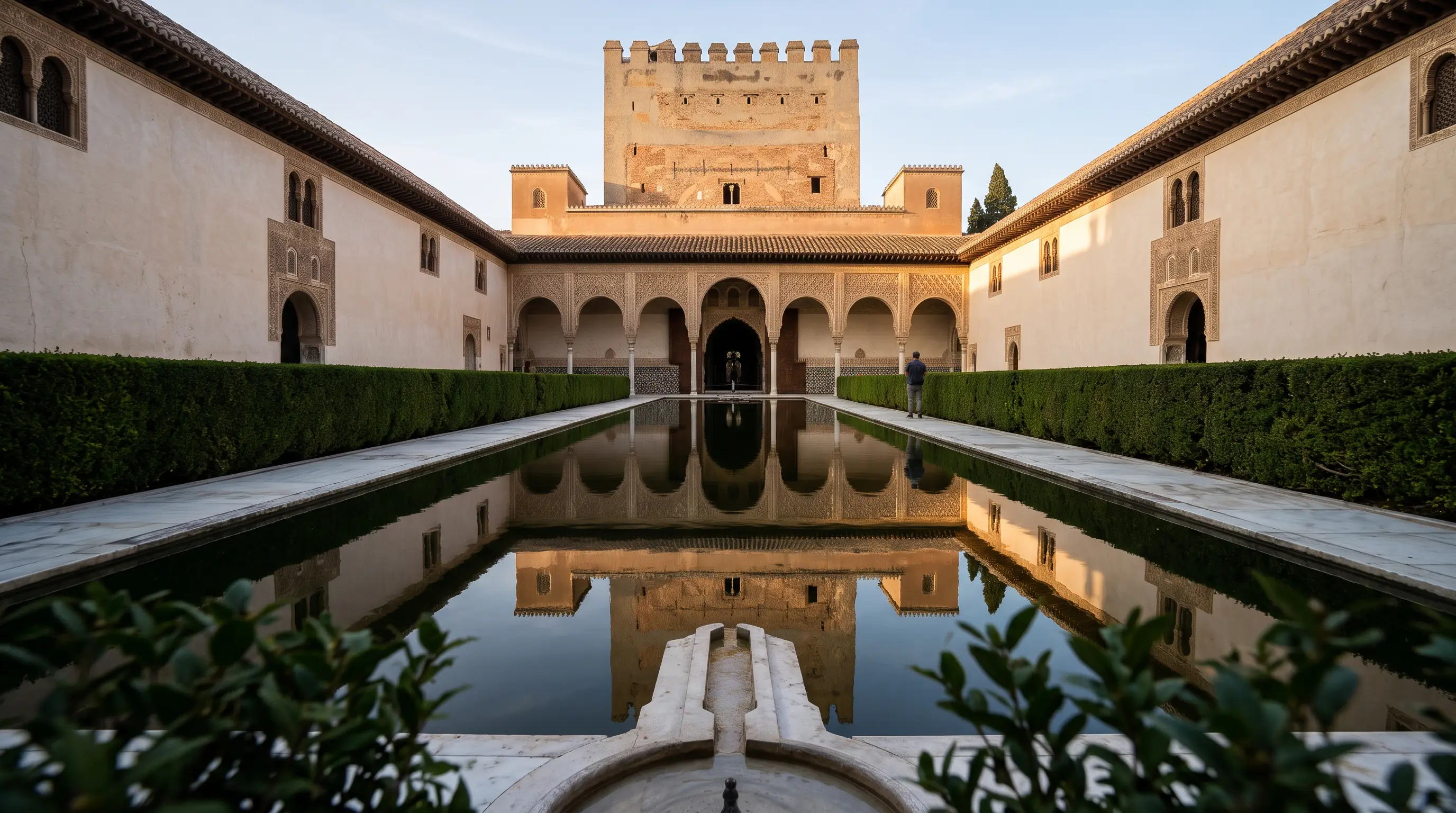
Court of the Myrtles in the Alhambra at golden hour, low myrtle hedges on both sides of the long still pool, white marble paving and the Comares Tower reflected in the water

The Court of the Myrtles is named for the myrtle hedges that line its long central pool, and its Spanish name, Patio de los Arrayanes, uses the Arabic-derived word for the shrub.

The Court of the Myrtles is named for the myrtle hedges that line its long central pool, and its Spanish name, Patio de los Arrayanes, uses the Arabic-derived word for the shrub.[4][5] The pool supplies a second name, the Patio de la Alberca, or Court of the Pool.[6] Both names describe the garden, not the building around it, which the Nasrid sultans Yusuf I and Muhammad V reworked in the 14th century.[7]
Central pool
34 x 7.10 m
The pool that gives the Patio de la Alberca its name[1]
Comares Palace refurbished
1362-1367
Muhammad V reworked the court and the Hall of Ambassadors[2]
Navagero visits the pool
1526
Venetian ambassador sees the Comares quarter's pool[3]

Why the court is named for its myrtle hedges
The name is literal. Thick hedges of myrtle run along both sides of the pool, which ends in a fountain at each narrow end,[8] and arrayanes, the plural of arrayán, is the Spanish word for them. Nothing in the name points to a sultan, a battle or a room, only to what a visitor sees on stepping into the court.
Colour does the rest. The shrubs are a vivid green set against the white marble paving,[9] and because the common myrtle, Myrtus communis, is an aromatic evergreen of the Mediterranean scrub,[10] that green does not drop out in winter.
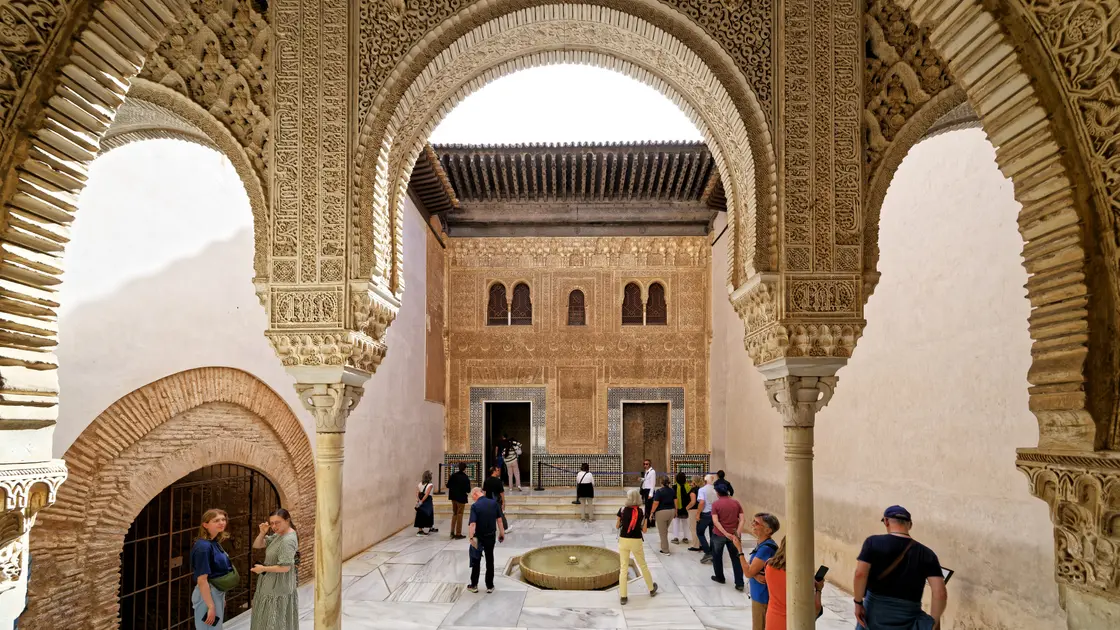
To find it, look for the centre of the Comares Palace: the court sits east of the Mexuar and west of the Palace of the Lions,[27] with the Comares Tower and the Hall of the Ambassadors closing its north end.[28] The general ticket covers it, but the Nasrid Palaces carry a fixed entry slot assigned at purchase that cannot be changed,[29][30] and entry is capped at 300 people every half hour.[31] The original approach is from the west, through the Patio del Cuarto Dorado at the east end of the Mexuar.[32]
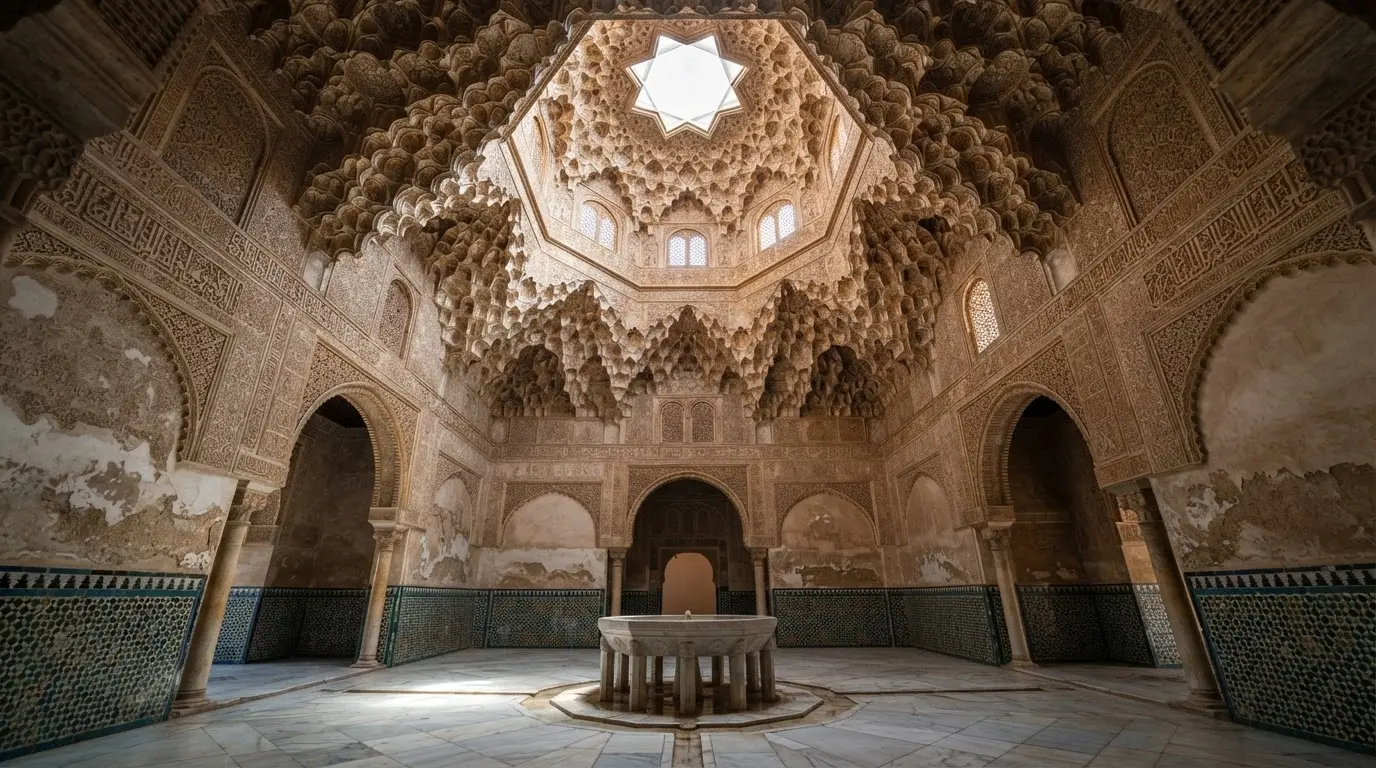
Interior of the Sala de los Abencerrajes Alhambra Granada, a key site in Abencerrajes Granada history, looking up at the octagonal muqarnas honeycomb stalactite ceiling rising above the twelve-sided central marble fountain, shafts of light filtering through high windows, warm stone walls with geometric tile dadoes below carved stucco friezes

Deep dive · Article

Abencerrajes of Granada: the noble clan behind the legend

Abencerrajes of Granada: the noble clan who shaped Nasrid court politics for a century and became legend through a massacre story set in the Alhambra.

The layout explains why the naming was so easy. A long rectangle with a strip of water down its middle and a green hedge on either side leaves two obvious things to call it by, the plant and the pool, and the court ended up with a name for each.[8] Seen from either narrow end, the composition reads as water flanked by green, with the marble underfoot setting both off.

One courtyard, four names

Three of the court's four names single out one element of the garden, the plant or the pool,[11] and the fourth, Comares, names the palace. The list runs from the plant to the palace:
  • Patio de los Arrayanes, the Court of the Myrtles: the hedges
  • Patio de los Mirtos: the same shrubs under a second Spanish word
  • Patio de la Alberca, the Court of the Pool: the water
  • Patio de Comares, the Comares Court: the palace the court belongs to[12]

34 x 7.10 m

Length and width of the central pool, the feature behind the name Patio de la Alberca.[1]
That alberca is no small ornament. At 34 metres it fills nearly the whole length of a court 36.6 metres long and 23 to 23.5 wide,[1][13] with its long axis running roughly north to south, so the water, not the planting, sets the proportions of the room.
Comares is the odd one out, since the palace's own name needs explaining, and one explanation derives it from comarías, the Arabic word for the coloured glass windows that covered the hall of the Comares Tower.[14]

The Arabic behind arrayán and alberca

Both of the court's main Spanish names are Arabic loanwords. Arrayán comes from Andalusi Arabic arrayḥán, and behind that from Classical Arabic arrayḥān;[5] alberca comes from Andalusi Arabic albírka, from Classical birkah.[15] Spanish took both words from the speech of al-Andalus.
The two words split the court between a plant and a piece of engineering. An arrayán is an aromatic evergreen shrub,[10] where an alberca is an artificial water tank with built walls, made for irrigation.[16] Alberca is the plainer word, which makes the Patio de la Alberca a more workmanlike name than its English rendering, the Court of the Pool, suggests.
The Alhambra palace complex viewed from the Albaicin hillside, with the Sierra Nevada mountains behind

Explore nearby · Monument

Alhambra

The Alhambra is Granada's UNESCO fortress-palace: Nasrid Palaces, Alcazaba and Generalife gardens. Tickets sell out weeks ahead; book via the Patronato site.

The distinction helps with older descriptions. A text that says alberca, estanque or arrayanes is pointing at one part of this single court each time, and the English guidebook names are translations of those labels rather than separate places.[11]
That Arabic layer runs under the complex's own name too: the meaning of the name Alhambra is another Arabic word that Spanish and English kept.

What myrtle meant in an al-Andalus garden

Myrtle was the signature plant of the gardens of al-Andalus.[17] When Ibn al-Khatib, the 14th-century Granada scholar, wanted a phrase for the act of making a garden, he used joining myrtles.[18] A court named for that plant carries the period's own shorthand for a garden in its title, and the plant has a sensory side the name leaves out: small, numerous white flowers of intense fragrance open in spring.[19]
Water does a different job. A short channel at each end lets the flow slow and pause before it enters the pool, reducing ripples,[20] so the surface stays calm enough to show the tower upside down. One reading takes that inverted image as a symbol that everything is changeable except God.[21] The same pool feeds a wider logic of controlled water that the Alhambra water system explains from the source down.
Foreign visitors recorded the pairing of pool and myrtle early. In 1526 the Venetian ambassador Andrea Navagero saw the pool of the Comares quarter with myrtle bowers and some orange trees at its sides,[3] which puts myrtle beside this water five centuries ago. The orange trees he mentions show that the planting around the pool was never limited to one species, yet the myrtle is the one that stuck to the court's name, and the one the Patronato calls the plant par excellence of al-Andalus gardens.[17]

The court today: what to look for

Muhammad V refurbished the Comares Palace between 1362 and 1367, work that took in both the court and the Hall of the Ambassadors.[2] The Patronato de la Alhambra y Generalife singles the court out as a highly unusual example of extraordinary aesthetic continuity.[22]

What to look for in the court

  • Myrtle hedges along both sides of the pool, green against white marble
  • A fountain at each narrow end of the long pool
  • The Comares Tower reflected in the still water
  • The surviving façade of the southern pavilion, kept when the Palace of Charles V was built
One later change is still visible at the south end: most of the pavilion there was demolished for the Palace of Charles V, and only its façade was kept so the courtyard would not lose its visual integrity.[23] A small passage now links the court to the Palace of the Lions, from which the Comares Palace was originally independent.[33]
The plant itself is a shrub of two to three metres with flexible branches and small, hard, glossy leaves that persist through the year,[24] a bushier habit than the green edging of the court suggests. Shearing it is an old Spanish garden habit: an early 16th-century agricultural treatise by Herrera says myrtle can be clipped flat on top like a table,[25] and the botanist Joseph Quer noted in the 18th century that gardeners cut it with shears into designs and figures.[26]
Stop at the pool rather than walking past it, because that is where the hedges, the water and the tower come together. For the order of rooms and the timing of the visit, follow the self-guided Alhambra tour.

Frequently asked questions

Why is it called the Court of the Myrtles in the Alhambra?

Myrtle hedges grow along both sides of its central pool. The Spanish name, Patio de los Arrayanes, uses the Arabic-derived word for the shrub.[4][5]

What does Patio de los Arrayanes mean in English?

It translates as Court of the Myrtles. The alternative Patio de los Mirtos names the same shrubs with a different Spanish word.[9]

What is the Patio de la Alberca, and is it the same courtyard?

Yes. Alberca is the pool, 34 metres by 7.10, and it gives the court its second name, the Court of the Pool.[1][6]

What does alberca mean in Spanish?

It is an artificial water tank with built walls, used for irrigation, from Andalusi Arabic albírka.[15][16]

Why is the Court of the Myrtles also called the Comares Court?

It belongs to the Comares Palace, and the Patio de Comares is a name sometimes used for it.[12] One explanation traces the palace's own name to comarías, the Arabic word for coloured glass windows.[14]

Are the myrtle hedges in the Court of the Myrtles original?

A pool with myrtle beside it was already on record in 1526, when Andrea Navagero saw it.[3] No firm planting date for today's shrubs is established, so treat any guide that gives one with caution.

What did myrtle mean in al-Andalus gardens?

It was the plant par excellence of their gardens,[17] and Ibn al-Khatib used the phrase joining myrtles for the act of making a garden.[18]

Sources

33 references Show
  1. Court of the Myrtles (opens in a new tab)

    “The pool measures 34 metres long and 7,10 meters wide.”

  2. Court of the Myrtles (opens in a new tab)

    “Between 1362 and 1367 he refurbished the Comares Palace (namely the Court of the Myrtles and the Hall of Ambassadors).”

  3. Cuadernos de la Alhambra 35 (1999) (opens in a new tab)

    “En la visita llevada a cabo en 1526 el veneciano Andrea Navagero (1483-1529) vio la alberca del Cuarto de Comares”

  4. Court of the Myrtles (opens in a new tab)

    “The name of the Court of the Myrtles (Patio de los Arrayanes) is due to the myrtle bushes that surround the central pool.”

  5. Diccionario de la lengua española: arrayán (opens in a new tab)

    “Del ár. hisp. _arrayḥán_, y este del ár. clás. _arrayḥān_.”

  6. Court of the Myrtles (opens in a new tab)

    “Because of the pool, the courtyard is also called the Patio de la Alberca ('Courtyard of the Pool').”

  7. Court of the Myrtles (opens in a new tab)

    “It was begun by the Nasrid sultan Isma'il I in the early 14th century and significantly modified by his successors Yusuf I and Muhammad V later in the same century.”

  8. Gothein, A History of Garden Art: the Alhambra (opens in a new tab)

    “At each narrow side it ends in a fountain, and on both sides there are thick hedges of myrtle.”

  9. Alhambra.info: Courtyard of the Arrayanes (opens in a new tab)

    “The current denomination (like that of Patio de los Mirtos) is due to the arrayanes (or myrtle) massifs whose vivid green color contrasts with the white marble floor of the patio”

  10. Junta de Andalucía: ficha del mirto (opens in a new tab)

    “También conocido como arrayán, es un arbusto muy aromático de hoja perenne que forma parte del matorral mediterráneo.”

  11. Alhambra.info: Courtyard of the Arrayanes (opens in a new tab)

    “It is also called Patio de los MIRTOS, ARRAYANES or ALBERCA depending on the elements it presents in the patio.”

  12. Court of the Myrtles (opens in a new tab)

    “It is sometimes also called the Patio de Comares ('Comares Court').”

  13. Court of the Myrtles (opens in a new tab)

    “The Court of the Myrtles measures 23 to 23.5 metres wide and 36.6 metres long, with its long axis aligned roughly north-to-south.”

  14. Junta de Andalucía: recurso didáctico sobre la Alhambra (opens in a new tab)

    “EL PALACIO DE COMARES o CUARTO DE COMARES debe su nombre a comarías , nombre en árabe de las vidrieras de colores que cubrían el Salón de la Torre de Comares.”

  15. Diccionario de la lengua española: alberca (opens in a new tab)

    “Del ár. hisp. _albírka_, y este del ár. clás. _birkah_.”

  16. Diccionario de la lengua española: alberca (opens in a new tab)

    “Depósito artificial de agua, con muros de fábrica, para el riego.”

  17. Patronato de la Alhambra: Juntando arrayanes (opens in a new tab)

    “El arrayán (mirto) es la planta por excelencia de los jardines de al-Andalus”

  18. Patronato de la Alhambra: Joining myrtles (opens in a new tab)

    “The phrase “joining myrtles” was used by Ibn al-Khatib, a 14th century scholar from Granada, to symbolize the act of making a garden.”

  19. Junta de Andalucía: ficha del mirto (opens in a new tab)

    “Sus pequeñas y numerosas flores blancas de intensa fragancia florecen en primavera”

  20. Court of the Myrtles (opens in a new tab)

    “the channel is design to let the water slow and pause before emptying into the pool, thus reducing the formation of ripples”

  21. Junta de Andalucía: recurso didáctico sobre la Alhambra (opens in a new tab)

    “El agua tranquila hace espejo y crea la imagen invertida de la torre ( simbolismo de que todo es mudable menos Alá )”

  22. Patronato de la Alhambra: Joining myrtles (opens in a new tab)

    “Some, such as the Court of the Myrtles, are highly unusual examples of extraordinary aesthetic continuity;”

  23. Court of the Myrtles (opens in a new tab)

    “Only the façade of this structure was preserved in order to maintain the visual integrity of the courtyard.”

  24. Diccionario de la lengua española: arrayán (opens in a new tab)

    “Arbusto de la familia de las mirtáceas, de dos a tres metros de altura, oloroso, con ramas flexibles, hojas opuestas, de color verde vivo, lustrosas, pequeñas, duras y persistentes”

  25. Cuadernos de la Alhambra 35 (1999) (opens in a new tab)

    “puédenles tundir que se hagan copados y llanos encima como mesa”

  26. Cuadernos de la Alhambra 35 (1999) (opens in a new tab)

    “En nuestros jardines hacen dibuxos, y distintas figuras con la tixera, de bellísimo aspecto a la vista.”

  27. Court of the Myrtles (opens in a new tab)

    “It is located east of the Mexuar and west of the Palace of the Lions.”

  28. Court of the Myrtles (opens in a new tab)

    “The Comares Palace is centered around the Court of the Myrtles, with the Comares Tower and the Hall of Ambassadors to the north”

  29. Spain.info: cómo comprar entradas para la Alhambra (opens in a new tab)

    “La entrada general da acceso a todos los espacios visitables.”

  30. Spain.info: cómo comprar entradas para la Alhambra (opens in a new tab)

    “solamente los Palacios Nazaríes tienen un horario preestablecido que se asigna en el momento de la compra y que no se puede modificar”

  31. Patronato de la Alhambra: preguntas frecuentes (opens in a new tab)

    “Recuerde ser puntual en el horario seleccionado para visitar los Palacios Nazaríes debido al control de aforo existente, 300 personas cada media hora.”

  32. Court of the Myrtles (opens in a new tab)

    “The Court of the Myrtles was entered from the west via a smaller courtyard, the Patio del Cuarto Dorado ('Courtyard of the Gilded Room'), at the east end of the Mexuar.”

  33. Court of the Myrtles (opens in a new tab)

    “It was originally independent of the Palace of the Lions to the east, but is now connected to it via a small passage.”