The barrio that became an open-air gallery
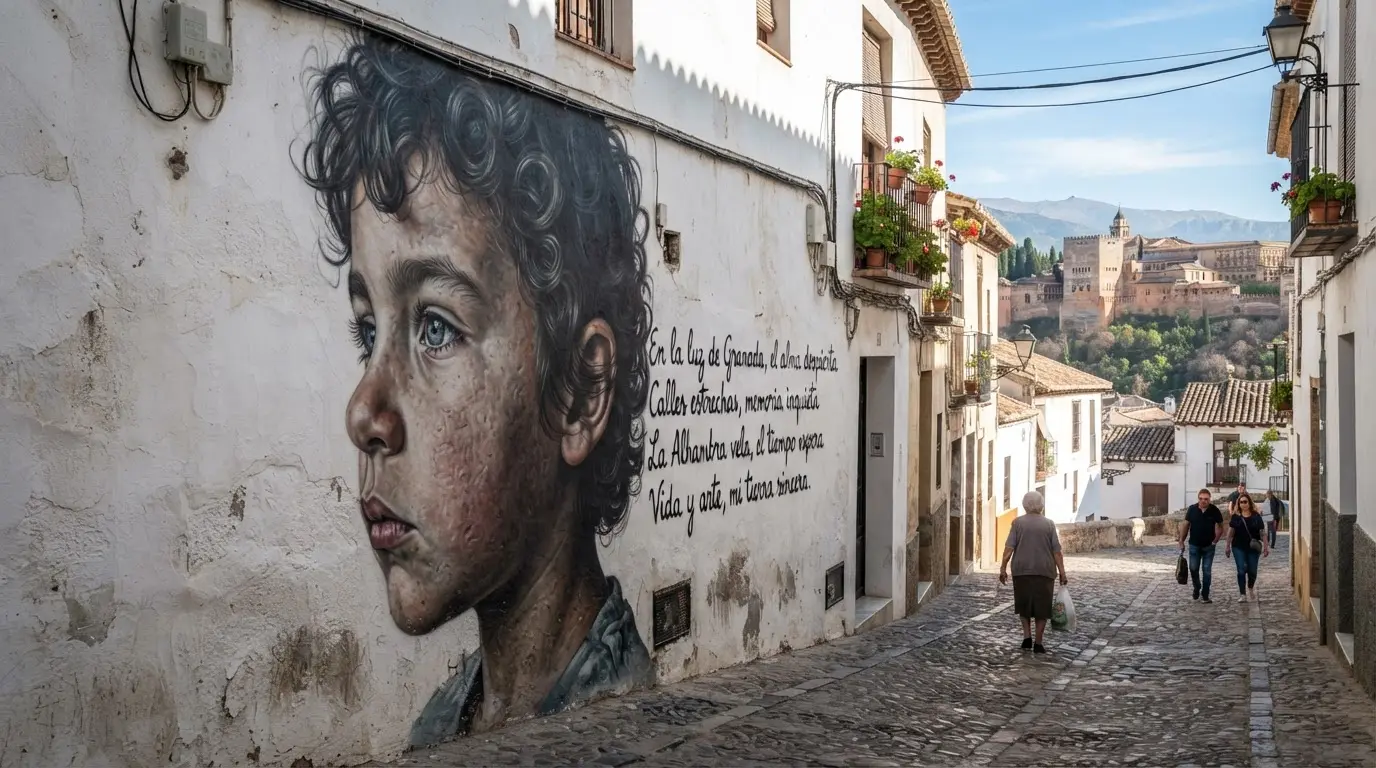
Walk the Realejo today and the faces come at you from gable ends and garden walls: children's faces, mostly, painted at twice life size, with handwritten lines of text running down the plaster beside them. Get the light right, late afternoon, and they catch a highlight like wet varnish. The densest run is around Calle Molinos and the long walls of the Colegio Santo Domingo, and the barrio has learned to live with it. This was Granada's old Jewish quarter, Garnata al-Yahud in the Arab period; the Sephardic history is told properly in our profile of the Realejo Jewish Quarter, and the paint came later, on top of the same walls.
The paint has a single author. Neighbours of Raúl Ruiz have told him straight: nobody ever came to the barrio to photograph the walls before he painted them[4].
“Men in my neighbourhood have told me: "what you paint or don't paint is all the same to me, but the truth is, when had people ever come here to take photos of the walls? That, you did."”
What sits on those walls is not a fixed collection. Murals get erased, repainted and transformed, and the impermanence is part of the medium; Ruiz has painted the same idea twice on the same wall more than once. For the map of where his work lives right now, our Granada street-art guide plots the routes. This story follows the man who put the paint there.
The Realejo was the right barrio for it, and the Albaicín was not. My own reading is that the flat, busy quarter below the Alhambra had blank wall to spare and a student population that liked the noise, where the whitewashed Albaicín guarded its postcard. Whatever the cause, the two quarters now send visitors in different directions: the Albaicín for the miradors, the Realejo for the paint.
From a Zaidín kid to El Niño de las Pinturas
Ruiz was born in 1977, and Granada and Madrid both claim the birth; he has let both versions stand, which is the only honest way to write it. What is not in dispute is that he was raised in the Zaidín, the flat district across the Genil built for workers rather than postcards, and that he lives now in the Realejo, in the middle of his own work[5].
He started Fine Arts at the University of Granada and left after a year and a half[6]; the record treats the decision without ceremony. His first tags go back to the late 1980s, and in the 1990s, deep in the rap and breakdance scene, he signed 'Gen' before switching to 'Sex 69' in 1993[7]. The Fine Arts interlude left one trace: the drawing discipline that separates his walls from the average tag.
1996 was the year everything locked into place. With other writers he co-founded Los Jinetes del Apocalipsis (LJDA), the Four Horsemen of the Apocalypse, a graffiti collective that became a reference for writers across much of Europe[8]. English readers keep taking LJDA for a mural; it was never a work, it was the crew. That same year he opened La Tapadera, the hip-hop shop on Calle Nueva de San Antón that became the meeting point of the scene[9].
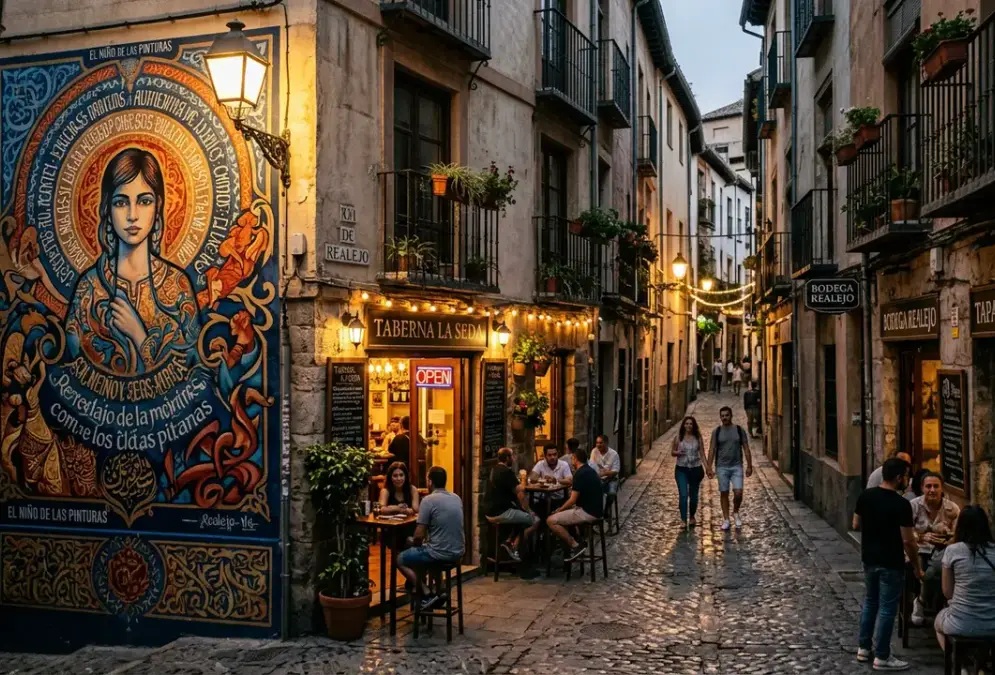
Explore · Neighbourhood
Realejo / Jewish Quarter
Medieval Granada's Jewish quarter, now a neighbourhood of historic palaces, street art, and the city's finest tapas bars — all at the foot of the Alhambra.
The full identity took another five years. In 2001, after years of intense graffiti, police pursuit and personal reinvention, he definitively became El Niño de las Pinturas, 'the boy of the paintings'[10]. No source explains why he chose the name, so nobody gets to invent that story; the translation is the safe ground.
The style: faces, haiku and clockwork gears
The signature is a hyper-realist human figure, a child or adolescent above all, and the face most of all[11], painted at a scale that makes the wall read as a person standing in it. The eyes track you down the street, which is the point; get close and the aerosol has been worked like pencil, in fine vertical passes. Beside the figures runs handwritten text: short poems and aphorisms that read like haiku, reflections of a nonconformity aimed at society[12].
Granada's provincial government, which has spent years fining him, describes the mix with more polish than he would bother with: 'delicate linework' interwoven with 'powerful messages often close to poetry'[13].
The style fuses graffiti, drawing, painting and Arabic calligraphy with poetry[14], a combination that reads naturally in a city that spent eight centuries with Arabic on its walls. The most personal signature is the time-gear (tuerca de tiempo): little clockwork mechanisms drawn into the composition, recurring across his work and still present on his studio canvases[15].
Within the culture he has reached the rank of king or master, respected by the rest of the writing and spray-paint community[16]. It is the graffiti world's aristocracy, and it is earned the hard way: a decade of getting up, getting caught and getting painted over. El Salto, which has interviewed him at length, calls Granada a reference point on the international urban-art scene and Ruiz its maximum exponent.
The erasure wars: how Granada fines its most famous painter
The first big erasure came in 1995, ahead of Granada's World Ski Championship — postponed to February 1996 for lack of snow — when the council scrubbed much of the city's graffiti in time for the cameras. Ruiz, still Sex 69, answered with Calagad 13: the two painted as many walls as possible, an act of creative resistance[17] that is the same gesture, essentially, he has made ever since.
The turning point was the Ordenanza Cívica of 2009, Granada's civic-ordinance regime that treated graffiti as a cleaning problem: walls scrubbed, restrictions tightened, the same pattern that had already hit Málaga[18].
Two pieces became the battleground. The cable-head giraffe began as a knot of cables in a junction box on a yellow wall; with a few simple strokes Ruiz added the body and the barrio got a legend[19]. It was one of the simplest pieces he ever painted, and it became one of the most fought-over: it survived years of conflict with the council before being erased, and in 2020 he brought it back as a trompe-l'oeil, after it had been scrubbed twice[20]. Recovered as a painted illusion, it now argues with the wall that erased it.
Recommended tours
Tours are selected for quality, not commission. We earn a small fee if you book — at no extra cost to you.
The orange cat of the El Gato Gordo micro-theatre on the Cuesta del Realejo went a different way: erased from the Realejo, it was later repainted in New York[21].
The council's dual attitude is what makes Ruiz's story Granada-specific. Across some twenty years of dealing with the institutions he has been given prizes and fined around 5,000 euros; commissioned for important events and forbidden from restoring the works the public loves[22]. That is not neglect; it is a policy with both hands: a clean wall for the official postcard, a famous painter for the brochure, and never the two reconciled.
Murals are impermanent
Plan your visit around the barrio, not a single wall. Works here are erased, repainted and transformed without notice: the giraffe came back as a trompe-l'oeil, the orange cat left for New York. A mural you saw in a photo last year may have become something else by the week you arrive.
The restraint is his own. He has never painted the Alhambra, and he says nobody has: a million graffiti writers and not one has touched it. 'There is a respect for things'[23]. The council scrubs; the artist declines, and the impermanence is the point: nothing on these walls is guaranteed.
New York, Lorca, and the studio years
In mid-2015 Ruiz went to New York for a couple of weeks and nearly stayed: the trip stretched to almost two months of chained projects[24]. In Manhattan he faced Brooklyn writer Cern in a live ArtBattles duel, the North American champion of the league against the European champion[25].
For the Governors Ball Festival on Randall Island he painted a mural 6 metres high: a Statue of Liberty gazing at itself, wrapped in a subway car[3].
The commission that defined the trip came through Granada singer Lara Bello and a film crew shooting a documentary on Federico García Lorca's New York years. They asked for a giant mural on the facade of the City Rooms NYC hotel on Lafayette Street, at the Soho end, at the entrance to Chinatown, inspired by the verses of Poeta en Nueva York[26]. It has become one of his most important works[27], and it is not in Granada: 'Lorca is also there, and not in the middle of Granada's city centre', as the El Salto interview put it[21]. No El Niño Lorca mural exists in the Realejo or anywhere else in the city centre; the New York facade is the work.
The Granada connection continued in January 2020, when Ruiz unveiled a street-art exhibition and a mural on the main facade at Lorca's birthplace museum, the Casa Natal in Fuente Vaqueros, under the 'Federico en tu ruta' programme[28].
Deep dive · Article
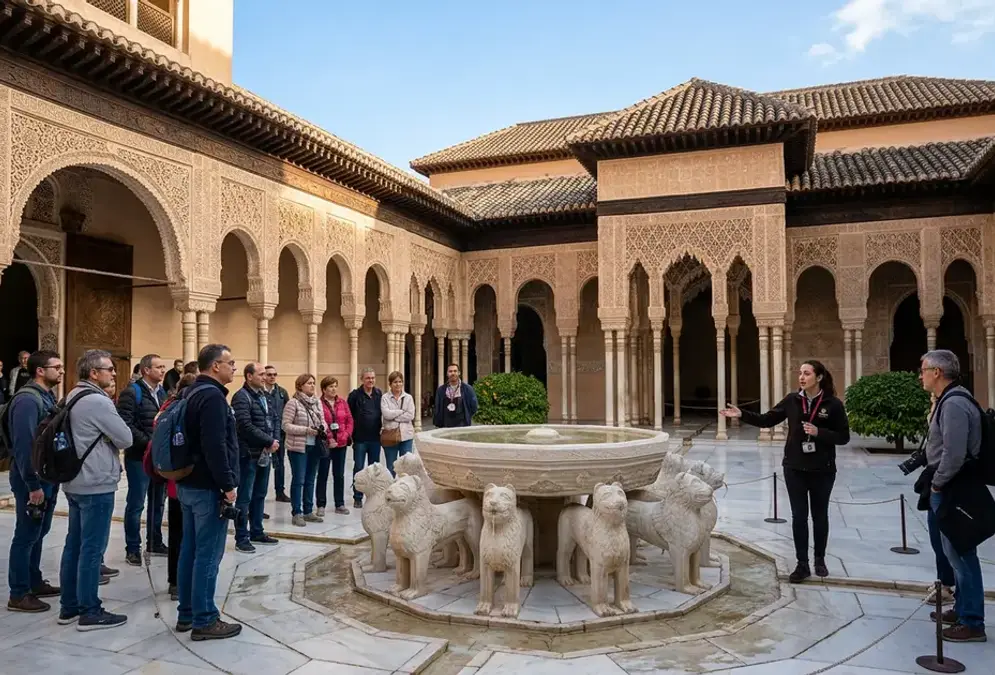
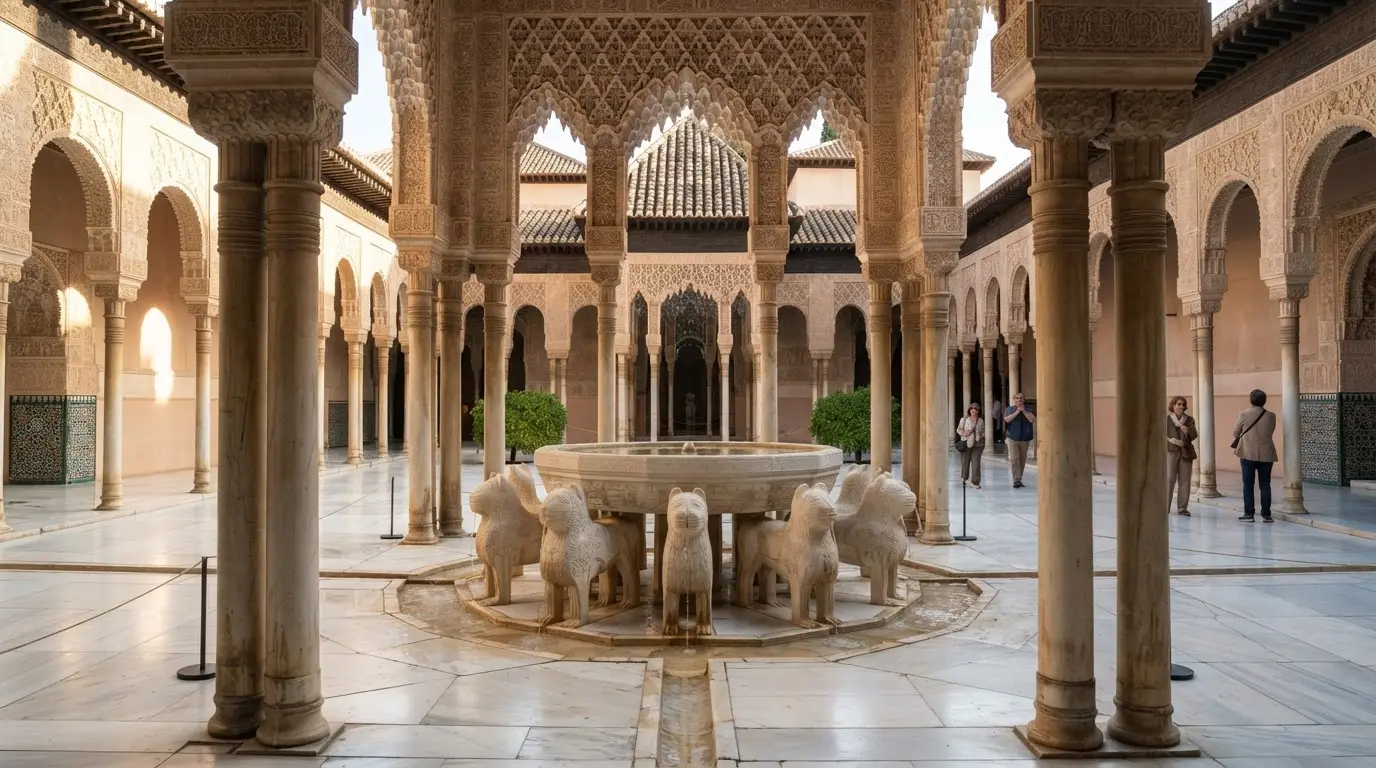
Court of the Lions Alhambra Granada: Decoding the Courtyard
Court of the Lions, Alhambra Granada: 124 marble columns, a lion fountain 650 years old, a Quranic paradise built by Muhammad V. What to see and when.
Two books document the career. A través del muro, in its third edition by 2020, is a personal archive of photos, press clippings and notes up to 2006[29]. El mundo está oscuro, ilumina tu parte, 'The world is dark, light up your part', published in 2021, runs 273 pages of a world tour through his art[30]; the title doubles as his motto.
The daily work has shifted toward the studio in recent years, with exhibitions into 2022 and 2024 covered by the local press. But the street is where he still wants to be: 'Painting on the street is what I love most. I don't believe I'll ever stop painting on the street'[31]. More than thirty years in[2], the walls of the Realejo are still the best place to meet him. The Realejo barrio walk passes the densest concentrations; bring fresh eyes rather than a checklist, because the walls change.