Mudéjar Granada: Islamic Art After the Reconquista
Mudéjar art in Granada: after 1492, Muslim craftsmen built Albaicín churches with horseshoe arches, sebka lattice and artesonado ceilings for Christian patrons.
Seven years resident in Granada. Specialist in Nasrid architecture, Al-Andalus history, and Andalusian walking routes.
Updated Published
The fall of Granada in 1492 did not stop Muslim craftsmen from working in the city. For another century, they built churches in the Albaicín using the same techniques that had decorated the Alhambra — horseshoe arches, interlocking sebka lattice, artesonado wooden ceilings — but now for Christian patrons. That hybrid, called Mudéjar, is one of the most historically layered art forms in Spain, and Granada's Albaicín is the best place in Andalusia to read it.
In this article
Jump to a section
⌄
What Mudéjar means and where it comes from
The word Mudéjar comes from the Arabic muwaddaj, meaning tamed or domesticated.[1] It was applied to Muslims who remained in territories reconquered by Christian kingdoms during the medieval period, and it carries, in its etymology, the political subordination of the communities it names. By the 15th century, Mudéjar described both the people and the architectural style they produced: Islamic decorative technique employed in buildings that served Christian purposes.
As a category of art history, Mudéjar is often stretched too wide. In Toledo and Seville, the style developed from the 12th century, long before the fall of Granada.[1] The Granada variant is specific to the post-1492 period, shorter-lived, and distinct in character because it emerged directly from the collision between the Nasrid court tradition and the administrative demands of a Christian conquest rather than from a longer, more incremental process of cohabitation.
1492–1609
Granada's Mudéjar period lasted roughly 117 years, from the Christian conquest to the final expulsion of the Moriscos. The living tradition of Muslim craftsmen working in the city ended with that expulsion.
The ornamental vocabulary these craftsmen carried into Granada's churches came from centuries of Andalusian Islamic practice: fired brick construction, geometric arabesques in carved stucco, glazed ceramic tile at dado level, and the woodworking tradition that produced the intricately compartmented ceilings known as artesonado. The craftsmen knew no other way to build well. Their Christian patrons, many of whom had just arrived in a city whose physical beauty was widely acknowledged as exceptional, wanted exactly what those craftsmen knew how to make.
The 1492 turning point: tolerance, then prohibition
When Ferdinand and Isabella accepted the surrender of Granada on 2 January 1492, the terms of the Reconquista included explicit protections for the Muslim population. The Granada Capitulations guaranteed that Muslims could keep their mosques, their laws, their language, and their customs.[2] For a few years, these promises held. Muslim craftsmen continued working. The technical knowledge that had built the Alhambra did not vanish on the day the keys changed hands.
The protections eroded quickly. In 1498, the city prohibited Mudéjar residency in certain areas of Granada, beginning a pattern of spatial and legal restriction.[2] Cardinal Francisco Jiménez de Cisneros, who arrived in Granada in 1499, accelerated the process: he ordered the mass burning of Arabic manuscripts in the city's main square, then forced conversions on a scale that explicitly violated the Capitulations. The 1502 decree required all Muslims in Castile to choose between baptism and exile. Most submitted to baptism and became Moriscos — nominally Christian, legally subject to the Inquisition, practically unable to maintain their cultural identity openly.
The Moriscos who remained in the Albaicín through the 16th century continued to practice traditional crafts. The demand for their skills did not disappear. Ironically, the very churches built to replace the mosques of a conquered Muslim city were constructed by the craftsmen of that city, using techniques developed over four centuries of Islamic building in Andalusia.
The final rupture came in 1609, when Philip III signed the decree of expulsion. Between 1609 and 1614, around 300,000 Moriscos were forced out of Spain.[2] The craftsmen who had sustained the Mudéjar tradition in Granada left with them. What remained were the buildings.
Timeline
2 Jan 1492
Fall of Granada
Boabdil surrenders the city to Ferdinand and Isabella. The Capitulations guarantee Muslim rights, mosques, and customs.
1498
First restrictions
Local prohibitions on Mudéjar residency in Granada begin. The legal framework of tolerance starts to unravel.
1499–1502
Cisneros and forced conversion
Cardinal Cisneros orders mass conversions, burns Arabic manuscripts in the Plaza Mayor. The 1502 decree forces all Castilian Muslims to convert or leave.
1568–1571
Alpujarras rebellion
The Morisco community in the mountain villages east of Granada rises against cultural suppression. The revolt is crushed; survivors are deported to Castile.
1609–1614
Morisco expulsion
Philip III's decree forces around 300,000 Moriscos out of Spain. The living tradition of Mudéjar craft in Granada ends.
The ornamental vocabulary: what to look for
Mudéjar decoration in Granada's churches draws on a specific set of techniques. None of them was invented after 1492; all of them trace to Islamic building practice in Andalusia, often centuries earlier.
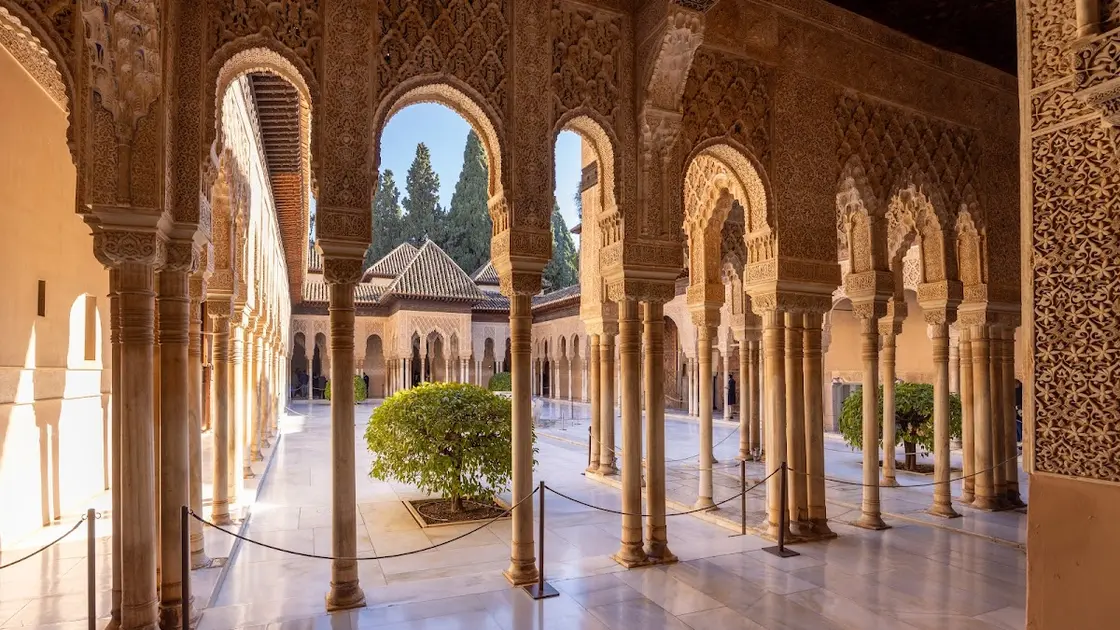
Horseshoe arches (arcos de herradura) are the most immediately recognisable element. The arch continues below the semicircle, so that the curve extends past the level of the springing point, producing the characteristic horseshoe silhouette. In Nasrid-era buildings this form appears in palatial contexts; in the Mudéjar churches of the Albaicín it frames doorways, courtyard arcades, and interior openings.[3]
Sebka lattice is the interlocking diamond pattern that covers upper wall surfaces and spandrels. It traces to the 10th-century Great Mosque of Córdoba, where it appears in the mosaic-decorated facades of the royal enclosure, and was refined through the Almohad and Nasrid periods before being adopted by Mudéjar craftsmen.[3] In practice, sebka is a continuous grid of small pointed lozenges achieved through carved stucco or ceramic inlay. The pattern creates an impression of surface depth that solid masonry cannot produce.
The alfiz is the rectangular frame that surrounds an arch, from the impost line to the top of the framing band. It is a defining feature of Andalusian Islamic doorways and appears consistently on the portals of Albaicín churches where Mudéjar craftsmen worked.[3] Together, the horseshoe arch and its alfiz frame produce the most immediately legible visual signature of this style.
Recommended tours
Tours are selected for quality, not commission. We earn a small fee if you book — at no extra cost to you.
Artesonado ceilings are the technique for which Mudéjar woodworking is most widely known. The word refers to compartmented geometric wooden ceilings in which the structure is divided by interlocking ribs into coffered sections, each filled with geometric or floral carved panels.[1] The mathematics underlying the most complex artesonado patterns is equivalent to that of a muqarnas vault in stone or stucco: the same eight-pointed star and polygon geometry, executed in timber. These ceilings required highly skilled labour and substantial quantities of seasoned wood. Their survival rate in the Albaicín churches has been poor.
Glazed ceramic tiles cover lower wall zones, as they do in Nasrid buildings. In Mudéjar work the palette tends toward blues, greens, and ochres on white grounds, though regional and chronological variation is wide. Fired brick is the constructional material of choice: cheaper than ashlar, more workable, and a material with which Muslim builders in Granada had centuries of experience.
A word on muqarnas in the Mudéjar context: the stalactite vaulting so dominant in the Alhambra's great halls appears in the Albaicín churches in simplified form, mostly in squinches, niches, and smaller transitional zones. The elaborate five-thousand-cell compositions of the Nasrid Palaces were palace-scale commissions for royal patrons. What survives in the churches is a more modest, functional application of the same principle.
The Albaicín churches: where to find Mudéjar in Granada
The largest concentration of Mudéjar work in Granada is in the Albaicín, the hillside neighbourhood across the Darro gorge from the Alhambra. After the conquest, the Catholic Monarchs converted the area's mosques into churches, usually by demolishing the prayer hall and building afresh while repurposing whatever could be kept. The results are architecturally layered in ways that reward close attention.
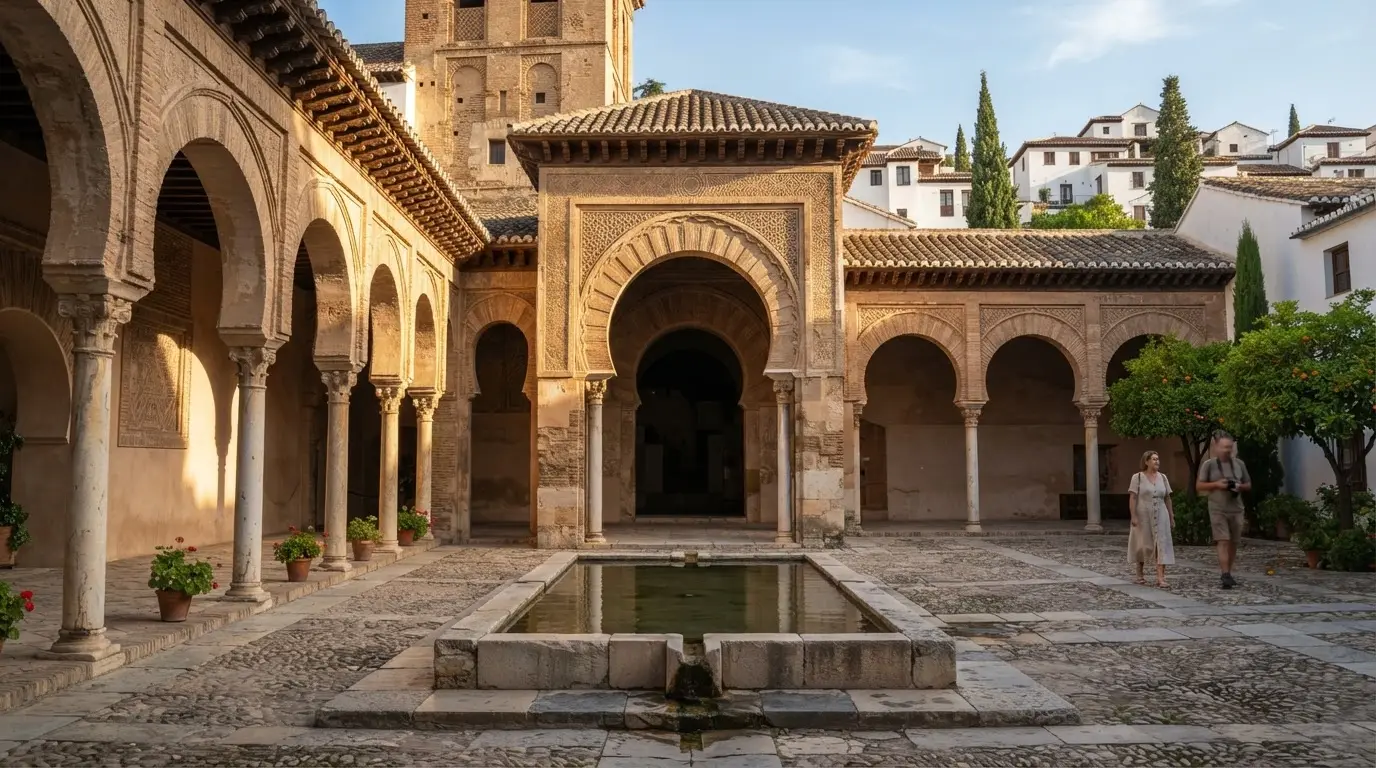
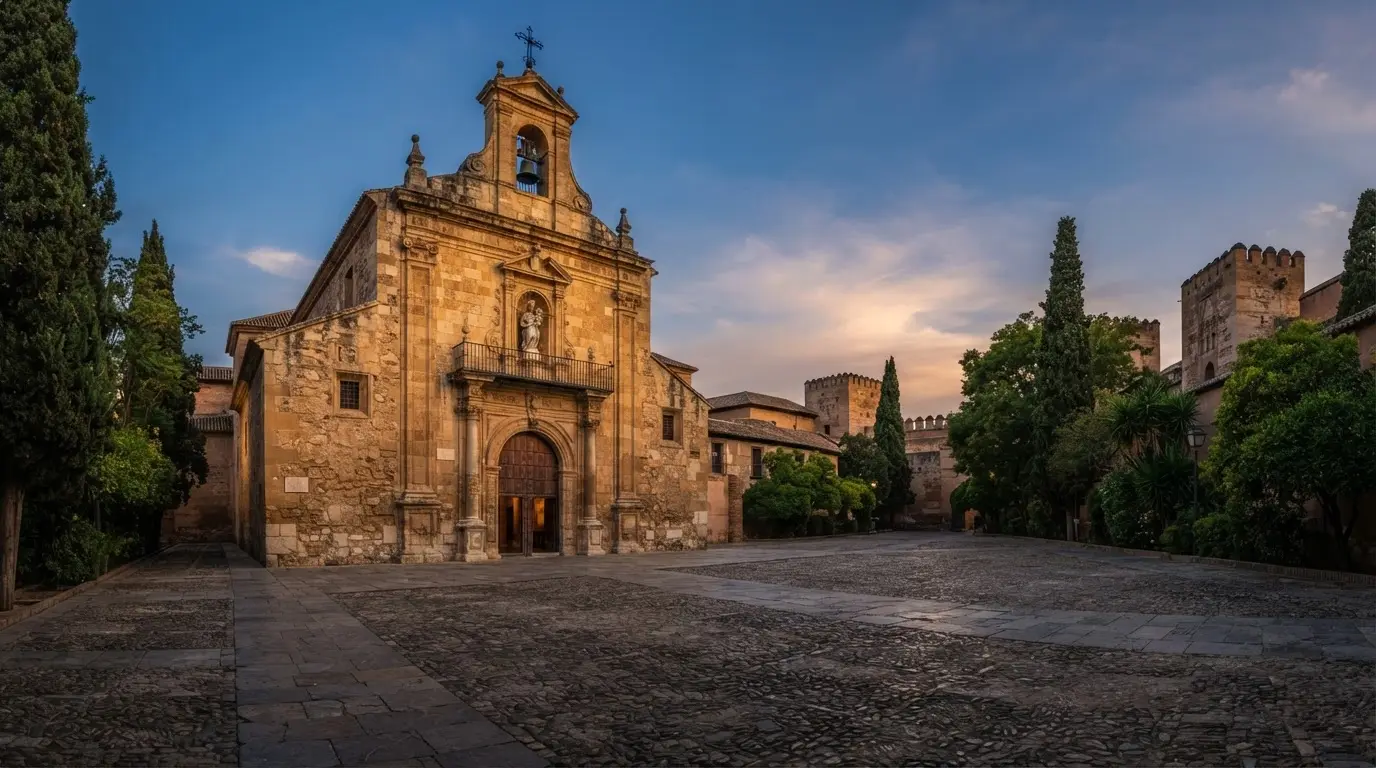
The Iglesia del Salvador is the most important example.[4] The church was begun in 1565 on the site of the Great Mosque of Granada — the main Friday mosque of the Muslim city, originally built in the 13th century. Most of the mosque was demolished to make way for the church, but its courtyard survived intact. The remaining courtyard still has its original horseshoe-arch arcades on three sides and a central cistern that served as the ablution pool for mosque worshippers.[5] This is the only surviving mosque courtyard in Granada, and it is also the clearest visible evidence of the layering that characterises Mudéjar Granada: the church behind you is a post-conquest Christian building; the courtyard you are standing in is a 13th-century Islamic space.
The interior of the Iglesia del Salvador originally had an artesonado ceiling of considerable complexity. A fire during the 1936 Civil War destroyed it. What replaced it after the war was cement — functional and period-typical in its brutality. The courtyard underwent partial reconstruction in the 1950s following damage from the 1936 fire, but it mostly retains its 13th-century mosque fabric — the closest surviving example of a mosque courtyard in Granada.[4]
The Iglesia de San Miguel Bajo sits in the square of the same name, one of the Albaicín's few genuinely open spaces with a view toward the Alhambra. The building retains Mudéjar elements in its structure and decoration, though later renovations have overlaid much of the original work. The square itself is worth the climb regardless: late afternoons, when the sun catches the Comares Tower across the valley, it draws a smaller crowd than the Mirador de San Nicolás a few hundred metres away.
The Iglesia de Santa Ana, at the foot of the Albaicín on the Plaza Nueva, is the most accessible of the three. Its bell tower was built on the base of a former mosque minaret, a pattern repeated across the city. The portal carries alfiz framing and decorative brickwork in the Mudéjar manner. Santa Ana marks the confluence of the Darro (briefly underground at this point) with the path up into the Albaicín, so most visitors to the neighbourhood pass it; few stop to look at the portal carefully.
Outside the Albaicín, the Corral del Carbón in the city centre is the only surviving Nasrid-era funduq in Spain, and its horseshoe-arch portal with alfiz frame shows the vocabulary that Mudéjar craftsmen inherited and adapted. It predates 1492 but illustrates exactly the architectural language the Mudéjar churches deploy.
Mudéjar and Nasrid: how to tell them apart
Visitors who arrive in Granada having read about the Alhambra palace complex sometimes assume that any Islamic-looking building in the city is Nasrid. The distinction matters, and it is easier to make than it appears.
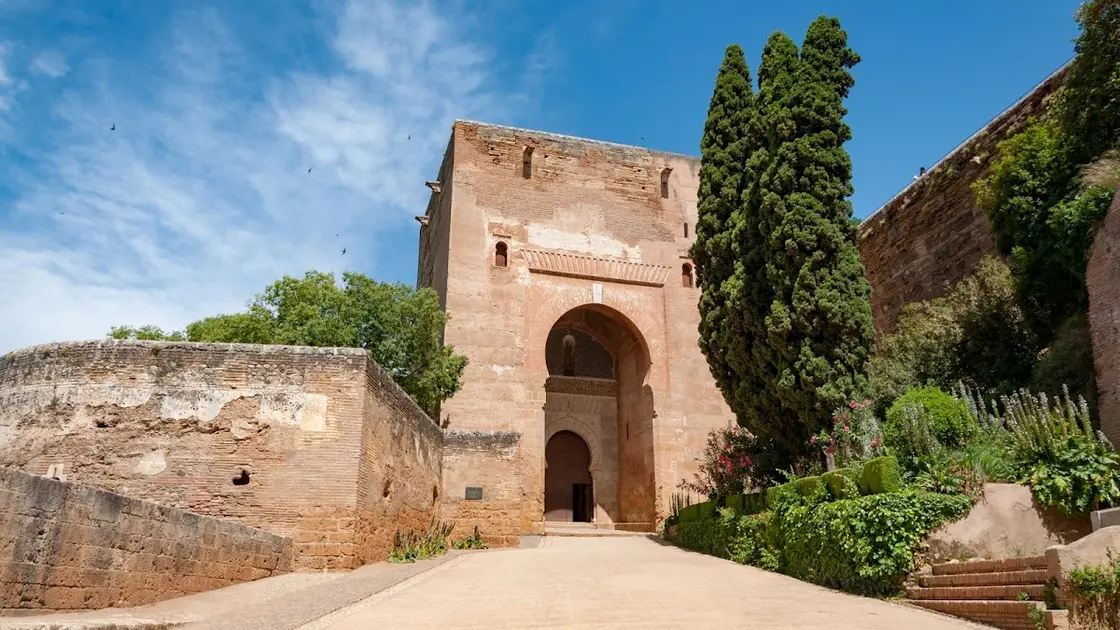
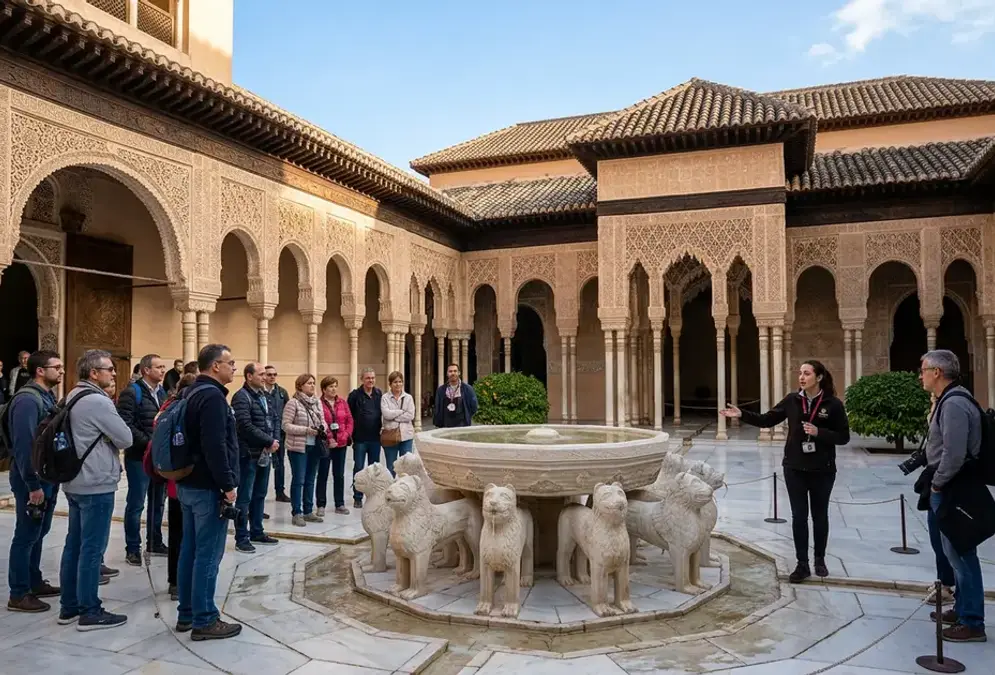
Nasrid architecture is Islamic architecture produced under the Muslim Emirate of Granada, for Muslim patrons, by Muslim craftsmen. The Alhambra — its palaces, towers, and gardens — is Nasrid.[6] So are the Generalife, the Corral del Carbón (as a Nasrid funduq), the Dar al-Horra (the queen mother's palace in the Albaicín), and the Madraza, the Nasrid theological college whose prayer hall survives partly intact on the Calle Oficios. All of this was built before 1492, under emirs who were themselves Muslim, for a Muslim city.[6]
Mudéjar architecture uses the same decorative vocabulary but operates in a completely different political and social context: Christian patrons, post-1492, buildings designed for Christian worship or civic use. The craftsmen were Muslim or Morisco; the clients were the new Christian administration. The Alhambra's royal apartments and the Iglesia del Salvador use horseshoe arches, but the arches in the Alhambra were built by craftsmen working for a Muslim emir who used the space for his court; the arches in the Salvador courtyard were built by craftsmen working for a Catholic institution in a building designed to replace a mosque.
For the companion article on the Nasrid period's own ornamental language — muqarnas, zellige, and yesería as they appear in the Alhambra — see Nasrid Architecture: Muqarnas, Mocárabes, and Zellige Explained. That article covers the craft traditions in their pre-1492 form; this one picks up from the moment those traditions were put to work by a different kind of patron.
For anyone trying to make sense of these distinctions in person, the practical test is simple: if the building was finished before 2 January 1492, it is Nasrid. If it went up after the surrender, under Christian administration, and carries Islamic decorative features, it is Mudéjar. The political history of the Alhambra's rooms adds a further complication — Charles V added a Renaissance palace to the complex after 1492, which is neither Nasrid nor Mudéjar — but for the Albaicín churches, the rule holds.
Decline: why so little Mudéjar survived
Granada's Mudéjar buildings had a difficult 16th century and a worse 20th. Understanding what is gone as well as what survives changes how you read what remains.
The first blow came from policy. From 1498 onwards, a sequence of legal measures stripped Mudéjar craftsmen of their protected status, forced conversions, and restricted where Moriscos could live and work.[2] By the 1560s the community had lost most of its legal standing and much of its economic base. The Alpujarras rebellion of 1568–71, when Morisco communities in the mountain villages south of Granada rose against suppression of the Arabic language and Islamic customs, ended in military defeat and the forced dispersal of survivors across Castile. Craftsmen who had supplied the labour for the Albaicín churches were deported. The 1609 expulsion removed whoever remained.
The buildings they had constructed were left in Christian hands. Some were maintained; others were modified beyond recognition as architectural fashions shifted through the Baroque period and into the 19th century. Artesonado ceilings were sometimes replaced with plaster vaults when the woodwork rotted or when funds ran short for repairs. Tile dados were removed or painted over. The ornamental vocabulary that Christian patrons had commissioned in the early post-conquest decades began to look, to later eyes, insufficiently Christian.
Then came 1936. The Civil War fire that destroyed the artesonado ceiling of the Iglesia del Salvador was not an isolated accident; the conflict damaged or destroyed significant quantities of Andalusian religious and civic buildings. In Granada the loss was concentrated in the Albaicín, which changed hands more than once. The post-war cement replacement at the Salvador stands as the bluntest measure of what was lost: a complex geometric wooden ceiling reduced, within a generation, to a flat slab.
What survives in the Albaicín is therefore a fraction of what was built. The Salvador courtyard is intact because it was outdoors and built of stone. The alfiz portals of several churches survive because carved stone and brick resist fire and neglect better than timber. The full scope of what Granada's Mudéjar period produced — the carved wooden ceilings, the glazed tile ensembles, the elaborated stucco programmes — is recoverable only partially, from archival descriptions and from the better-preserved examples in Seville and Toledo where the tradition had a longer run and a quieter history.
Frequently asked questions
What does Mudéjar mean in the context of Granada's architecture history?
Mudéjar refers to the style of architecture produced by Muslim craftsmen working for Christian patrons after the Reconquista. The word comes from the Arabic muwaddaj, meaning domesticated or tamed. In Granada, the Mudéjar period runs from 1492 to around 1609, when the final expulsion of the Moriscos ended the living tradition of Muslim craftsmen working in the city. The style applies Islamic decorative techniques — horseshoe arches, sebka lattice, artesonado ceilings — to buildings serving Christian purposes, primarily the churches built in the Albaicín to replace converted mosques.
How is Mudéjar architecture different from Nasrid architecture in Granada?
Nasrid architecture was produced before 1492 under the Muslim Emirate of Granada, for Muslim patrons. The Alhambra, the Generalife, and the Corral del Carbón are all Nasrid. Mudéjar architecture uses the same decorative vocabulary but in a post-1492 context: Christian patrons, buildings designed for Christian worship, craftsmen who were Muslim or Morisco. The quickest test is the date: if the building was completed before 2 January 1492 (the date of the surrender), it is Nasrid. If it went up under Christian administration with Islamic decorative features, it is Mudéjar.
Why did Christian patrons in Granada hire Muslim craftsmen after the Reconquista?
Two reasons: technical mastery and aesthetic prestige. Muslim craftsmen were the only people in Granada who knew how to build in the elaborate Andalusian Islamic tradition. They understood the geometry of artesonado ceilings, the fabrication of muqarnas cells, the laying of sebka patterns in carved stucco. Beyond skill, Christian patrons — many of whom had just arrived in a city whose architecture was widely admired — wanted buildings that matched the quality of what the Nasrid emirs had built. Hiring the craftsmen who had built the Alhambra was the obvious way to achieve that.
What are the main decorative elements of Mudéjar art in Granada?
The key elements are: horseshoe arches (arcos de herradura), where the curve extends below the springing point; sebka lattice, an interlocking diamond pattern in carved stucco tracing to the 10th-century Great Mosque of Córdoba; alfiz rectangular frames around arches; artesonado wooden ceilings with compartmented geometric panels; glazed ceramic tiles at lower wall levels; and fired brick as the primary construction material. Simplified muqarnas vaulting also appears in squinches and niches, though not at the palace-scale complexity of the Nasrid Palaces.
Which churches in the Albaicín show Mudéjar architecture?
The three main examples are the Iglesia del Salvador, the Iglesia de San Miguel Bajo, and the Iglesia de Santa Ana. The Salvador is the most significant: begun in 1565 on the site of Granada's 13th-century Great Mosque, it retains the mosque's original courtyard with horseshoe-arch arcades and a central ablution cistern — the only surviving mosque courtyard in Granada. Santa Ana, at the foot of the Albaicín on the Plaza Nueva, has the most accessible portal with its alfiz framing and decorative brickwork. San Miguel Bajo sits in the Albaicín neighbourhood itself, with views toward the Alhambra from its square.
What is an artesonado ceiling?
An artesonado ceiling is a type of compartmented geometric wooden ceiling in which interlocking ribs divide the surface into coffered panels, each filled with carved geometric or floral elements. The underlying geometry — built around eight-pointed star and polygon patterns — is the same as that used in muqarnas stone vaulting, translated into timber. Artesonado ceilings were a speciality of Mudéjar woodworkers and were commissioned for churches, civic buildings, and aristocratic houses across Andalusia after 1492. The original artesonado ceiling of the Iglesia del Salvador in Granada was destroyed by fire in 1936 and replaced with cement.
When did Mudéjar architecture decline in Granada?
Granada's Mudéjar tradition declined in stages. From 1498, legal restrictions began stripping Mudéjar craftsmen of their protected status. Cardinal Cisneros forced mass conversions from 1499. The Alpujarras rebellion of 1568–71 ended in the deportation of Morisco communities to Castile, removing much of the skilled workforce. The Morisco expulsion of 1609–14 eliminated whoever remained. Later modifications and a Civil War fire in 1936 destroyed many of the surviving Mudéjar interiors, including the artesonado ceiling of the Iglesia del Salvador.