What the Granadan school of sculpture actually is
Historians use the label escuela granadina precisely: the tradition of Christian religious sculpture practised in Granada from the 16th century onwards, recognisably a school of its own by the seventeenth.[4] The standard summary of its arc runs in one line. It began with Diego de Siloé, was developed above all by Pablo de Rojas, and culminated in Alonso Cano.[5]
Two things made the city fertile ground for it. The first was the Capilla Real, where the royal funerary monuments of the newly conquered kingdom were carved by imported masters: Domenico Fancelli made the tomb of the Catholic Monarchs, Bartolomé Ordóñez the tomb of Joanna of Castile and Philip I, and Felipe Bigarny the great altarpiece.[6] Granadan workshops watched the most prestigious sculptural project in Spain rise next door, and the skills settled in the city afterwards. You can still read that moment in the building itself; beside the tombs hang Flemish paintings from the same royal collection.
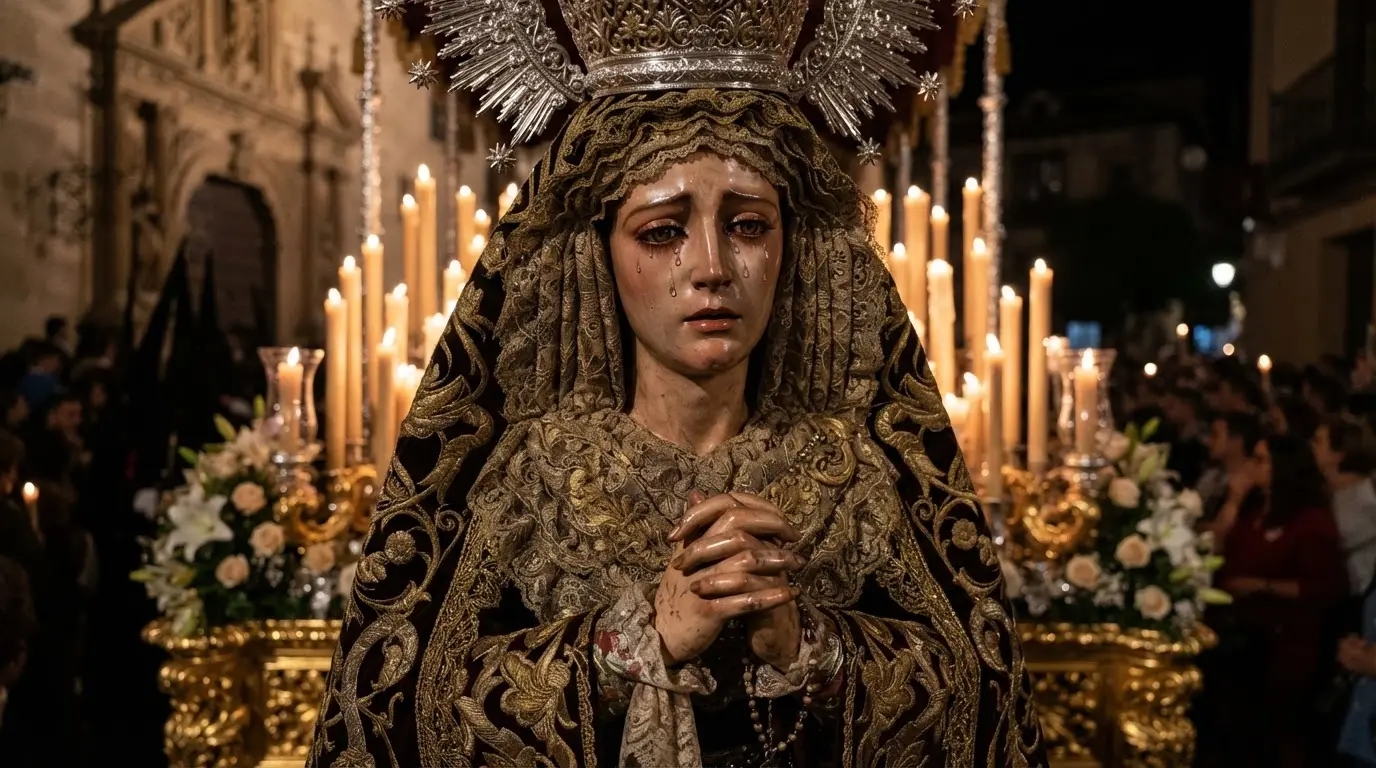
The second condition was the material. Almost everything these men made was talla policromada: wood, carved, gilded and painted, commissioned by churches and cofradías rather than collectors. Nobody in Granada was carving marble for palazzos. This was a workshop trade in devotional objects, and its test was blunt: could a carved saint convince a kneeling one?
Pablo de Rojas: the man who taught Seville
Every school needs a bridge figure, and Granada's was Pablo de Rojas, baptised in Alcalá la Real on 16 November 1549 and dead in Granada by 1611.[7] He spent nearly his whole career in the city, and historians credit him with a double achievement: shaping the Granadan school itself and consolidating Counter-Reformation imagery across eastern Andalusia.[8]
His obrador, the workshop that functioned as an academy, trained a generation of carvers. Among the apprentices was Juan Martínez Montañés, who left for Seville and became the most important figure of the Sevillian school of sculpture.[9] That is the fact most visitors miss: Granada taught Seville. The two traditions spent the 17th century exchanging artists and arguments, and ranking them against each other misses the point; they are siblings raised in the same workshop.
What Rojas passed on was a temperament rather than a pattern book: bodies that look like bodies, grief legible at ten paces, drapery heavy enough to believe. Cano would refine that inheritance towards sweetness. Mora would push it towards reverie. Both started from what Rojas established.
Alonso Cano: grace over drama
Alonso Cano is the school's centre of gravity, and his contemporaries struggled to file him. Painter, sculptor, architect and draughtsman, he is sometimes called the Spanish Michelangelo because of the diversity of his talents.[10] He was born in Granada, baptised on 19 March 1601, and died there, poor, on 3 September 1667.
The range was real, and so was the training behind it. He learned architecture from his father Miguel, an ensamblador who assembled retablos; painting in Juan del Castillo's academy and under Francisco Pacheco, Velázquez's teacher; and sculpture from Juan Martínez Montañés.[11] Read that last name twice. The defining talent of the Granadan school learned his sculpture from Rojas's most famous export, and the lineage closed its own loop.
In 1652 the King granted him a canonry of Granada Cathedral so that he could serve as its chief architect, and late in life he drew the west façade, which was erected to his design after his death.[12] By then he had already produced the small carving that explains why the city forgave him everything else.
The Inmaculada the canons moved
Between 1655 and 1656 Cano carved the Inmaculada del Facistol for the cathedral choir lectern; it now stands in the cathedral sacristy.[13] The canons admired it so much they had it lifted out of the choir altogether and installed in the sacristy, where it could be contemplated properly, dispatching a replacement Virgen de Belén to the lectern in 1664.[14] Stand in front of it and the school's whole temperament becomes obvious. For Cano, as the classic account puts it, grace prevailed over intensity, delicacy over force, sweetness over drama.[15]
Seville carved agony. Granada, under Cano, preferred the moment just before or just after it, faces closed around something private. That preference is why Granadan dolorosas look the way they do, and why Mora's mourners, a generation later, seem to be listening to something you cannot hear.
Gold leaf, glass eyes: how wood becomes flesh
The engine behind all of this was doctrinal. After the Council of Trent (1545 to 1563) the Catholic Church, answering the Lutheran Reformation, resolved to push the plastic arts as a means of reaching the faithful, and imaginería developed extraordinarily through the baroque period.[16] A carved saint was theology you could kneel in front of.
The realism was engineered, layer by layer. Garments got estofado: gold leaf laid over the wood, painted over with pigments, then scratched through in patterns so the designs shine with actual metal underneath.[17] Flesh got the opposite treatment, encarnación: skin tones worked onto faces and hands to recreate human skin, with polished finishes more usual in Castile and matt ones typical of Seville.[18]
Recommended tours
Tours are selected for quality, not commission. We earn a small fee if you book — at no extra cost to you.
Then came the postizos, the additions that still unsettle people at midnight processions: glass eyes set into the sockets of the face, teeth of bone, eyelashes of hair, cork built up into coagulated wounds, tears of resin.[19] Watch a paso turn a corner under streetlights and you will see the trick working exactly as designed; the resin tears catch the light before anything else moves.
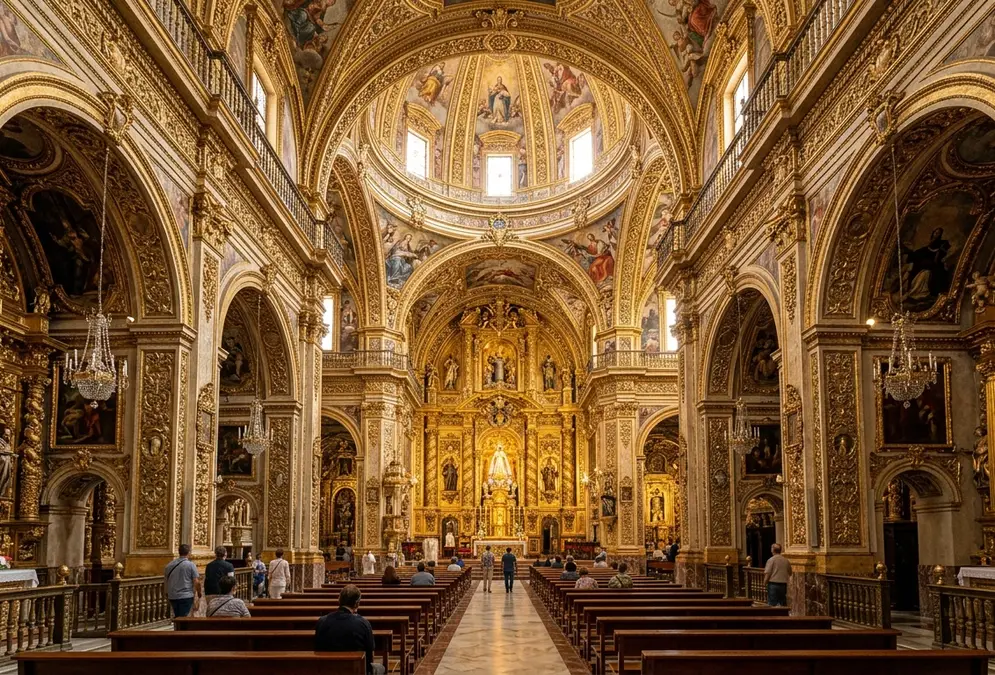
Indoors, the full sensory effect of gilded Granadan baroque is best judged at the Basílica de San Juan de Dios, the loudest room in the city, and a useful reminder that this sculpture was never meant to be seen under a museum's even light.
Explore nearby · Monument
Basilica of San Juan de Dios
Built in 1737, Granada's most opulent baroque church hides gold leaf on every surface, 190 mirrors, and the relics of St John of God kept in a silver urn.
José de Mora and where the school lives now
Cano's pupils carried the style across southern Spain. Pedro de Mena, born in Granada in 1628, trained under his father Alonso de Mena and under Cano himself before settling in Málaga.[20] But the heir who stayed was stranger and better.
Deep dive · Article
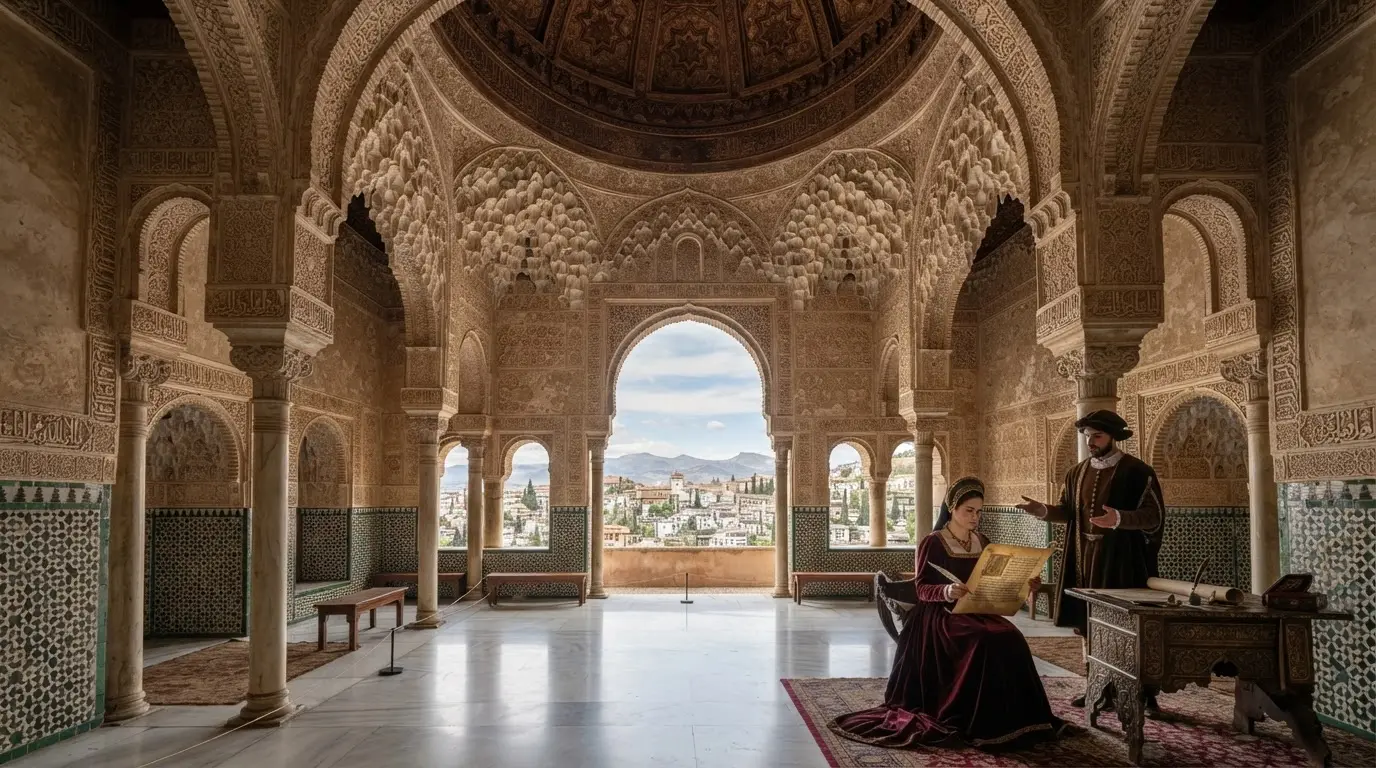
Alhambra Decree 1492: Granada's Jewish Expulsion Explained
The Alhambra Decree (Edicto de Granada) expelled Spain's Jews in 1492. Learn why it happened, what else happened in Spain that year, and where exiles went.
José de Mora: the royal sculptor who came home
José de Mora was born in nearby Baza in 1642, son of the sculptor Bernardo de Mora and a pupil of Cano in Granada.[21] In 1672 he became sculptor to King Charles II in Madrid; by 1680 he had left court and gone home, and he died in Granada in 1724.[22] The classic Spanish account of the school describes what he did with Cano's inheritance: he refined the figure types and subtled the expression until it reached ensoñación mística, mystical reverie.[23]
His Cristo de la Misericordia was carved in 1688 for 2,000 reales, and University of Granada research has since recovered the forgotten paperwork; the image leads a double life, the original presiding over a chapel in the church of San José while a replica processes every Maundy Thursday.[24] A few streets away, San Pedro y San Pablo keeps the Cristo de la Sentencia, described as the processional image with the widest projection in Granada's Semana Santa; in 2025 the cathedral gathered more than fifty Mora works into a single exhibition.[25] To watch these carvings do their original job, plan around Granada's Semana Santa; the school does not perform on request the rest of the year.
Where to see the school the rest of the year
- Museo de Bellas Artes: Cano has a monographic hall to himself, with the Virgen del Lucero and the San Jerónimo penitente among the highlights,[26] and the followers are well represented too, including Pedro de Mena's bust of the Dolorosa and works by José de Mora.[27]
- The cathedral sacristy: the Inmaculada del Facistol, whose relocation saga you have already met above.
- The Cartuja: Mora's statues of Saint Bruno and Saint Joseph, with eight further figures in the Cardinal Salazar Chapel of Córdoba's Mosque-Cathedral if your travels stretch that far.[28]
- The baroque city itself: for the buildings all this sculpture was made to live in, the Granada Renaissance and Baroque walk strings the relevant churches and façades into a single route.