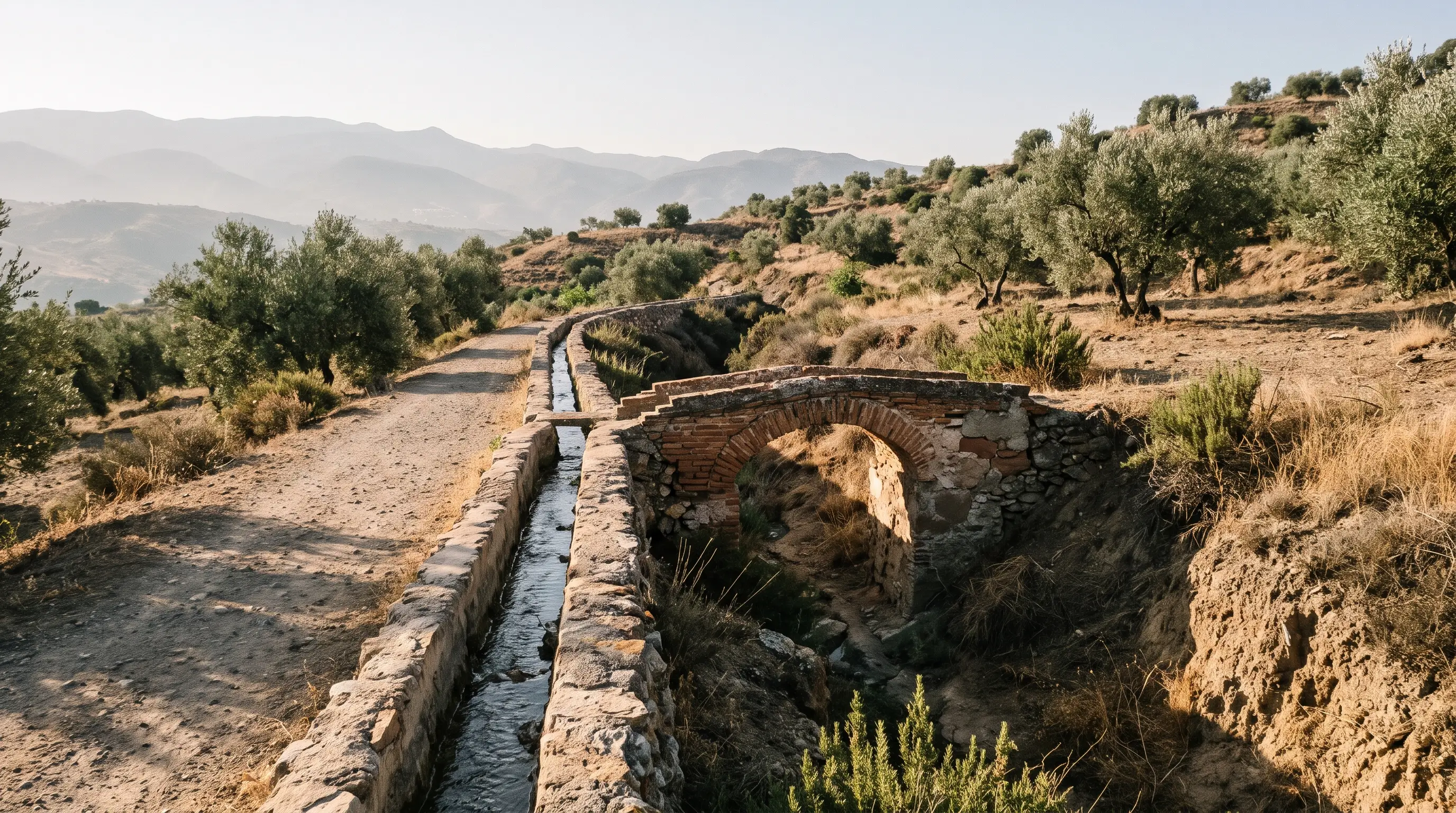
How Aynadamar, Granada's Fountain of Tears, Fed the Albaicin

Seven years resident in Granada. Specialist in Nasrid architecture, Al-Andalus history, and Andalusian walking routes.
In this article
Jump to a section
The spring at Alfacar and why it is called the Fountain of Tears
Who built it? An 11th-century channel with an open question
How the channel worked: bridges, mills and the water calendar
Explore · Neighbourhood
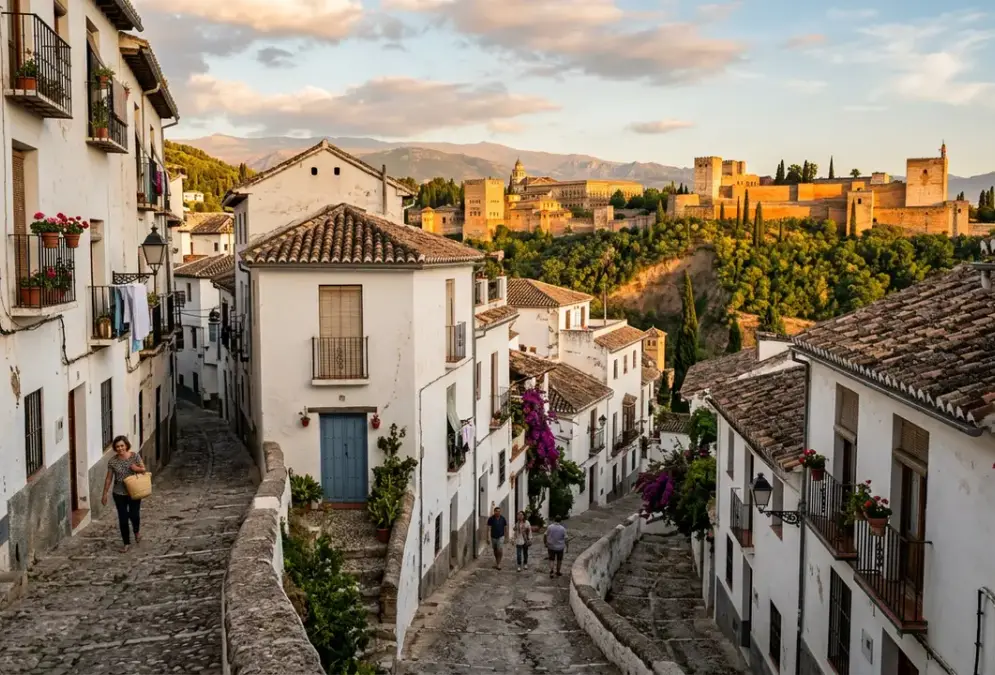
Albaicín
Granada's oldest neighbourhood: the Albaicín holds a UNESCO-listed maze of whitewashed lanes, Moorish cármenes, and the finest Alhambra views in the city.
Piping, demolition and the 2023 recovery
- 11th century
Supply to the Zirid Alcazaba
Documented water for the Alcazaba and the Albayzín.
- 1334
Earliest Arabic water documents
Oldest surviving deeds on the water share.
- 1992
Protection procedure opened
Archaeological zone proposed after piping erased part of the route.
- 1980s
City section destroyed
The final stretch is abandoned and lost on arrival in the city.
- 2022
Recovery agreement
University of Granada and Fundación AguaGranada target 2.8 km.
- 15 April 2023
Channel inaugurated
Recovered in all its sections.
Walking the Alfacar to Víznar stretch and the Lorca park
Deep dive · Article
Corral del Veleta Glacier: Europe's Southernmost Ice
Corral del Veleta held Europe's southernmost glacier — active until 1913 at 37°N. Relict ice and permafrost still cling on in Sierra Nevada, shrinking fast.
Recommended tours
Tours are selected for quality, not commission. We earn a small fee if you book — at no extra cost to you.




- The trail is 1.5 km and about 30 minutes,[37][38] low difficulty,[47] on a stony path[46]
- It starts near the Puerto Lobo visitor centre, about 3 km after leaving the main road towards Víznar[36]
- Carry drinking water and wear suitable clothing and footwear, and take care in hunting season[40]
- Stay on marked paths[41]
Frequently asked questions
What does Aynadamar mean, and what is the Fountain of Tears in Granada?
Is the Aynadamar aqueduct Roman or Moorish?
Where does the Acequia de Aynadamar start and end?
Can you walk along the Aynadamar channel near Alfacar?
Is the Aynadamar canal still working?
Is Lorca buried near the Fountain of Tears?
Did the Aynadamar aqueduct supply the Alhambra?
Sources
48 references Show Hide
- Junta de Andalucía — 78 (opens in a new tab)
“Dicha acequia de origen árabe, datada en el siglo XI, discurre por los Municipios de Alfacar y Viznar hasta llegar a Granada.”
- Junta de Andalucía — 78 (opens in a new tab)
“La acequia de Aynadamer nace en la Fuente Grande en el término municipal de Alfacar, atraviesa los términos municipales de Viznar y Granada, y termina su recorrido en la ciudad de Granada.”
- Junta de Andalucía — 78 (opens in a new tab)
“Se trata de una acequia de origen árabe, de época anterior al siglo XI, mencionada ya por Ibn al Jatib cuando comenta la construcción de un acueducto que lleva las aguas a Granada.”
- Junta de Andalucía — 78 (opens in a new tab)
“Su trazado está realizado con muros de argamasa revestido con mortero de cal, conservándose los puentes originales que impedían que las aguas pluviales afectarán a la acequia”
- Junta de Andalucía — 78 (opens in a new tab)
“estos están construidos con bóveda de ladrillo y mampostería.”
- Junta de Andalucía — 78 (opens in a new tab)
“De su trazado, unicamente se conserva en estado original, la parte existente entra las localidades de Viznar y Alfacar, estando entubado el resto hasta Granada.”
- Junta de Andalucía — 78 (opens in a new tab)
“Elemento de gran singularidad que conservaba numerosos tramos originales, que debido al entubamiento realizado por la Confederación Hidrográfica del Guadalquivir, ha perdido parte de su trazado”
- Junta de Andalucía — 78 (opens in a new tab)
“Incoar el procedimiento para la inscripción con carácter específico en el Catálogo General del Patrimonio Histórico Andaluz, a favor de la Zona Arqueológica denominada”
- digitalmeetsculture.net — Recovery aynadamar irrigation channel (opens in a new tab)
“The Aynadamar irrigation channel was built during the 11th century to supply water to the ancient Alcazaba of Granada (Qasabat Garnata), the seat of the Zirid dynasty, and to the present-day Albayzín.”
- digitalmeetsculture.net — Inauguration of aynadamar irrigation channel in granada (opens in a new tab)
“The Aynadamar irrigation channel has been documented at least since the 11th century to supply water to the ancient Alcazaba of Granada (Qasabat Garnata), the seat of the Zirid dynasty, and to the present-day Albayzín.”
- dialnet.unirioja.es (opens in a new tab)
“aunque abundan más las alusiones a partir del siglo XI, cuando los ziríes trasladaron la capital de Medina Elvira al Albaicín de Granada.”
- dialnet.unirioja.es (opens in a new tab)
“Es una cuestión abierta entre unos que defienden el origen romano y otros que la hacen surgir en el siglo XI.”
- dialnet.unirioja.es (opens in a new tab)
“Los puentecillos tenían la finalidad de evitar que las aguas de lluvia ensuciaran la acequia, los acueductos la de salvar el desnivel de barrancos.”
- dialnet.unirioja.es (opens in a new tab)
“Los documentos árabes más antiguos se remontan a 1334. Francisco Nuñez Muley, el famoso morisco que procedía de la familia real nazarí,”
- dialnet.unirioja.es (opens in a new tab)
“Tenía la finalidad de garantizar el riego de las cosechas cuando la sequía las pone en peligro, eran nueve días y se aplicaban cuando los vecinos lo solicitan”
- Junta de Andalucía — 26c74287 7080 f02b babf 31844dece42d (opens in a new tab)
“Se podría traducir metafóricamente como la Fuente de las Lágrimas.”
- Junta de Andalucía — 26c74287 7080 f02b babf 31844dece42d (opens in a new tab)
“que significa ojo y, por extensión, fuente”
- Junta de Andalucía — 26c74287 7080 f02b babf 31844dece42d (opens in a new tab)
“Desde aquí partía la acequia que, a modo de arteria, llegaba hasta los ciudadanos del famoso barrio granadino del Albaycín.”
- es.hispanopedia.com (opens in a new tab)
“también conocida como Fuente de las Lágrimas, quizá porque en su manantial se ven unas pequeñas burbujas que suben lentamente desde el fondo a la superficie en forma de lágrimas”
- es.hispanopedia.com (opens in a new tab)
“fueron encauzadas a través de la acequia Aynadamar para el abastecimiento y riego del barrio del Albaicín; a las orillas de esta acequia se instalaron también un buen número de molinos.”
- Wikipedia (opens in a new tab)
“Alfacar is a historic town approximately 8 kilometres (5.0 mi) from the city of Granada, in the autonomous Spanish region of Andalusia.”
- Wikipedia (opens in a new tab)
“Alfacar is renowned throughout the region for its famous bakeries which probably date back to Arab times”
- Wikipedia (opens in a new tab)
“He was subsequently shot during the early morning at a location between Alfacar and the neighbouring village of Víznar.”
- Wikipedia (opens in a new tab)
“The circumstances of his assassination and the location of his grave remain a controversy.”
- elindependientedegranada.es (opens in a new tab)
“La ruta conocida como Último Paseo acabó en el Parque Federico García Lorca de Alfacar, donde está el monolito que rinde homenaje al poeta.”
- elindependientedegranada.es (opens in a new tab)
“siguiendo el curso de la Acequia de Aynadamar, que en árabe significa acequia de las lágrimas”
- ahoragranada.com (opens in a new tab)
“una marcha popular desde La Colonia de Víznar hasta el Parque García Lorca de Alfacar, en homenaje a Federico García Lorca en el 88 aniversario de su asesinato.”
- universolorca.com (opens in a new tab)
“Barranco de Víznar (Víznar Ravine) is a sloping edge of about 10,000 square meters that descends on a sharp and shady curve of the road between Alfacar and Víznar, declared a Place of Memory.”
- universolorca.com (opens in a new tab)
“On August 19, it hosts a poetry evening, which began to be held clandestinely during the last years of the dictatorship”
- horizontevcentenario.ugr.es (opens in a new tab)
“El tramo a recuperar tiene un recorrido de 2,8 kilómetros y transcurre desde la salida de El Fargue hasta el Campus Universitario de Cartuja.”
- digitalmeetsculture.net — Inauguration of aynadamar irrigation channel in granada (opens in a new tab)
“it was recovered in all its sections, and was inaugurated on 15 April 2023.”
- digitalmeetsculture.net — Inauguration of aynadamar irrigation channel in granada (opens in a new tab)
“The recovery work, in which more than 500 volunteers from various interests and more than 1000 schoolchildren have participated”
- digitalmeetsculture.net — Inauguration of aynadamar irrigation channel in granada (opens in a new tab)
“In the 80s of the 20th century, the final section was definitively abandoned and destroyed on its arrival in the city, with the consequent loss of heritage, landscape and environment.”
- digitalmeetsculture.net — Inauguration of aynadamar irrigation channel in granada (opens in a new tab)
“However, the scarcity of water due to the overexploitation of the aquifer and the drought, now confront the irrigation community and the irrigation channel with a new challenge”
- Junta de Andalucía — 2a5ff601 c1bf d62b 6a04 53b0d800ed3e (opens in a new tab)
“Desde Granada por la A-92 en sentido Este, hacia Guadix. En la salida 253 tomar la GR-NE-52 sentido Víznar.”
- Junta de Andalucía — 2a5ff601 c1bf d62b 6a04 53b0d800ed3e (opens in a new tab)
“Tras recorrer unos 3 km se llega al centro de visitantes Puerto Lobo, próximo al inicia el sendero.”
- Junta de Andalucía — 2a5ff601 c1bf d62b 6a04 53b0d800ed3e (opens in a new tab)
“TIEMPO ESTIMADO 30 minutos”
- Junta de Andalucía — 2a5ff601 c1bf d62b 6a04 53b0d800ed3e (opens in a new tab)
“Acequia de Aynadamar, monumento a F. García Lorca, Cruz de Víznar.”
- Junta de Andalucía — 2a5ff601 c1bf d62b 6a04 53b0d800ed3e (opens in a new tab)
“Llevar agua potable y vestimenta y calzado adecuados. Tomar precaución en épocas de caza.”
- Junta de Andalucía — 2a5ff601 c1bf d62b 6a04 53b0d800ed3e (opens in a new tab)
“Camina por los senderos marcados Respete los bienes y propiedades privadas No se permite encender fuego”
- siu.ctagr.es (opens in a new tab)
“| 09:00 | 09:15 | 09:20 | 09:30 | 09:40 | -----S-- |”
- siu.ctagr.es (opens in a new tab)
“| 11:00 | 11:15 | 11:25 | 11:30 | 11:40 | ------DF |”
- siu.ctagr.es (opens in a new tab)
“From 22/11/2025”
- festivalesdeespana.com (opens in a new tab)
“Desde entonces, cada 18 de agosto, los colectivos memorialistas convocan la marcha popular El Último Paseo”
- dialnet.unirioja.es (opens in a new tab)
“Algunos de estos puentecillos se han destruido porque este patrimonio tan interesante no ha tenido la protección que necesitaba”