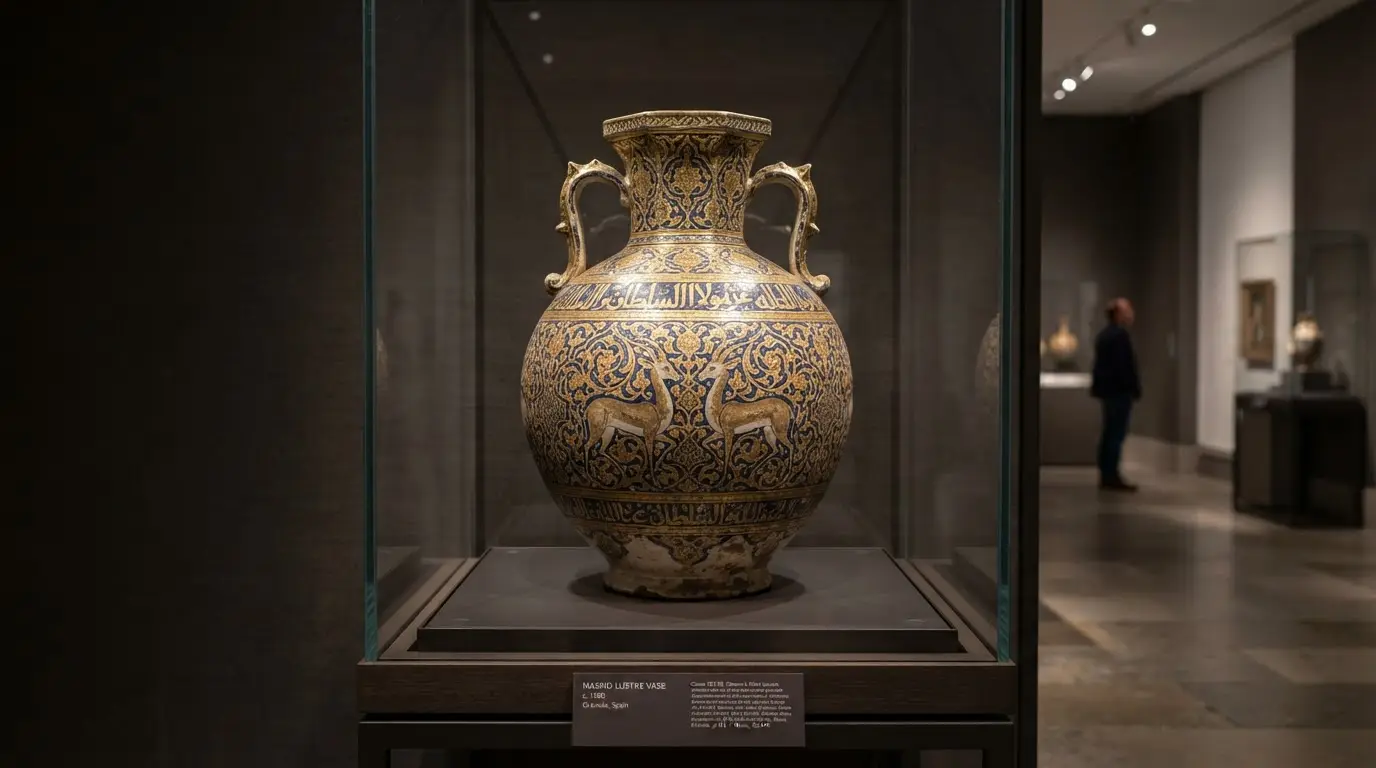

What is the Vase of the Gazelles?
The Vase of the Gazelles (Jarrón de las Gacelas) is a monumental Nasrid storage jar in gold-and-cobalt lustre, one of a small family of vessels historians call the Alhambra Vases. It is the only one of that family that has continually remained inside the Alhambra complex since it was made, from its creation through to its current status as the museum's "Royal Treasure."[1]
Granada's own tourism authority calls it the single most important object in the Alhambra Museum's collection, and singles out its zoomorphic decoration — animal figures were generally avoided in Islamic art, which makes the vase's gazelles an unusual choice rather than a routine one.[4]
The wider Alhambra Vases were never built to hold anything practical. Historians describe them as the largest lustreware vessels ever produced, made purely to be looked at, with the precise shape and decoration varying from piece to piece.[5] That distinction matters for how you read the vase in front of you: not as forgotten storage equipment, but as a deliberate, expensive statement piece for a Nasrid palace. Stand in front of it and the scale registers before the decoration does: even among ordinary storage jars this one would be enormous, closer in height to a person than to anything you'd expect to find on a shelf.
That survival is not an accident of neglect, either. The Alhambra itself changed hands from Nasrid sultans to Christian monarchs to a 19th-century tourist attraction, and objects inside a building that changes owners tend to travel with the new owners' taste. This one didn't, which is arguably the more interesting fact about it than the pair of gold gazelles on its shoulder.
Made in Málaga, not the Alhambra: production and dating
It's tempting to assume a vase this closely tied to the Alhambra was thrown and glazed inside the palace itself. It wasn't. Every source that names a production site points to Málaga, the Nasrid kingdom's main ceramic and export centre, not a workshop behind the Alhambra's own walls. The vase belongs to a product line manufactured continually from the 13th to the 15th century, made for royal palaces and exported from Málaga to the East.[6]
The dating is more precise for this particular piece. Specialists place it in the reign of Muhammad V, during what they call the plenitude of the third Nasrid artistic period — the same decades of Nasrid muqarnas and stucco craftsmanship that produced the Alhambra's finest ceilings. That was also the period when Nasrid patrons were commissioning much of what still defines the palace today, from carved wooden ceilings to its finest epigraphic friezes.
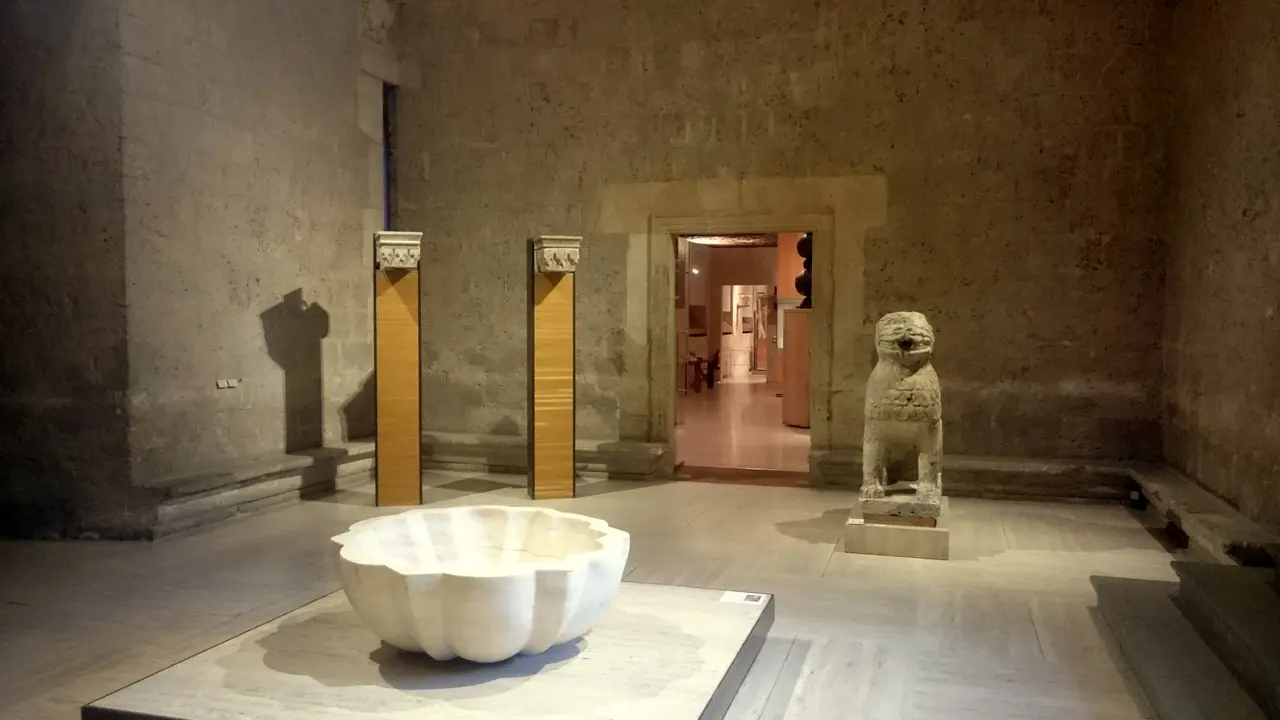
Explore nearby · Museum
Museo de la Alhambra
Free Islamic art museum inside the Palacio de Carlos V, with Nasrid ceramics, carved stucco, and the Blue Amphora. Essential context for the Alhambra visit.
Getting that gold sheen out of a kiln took three separate firings, and any one of them could ruin the piece:
- A white tin glaze applied to the raw earthenware body
- A layer of cobalt-blue decoration painted over the glaze
- A final, low-temperature firing starved of oxygen, in which silver and copper pigments turned metallic gold on contact with the glaze[7]
The technique reached al-Andalus in the eleventh century, after spreading west from tenth-century Iraq, and Málaga's potters were still using it for palace commissions three hundred years later.
Reading the decoration: gazelles, inscriptions, and an unresolved purpose
On one face of the body, a confronted pair of gazelles stands within a dense ground of curling vegetal arabesque, the ataurique pattern that fills almost every surface of Nasrid decoration.[8] The composition is symmetrical — the two animals face each other rather than running in profile, closer to a heraldic emblem than a naturalistic scene.
The rest of the surface keeps the same restraint. White, blue, and gold are the only colours used anywhere on the vase, arranged across an octagonal moulded neck, a strongly globular body, and a base so narrow and flat it looks almost too small to carry the weight above it. Vegetal, epigraphic, geometric, and zoomorphic motifs share that surface without ever competing for attention, which is presumably the point of putting the gazelles there in the first place.
“Few other pots in the world make such a strong physical impression.[9]”
It's worth separating this tradition from Fajalauza ceramics, the blue-and-white pottery still made and sold around the Albaicín today. Fajalauza ceramics is a much later, unrelated craft that emerged under Christian rule from the 16th century onward — it shares a city and a colour palette with Nasrid lustreware, and nothing else. Folding the two into one gift-shop category erases three centuries of history.
Whether the Vase of the Gazelles or any of its siblings ever held anything is still an open question. The family's decorative-only, non-utilitarian design counts against a storage function, and no record establishes what — if anything — it was meant to contain. The most defensible reading treats it as a status object: a display of wealth and craftsmanship for a court that needed both, rather than a jar with a job to do.
The scattered family: where the other Alhambra Vases ended up
Every other vase in this family left Granada, in most cases centuries ago, by routes that had nothing to do with careful museum planning. Survivors are now split across five Spanish museums plus institutions in St Petersburg, Berlin, Washington D.C., Stockholm, and Palermo; a number of large fragments also survive without being attached to any complete piece.[10]
The example in Madrid's National Archaeological Museum stands 126 cm tall with a 63 cm diameter, made in Málaga like the Gazelles Vase, though it spent centuries out of sight. Workers shoring up vaults inside a monastery in Jerez de la Frontera found it by chance at the start of the 20th century.[11]
The Stockholm vase had a stranger trip. At 155 x 80 cm, it only reached Sweden after Queen Christina's forces sacked Prague in 1648 and carried off the treasures accumulated by Holy Roman Emperor Rudolf II, among them a vase that had already spent time in Cyprus, venerated there as a relic supposedly connected to the biblical Marriage at Cana.[12]
Two further vases are sometimes cited as surviving originals, and neither holds up. The Louvre's piece, catalogued as 'Vase dit de l'Alhambra' and inscribed with a sultan's name, is dated by the museum's own records to 1700–1850 — an 18th- or early-19th-century piece in the Nasrid style, not a 14th-century original.[13] The Victoria and Albert Museum in London is more upfront about its own vase: it is an explicit 19th-century copy made in Manises, near Valencia, acquired only in 2008 because the V&A had never owned an original.[14]
None of this scattering should be surprising, given how far Málaga's ceramics travelled even in their own time. The 14th-century North African traveller Ibn Battutah wrote that the city produced "wonderful gilded pottery that is exported to the remotest countries," a reputation the Gazelles Vase's own siblings ended up proving centuries after his visit.[15]
| Vase | Now housed at | How it got there |
|---|---|---|
| Gazelles Vase | Alhambra Museum, Granada | Never left; still inside the Alhambra complex |
| Madrid vase | National Archaeological Museum, Madrid | Found by chance in a Jerez monastery, 1927; donated to the museum, 1930[20] |
| Stockholm vase | Royal collections, Stockholm | Looted from Prague by Queen Christina, 1648 |
| Louvre and V&A pieces | Paris and London | Later copies, not surviving Nasrid originals |
From rediscovery to Room V: the vase's modern history
The vase's documented history doesn't reach back seamlessly to the 14th century. The Gazelle Vase was "found," meaning first documented as a notable object rather than physically unearthed, at the Alhambra Palace only in the late 18th century, and it took until the mid-19th century to become an icon of the European rediscovery of Spain's Islamic past.[16] That rediscovery happened alongside a broader European fascination with Islamic Granada, the same wave of interest that later sent Romantic writers wandering through the Alhambra's half-ruined halls.
The clearest physical evidence of where it stood before entering a museum comes from a photograph, not a written record. A postcard published by Enrique Linares sometime between 1904 and 1910 shows the vase standing inside the Hall of the Two Sisters, one of the grandest rooms of the Nasrid Palaces.[17] That image is often stretched into a claim that the vase stood there since Nasrid times — the postcard proves early-20th-century display, nothing earlier.
Deep dive · Article
Alhambra 19th Century Restoration: What Contreras Changed
Rafael Contreras renewed parts of the Alhambra in the 1800s. See how Leopoldo Torres Balbás later changed the method through conservation and restraint.
At some point after that photograph was taken, the vase moved out of the palace circuit entirely and into the purpose-built Museum of the Alhambra, inside the Palacio de Carlos V. Today it stands in Room V, a few hundred metres and one very different architectural style away from the room in the postcard.[18]
Seeing the Vase of the Gazelles today
Look for the gold inscription band running around the rim of the handles: it reads al-yumn wa al-iqbal, "good fortune and prosperity," in Arabic script set against a dark ground.[19] It's a short phrase, but it states plainly what the vase was for — projecting the good fortune of the dynasty that commissioned it, whether or not it ever held anything more solid than that.
Room V is included with a standard Alhambra ticket and, separately, through the museum's own free admission, entered off Calle Real de la Alhambra. Go early or late in the day if you can — the museum keeps shorter hours on Sundays and Tuesdays and closes on Mondays, and its rooms only fill when a tour group happens to pass through.
The gallery lighting in Room V is deliberately dim and warm: it protects the lustre glaze, but it also means the gold sheen only really appears when you shift position slightly and catch it at an angle, the same effect that made this kind of pottery such a prized luxury in the first place.