What 1492 did to the hill above the Darro
The fall of Nasrid Granada on 2 January 1492 did not end overnight. The formal surrender, the procession through the Alhambra gates, the raising of the Cross on the towers: those were the public moments. What followed was slower and less visible, the administrative sorting of a city's population by religion, origin, and usefulness to the new order.[1]
Muslim families who refused conversion (and later those who converted but remained suspect) faced expulsion from the lower city. Roma (Gitano) families, already marginalised, had no place in the reorganised streets around the cathedral. Jewish families had been expelled across all of Castile and Aragon that same year, scattered from the flatlands of the Vega de Granada toward whatever margins they could reach. Moriscos, the nominally converted Muslims who stayed, occupied a middle position of perpetual suspicion, neither fully inside nor fully expelled.[2]
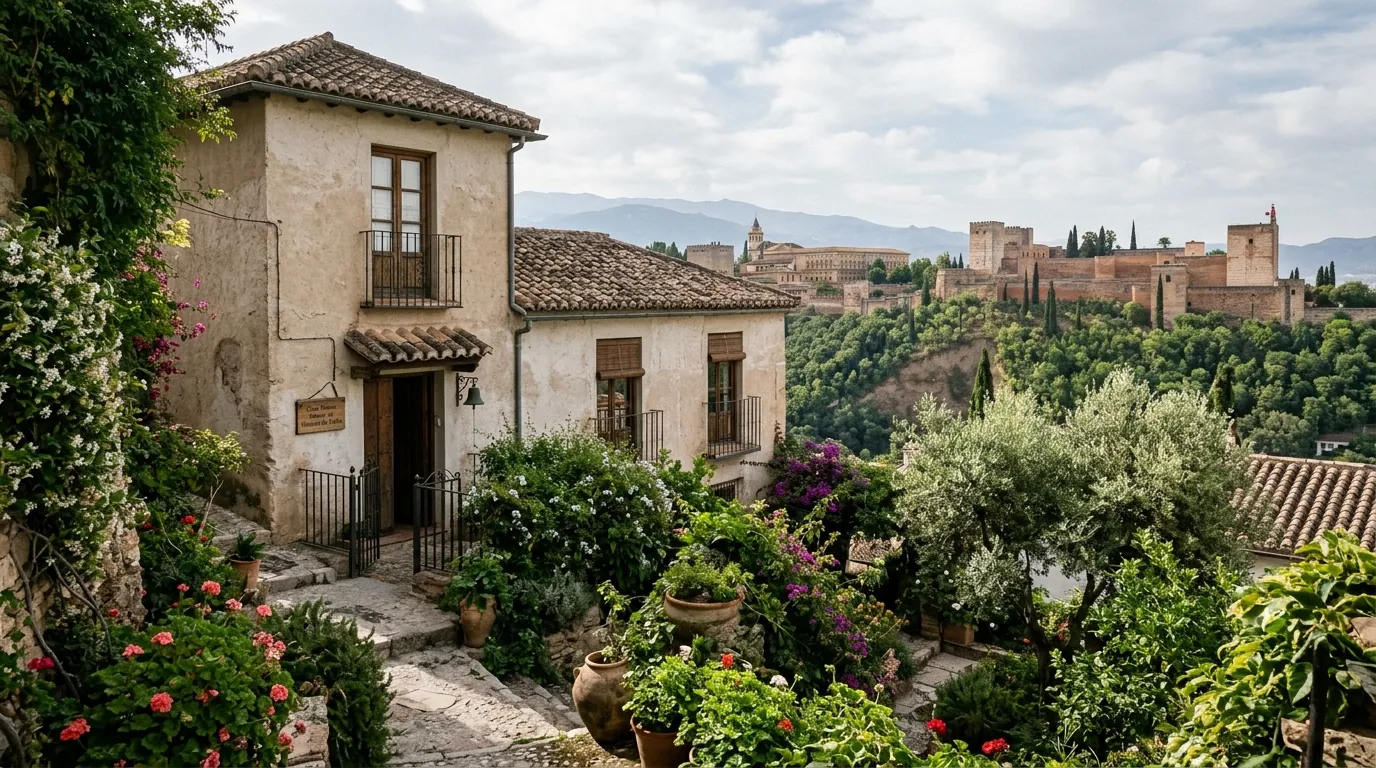
The slope above the Darro offered a solution of sorts. The hillside, then called Valparaíso, lay outside the city walls. No one with options wanted to live on it. The rock was not buildable in any conventional sense; there was no flat ground, no water on demand, no administrative infrastructure. What the hill did have was the Alhambra-Formation conglomerate: a clay-bound rock that could be cut by hand, would hold its shape once the weight above it had been removed, and maintained a near-constant temperature inside regardless of the Andalusian summer or the January cold.
Families began digging. They did not build outward; they burrowed in. A door cut into the rock face, a chamber behind it, more chambers as the family grew and the tools went deeper. The resulting neighbourhood, Sacromonte, was not planned. It accumulated, community by community, through the 16th century, until the slope held a population of cave-dwelling families who had arrived there because nowhere else would take them.
Explore nearby · Museum
Casa-Museo Manuel de Falla
Manuel de Falla's Granada home from 1921 to 1939, preserved as he left it. His piano, manuscripts, gifts from Picasso, and garden views of the Sierra Nevada.
A kitchen carved from stone: how cave households fed themselves
The thermal logic of cave living is well understood: a constant interior temperature around 17°C, regardless of what the air outside is doing. The culinary logic follows from the same physics. A hearth set into a cave wall draws smoke upward through a chimney bored through the rock above. The enclosed space holds heat with extraordinary efficiency. A slow-cooked pot requires less fuel than the same pot in an open kitchen.
What went into the pots was not a matter of taste. It was a matter of what the city above left behind. The families of Sacromonte had limited access to markets in the lower city and limited money to spend in them. What they had was proximity to the agricultural economy of the Vega de Granada: the grain fields, the animal herds, the slaughter season.
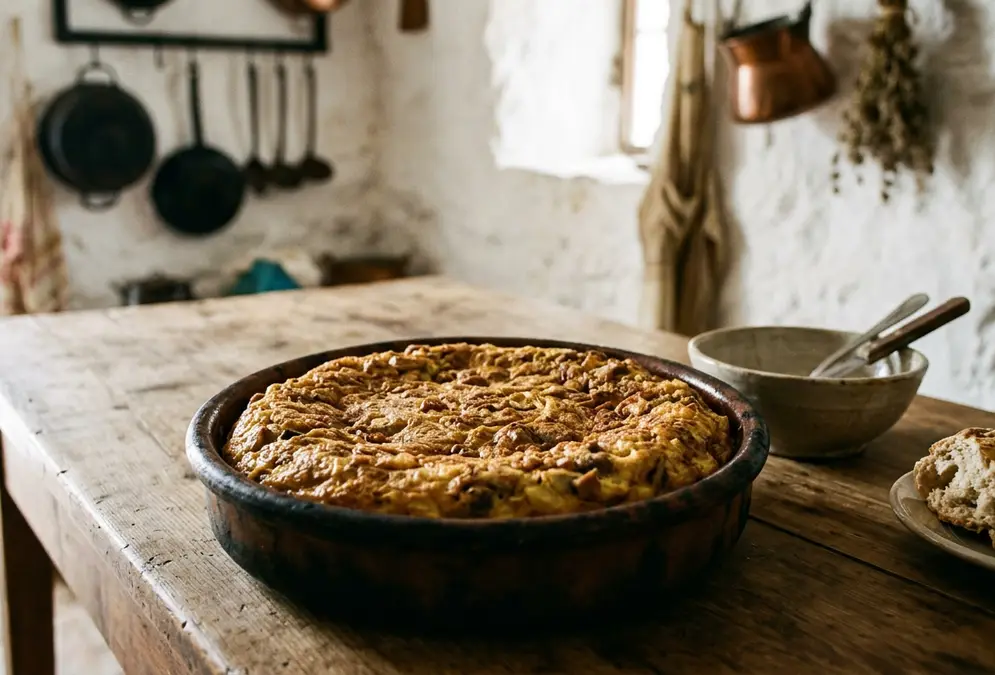
Offal was the critical ingredient. Sheep's brains, kidneys, and testicles (called criadillas in Spanish) were the parts of the animal the urban market did not value and would not pay premium prices to preserve.[3] For a cave-dwelling family, they were protein: fresh, abundant at slaughter time, requiring no curing or drying. The eggs came from the chickens most families kept. The broad beans were a staple crop. Ham appeared when it could be sourced, adding salt and fat.
The form the dish took, an egg-bound tortilla rather than a stew, had practical advantages. A tortilla cooks quickly over high heat, holds together as a single portion, and can be eaten cold if necessary. It is also one of the most economical ways to extend expensive protein with cheap eggs.
This was not a peasant simplification of something more elaborate. The dish page covers the full ingredient breakdown for anyone who wants it. The point here is that the dish's composition was determined by the exact economic position of the community that created it: marginal, resourceful, and working with what the city did not want.
San Antón on 17 January: the feast day that fixed the dish in the calendar
San Antón, Saint Anthony the Abbot, is the patron saint of animals. His feast falls on 17 January, and in the traditional Andalusian agricultural calendar, it marks the end of the post-Christmas quiet before the year's work begins in earnest. It also falls in the heart of winter slaughter season, when livestock culled before the lean months had filled curing rooms with meat, and offal, perishable and unsuitable for long-term preservation, needed to be eaten before it spoiled.[4]
The alignment is not coincidental. The feast of San Antón is when you eat what will not keep. In Granada's rural hinterland and in the cave community of Sacromonte, that meant offal. It meant exactly the ingredients that went into the tortilla del Sacromonte.
The Albaicín neighbourhood and Sacromonte both observed San Antón with particular intensity. The blessing of animals (horses, donkeys, dogs, goats) took place outside the church of San Antón in the lower part of the city on 17 January, a practice that continues today in Granada's more traditional parishes. After the blessing came the meal. And in Sacromonte, the meal was the tortilla.
17 January
Recommended tours
Tours are selected for quality, not commission. We earn a small fee if you book — at no extra cost to you.
This connection gave the dish a ceremonial role it would not otherwise have had. It became attached to a date, a saint, a season. Something eaten daily out of necessity became eaten on a specific day out of tradition. That transformation is what anchors a food in a culture.
Granada's bars and restaurants still serve tortilla del Sacromonte with particular frequency around 17 January.[5] The practice is less universal than it was, and the connection to the feast day is not well known among visitors. But in the older bars of Sacromonte and the Albaicín, the San Antón link remains. Ask a barman in January why the tortilla is on the menu and the answer will reference the feast before it references anything else.
From survival food to cultural marker: how the dish held its form
Most dishes born from scarcity change when circumstances improve. The cave community of Sacromonte did not become prosperous, but it did become culturally legible to the outside world, recognised (if not respected) through the flamenco zambra tradition that developed in the same rooms where the tortilla was cooked.[2]
When 19th-century travellers came to Granada in increasing numbers from the 1820s onward, drawn by the Alhambra and the Romantic idea of Moorish Spain, some of them made it up the hill. Washington Irving wrote about the Alhambra. Later travellers wrote about the caves. The Sacromonte community and its food began to appear in travel writing as part of the exoticisation of Romani life that characterised European Romantic travel: not always accurately, not always fairly, but with the effect of making the cave community's practices visible to audiences they would never otherwise have reached.
The tortilla survived this attention without significant alteration because the community that made it never stopped making it the same way. A dish appropriated by restaurants that swap the offal for something more palatable to squeamish visitors is not the same dish. The Sacromonte tortilla resisted this substitution through no formal protection, but because the community that owned it continued to insist on the specific ingredients that defined it.
Deep dive · Article
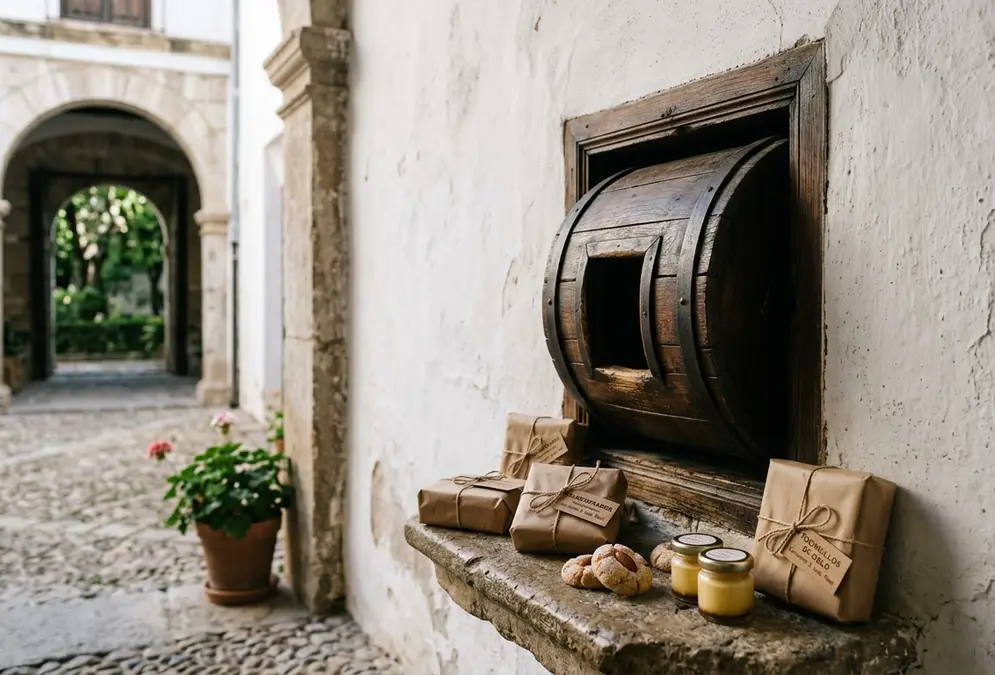
Convent Sweets in Granada: Buying Dulces Through the Torno
Nine convents in Granada sell sweets through the torno, a revolving shelf in the convent wall. Cash only, mornings only, and the greeting ritual is mandatory.
Offal became the guarantee of authenticity rather than a deficiency to be worked around. The Sacromonte Caves Museum, which opened in 2002 at Barranco de los Negros and documents the full range of cave-dwelling domestic life, treats the community's food practices as part of the living cultural record.[6] The kitchen reconstruction in one of the eleven restored caves shows the hearth, the pots, and the context in which a tortilla like this one was assembled from whatever that morning's market or cellar could provide.
The dish moved from the caves into Granada's bar culture gradually through the 20th century. By the time it became a feature of restaurant menus, its form was already fixed. Granada's version of the tortilla del Sacromonte has the specific ingredients it has, the brains, the kidneys, the criadillas, the eggs, the ham, because a community held to them across five centuries of economic marginalisation.
The Sacromonte community that carried this forward
The story of Sacromonte is not straightforwardly triumphant, and the dish it produced should not be presented as a symbol of cheerful resilience. The community that developed the tortilla was pushed to the hill because no one wanted them in the city. They ate offal because they could not afford better cuts. The cave homes that look picturesque to modern visitors were, for their first occupants, the only available shelter outside the city walls.
What is true is that the same conditions that imposed scarcity also produced cultural density. Flamenco zambra, the cave flamenco form unique to Sacromonte, developed in the same enclosed spaces as the tortilla. Caló, the mixed language that blended Romani grammar with Spanish vocabulary, was spoken in the same rooms. The art forms and the food came from the same economic logic: making something durable out of whatever was available.
The 1963 floods interrupted this continuity sharply. Sustained rainfall saturated the hillside through that year, causing widespread cave collapses. Francoist authorities ordered a forced evacuation and relocated families to housing blocks in the city. Many caves stood empty for years afterward. Families that returned gradually from the 1970s did not always return to the same caves, or to the same conditions.
What survived the evacuation, along with the flamenco and the language fragments, was the recipe. The tortilla del Sacromonte was simple enough to carry in memory and specific enough to reconstruct exactly. You do not need the cave to make it. You need the offal, the eggs, and the knowledge of what goes in and when. The dish crossed the evacuation intact.
Where to eat it in Granada, and when
The tortilla del Sacromonte is available year-round in Granada. Most bars in Sacromonte and the Albaicín will have it. So will a number of restaurants in the city centre.
The distinction worth making is between versions that use the traditional offal composition and versions that substitute more accessible ingredients. The dish page covers this in detail. In practice, ask before ordering. A tortilla del Sacromonte with brains and criadillas is different in texture and flavour from an egg-and-ham tortilla with Sacromonte in the name.
For the San Antón context, arrive in January. The 17th is the feast day, but the week around it sees the dish appear more prominently on menus in the older bars of the cave-district barrio and the Albaicín.[5] This is when the dish has its ceremonial weight: a seasonal marker the bar takes seriously enough to put in the specials, not just any item on the regular menu.
The walk up to Sacromonte from the Albaicín takes about fifteen minutes along the Camino del Sacromonte. The bars at the lower end of the Camino tend toward the tourist circuit. The ones further up, past the Abadía del Sacromonte turnoff, are where the locals eat and where the tortilla is taken more seriously. Go further than the first bar that catches your eye.
The bars at the lower end of the Camino tend toward the tourist circuit. The ones further up, past the Abadía del Sacromonte turnoff, are where the locals eat and where the tortilla is taken more seriously. Go further than the first bar that catches your eye.