Zambra gitana vs tablao flamenco: the difference that matters
If you have seen flamenco in Seville or Madrid, you have seen tablao flamenco: a sequence of independent dance forms (palos) performed on a purpose-built stage for audiences of two hundred. Each form stands alone. The show is a showcase.
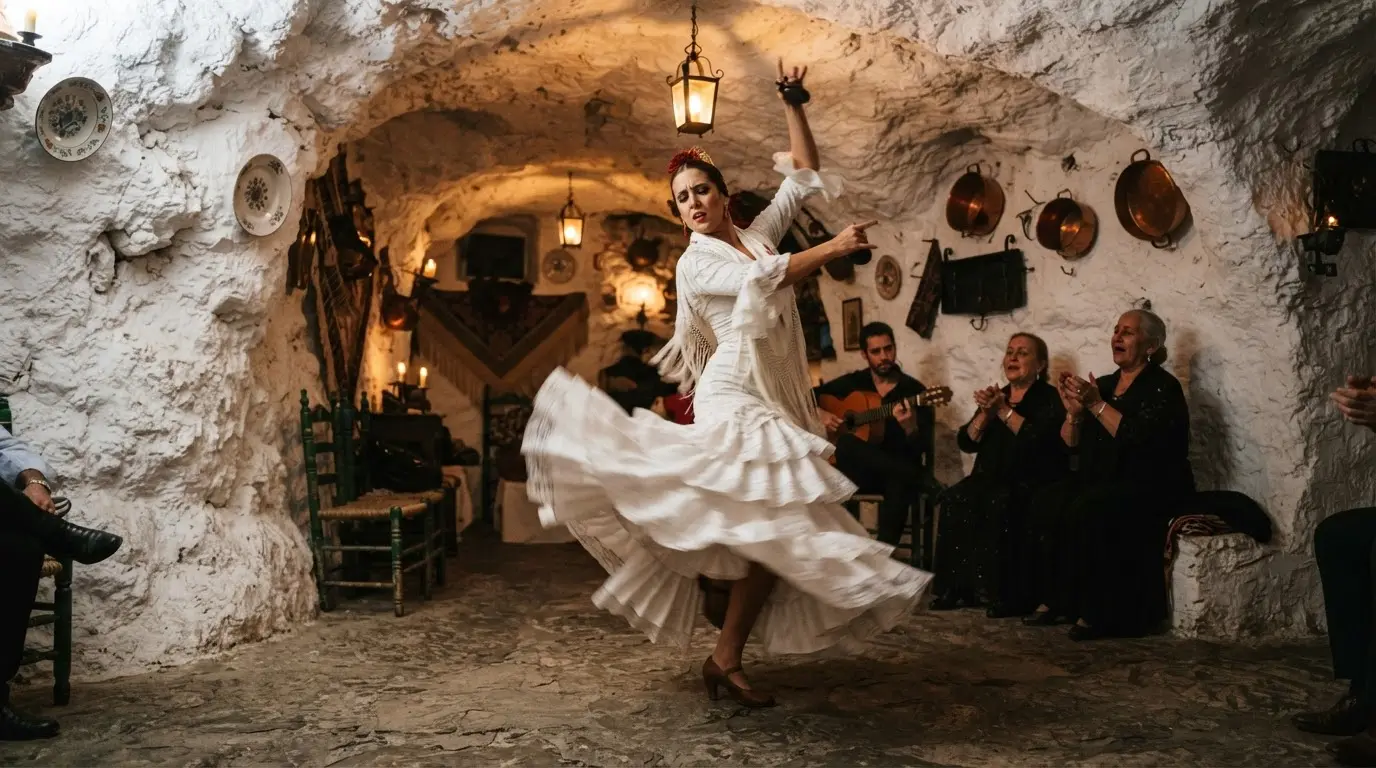
Zambra is something else. The word comes from the Arabic zamra (flute, music, a gathering with dance) and the form it names is a ceremonial narrative in three acts, not a recital. Its frame is the Gypsy wedding. Its setting is a limestone cave with a ceiling low enough to touch. Its capacity is forty to sixty people sitting close enough that the dancer's zapateado (footwork) carries through the bench.
The theatrical conditions are not incidental. They follow from what zambra actually is: a ritual that the Romani community of Sacromonte developed from Moorish wedding celebrations after 1492, practised in the cave homes where they lived, and passed through families under conditions that required it to stay private for generations. The caves were never a venue. They were rooms.
The differences run deep:
| Zambra (Sacromonte) | Tablao flamenco (Seville, Madrid) | |
|---|---|---|
| Origin | Moorish wedding ritual absorbed by Romani community post-1492 | 19th-century café-cantante entertainment |
| Setting | Cave interior, whitewashed rock walls, 40–70 seats | Purpose-built theatre stage, 200–500 seats |
| Structure | Three-act ceremonial narrative (alboreá, cachucha, mosca) | Sequence of independent palos (soleá, bulería, farruca...) |
| Character | Ritual-rooted, female-led, wedding-ceremony frame | Virtuosic showcase, mixed gender, independent numbers |
| Geography | Exclusive to Granada / Sacromonte | Associated with Seville, Jerez, Madrid |
- Origin: Tablao emerged from 19th-century café-cantante entertainment venues in Seville and Cádiz. Zambra developed from Arabic ceremonial music absorbed and transformed by Granada's Gitano community in their own homes.
- Structure: Tablao presents a sequence of independent palos (soleá, bulería, farruca, alegría). Zambra follows a single narrative arc with a defined beginning, middle, and end.
- Posture and movement: Mainstream flamenco is vertical, contained, architecturally precise. The zambra's Moorish inheritance gives it an undulating quality; the arms move differently, the hips carry weight the tablao dancer would hold still.
- Scale: Purpose-built tablao theatres in Seville seat 200 to 500 people. Most Sacromonte caves seat fewer than 70.
This is why the flamenco show in Sacromonte's caves reads differently from what most visitors expect when they book a flamenco night.
How zambra came to be: Moors, Romani, and the caves of Sacromonte
After January 1492, when Ferdinand and Isabella rode into Granada and the Nasrid kingdom became Castilian territory, two communities found themselves simultaneously outside the new order.
The Romani people, called Gitanos in Andalusia, had been present in Spain for perhaps half a century and had no formal status under the Christian crown. They settled on the hillside above the Darro river, on the slopes of Valparaíso, where the natural sedimentary and volcanic formations created caves large enough to live in. They extended and whitewashed them, fitted doors into the rock face, and made homes outside the city walls because they were not permitted to live inside them.[1]
The Moriscos were Moors who had converted to Christianity after the conquest but retained Moorish culture, language, and customs; they faced escalating pressure through the 16th century. Many took refuge with Romani communities who, marginalized from the city's guild system, had less to lose from association with other outsiders. For more than a century, Gitanos, Moriscos, converso Jews, and displaced Christians coexisted in the Sacromonte caves, sharing an extraordinary concentration of suppressed cultural knowledge.
The zambra as a performance form was a Moorish wedding celebration. The Arabic root zamr refers to a toccata played on wind instruments; the zamra was the social gathering where these were performed, with dance, alongside wedding ritual. The Romani community absorbed this form, transformed it through cante jondo (deep song), their own rhythmic vocabulary, and the specific acoustics of low rock rooms, and made it their own.[2]
The name Sacromonte (Sacred Mountain) came later. In 1595, workers uncovered lead plates on the hillside inscribed with texts claiming to reconcile Islam and Christianity — a forgery now known as the Lead Books of Sacromonte, almost certainly made by Morisco scholars as a defence of their community's identity. The Abbey of Sacromonte was built above the supposed discovery by 1601. The Vatican eventually declared the plates forgeries in 1682. But by then the hill had a name, and the community living on it had been forming its art for a hundred years.
The three acts: alboreá, cachucha, mosca
A traditional zambra gitana is not improvised, whatever it feels like from the front row. It moves through three distinct acts, each with defined choreography, specific rhythm, and symbolic content rooted in the Gypsy wedding ceremony. Modern shows compress or evoke the structure rather than performing it in its full ceremonial form, but the arc remains recognizable.
Alboreá opens the zambra. The name comes from alborada (dawn): the wedding ritual traditionally began before first light. The alboreá celebrates the bride's purity and is danced in the rhythm of soleá por bulerías, with choreography dominant over song. The movements are deliberate, the palette of expression formal. This is the ceremony in its most controlled register.
Cachucha follows and shifts the emotional register entirely. This act represents the groom asking for the bride's hand. Two women dance accompanied by a chorus of couples. The key moment: one dancer kneels before the group, symbolizing the groom seeking forgiveness from the bride's family for taking her away. The choreography is intimate and the dynamic between performers becomes social in a way the alboreá is not; the audience, physically close in the cave, becomes implicated in the ritual.
Recommended tours
Tours are selected for quality, not commission. We earn a small fee if you book — at no extra cost to you.
Mosca closes the ceremony in celebration. Pairs of women face each other, lifting one leg forcefully then turning. All dancers form a large spinning circle, calling out "¡mosca!" and striking their aprons every four steps in a rhythmic pattern that escalates toward the finale. The name refers to the fly; the movement recalls the insect's rapid, circular energy. The sound in a low-ceilinged cave during the mosca is considerable.[3]
The structure matters for understanding what you are watching. A tablao performance presents forms in sequence, each complete in itself. The alboreá, cachucha, and mosca build toward each other; remove any act and the ritual collapses.
Explore nearby · Monument
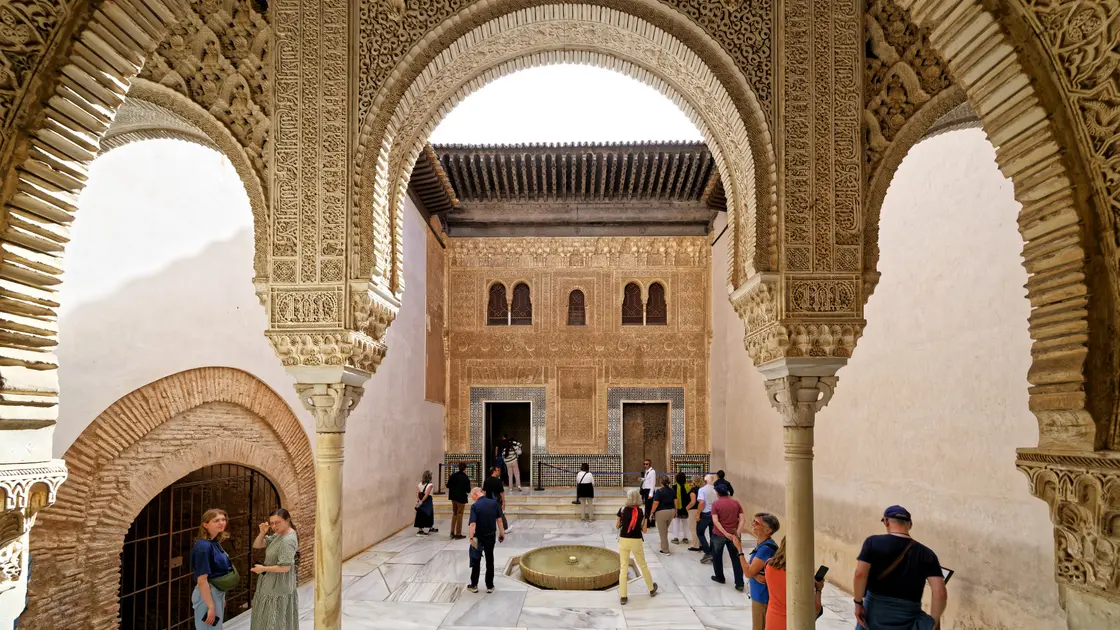
Alhambra
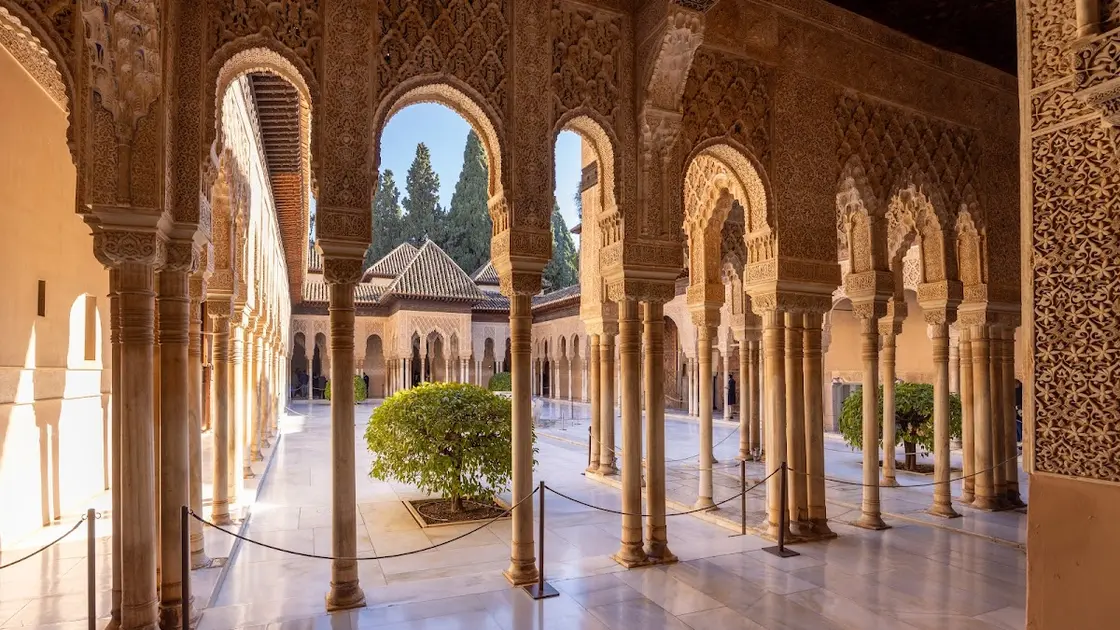
The Alhambra is Granada's UNESCO fortress-palace: Nasrid Palaces, Alcazaba and Generalife gardens. Tickets sell out weeks ahead; book via the Patronato site.
Persecution and survival: how the zambra lived underground
In the mid-16th century, Philip II and the Spanish Inquisition banned the zambra by decree. The same legislation that outlawed Moorish dress, the Arabic language, Moorish music, and Gitano celebrations identified zambra as indecent and contrary to Catholic doctrine. The form was simply prohibited, along with the broader Moorish cultural inheritance it carried.[4]
The Sacromonte community preserved it anyway, passing it privately through families for more than two centuries. The transmission was oral and physical: posture, rhythm, the specific sequence of the three acts, the moment the dancer kneels. None of this could be written down in a way that would survive a house search. It survived because people held it in their bodies and taught it to their children in private.
The Gran Redada of 1749, the Great Gypsy Round-up, intensified the conditions that made this transmission necessary. Ferdinand VI ordered the arrest of approximately 12,000 Gitanos across Spain, removing them from their communities and separating men from women.[5] The operation was a demographic catastrophe for Romani Spain. For flamenco, the recurring themes of loss, defiance, and perseverance that distinguish cante jondo from more formal musical traditions have their roots in exactly this period.
Cut off from the city's guild system and forbidden from most trades, Gitanos increasingly relied on music and dance as economic activity. The cave shows were both income and cultural resistance, a way to preserve Romani identity under conditions designed to erase it. The same intimacy that made the caves vulnerable (a performance was impossible to deny if authorities arrived) also made them defensible: a small room with forty witnesses generates a different kind of solidarity than a public stage.
By the early 19th century, the conditions of suppression had changed. Washington Irving's Tales of the Alhambra (1832) helped spark European Romantic fascination with Granada's Gitano culture, and the cave zambras began attracting Romantic-era travellers who wrote about them extensively. What had been preserved in secret became, over the course of a century, one of the city's defining cultural attractions, without changing fundamentally what it was.
The Canastera lineage and the venues that still carry it
The authenticity of Sacromonte's flamenco rests on a specific claim: not that performances are ancient, but that the families performing them are the direct descendants of the people who developed and preserved the form. The tourist industry can produce a cave and whitewash the walls. What it cannot produce is a continuous lineage.
María la Canastera is the figure around whom this lineage coheres. She was a matriarch of the zambra gitana tradition on Camino del Sacromonte, recognized by Granada's City Council with the title of Twentieth Century Grenadian in 1999. The venue bearing her name, Zambra María la Canastera at Camino del Sacromonte 89, was established roughly seventy years ago and has operated as a family business since. The performers are her descendants. The 55-seat cave has changed little. Tickets are €26 for adults, including the show and a drink; €20 for children aged 5 to 11.[6] Shows run at 9:15 PM (from September: 7:45 PM) and last one hour.
Cueva de la Rocío, founded in 1951 at number 70 on the same road, is the other pillar. Four show times nightly: 8:00 PM, 9:00 PM, 10:00 PM, 11:00 PM. Tickets are priced in tiers depending on the package. Both venues are small enough that no seat is far from the performers; both retain the three-part zambra structure as the core of the show.
Venta El Gallo operates differently: it combines an Andalusian restaurant with the cave show, pitched at visitors who want the full evening. The atmosphere is less concentrated than the purely intimate cave venues but the location sits higher up Camino del Sacromonte with terrace views toward the Alhambra, which provides a different kind of setting. It's the better choice for visitors who want dinner built into the evening rather than arranging it separately.
Deep dive · Article
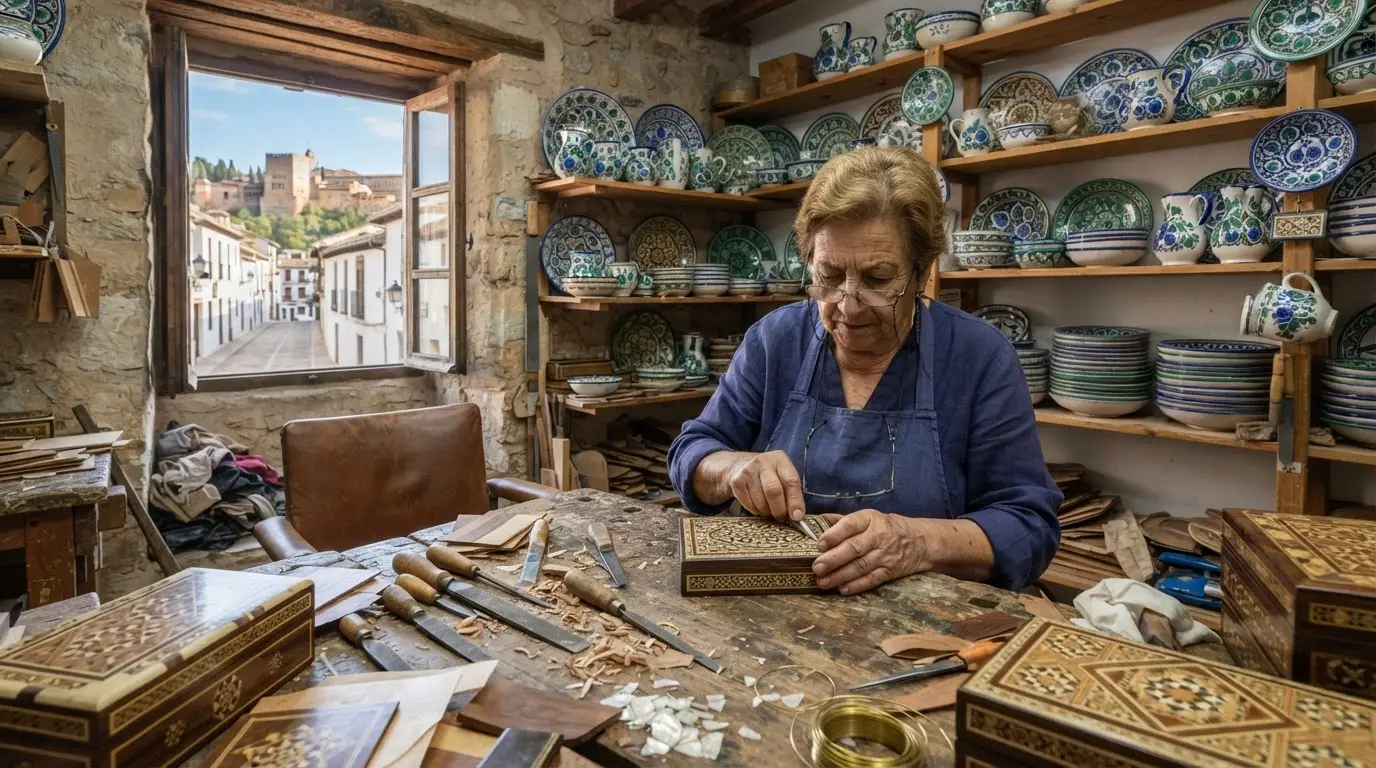
Granada Artisan Crafts: Taracea, Fajalauza Ceramics and Leather
Granada's taracea marquetry, Fajalauza ceramics, leather goods, and luthiery trace directly to Nasrid workshop traditions. A guide to finding the real thing.
Contemporary performers carrying the tradition include cantaora Marina Heredia and dancer Salvador Amaya, both associated with Sacromonte's flamenco community and with the wider recognition flamenco gained when it was inscribed on UNESCO's Representative List of Intangible Cultural Heritage in 2010, as a whole art form with zambra included.[7]
A word on what to avoid: the Internet's fringe of commercial listings occasionally claims a separate UNESCO inscription for zambra specifically in 2019. That claim is false. No such inscription exists. Flamenco was inscribed as a single tradition in 2010; zambra is part of that tradition, not the subject of a separate listing.
Seeing a zambra show: timing, access, and what to expect
The practical facts first. Sacromonte sits on the northern slope of Valparaíso hill above the Darro valley, a fifteen-to-thirty-minute climb from the Albaicín. The Camino del Sacromonte road is steep and unlit in sections. Two sensible options for an evening show: the C34 minibus from Plaza Nueva (runs to the main cave quarter at city-bus fares), or a taxi (a few euros from the city centre). Walk back down after the show along the Carrera del Darro; the Alhambra is lit above the river and the path is one of the better thirty minutes in Granada after dark.
When to go: spring (April and May) and early autumn (September and October) are the most atmospheric months. Warm evenings, venues at comfortable capacity, shows that don't feel like crowd management. July and August push volumes high enough that venues run multiple shows per night to meet demand; the intimacy holds if you book early in the evening, but it's noticeably tighter. Winter shows are smaller still and occasionally, in December and January, you'll find yourself in a cave with an almost-empty room and artists performing with an intensity that summer crowds don't always allow.
Booking: advance booking is essential in summer and strongly recommended at any other time of year. Both Zambra María la Canastera (marialacanastera.com) and Cueva de la Rocío (cuevalarocio.es) take direct bookings. The third-party platforms also list the main venues, but direct booking is the simplest path and the same price.
Inside the cave: the rooms are cool in summer and warm enough in winter, a feature of the limestone rather than any heating system. The ceiling is low. In a cave of forty seats, the zapateado footwork produces vibration that travels through the floor into the seats. The palmas (hand-clapping) bounces off the rock walls. There is no amplification, no lighting rig, no acoustic treatment. The closeness is a feature rather than a limitation, but it is worth knowing before you arrive that this is nothing like a theatre.
For the full context of the neighbourhood before you go, the Sacromonte cave route walk covers the Camino del Sacromonte, the Ethnographic Caves Museum, and the abbey at the top of the hill. The area rewards an afternoon before the evening show.