The vermut hour: Spain's midday pause before lunch
In Spain, the vermut hour (la hora del vermut) sits in a narrow window, roughly noon to one in the afternoon and always ahead of lunch, a habit that runs opposite to the rest of Europe, where vermouth is typically poured before dinner rather than before the midday meal.[3]
The Spanish aperitivo is not primarily about the alcohol. It exists to prime the appetite: a light snack alongside a cold drink, taken specifically to make the stomach ready for a proper meal an hour later.[4]
That gap matters because Spanish lunch typically doesn't start until early afternoon. A drink and a small plate at noon or half past isn't dinner-before-dinner; it's a bridge across an unusually long morning, one that gives a bar the same rush other cities save for evening happy hour.
Granada runs on the same clock as the rest of the country for this. What sets its version apart is not the timing but what happens on the bar top the moment the glass is poured, a difference that has less to do with the vermouth than with an old civic habit the city has never given up.
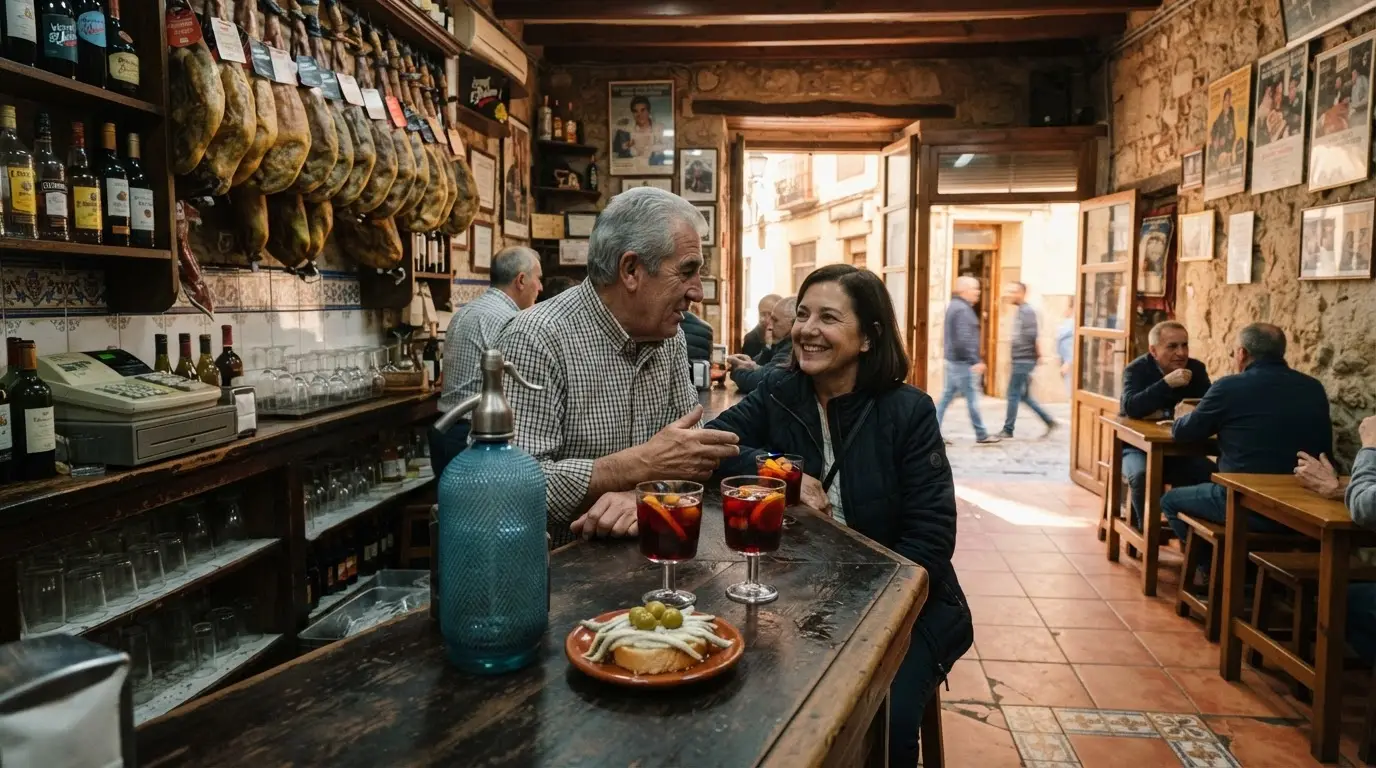
Walk past a bodega doorway at half past twelve on a weekday and the room is not full of tourists working through a bucket list. It's retirees who've had the same spot at the counter for years, market traders finishing an early shift, office workers stretching a break by ten minutes. The ritual survives because it still serves the people it was built for.
From Turin to the bodega counter: how vermouth reached Spain
Vermouth as it is drunk today was first produced in Turin in the mid-to-late 18th century, sold originally for medicinal use before fashionable Turin cafés began serving it as an apéritif.[5]
The sweet, red style most associated with the drink came a little later: the merchant Antonio Benedetto Carpano introduced it in Turin in 1786, and it caught on quickly with the city's royal court.[6]
It is, technically, a fortified and aromatized wine, which is why a glass of it carries more of a kick than an ordinary red or white: most bottles run 16 to 18 percent alcohol, against 9 to 14 percent for most unfortified wine.[7]
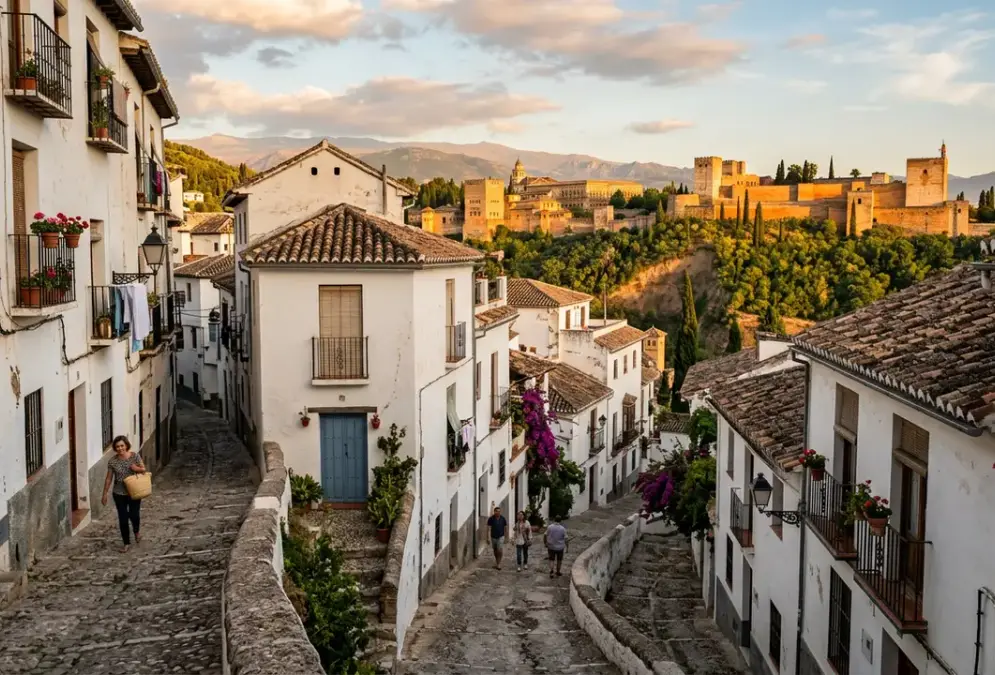
Explore · Neighbourhood
Albaicín
Granada's oldest neighbourhood: the Albaicín holds a UNESCO-listed maze of whitewashed lanes, Moorish cármenes, and the finest Alhambra views in the city.
Vermouth reached Spain by way of Barcelona, where the Italian producer Perucchi began making his own recipe in 1860.[8]
The foothold held because Barcelona already had one of the largest communities of Italian immigrants in the country just as vermouth exports from Italy were taking off, and it was there that families made a habit of drinking it after church and before Sunday lunch.[9][10]
The custom did not become a truly national one until later still, decades after vermouth had already settled into Barcelona life. It spread to lower-middle-class households nationwide specifically during the Franco years, turning up at village bars at the tail end of Sunday Mass.[11] Minus the Mass, that same beat still describes a Granada bar around 1pm on any given Sunday.
Vermouth was never the only option at that hour. A caña of beer or a glass of chilled white wine does the same job for plenty of regulars. What made vermouth different, when it mattered, was the ritual attached to it: pouring from a fixed bottle behind the bar, the ice, the twist, the small performance of it, rather than just another drink poured and forgotten.
None of this history is specifically Granada's. The city inherited a national habit that started on the coast and moved inland decade by decade, the same way it moved through every Spanish province with a bar and a Sunday. What Granada added was not the vermouth. It was what came with it on the same saucer.
Inside the ritual: ice, sifón, and a century-old bodega counter
The classic Spanish serve is unfussy: vermouth over ice, with a twist of citrus and an olive dropped in. The snack alongside it is just as plain:[12]
- a handful of crisps
- some tinned fish
- a gilda, the skewered olive, pepper and anchovy that sharpens the next sip
That plainness is deliberate, not a shortcut. A proper bodega's whole design serves the pour: a marble or wood counter worn pale where generations of forearms have rested, barrels stacked along one wall, hams hanging from the ceiling beams, and a fridge doing nothing more ambitious than keeping the ice cold and the beer colder.
There's a script to how you drink it too. A bodega vermut is a standing drink at the bar, not a table order: quick, social, over almost as soon as it starts, unless a second round changes the plan.
This is Granada's version of the same pour: a bodega old enough that what lands in the glass is often a barrel-aged red vermouth (vermut de barrica), not a bottle broken out for the tour groups.
Bodegas Castañeda, tucked into the Bajo Albaicín, is the clearest surviving example. It has operated since 1927[1], and vermouth has been its standout drink from that first year.[13] The sifón still earns its keep here too: the bodega's own calicasas mixes sweet and dry wine with spirits and grenadine, cut with a splash from the soda siphon.[14] In 2024, the bodega won Spain's Premio Nacional de Hostelería, the national hospitality award, in its eighteenth edition.[15]
Castañeda is not the only bodega running this same script, and a full round-up is not this piece's job; for that, see the guide to Granada's best traditional bodegas and tabernas.
Granada's free tapa: legend, decree, and a threat that never happened
One origin story for Granada's free tapa reaches back to the 13th century: Alfonso X, 'the Wise', is said to have passed a decree forcing taverns to serve a small portion of food alongside wine, specifically to curb public drunkenness.[2]
A more commonly credited version has nothing to do with royal decrees. The original 'tapas' were literal lids, bread or cured meat set over a wine glass to keep flies out while a drinker wasn't looking; salty ham or chorizo used as the lid only made drinkers thirstier, which meant more wine sold.[16]
A third explanation points to pre-19th-century roadside inns across Andalusia. Proprietors there often could not read or write, so small food samples stood in for a menu board, letting a guest see what was on offer before ordering.[17]
2022
Whichever version is true, and probably none is entirely, the practical result predates any single explanation: a drink ordered at a Granada bar has come with something to eat for long enough that nobody working the counter treats it as generosity. It's just what you do when someone orders.
Giving away food with every drink is not free for the bar; a tapa costs the kitchen real ingredients and real labour. That's presumably part of why the idea of ending it reached Granada's city hall at all.
In 2022, Granada's mayor threatened to end the city's free-tapa tradition; to date, it hasn't happened.[18] For an evening that starts with a vermouth and ends somewhere else entirely, Peña La Platería in the Albaicín is a short walk from most of the bodega counters mentioned here.
A Catalan slump, a Catalan revival, and Granada's own argument
Vermouth's story in Spain has not run in a straight line upward, at least not in the region best documented. In Catalonia, its home turf, the drink slid by the late 20th century into the reputation of an old man's drink, something a grandfather ordered rather than something anyone chose.[19]
A renaissance changed that, starting roughly a decade before 2023 and driven by a younger generation of trendsetters in Barcelona alongside a wave of new local vermouth brands rediscovering a drink their own grandparents had put down.[20]
That slump and that rescue are Catalonia's story, not a documented national one, and nothing in the record says Granada's bodegas went through the same rise and fall. One plausible reason, if that's true, is the free tapa: a drink that always arrived with something to eat never had to compete purely on the strength of the drink itself, which is a harder thing to get bored of.
What makes Spanish vermouth Spanish is the taste and how it's drunk: brighter and less bitter than the Italian original, served on the rocks with food rather than mixed into a cocktail.[21]
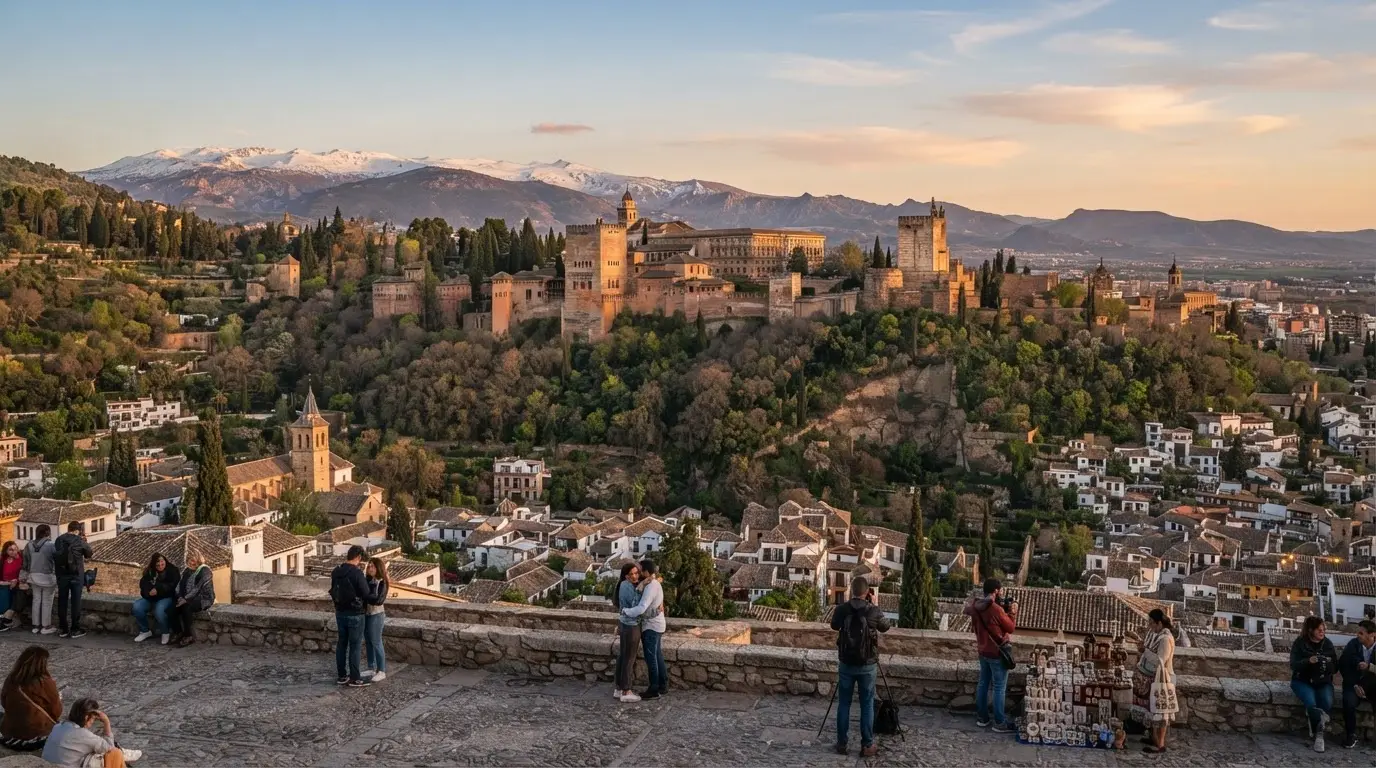
Deep dive · Article
20 Interesting Facts About Granada, Spain
Interesting facts about Granada Spain that guidebooks skip: disputed etymologies, the soldier who saved the Alhambra, and a river buried under Plaza Nueva.
That habit of drinking it straight, as an aperitif rather than an ingredient, is itself more Mediterranean than Anglo-American: vermouth stays something people drink for its own sake in Spain, Italy and France[22], while in the US and UK it declined after the mid-20th century and survives mainly in smaller amounts inside classic cocktails such as the Manhattan.[23]
If Granada's own vermut hour really did skip Catalonia's old-man's-drink slump, the free tapa is the most plausible reason: it gave people at the bar top something besides the drink itself to stay for. Take the tapa away, and Granada's vermut hour is just Spain's vermut hour with better weather. Keep it, and it's a distinct habit worth building an afternoon around. For a guided introduction rather than working it out at the counter, the vermouth and wine bar tour strings a few stops together in one afternoon.