Why Romani families came to Sacromonte's hillside
The Reconquista changed the population map of Granada overnight. When Ferdinand and Isabella took the city on 2 January 1492, the new Christian administration pushed its unwanted populations toward the margins. The Romani community (gitanos in Spanish) found itself alongside expelled Moriscos, converts, and freed enslaved people of African origin, all directed to the hillsides outside the city walls.[1]
The eastern slope above the Darro, known as Valparaíso Hill, was the result. The land had no administrative value and no strategic significance. It also had something the city lacked: Alhambra-Formation conglomerate — a clay-bound rock made of rounded stone fragments, soft enough to cut by hand with basic tools but cohesive enough to form self-supporting arched chambers once the excavation was done. Families could dig a home without masonry, without engineering, without any capital investment beyond physical labour.
Protection mattered as much as shelter. The hillside lay outside the reach of the Spanish Inquisition's urban surveillance networks. Living inside the rock meant living below the administrative gaze. This dual practicality — thermal comfort and relative invisibility — explains why the community stayed for five centuries rather than seeking better-appointed housing once circumstances changed.
Explore nearby · Museum
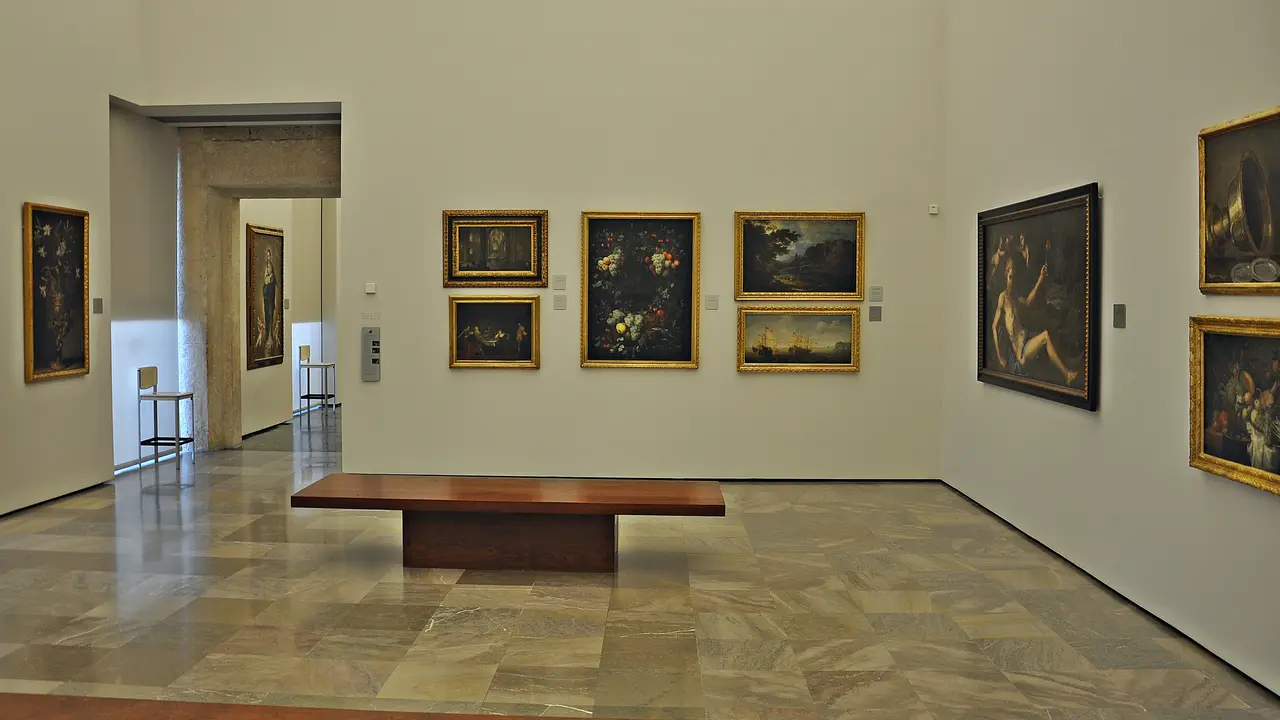
Museo de Bellas Artes de Granada
Spain's oldest public museum (1839), upper floor of the Palace of Charles V. Free for EU visitors. Alonso Cano's Granada School paintings and sculptures.
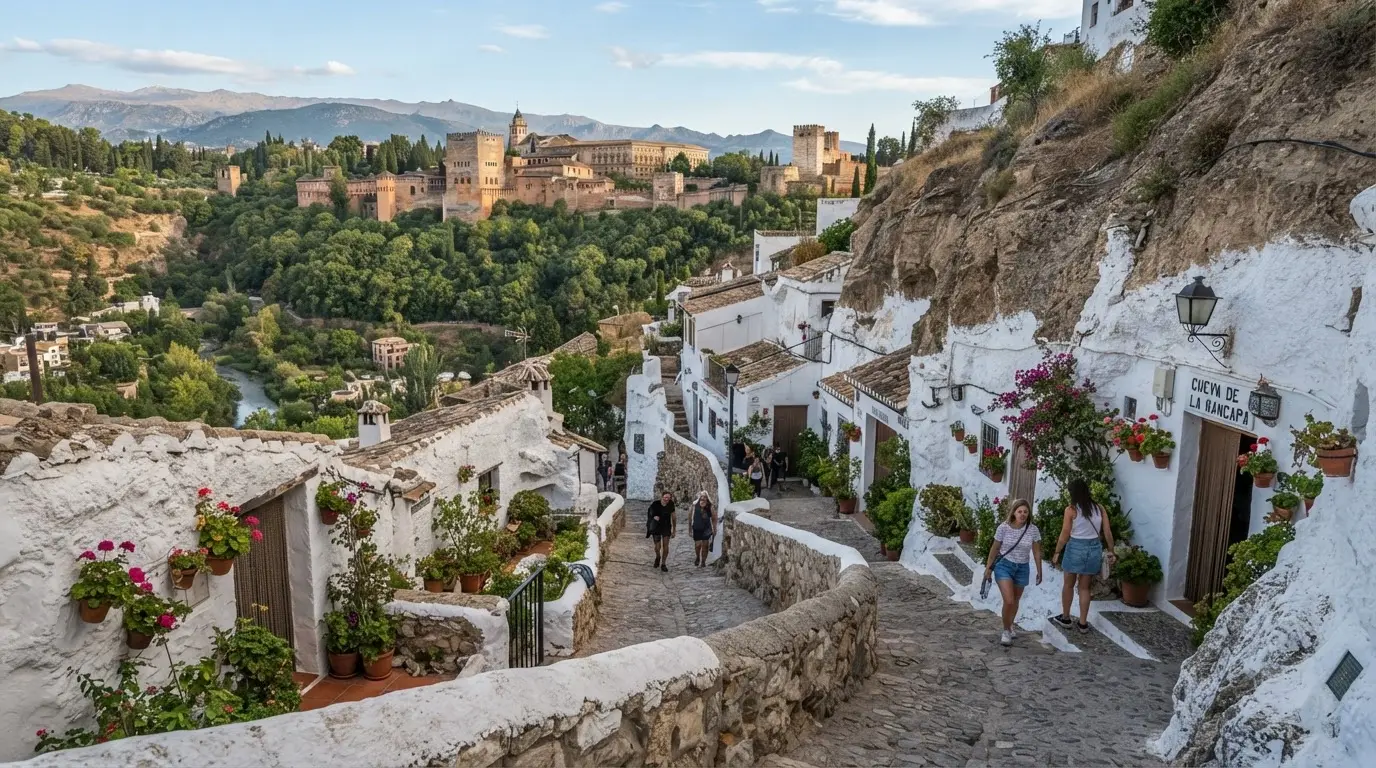
The Sacromonte neighbourhood still carries this topography: the camino running east above the Darro, the wooden doors cut into raw white hillface, the chimneys rising from the rock above them.
The geology that made cave living possible
Not every hillside in Granada could be excavated. The specific geology of the Sacromonte slope is what made cuevas viable here rather than anywhere else in the city.
The rock is Alhambra-Formation conglomerate: a sedimentary deposit of rounded clasts of varying size, bound together in a clay matrix.[2] The clay binding is what matters. It is soft enough that a family with hand tools could excavate a chamber in weeks. Once the rock is removed, the interlocking structure of the clasts provides the arched chamber with enough integrity to stand without timber framing or masonry.
The thermal properties follow from the mass. Walls typically reach two or three metres of solid rock on three sides. That mass absorbs heat slowly and releases it slowly — holding interior temperatures close to 17°C year-round, regardless of the Andalusian summer heat outside or the cold nights of December. There is no air conditioning in Sacromonte caves because there has never needed to be.
Expansion required no specialist knowledge. A family that needed a new room simply dug deeper into the hillside. The same technique produced bedrooms, kitchens, animal stalls, and storage. The cave grew with the family.
17°C
Caló, the mixed language the community used, has a word for the entire complex of rooms carved from one face: a single cueva might contain four or five chambers while presenting a single whitewashed facade to the path outside.
Five centuries of cave life: interiors, craft, and the zambra tradition
The interior of a traditional cueva was immediately recognisable. Whitewashed walls, copper pots hung in rows from the rock, brass trays, ceramic plates, woven baskets, horse harnesses: the metalworking heritage of the community expressed itself through domestic objects displayed as decoration. Some older caves still have packed-earth floors.
The outside was equally distinctive: a whitewashed facade, wooden door set directly into the rock face, and geraniums in clay pots at the doorway. A red geranium against white conglomerate and a river valley in the background is one of the defining images of Granada.
Inside these walls, cut off from polite society and protected by the neighbourhood's informal solidarity, the community developed flamenco zambra — the form specific to Sacromonte, with its Arabic rhythmic ancestry and its roots in the ceremonial dances the community brought from further east.[3] Federico García Lorca documented Romani life on this hill in his 1928 collection Romancero Gitano, giving the outside world its first extended literary account of what happened in the cuevas.
Recommended tours
Tours are selected for quality, not commission. We earn a small fee if you book — at no extra cost to you.
The family lines here are long. Some families have lived on the hill for six or more generations, going back to the founders of the zambra tradition more than 500 years ago. The Caló language they speak is a living hybrid: a Romani grammatical structure woven with Spanish, its active use shrinking but not gone.
The tortilla del Sacromonte, the local omelette made with lamb brains, bull's testicles, bread, and vegetables, came from the same economy of scarcity. The community ate what the city discarded — and how that necessity became a dish tied to a specific feast day and a five-century tradition is the subject of the tortilla del Sacromonte history article.
The 1963 floods and the forced evacuation
In 1962, Swedish documentary photographer Lennart Olson and guitarist Dan Grenholm filmed the community on the hill. The footage they made became, without their knowing it at the time, the last visual record of uninterrupted cave life before catastrophe.
Six months of sustained torrential rainfall in 1963 saturated the hillside.[4] Clay-bound conglomerate, which makes for ideal cave walls under normal conditions, loses cohesion when fully waterlogged. Caves collapsed. Residents were killed — reportedly including the guitarist Antonio Maldonado and his young son, though this appears in only one secondary account. Francisco Franco visited Granada in the aftermath.
Francoist civil authorities ordered a full evacuation of the hill and declared it uninhabitable. The community was relocated to purpose-built housing blocks in the city and told explicitly never to return. Centuries of continuous habitation ended in weeks.
The displacement was the community's second great rupture after 1492. Families that had lived on the hill for generations were now in apartment blocks with no connection to the landscape that had shaped them. Many caves sat empty for years, the whitewash fading, the geraniums gone.
The return was gradual. Through the 1970s and 1980s, some families came back and began restoring abandoned caves. Others converted their cuevas into tablaos and zambra performance spaces for the growing tourist trade — a pragmatic response that local purists still debate, as the commercial flamenco circuit inevitably reshaped what was performed and for whom.
Visiting Sacromonte's two heritage sites: the museum and the abbey
The community's own act of formal reclamation came in 2004 with the opening of the Museo Cuevas del Sacromonte, an open-air ethnographic museum at Barranco de los Negros s/n. Eleven original restored caves arrange themselves thematically across the hillside: one shows a complete traditional domestic interior, others demonstrate the blacksmithing, weaving, and basketry trades that the community practised.[5]
Admission is €5. Hours are daily 10:00–18:00 in winter (approximately late October to late March) and 10:00–20:00 in summer. A free audio guide covers the site in Spanish and English; printed guides are available in French, Italian, and German. The museum complex includes a botanical garden with native plants and a viewpoint over the Alhambra and the Albayzín. Allow at least an hour.
Higher on the hill, the Abadía del Sacromonte (€7 adults, €5 students with ID, free under 13)[6] rewards the extra climb with something few visitors expect: the Santas Cuevas, an underground network of passages, chapels, and an altar built over the cave where San Cecilio's relics were allegedly found in 1595. Access is guided-only and included in the ticket. The abbey terrace offers one of the cleanest views of the Alhambra in Granada, without the crowds of the Mirador San Nicolás.
Deep dive · Article
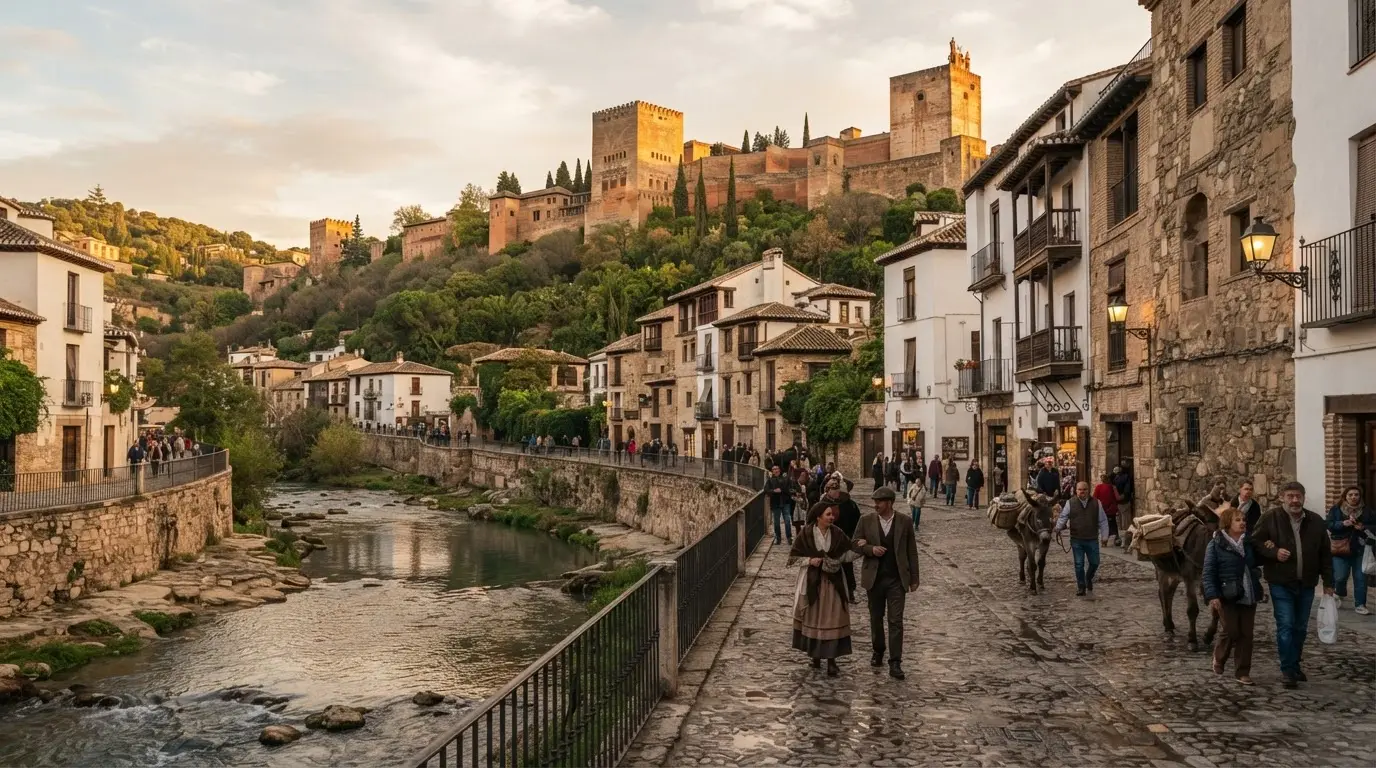
Carrera del Darro: Granada's Medieval Street Explained
Carrera del Darro history: 11th-century Moorish bridges, El Bañuelo bathhouse, a 1539 Renaissance palace, and Granada's only open stretch of the Darro river.
Abbey opening hours: daily 10:00–13:00 and 15:00–17:00 in winter (28 October–31 March), 10:00–13:00 and 15:30–18:00 in summer (1 April–27 October).
The logical sequence is museum first, abbey second: walk up, spend an hour in the ethnographic caves, continue to the abbey, descend along the Camino del Sacromonte back toward the Albayzín in the late afternoon light.
Staying in a cave house: what to expect and how to book
The same excavated rock that sheltered Romani families in the 16th century now provides some of the more unusual accommodation in Granada. A number of private cuevas have been converted into rental properties, bookable through Airbnb and specialist agencies including Exclusive Granada (exclusivegranada.com).
Prices run from approximately €68 per night for a two-person cave to €80–110 for larger properties sleeping four to six.[8] Most rentals require a two-night minimum. What you get: one or two bedrooms, a living room, a kitchen, a bathroom with shower, and a private terrace with Alhambra views.
The thermal mass works as advertised. The 17°C interior temperature means no air conditioning, no heating, and a level of quiet that visitors consistently find startling. The thick cave walls block external sound almost completely — a contrast to staying in the Albayzín, where the sound of flamenco and late diners carries long into the night.
The thick cave walls block external sound almost completely. Visitors consistently find it startling — a level of quiet you don't expect on a hillside above a city.
A few practical notes:
- Book at least two months ahead for summer stays; the best-positioned caves go quickly
- Parking on the hillside is very limited; use the bus (lines 31, 32, 35 from central Granada) or walk the camino from the top of Cuesta del Chapiz
- Confirm with your host whether the cave has wi-fi — most do, but connections vary
- The 17°C interior can feel cool on arrival in summer; bring a light layer for the first evening
For the Albaicín neighbourhood as a base, several hotels and guesthouses cluster along Carrera del Darro, five minutes' walk from the Sacromonte path. Staying in a cave on the hill itself, though, is one of those experiences that changes how you read the neighbourhood: not as a curiosity but as a place where people have actually lived, for centuries, at the exact temperature of the rock.