Santa Fe in 1897: the town where Granada's pastry was born
Santa Fe sits on the Vega de Granada, the flat agricultural plain that extends west of the city toward the Sierra Nevada foothills. Today it takes about 25 minutes by bus from Granada's main station. In 1897 it was a longer journey through farmland, but the town had a history that outweighed its modest size.
Isabella I and Ferdinand II founded Santa Fe in 1491 as a permanent military encampment during the final siege of the Nasrid kingdom. Earlier Spanish armies had made do with tents and wood; the Catholic Monarchs built in brick and stone, a signal they intended to stay until Granada fell. The siege held through winter. The Reconquista and Fall of Granada concluded in January 1492.[1] It was from this same town, a few months later, that Columbus received the royal backing for his Atlantic voyage: the Capitulations of Santa Fe, signed in April 1492.
The town's grid plan survived. Calle Real, the central street where Ceferino Isla eventually opened his workshop, still runs through the same blocks the Catholic Monarchs laid out. The street names and the stone-built churches made Santa Fe feel older and more authoritative than its actual age. That weight of place mattered to the kind of devout, tradition-minded pastry chef Ceferino Isla appears to have been.
405 years
Isla had trained as an apprentice under a baker known as Manuel El Gallego. His family came from Rincón de Isla in Cantabria; some of that northern ancestry had moved south during the Reconquista and settled in Andalusia generations before him. When he opened Casa Ysla on Calle Real, the name was a pointed spelling of his surname. The 'Y' distinguished the bakery from the family name and gave it an air of formal establishment.
The pastry as papal portrait: how Ceferino Isla designed the pionono
Ceferino Isla created his pastry in 1897 as a devotional act. The man he wanted to honour was Pope Pius IX, known in Italian as Pío Nono, who had died in 1878 but remained a towering figure in Catholic popular consciousness. In 1854, Pius IX had proclaimed the dogma of the Immaculate Conception, the doctrine that the Virgin Mary had been conceived without original sin. For a devout Andalusian confectioner in the 1890s, that proclamation was still culturally recent, and the man behind it was worth commemorating in the idiom he knew best.
The design is precise and deliberate, not accidental.
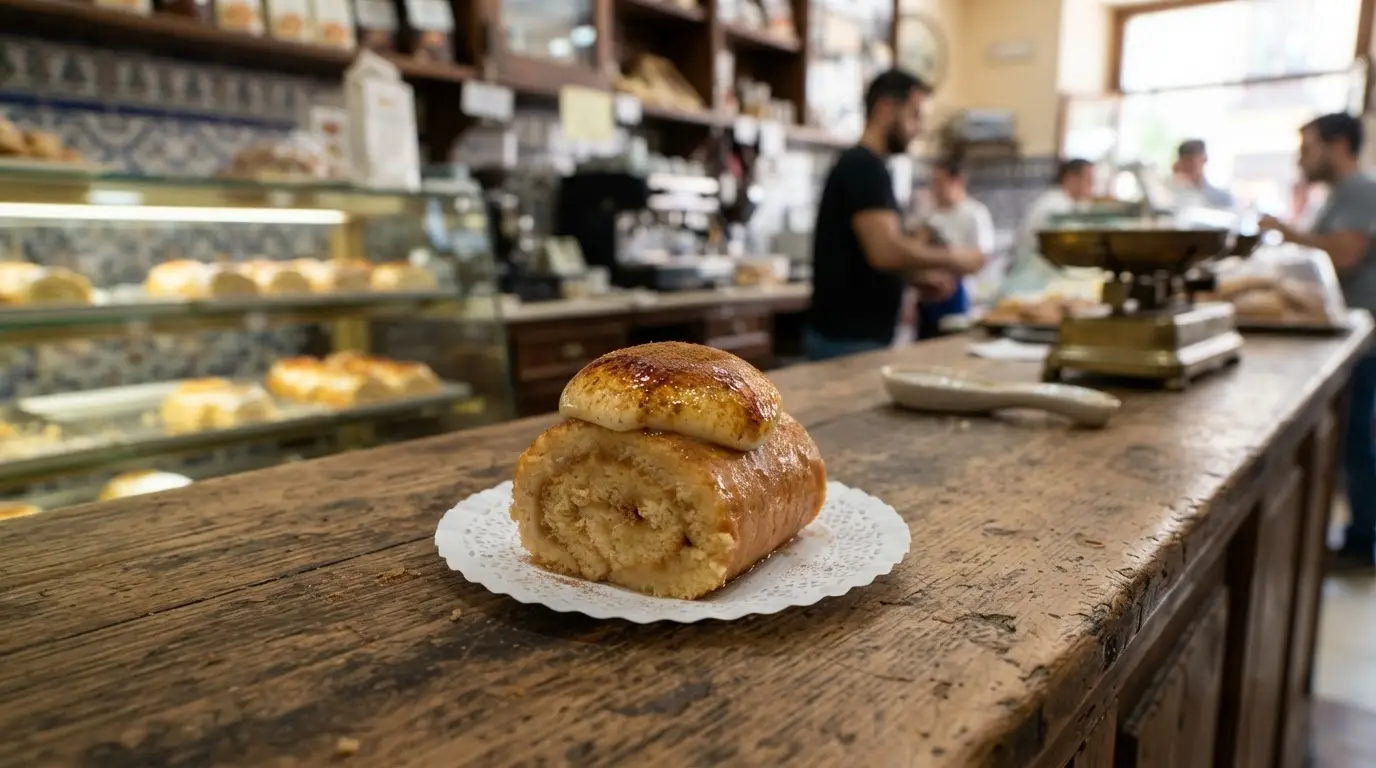
- The rolled sponge cylinder represents the papal body, wrapped in the long balandrán robe
- The white paper wafer at the base evokes pontifical vestments
- The caramelized cream dome on top mimics the solideo, the small white skullcap that identifies a pope
He soaked the sponge in a cinnamon-and-sugar syrup and filled it with a yolk-enriched cream seasoned with cinnamon. The result was approximately 3 to 4 cm in diameter, tall enough to look like a figure when standing upright on its paper square. Every element of the recipe pulled double duty: flavour and symbol at once.[2]
Explore nearby · Monument
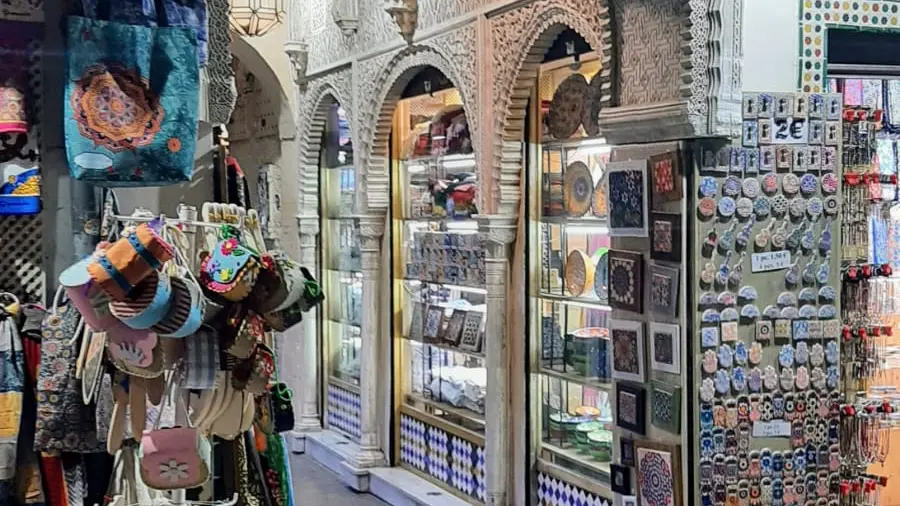
Alcaicería
Granada's historic silk market, rebuilt after 1843 in Neo-Moorish style. Small shops sell ceramics, taracea woodwork, spices, and leather goods. Free to enter.
The proprietary syrup formula and cream recipe have never been published. Five generations of the Isla family have maintained them. The authentic version has a pronounced cinnamon note in the syrup and a lighter, eggier cream than most imitations, less sweet and more complex.
Royal recognition and Casa Ysla across five generations
For nearly two decades after Ceferino Isla invented the pionono, the pastry had a local reputation but no formal recognition beyond Santa Fe and Granada. That changed in 1916, when a man named Pedro Galatino presented a pionono to King Alfonso XIII.
Alfonso XIII's enthusiasm was immediate enough that Casa Ysla was granted the title Proveedor Oficial de la Casa Real (Official Supplier to the Royal House). The bakery added a royal crown of five points to its logo. That crown was removed during Spain's Second Republic (1931–1939) and reinstated afterward. It still appears on every Casa Ysla box sold today.[3]
The five-generation continuity is unusual in Spanish artisan food. Most regional sweets with a 19th-century origin have been absorbed by industrial producers or quietly changed beyond recognition. The Isla family has never licensed the recipe. Production runs at approximately 4,000 to 5,000 piononos per day, all made by hand at the Santa Fe facility.[2] The scale is large enough to supply Granada's hotels, pastry shops, and airport retail, but small enough that each pastry receives the individual torching and paper-setting that the recipe requires.
The current Casa Ysla operation runs from two sites:
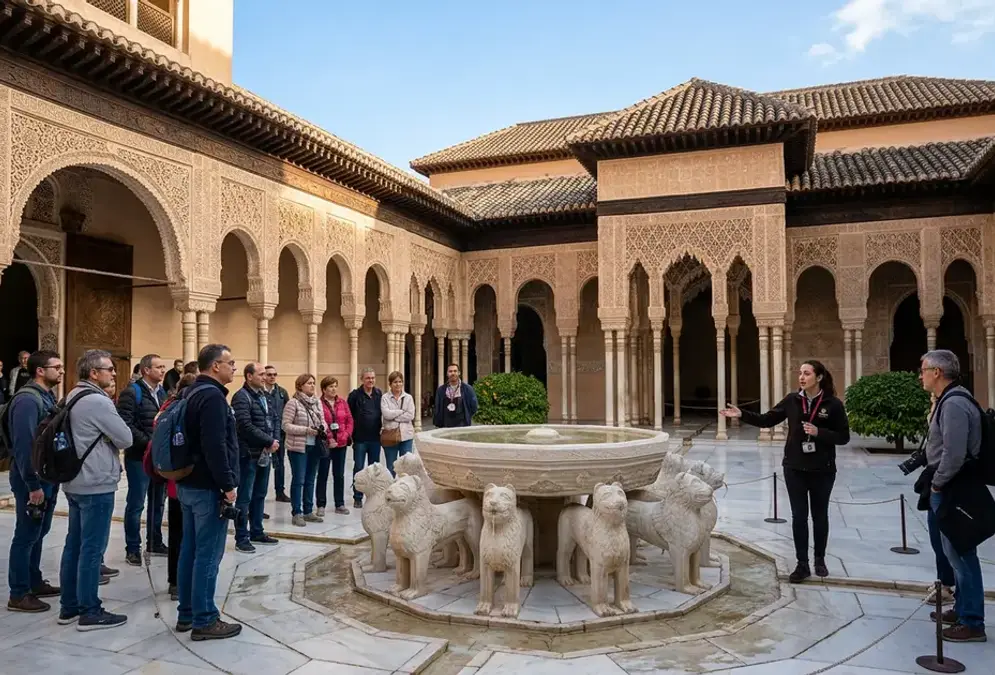
Recommended tours
Tours are selected for quality, not commission. We earn a small fee if you book — at no extra cost to you.
- Santa Fe original: Carretera A-92G Km 3.3, 18320 Santa Fe (production facility and retail counter)
- Granada city: Avenida de la Constitución 3 (city-centre branch, no bus required)
For the full experience (production smells, bakery counters, 15th-century street plan), the Santa Fe location rewards the journey.
How to recognise an authentic pionono and why it matters
Granada produces more imitation piononos than real ones. The pastry's fame has made it a default souvenir, and most of what fills airport display cases, hotel gift shops, and roadside tourist-trap counters is an oversized, over-sweet version made with industrial sponge.
The differences are observable before you bite:
- Size: the authentic pionono is strictly one to two bites, roughly cork-sized. Anything larger is a giveaway
- The cream dome: Casa Ysla's version is genuinely torched. Look for a glossy, slightly darkened cap with visible caramelization marks, not a sugared surface that is merely white or dusted
- The paper wafer: clean white, firm, not adhesive or soggy
- Cinnamon presence: the syrup in an authentic pionono has a distinct warm spice note. The imitation versions lead with pure sweetness
The pionono de Santa Fe dish page covers where to find them in Granada city if you're not making the Santa Fe trip, including Pastelería López-Mezquita on Calle Reyes Católicos and the alternatives in the Realejo neighbourhood. The dish page also covers allergens and pricing for those who need that information.
What the dish page cannot tell you is what it means when a granadino who has eaten these since childhood picks up a box from Casa Ysla at the Avenida de la Constitución branch. The pionono functions in Granada the way certain biscuits and sweets work in every culture with a pastry tradition: it is the taste that closes the gap between where you are and where you were.
Santa Fe has built a monument to the pastry in the town centre. That kind of civic commemorating does not happen for industrial confectionery. It happens for something that has become genuinely embedded in how a place understands itself.
Santa Fe today: visiting the birthplace of the pionono
Santa Fe is 14 kilometres southwest of Granada. A direct bus from the Estación de Autobuses runs every 20 to 30 minutes and takes about 25 minutes. Drivers heading out to the A-92 motorway or returning from the coast pass through without stopping; it is worth stopping.
The town centre has changed relatively little since its 1491 grid was laid out. The main square, the church, and Calle Real still follow the Catholic Monarchs' original plan. The Plaza de España at the centre carries a commemorative plaque to Columbus; the Capitulations were signed either in the town or in the monarchs' tent, depending on which account you trust, but the weight of the moment is palpable in a place this size.
Casa Ysla's production facility on Carretera A-92G is a few minutes from the centre on foot. The retail counter sells piononos individually, by the box, and occasionally lets visitors see the production area through a window in the wall. Arrive before 10am to catch the first batches of the day. The sponge has maximum moisture, the cream is freshly set, and the torching has just happened.
Deep dive · Article
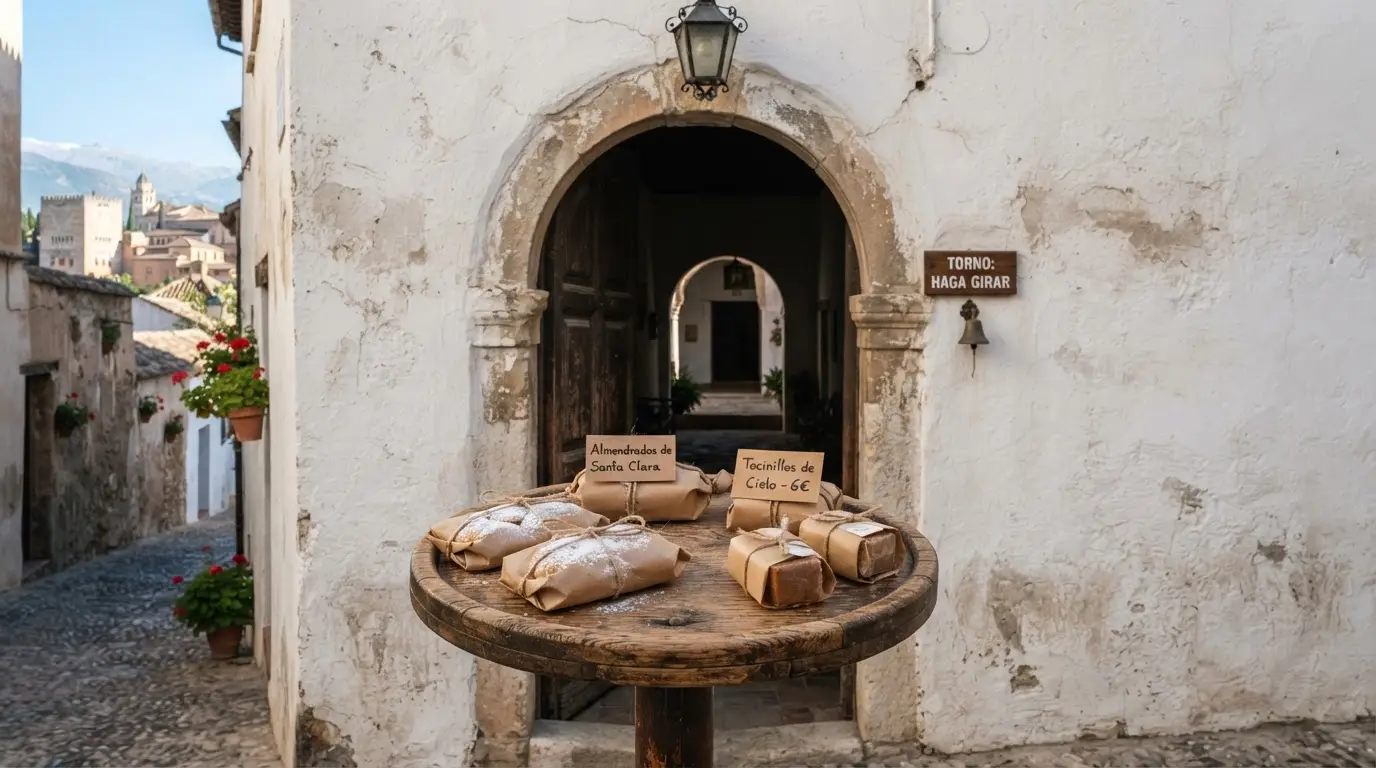
Convent Sweets in Granada: Buying Dulces Through the Torno
Nine convents in Granada sell sweets through the torno, a revolving shelf in the convent wall. Cash only, mornings only, and the greeting ritual is mandatory.
If you have time, combine the trip with a walk through Granada's old Jewish quarter when you return to the city. That is where Granada's modern craft patisseries concentrate, including the shops that sell matcha and chocolate variations on Ceferino Isla's original design.
The pionono in Granada's food culture: why it outlasted everything else
Granada has other traditional sweets: tortas de aceite, roscos de vino, alfajores, polvorones from the surrounding towns. All exist, all have regional followings. None has the same cultural penetration as the pionono, and the reasons are traceable.
First: the story. Most regional sweets have origins lost in general Moorish or monastic tradition, which makes them hard to attach to a specific person, place, or date. The pionono has Ceferino Isla, 1897, Santa Fe, a pope, a royal warrant. That specificity makes it memorable and repeatable.
Second: the size. A one-bite pastry travels, photographs, and gift-wraps easily. It fits in a paper box. It survives a train journey without refrigeration for a few hours. The very property that made it a devotional miniature, compact and self-contained, makes it ideal as a souvenir.
Third: the cooking class circuit. Granada's Granada Cooking Class circuit uses the pionono as a signature demonstration piece. Rolling the thin sponge, filling the cream, and torching the top are techniques a non-pastry cook can execute in 90 minutes, producing something that looks impressive and tastes correct. That reproducibility has spread the recipe through every level of Granadan domestic cooking.[4]
The wider food tradition that produced the pionono was Andalusian confectionery: egg-yolk creams, honey and almond work, syrup-soaked sponges. That lineage runs from Moorish palace kitchens through convent sweets to the 19th-century artisan pastelería. Ceferino Isla did not invent from nowhere. He worked within a tradition, gave it a devotional shape, and attached it to a name the whole Catholic world knew.