• 5 min
  • 27 sources

Leo Africanus: The Granada-Born Man Rome Renamed

Leo Africanus said he was born in Granada. Follow al-Hasan al-Wazzan from Fez to papal Rome and the Description of Africa, and see what is still uncertain.
An Arab scholar's desk in 1520s Rome with an open manuscript and a hand-drawn map of Africa, warm candlelight, a horseshoe-arched window onto Renaissance rooftops, evoking Leo Africanus Granada origins
On 6 January 1520 the pope himself baptised a Muslim captive in Rome and christened him Johannes Leo de Medicis[1]. The captive was born al-Hasan ibn Muhammad al-Wazzan and became known in Europe as John Leo Africanus[2]; in his own Cosmography he says he was born in Granada[3], which one historian dates a few years before the city fell in 1492[4]. His birth year, the place of his capture and the date of his death are all disputed, so Granada is his own claim rather than a settled fact, and no site in the city is firmly tied to him.
Baptism date
6 Jan 1520
Named Johannes Leo de Medicis by the pope himself[1]
Fall of Granada
1492
One historian places his birth a few years before[4]
Birth name
Al-Wazzan
Al-Hasan ibn Muhammad al-Wazzan, later John Leo Africanus[2]

Born in Granada, raised in Fez

For his early life as a Muslim, Leo Africanus is the only witness: what is known of it comes from what he tells us himself[5]. In the Cosmography he gives Granada as his birthplace[3], and Robert Irwin places the birth a few years before the city fell to Aragon and Castile in 1492[4]. Historians offer different years, and none is secure.
A single self-report is thin ground for a biography. It does not make the Granada birth false. It does mean that every date built on it, the family's departure included, rests on one man's memory and on how historians choose to square his dates with 1492.
The family left the peninsula for northern Morocco in the upheaval that followed the conquest, though the year of departure is uncertain[6]. The Mediterranean they entered was a war zone in several directions at once: the Hispano-Ottoman clash, the Portuguese siege of Morocco's Atlantic coast and the Turks' push into North Africa all belong to these years[6].
He grew up in Fez, spent some years as a notary at a hospital, and was then sent by the Wattasid sultan on diplomatic missions to African rulers[7]. Fez is also where the Cosmography concentrates its autobiographical detail[3]. For a man who later named Granada as his birthplace, the city he actually knew from the inside was in Morocco.

Captured at sea, baptised in Rome

In 1518, on his way back from Cairo, Christian pirates intercepted his ship and took him to Rome as a captive[8]. Where the ship was taken is disputed, and so is the route he followed.
Corsairs handed him to Pope Leo X, who baptised him and gave him his own name[9]. The ceremony came on 6 January 1520, and the convert became Johannes Leo de Medicis, in Italian Giovanni Leone, a mark of favour because Giovanni was the pope's own name[1]. The favour followed a capture, not a choice.
Rome wanted his Arabic. The Hebraist Cardinal Aegidius of Viterbo became a pupil, and a vocabulary in three languages begun with Jacob Mantino, a Jewish physician, was left incomplete[10]. Put to work in humanist circles, he acted as a privileged liaison between Islamic intellectual traditions and European culture[9].
The two names split one man into two readerships. The Maghreb had known a notary and an envoy; Rome met a teacher of Arabic and, in time, an author. Which of the two he felt himself to be is the question his silences leave open.

The Description of Africa, finished in 1526

His most important work, the Description of Africa, was completed in 1526[11]. Geographers were still leaning on it in the 1800s, roughly three centuries later[12]. It moves from the urban to the economic:
  • the towns and kingdoms he describes
  • terrain
  • manners and customs
  • how people earned a living, and the roads their goods travelled
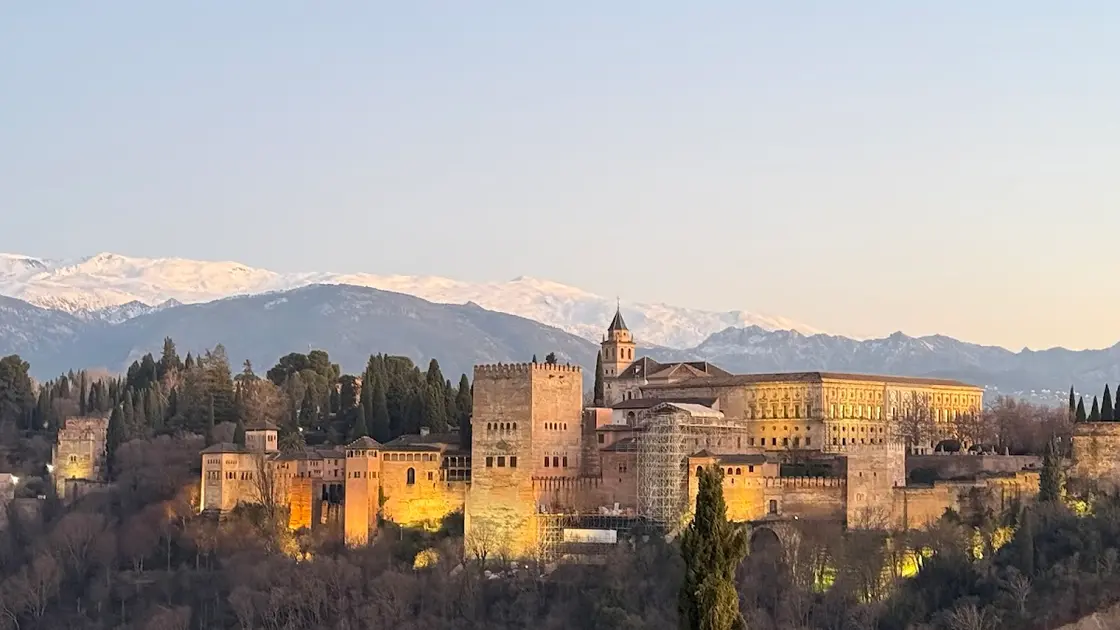
View from Mirador de San Nicolás across the Darro valley to the Alhambra, with the Sierra Nevada mountains in the background

Explore nearby · Monument

Mirador de San Nicolás

Free 24-hour viewpoint in the Albaicín with unobstructed Alhambra views and the Sierra Nevada as backdrop. Crowds peak at sunset; early morning is far quieter.

Leo's geography concentrates on Islamised North Africa, and Fez gets the fullest treatment, with its buildings, its population and its religious and cultural life set down in unusual detail[13]. That is the city he knew from the inside, and it shows. The record of other Granada exiles can be far thinner, as the unresolved search for Boabdil's tomb in Fez shows.
The book reached print in 1550, in Giovanni Battista Ramusio's compendium Navigazioni e Viaggi, and that edition was a turning point in European knowledge of Africa[14]. A quarter of a century lay between completion and print. Over that gap an editor's choices, not only Leo's, shaped what readers eventually saw.

How far to trust the Description

The Description is a rich source, but not an equally good one everywhere: Irwin judges Leo's information about places south of Timbuktu slight and unreliable[15]. Read it as the work of a well-placed observer with a patchy view of the south.
Timbuktu shows what the book gives and where it needs care. Leo describes a city of cotton weavers, artisans and merchants, with handwritten books from Barbary among the goods sold[17][18].
The same passage records a ruler who, after a victory, has all his captives sold in the Timbuktu market, children included[19]. Cloth, books and the sale of people appear in one account, and any picture of Timbuktu's prosperity has to hold all three.
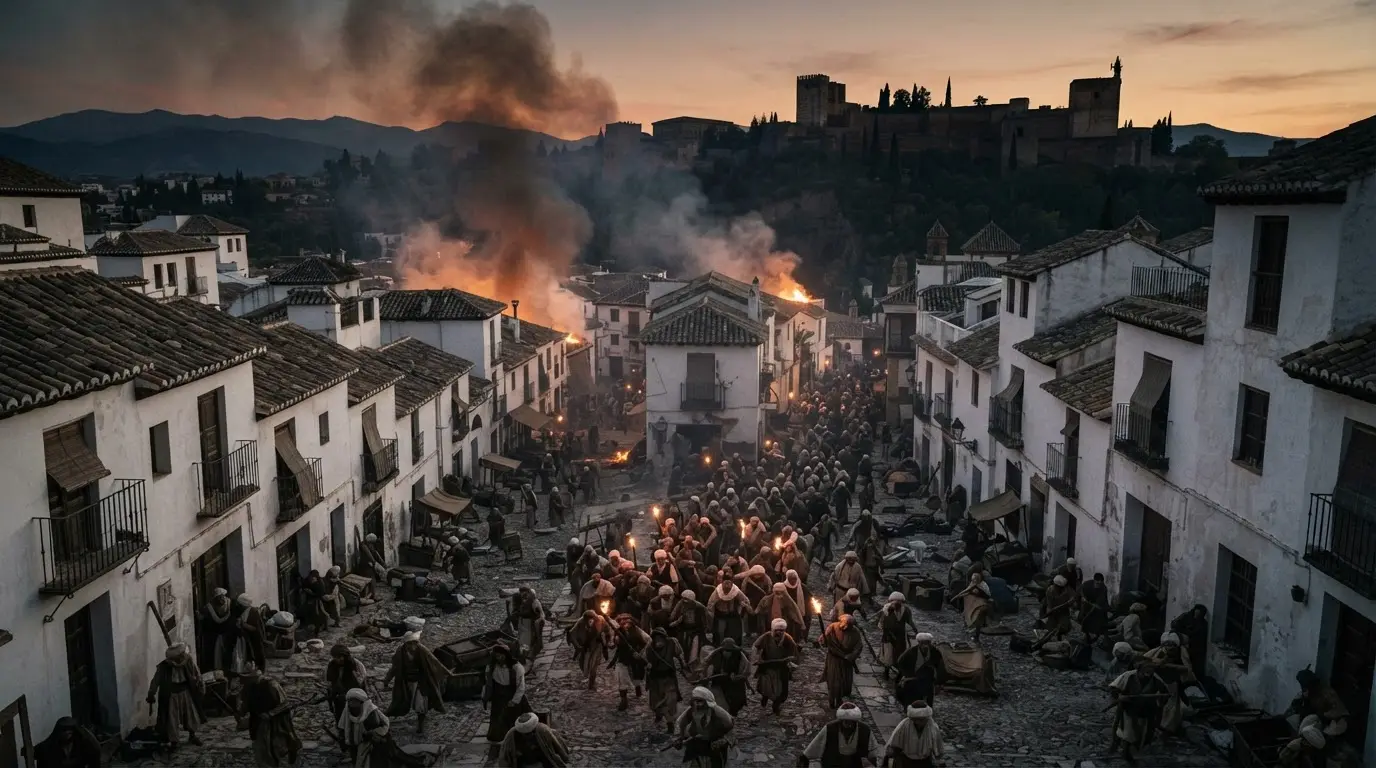
1066 Granada massacre scene in Jewish history: a mob attacking the Jewish quarter of Nasrid-era Granada at dusk, the Alhambra hill silhouetted in the background, smoke rising over whitewashed rooftops, sombre red and amber tones

Deep dive · Article

1066 Granada Massacre: When the Jewish Golden Age Ended in a Day

The 1066 Granada massacre killed Joseph ha-Nagid and thousands of the city's Jews in a single day, ending three decades of Jewish power under Samuel ha-Nagid.

A modern translator also doubts the size of a gold ingot in the account, noting that Arab writers often mention such nuggets and that their size is probably grossly exaggerated[20]. A fair rule of thumb is to trust Leo most where the book is most detailed, around Fez, and to treat the far south as a sketch.
Leo's own end is lost too. Irwin writes that we do not know which culture he chose in the end, or how, where or when he died[21]. The silence fits the rest of the record: the Muslim years rest on his word, the Roman years on a few dated episodes, and the last chapter is blank.

Where to stand in Granada today

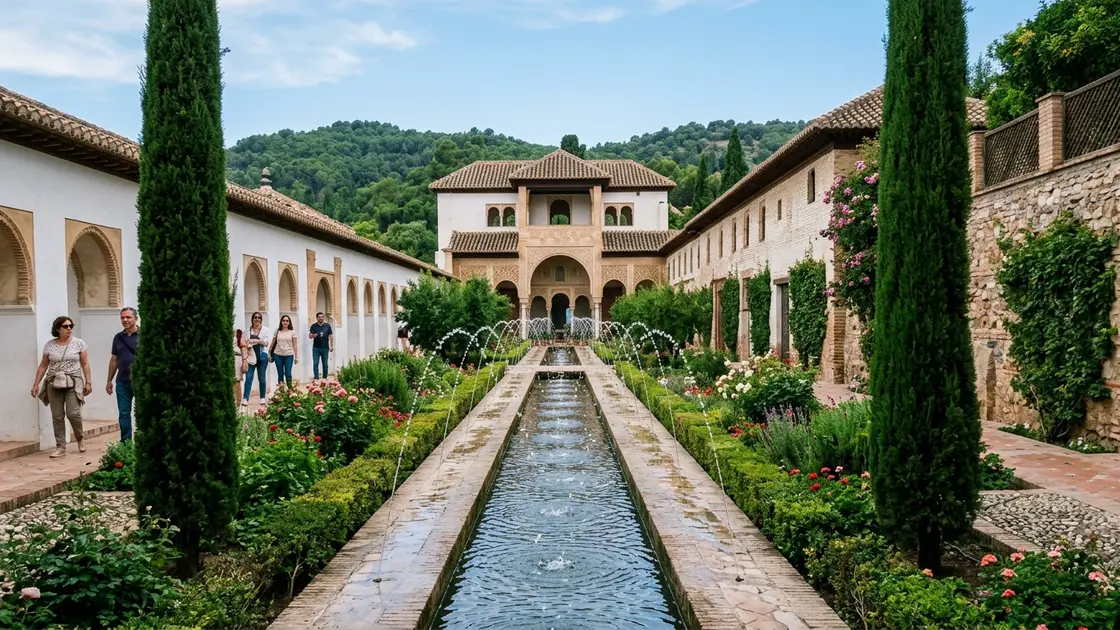
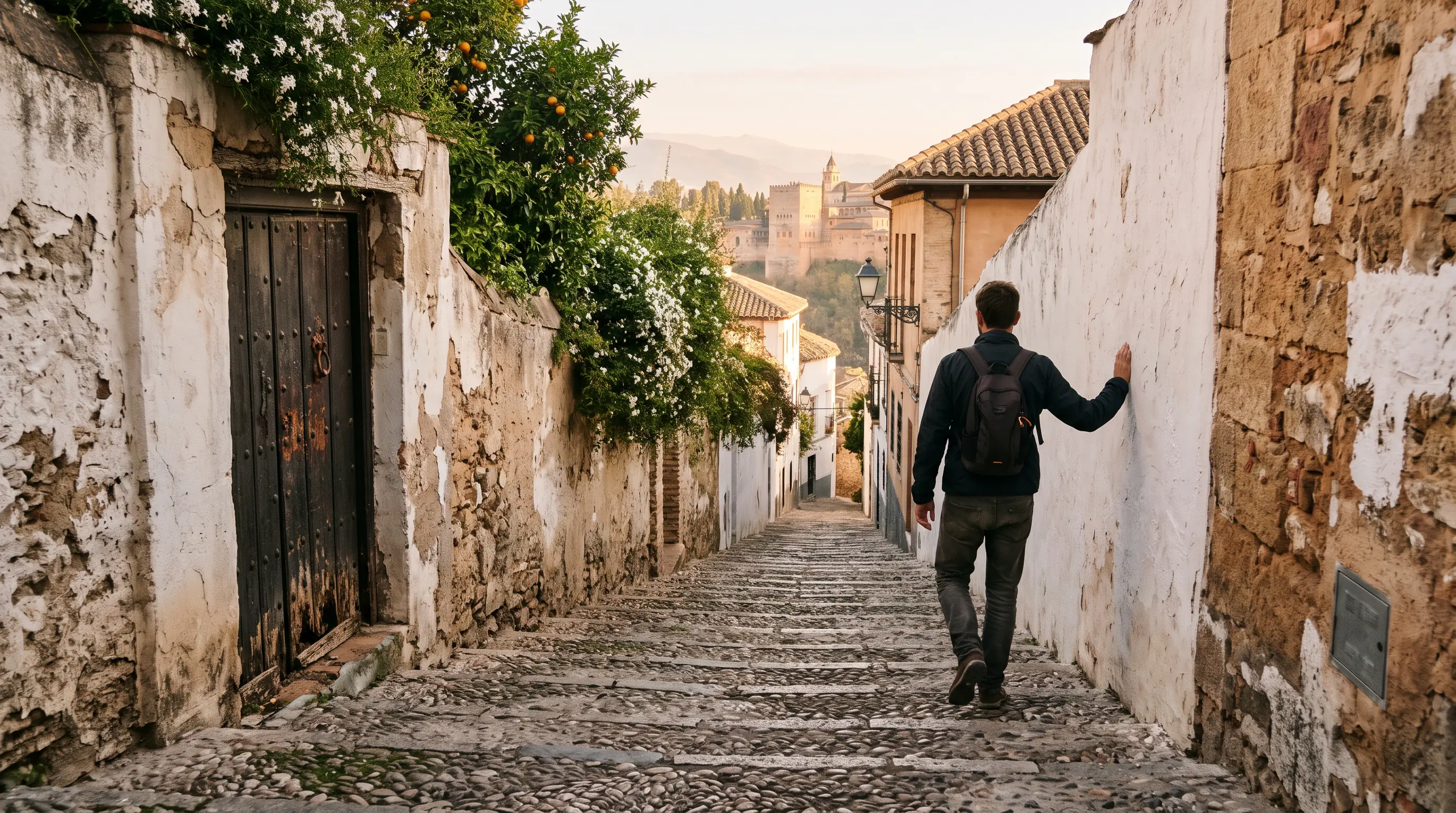
No site in Granada is firmly tied to Leo Africanus, so a visit here is about the setting he left. The Albaicín is the place to picture the city he named as his birthplace, a setting, not an address. Together with the Alhambra it forms the medieval part of Granada, and it preserves remains of the old Arabic quarter[22].
A short loop through the quarter links three stops worth the climb[23]:
  • the Bibalbonud Tower and its underground reservoir
  • the Mirador de San Nicolás, the viewpoint
  • the Hizna Román gateway
The lanes climb, so wear shoes with grip. The suggested route starts at Plaza Nueva, follows Paseo de los Tristes into the Albaicín and San Nicolás, then heads back toward Calle Elvira[24]. The Bibalbonud cistern sits on Placeta de Abad[25]. For a fuller route through the quarter, the self-guided Albaicín walk is the place to start.
Leo Africanus left this city behind before he wrote anything, if he was born here at all. The medieval fabric of the Albaicín is what a visitor finds; for his voice, look for John Pory's 1600 English translation[26], reissued by the Hakluyt Society in 1896 with an introduction and notes by Robert Brown[27].

Frequently asked questions

Was Leo Africanus born in Granada?

He says so himself in his Cosmography, and historians such as Robert Irwin accept a Granada birth a few years before the city fell in 1492[3][4]. The year is disputed, and his early life rests on his own testimony[5].

What was the Granada-born Leo Africanus's original name?

Al-Hasan ibn Muhammad al-Wazzan[2]. After his baptism on 6 January 1520 he became Johannes Leo de Medicis, in Italian Giovanni Leone[1].

How did Leo Africanus, a Granada native, end up in Rome?

In 1518, returning from Cairo, his ship was intercepted by Christian pirates and he was brought to Rome as a captive[8]. Pope Leo X baptised him and gave him his own name[9].

What did Leo Africanus write about Africa?

His Description of Africa, completed in 1526, moves from cities and kingdoms to customs and trade routes, with an especially detailed account of Fez[11][12][13]. It was printed in 1550 in Ramusio's Navigazioni e Viaggi[14].

How reliable is the Description of Africa by the Granada-born Leo Africanus?

Unevenly. Irwin judges his information on places south of Timbuktu slight and unreliable[15], and the text printed in 1550 varies significantly from the one he dictated[16].

Can you visit anything in Granada linked to Leo Africanus?

Nothing visitable is firmly tied to him. The Albaicín and the Mirador de San Nicolás give the medieval setting of the city he named as his birthplace[22][23].

When and where did Leo Africanus die?

Nobody knows. Irwin writes that we do not know which culture he chose in the end, or how, where or when he died[21].

Sources

27 references Show
  1. archive.aramcoworld.com (opens in a new tab)

    “Leo was baptized on January 6, 1520 by the pope himself, who christened his new convert “Johannes Leo de Medicis,” or “Giovanni Leone” in Italian, a gesture of high favor, for Giovanni de’ Medici was the pope’s own name.”

  2. en.casaarabe.es (opens in a new tab)

    “Al-Hasan ibn Muhammad al-Wazzān, known in Europe as John Leo Africanus, embodies the complex dynamics and tensions of the Mediterranean in the early sixteenth century like few others.”

  3. legadoandalusi.es (opens in a new tab)

    “His stay in Fez is indeed the bulk of data about his biography released in his Cosmography, where he also asserts that he was born in Granada.”

  4. lrb.co.uk (opens in a new tab)

    “Al-Hasan ibn Muhammad al-Wazzan, as Leo was first named, was born in Muslim Granada a few years before the city fell to the armies of Aragon and Castile in 1492.”

  5. lrb.co.uk (opens in a new tab)

    “We know about his early life as a Muslim only from what he tells us about himself.”

  6. legadoandalusi.es (opens in a new tab)

    “What is certain is that the al-Wazzan family left the peninsula in direction of the north of Morocco in a moment of great upheaval, in the aftermath of the Reconquest, with the Mediterranean as the stage for the Hispano-Ottoman clash, the Portuguese siege of the Atlantic coast of Morocco and the penetration of the Turks into North Africa.”

  7. lrb.co.uk (opens in a new tab)

    “He grew up in Fez and, after some years working as a notary to a hospital, was sent by the Watassid sultan of Fez on various diplomatic missions to African rulers.”

  8. lrb.co.uk (opens in a new tab)

    “In 1518, on his way back from Cairo, his ship was intercepted by Christian pirates and he was brought as a captive to Rome.”

  9. en.casaarabe.es (opens in a new tab)

    “Captured by Christian corsairs and handed over to Pope Leo X, who baptized him and gave him his own name, he brought his knowledge in the Arabic language to the heart of Renaissance Rome, placing it at the service of humanistic circles while acting as a privileged liaison between Islamic intellectual traditions and the European cultural landscape.”

  10. lrb.co.uk (opens in a new tab)

    “In Rome he taught Arabic to the great Hebraist Cardinal Aegidius of Viterbo, and worked with the Jewish physician and translator Jacob Mantino on an unfinished Latin-Arabic-Hebrew vocabulary.”

  11. lrb.co.uk (opens in a new tab)

    “His most important work was certainly The Description of Africa, completed in 1526.”

  12. en.casaarabe.es (opens in a new tab)

    “Divided into several books, it discusses cities, kingdoms, landscapes, customs, traditions, economic structures and trade routes, becoming an essential work of reference on African geography and the Maghreb well into the nineteenth century.”

  13. lrb.co.uk (opens in a new tab)

    “Leo’s geography deals chiefly with Islamised North Africa and he provides a particularly detailed account of the buildings, population and religious and cultural practices of Fez.”

  14. lrb.co.uk (opens in a new tab)

    “The subsequent printing of this work in 1550, in Giovanni Batista Ramusio’s compendium of travel writings, Navigazioni e Viaggi, was a turning point in European knowledge of Africa.”

  15. lrb.co.uk (opens in a new tab)

    “Leo’s information about places south of Timbuktu was slight and unreliable.”

  16. legadoandalusi.es (opens in a new tab)

    “Yet, after many studies, it has been taken into consideration that the original text that Leo Africanus dictated to an scribe varies significantly from the text used by the Venetian geographer and travel writer Giovanni Battista Ramusio in 1550.”

  17. brians.wsu.edu (opens in a new tab)

    “The shops of the artisans, the merchants, and especially weavers of cotton cloth are very numerous.”

  18. brians.wsu.edu (opens in a new tab)

    “Many hand-written books imported from Barbary are also sold.”

  19. brians.wsu.edu (opens in a new tab)

    “When he has gained a victory, he has all of them–even the children–sold in the market at Timbuktu.”

  20. brians.wsu.edu (opens in a new tab)

    “Such fabulous nuggets are commonly mentioned by Arab writers about Africa, but their size is probably grossly exaggerated.”

  21. lrb.co.uk (opens in a new tab)

    “We don’t know which culture Leo Africanus chose in the end, or how, where or when he died.”

  22. UNESCO World Heritage (opens in a new tab)

    “Rising above the modern lower town, the Alhambra and the Albayzín form the medieval part of the City of Granada, which preserves remains of the ancient Arabic quarter.”

  23. Spain.info (opens in a new tab)

    “Bibalbonud Tower and underground reservoir, San Nicolás viewpoint and Hizna Román gateway round off this little tour.”

  24. turismo.granada.org (opens in a new tab)

    “Start your itinerary in**Plaza Nueva** and continue along **Paseo de los Tristes**. Go deeper into the wonderful neighbourhood of the**Albaicín**, where you'll find the famous**Mirador (viewpoint) of****San Nicolás**.”

  25. granada.org (opens in a new tab)

    “Se encuentra ubicado en la Placeta de Abad.”

  26. ediscovery.qnl.qa (opens in a new tab)

    “done into English in the year 1600 by John Pory, and now edited, with an introduction and notes, by Robert Brown.”

  27. ediscovery.qnl.qa (opens in a new tab)

    “| Publisher | Hakluyt Society | | Contributor | Leo approximately 1492-approximately 1550 Pory John 1572-1636 Brown Robert 1842-1895 | | Date | 1896 |”