The name nobody can pin down
Start with the one thing linguists and historians agree on: the Spanish word Granada reaches the modern language through the Arabic Gharnāṭa (also transliterated Ġarnāṭa, Gárnata, or Qarnāṭa). Everything before that is contested. Nobody knows what Gharnāṭa meant, or which language it came from, or when exactly it was first used for this particular spot on the Darro River. The uncertainty is not a gap in the scholarship; it is the conclusion.[4]
Before anything else: this is about Granada, Spain, the Andalusian city beneath the Sierra Nevada. It has nothing to do with Grenada, the Caribbean island nation whose name derives from the same pomegranate word but through an entirely separate colonial Spanish route.
The earliest datable appearance of the name Gharnāṭa comes from the 9th century, and by the 10th century it was appearing regularly in Arabic geographical sources.[1] The name almost certainly predates those documents. The settlement that carried it, a small fortress and community on the south bank of the Darro roughly where the Albaicín neighbourhood now climbs the hill, was older than its first mention in writing. It began as a ḥiṣn, a fortified stronghold, not as a city. The main urban centre of the region at the time was Madīnat Ilbīra, a larger town built on the plain to the north-west, near the present-day municipality of Atarfe.[5] Gharnāṭa was the backwater neighbour with the better defensive position.
The settlement had a notably Jewish character early on. Arab sources refer to it as Gharnāṭat al-Yahūd, "Gharnāṭa of the Jews", indicating that the population was predominantly Jewish before and during the early centuries of Muslim rule.[3] That fact alone suggests the name Gharnāṭa predates the 9th-century Arabic documents and may reach back into the late Roman or Visigothic period, though no inscription or text from that era has been found to confirm it.
The pomegranate: the theory everybody learns
The word granada is Spanish for pomegranate. When Ferdinand and Isabella took the city in 1492, they placed a split pomegranate in the Spanish royal coat of arms, where it remains to this day.[6] The visual link between the city and the fruit has been reinforced for five centuries: pomegranates appear on manhole covers, street signs, ceramic tiles, and every piece of tourist merchandise sold between the Cathedral and the Alcaicería.
The pomegranate theory of the name is the earliest documented etymology. The 17th-century Arab chronicler Al-Maqqari, writing from his exile in Cairo, believed that the name Gharnāṭa derived from the Latin word for pomegranate, granata.[7] He was a careful historian by the standards of his time, and the Roman name Iliberis was known to him. But Al-Maqqari was writing six centuries after the events he described, and his reasoning, that Latin settlers named the place after the fruit they found growing there, has not been borne out by subsequent scholarship. The Latin word granata itself evolved from granum (seed, grain) into a fruit name, and the city name may well share that route without the fruit being the direct source.
For the full story of how the pomegranate became Granada's heraldic emblem, from Islamic paradise symbolism to Ferdinand's trophy heraldry to the souvenir tiles of the Albaicín, see the Granada pomegranate symbol article. This piece stays with the name.
“The Arab chronicler Al-Maqqari believed that it came from the Latin word for pomegranate, granata.”
What keeps the pomegranate theory alive is the coincidence of sound, not scholarly conviction. The Spanish word granada and the Arabic name Gharnāṭa sound close enough that a folk etymology was almost inevitable. When the Catholic Monarchs formalised the link through heraldry in 1492, the theory gained institutional backing that no purely academic argument has ever been able to dislodge. The pomegranate etymology is probably wrong, but it has a five-century head start on every alternative.
Hill of strangers: the scholarly frontrunner
The theory that commands the most respect among modern linguists is the least romantic: Gharnāṭa may simply mean "hill of strangers."
In this reading, the root is not Latin at all but Berber. Specifically the word Gárnata or Karnata, which could carry the meaning "hill of strangers" or, in an alternative interpretation, "hill of pilgrims."[8] The Berber origin is methodologically attractive because the dynasty that elevated Gharnāṭa from a minor fortress to the capital of an independent kingdom was itself Berber: the Zirids, led by Zawi ben Ziri, who established the Taifa of Granada in the early 11th century after the collapse of the Umayyad Caliphate of Córdoba.[9] A Berber ruling family naming their new capital in their own language is a more parsimonious explanation than a Latin fruit word travelling through several centuries of undocumented transmission.
Two further details strengthen the Berber case. The first is that the Berber origin is treated as a live possibility, not a fringe theory, in mainstream scholarship. The Wikipedia article on Granada, which synthesises current academic consensus, notes that the name "could even have been of Berber origin" without hedging or qualification.[10] The second is context: Gharnāṭa was not a Muslim city in a Muslim world. It was a mixed settlement, predominantly Jewish in its earliest documented form, in a region that had been Roman, then Visigothic, then Arab-ruled. A name meaning "hill of strangers", a place where outsiders gathered, fits that reality better than a fruit metaphor.
The alternative reading "hill of pilgrims" points in a similar direction, suggesting a place of assembly or transit rather than a stable, homogeneous community. Either version describes a settlement defined by who was passing through it, not by what grew on its slopes.
Explore · Neighbourhood
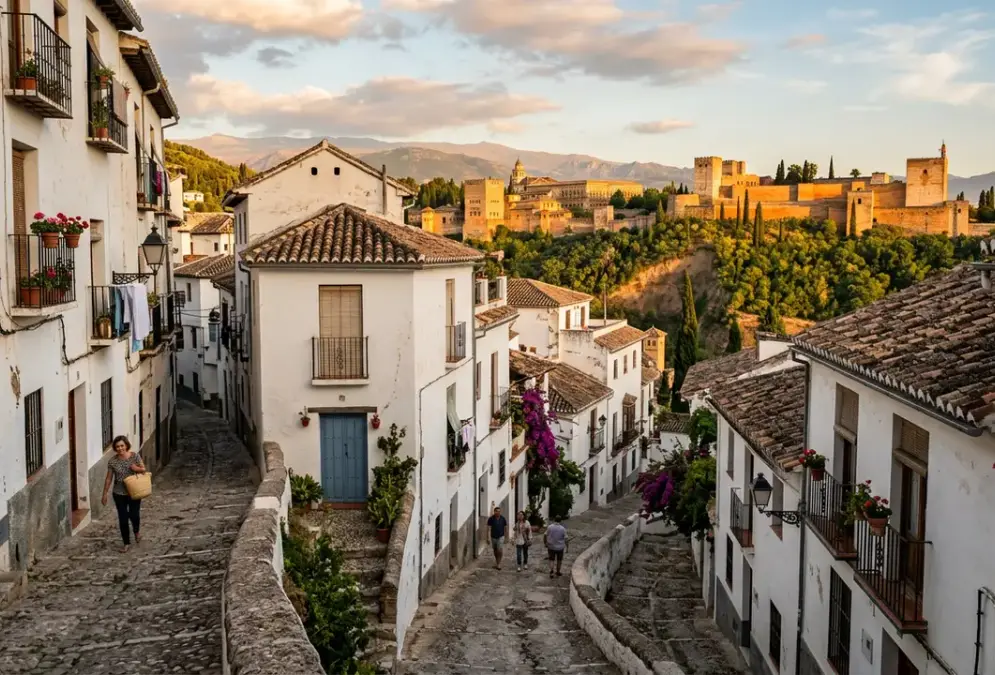
Albaicín
Granada's oldest neighbourhood: the Albaicín holds a UNESCO-listed maze of whitewashed lanes, Moorish cármenes, and the finest Alhambra views in the city.
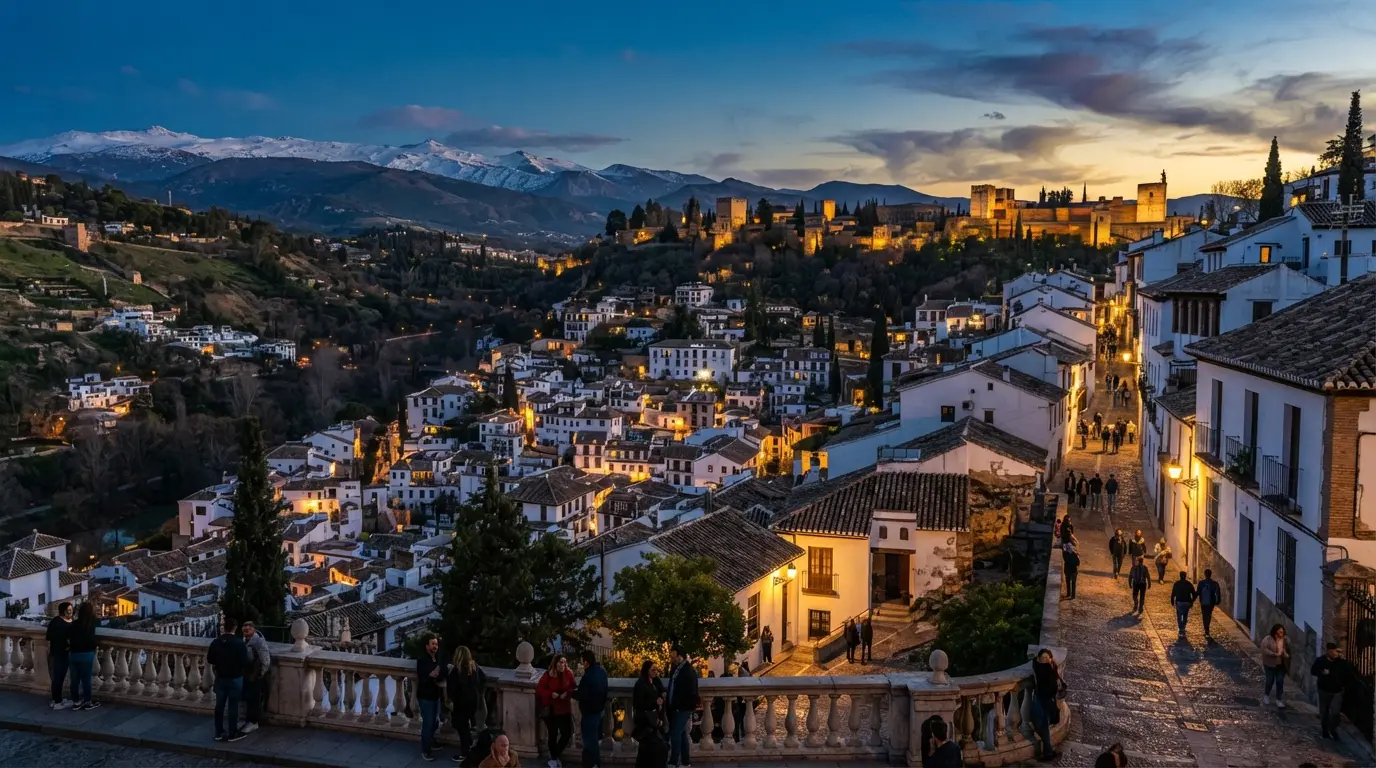
Physically, the original Gharnāṭa sat on the hill now occupied by the Albaicín, on the south bank of the Darro River. The location was chosen for defence, not agriculture. The Darro River's history as Granada's founding waterway explains why this particular hill mattered: fresh water, a defensible slope, and proximity to the fertile vega made it the natural site for a fortress settlement long before anyone called it a city. The Zirid dynasty would later build the infrastructure, including the aljibes or cisterns, that turned the hilltop into a viable urban centre.
Noah's daughter and the legends that refuse to die
Walk through the Albaicín with a guide who has been working the route for twenty years, and you may hear a different story: Granada was founded by Grana, a daughter of the biblical Noah. According to the legend, Grana settled the hill after the floodwaters receded, planted the first pomegranate tree, and gave the city her name.
The Grana story has no scholarly standing whatsoever. It appears in no reliable medieval source, carries no archaeological or linguistic support, and belongs squarely to the category of foundation myths that most Mediterranean cities accumulate. The kind of story that sounds satisfying around a fire and dissolves in daylight. It is recorded here because it persists in oral tradition and local guidebooks, and because ignoring it would misrepresent what Granadinos themselves sometimes tell visitors about their city's name. Like the pomegranate theory, it thrives on a coincidence of sound: Grana, Granada.
The wider category of folk etymologies for Granada includes several variants on the "daughter of" theme and a small constellation of stories involving ancient kings and lost tribes. None of these are taken seriously by linguists or historians. Their value is anthropological, not etymological: they tell you what later generations wanted the name to mean, not what it did mean when it was coined. A city whose identity has been shaped by conquest and cultural layering naturally attracts origin stories that smooth over the fractures.
The Latin granum: seeds, scarlet, and the red-city theory
The etymology that the Oxford-based Etymonline database favours, and the one closest to the pomegranate story without actually being about the fruit, traces the name to Latin granum, meaning "seed" or "bead," or its plural grana, meaning "seeds" or "a scarlet colour."[11] Under this reading, the Roman-era inhabitants described the area's distinctive red soil with a Latin colour word, and the Arabic-speaking incomers of the 8th and 9th centuries adapted it phonetically as Ġarnāṭa or Iġranāṭa.
The "red" theory has one striking piece of corroboration: it mirrors the meaning of the Alhambra's name. The name of Granada's most famous monument derives from the Arabic al-Ḥamrāʾ, "the red one", a reference to the reddish hue of the rammed-earth and stone walls that Muhammad I began building in the 13th century. If the Nasrids named their fortress for the colour of its walls, it is at least plausible that the earlier inhabitants named the city for the colour of its soil, and that both names converge on the same visual fact.[12]
The granum theory does not require the pomegranate. It requires only that the Romans or Romanised Iberians described a place as red, and that Arabic speakers found the word useful enough to keep. The pomegranate fruit, Latin malum granatum ("seeded apple"), took its name from the same Latin root. The city and the fruit would then be linguistic cousins, not parent and child: both descended from the colour and texture of seeds, not from one naming the other.
For the visitor standing on the Alhambra ramparts looking down at the red-tinted earth of the Darro valley in late-afternoon light, the theory has the advantage of being visible. You can argue about morphology and Berber phonetics in a seminar room, but the colour of Granada's soil is something you can see from the mirador.
How the name travelled: from Iliberis to Granada
The name Gharnāṭa did not replace a void. The site had been inhabited for centuries under different names, and understanding the sequence matters for understanding why the name jumped.
Iliberis to Elvira: the Roman and Visigothic names
The earliest recorded name for a settlement in the Granada area is Iliberis (or Iliberri), an Iberian settlement that became the Roman colony of Iliberis in 44 BC and was renamed Florentia Iliberritana, "Flourishing Iliberri", in 27 BC.[2] The Roman name is itself a Latinisation of an older Iberian word, probably cognate with the Basque hiri (town) and berri (new). The earliest name for the place, in any language, may have meant simply "new town."[13] The name survives today in the Sierra Elvira, the limestone massif north-west of the city.
During the late Roman and Visigothic period, the name Iliberis softened into Elvira, and the regional centre of gravity shifted to a town on the plain. The Synod of Elvira, one of the earliest Christian councils in Hispania, met near here around 300 AD. The name Elvira derives directly from Iliberri.[14] Under Muslim rule after 711, this town became Madīnat Ilbīra, an Arabised version of the same name.
The Zirid move: why the city relocated
In the early 11th century, the entire urban centre moved. Ilbīra sat on an exposed plain and was difficult to defend during the Fitna, the civil war that followed the collapse of the Córdoba caliphate. The Zirid Berber leader Zawi ben Ziri decided to move his seat of power to the higher, more defensible hilltop stronghold of Gharnāṭa.[15] When Ilbīra was razed during the conflict, it was not rebuilt. Gharnāṭa absorbed its population and replaced it as the main city of the region.[16]
This is the moment that matters for the name. Gharnāṭa was not the original, natural, or inevitable name for this place. It was the name of a specific secondary settlement, a fortress with a mainly Jewish population, that happened to survive while the bigger city did not. If Ilbīra had been defensible, the city we now call Granada might still carry a variant of the Iberian name Iliberri. Instead, the Berber fortress name won by default.
Gharnāṭa becomes Granada: the name settles
By 1238, when Muhammad I established the Nasrid Emirate of Granada, the name Gharnāṭa was fixed. The Nasrids made it the capital of the last Muslim kingdom on the Iberian Peninsula and built the Alhambra above it. When the Catholic Monarchs took the city in 1492, they inherited the Arabic name and naturalised it into Spanish as Granada. The phonetic circle closed on a word that had travelled through Iberian, Latin, Arabic, Berber, and Castilian, carrying different meanings for different speakers at every stage.