Written by Sarah Mills
  • 5 min
  • 27 sources

Pestiños and Torrijas in Granada: When Each Fried Sweet Appears

Pestiños at Christmas, torrijas in Lent: what Andalusia's fried sweets are, their documented roots, and which Granada convents and towns make them today.
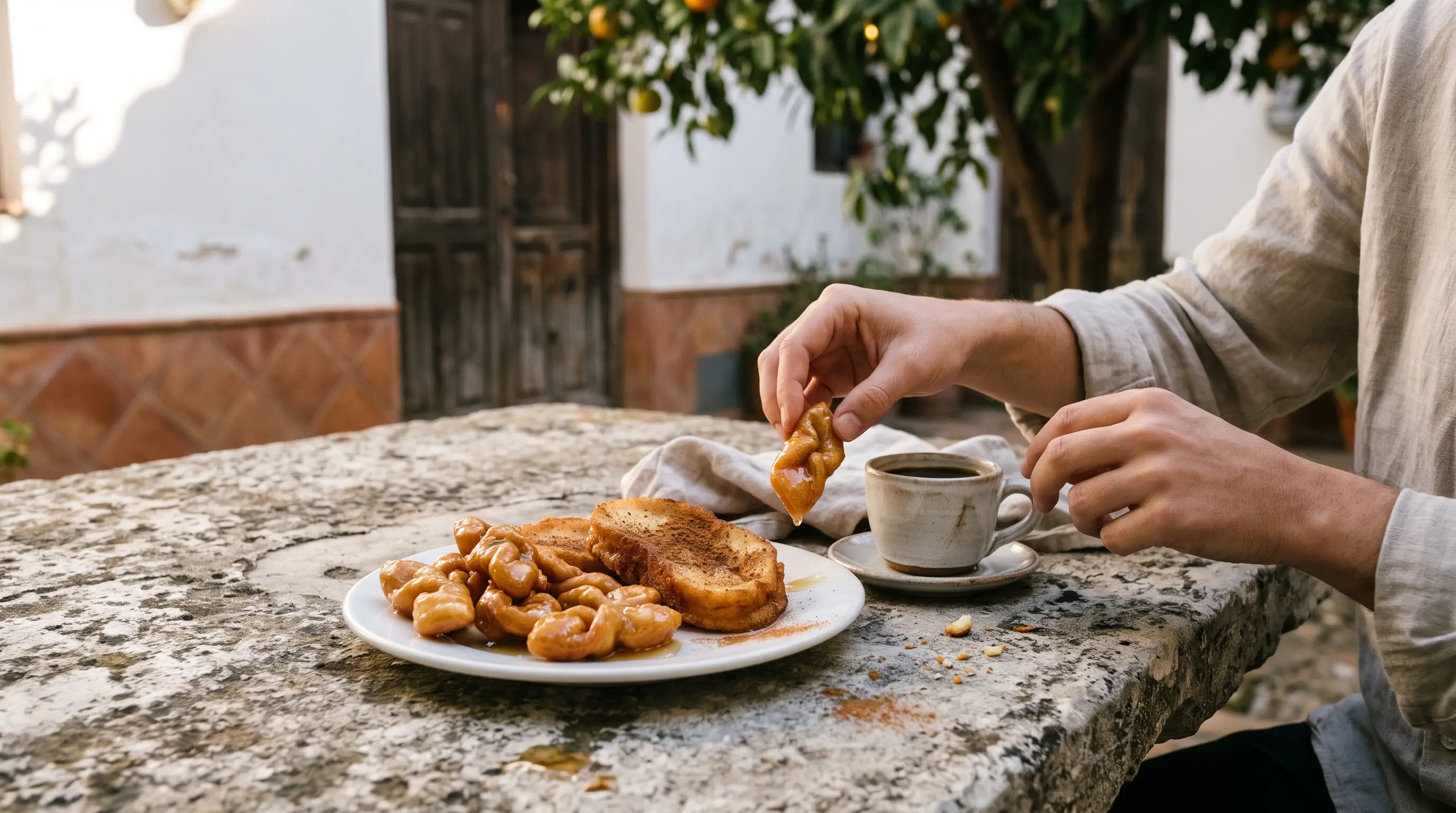
Plate of pestinos torrijas Granada: honey-glazed pestiños beside golden fried torrijas on a stone table in a Granada convent parlour, soft morning light

Pestiños are fried dough made from wheat flour, white wine and olive oil, flavoured with orange and lemon peel and anise or sesame seeds, then usually bathed in honey.

Andalusia cooks its celebration sweets in the frying pan, and Granada's convents and bakeries keep the same calendar: honeyed pestiños around Christmas and Easter, torrijas in Lent and Holy Week[1]. Torrijas and flores fritas are an Andalusia-wide Lent and Easter habit you will see across Granada's Holy Week, while the Granada makers named in print (the Encarnación, Corpus Christi and Visitación convents, Vélez de Benaudalla and Cájar) are documented for pestiños and roscos. La Lozana andaluza mentions the pestiño as early as 1528[2], and every origin story below is Andalusia-wide, never Granada's alone.
Torrija season
Lent
Typical of Lent and Holy Week across Spain[1]
Early pestiño mention
1528
La Lozana andaluza, written in 1528, names it[2]
Lard before olive oil
16th century
Pestiños were preferably fried in pork lard until then[3]

What pestiños, torrijas and flores fritas are

A pestiño is fried dough made from wheat flour, white wine and olive oil, flavoured with orange and lemon peel and anise or sesame seeds, then usually bathed in honey[4]. The result is a crisp, curled piece that is sticky, sweet and faintly of citrus. A torrija is simpler: the Spanish dictionary defines it as a slice of bread soaked in milk or wine, coated in egg, fried and sweetened[5]. Eat one warm and the inside is custard, the outside a thin caramelised crust. The pestiño keeps better in a paper bag and the torrija does not, which is one reason the first turns up in convent parlours and bakery windows for weeks, and the second is a same-day treat.
Flores fritas, fried flowers, is the third name you will meet. Granada's provincial list of Holy Week sweets includes them alongside borrachuelos, leche frita, huevos moles, pestiños and roscos fritos[6], and the Encarnación convent, one of the houses behind Granada's dulces de convento, lists flores de hojuela for Holy Week[7]. Elsewhere in Spain flores fritas are also called florones or flores de Calatrava[8], and their origin is uncertain, with one theory pointing to a Sephardic past[9]. Beyond the list and the convent entry there is little to say about a Granada flores fritas tradition, so do not plan a trip around them.
A quick key for the pastry counter:
  • Pestiños: fried dough, citrus peel, honey; Christmas and Easter.
  • Torrijas: fried bread soaked in milk or wine; Lent and Holy Week.
  • Flores fritas: on Granada's provincial Holy Week list; also called florones.
  • Flores de hojuela: on the Encarnación convent's Holy Week list.
  • Roscos fritos and borrachuelos: other fried sweets on the same Holy Week lists.

Where the recipes come from, and what Granada cannot claim

Nothing here is a Granada invention, and the sources do not say it is. Tradition describes the pestiño's finished recipe as a fusion of the Roman, Jewish and Muslim cultures that lived side by side in al-Andalus[10], and a Sephardic ancestor, the fijuelas (flour dough fried and bathed in syrup), is named in the family tree[11]. It is a plausible lineage rather than a documented one, which is why the claim stays regional. Across the strait, the Moroccan chebakía is a Ramadan sweet described as similar to Spanish pestiños with honey, served at the fast-breaking meal[12]; its origin is hard to settle, though some theories point to Muslim-era Iberia[13].
The words tell a similar story. Pestiño comes from the Latin pistus ('pounded, beaten') and torrija from torrar[14]. On paper the pestiño is the older word: Nebrija's Latin-Spanish dictionary of 1492 already lists prestiño[15], Juan del Encina used torreja in a villancico of his Cancionero in 1496[16], and La Lozana andaluza mentions the pestiño in 1528[2]. The word torrija itself waits until 1591 to reach a dictionary[17]. Those dates measure what survives in print, not who cooked first.
What Granada does have is a convent-kitchen tradition and a named Jewish contribution: the city's sweet-making credits the Jewish presence with the fried hojuelas, alongside raisin sponges and syrups of honey and sugar[18]. The fried sweets on convent lists are best read as Granada's local branch of an Andalusia-wide habit.

The fried-sweet calendar: Christmas, Lent and Holy Week

Pestiños are eaten across Andalusia at Christmas and Easter, though bakeries sell them all year[19]. In Granada they are among the most popular sweets of Holy Week[20].
Torrijas run on a different clock. Eating them is typical of Lent and Holy Week across Spain[1], and the usual explanation is Lenten abstinence, which left Andalusian cooks building sweets from bread, flour and oil: hence torrijas, leche frita and pestiños[21]. A December trip gets you pestiños and mantecados; torrijas belong to the weeks before Easter.
Sweet Typical season Granada evidence
Pestiños Christmas to Easter; bakeries all year Convent lists, a Holy Week favourite
Torrijas Lent and Holy Week Spain-wide custom; absent from the convent lists in this piece
Flores fritas Holy Week Provincial list only
Flores de hojuela Holy Week Encarnación convent list
Roscos fritos Holy Week Provincial list; Corpus Christi convent
Convent stock follows the same logic. The Visitación convent has listed pestiños among its all-year sweets, with mantecados also made for Christmas[22], while Holy Week lists elsewhere swap in borrachuelos and flores de hojuela. Treat a list as a guide to what a kitchen can make, not a promise of what is on the shelf that morning.
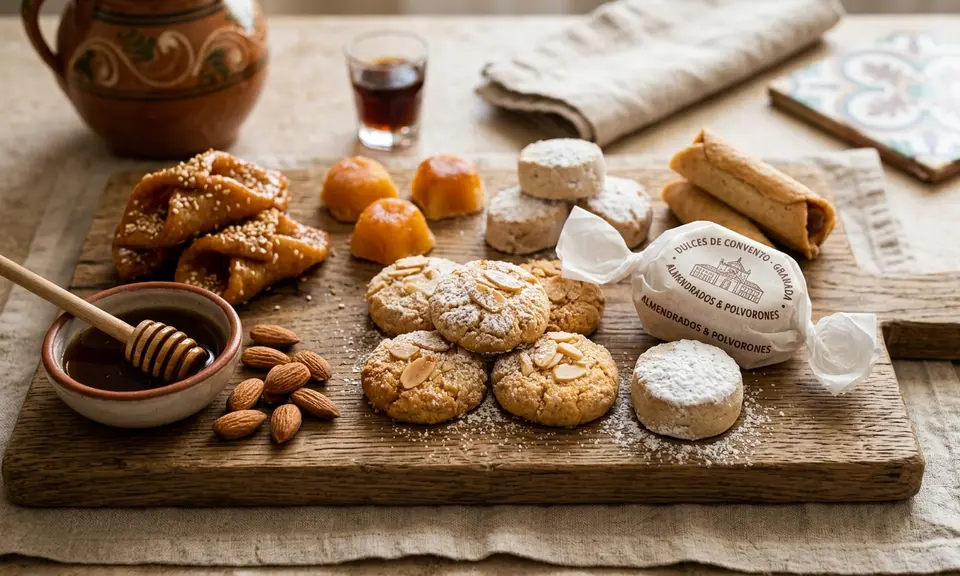
Dulces de convento Granada — assorted convent sweets including almendrados and polvorones on a wooden board

Taste of Granada · Dish

Dulces de Convento

Almond cookies, crumbly polvorones, ring pastries and marzipan figures made by Granada's enclosed nuns and sold through a wooden turn-box in the convent wall.

Which Granada convents and towns make them

In the city, the pestiños with the most paper behind them come from behind the torno. Pestiños from the Encarnación convent sit on Granada's list of convent sweets[23], and two other cloistered houses have listed them too. Here is what each has advertised, with the caveat that stock lists date quickly:
  • Monasterio de la Encarnación: borrachuelos, flores de hojuela, pestiños and plum cake for Holy Week[7]
  • Convento del Corpus Christi (calle Gracia): fried roscos and pestiños at Holy Week[24]
  • Monasterio de la Visitación: pestiños among the all-year sweets[22]
Outside the city, three towns have their own claim. Vélez de Benaudalla, on the Costa Tropical, is known for its pestiños[25]; Cájar, on the road up towards the Sierra Nevada, pairs pestiños with roscos[26]; and Salobreña is among the Andalusian towns whose pestiño differs in shape and composition from its neighbours'[27].
The routine at the hatch is the one visitors follow when buying convent sweets through the torno: cash, short morning hours, a greeting. Confirm at the convent door before you plan a morning around one named sweet.

Confirm before you go

Convent stock lists in print can be a few years old, and kitchens change what they bake. Check the notice at the convent door, and do not plan a morning around one named sweet.

Planning a trip around Christmas or Holy Week
Come in December and the pestiño is your target, along with the mantecados that convents such as the Visitación also make for Christmas[22]. Buy them from a convent or a bakery that fries to order, and eat the first one warm.
Come for Holy Week and the list widens: torrijas wherever you find them, plus pestiños, roscos fritos and borrachuelos at the convents, the whole fried shelf at once[6]. Bakeries and convents are busiest then, so go early and bring cash.
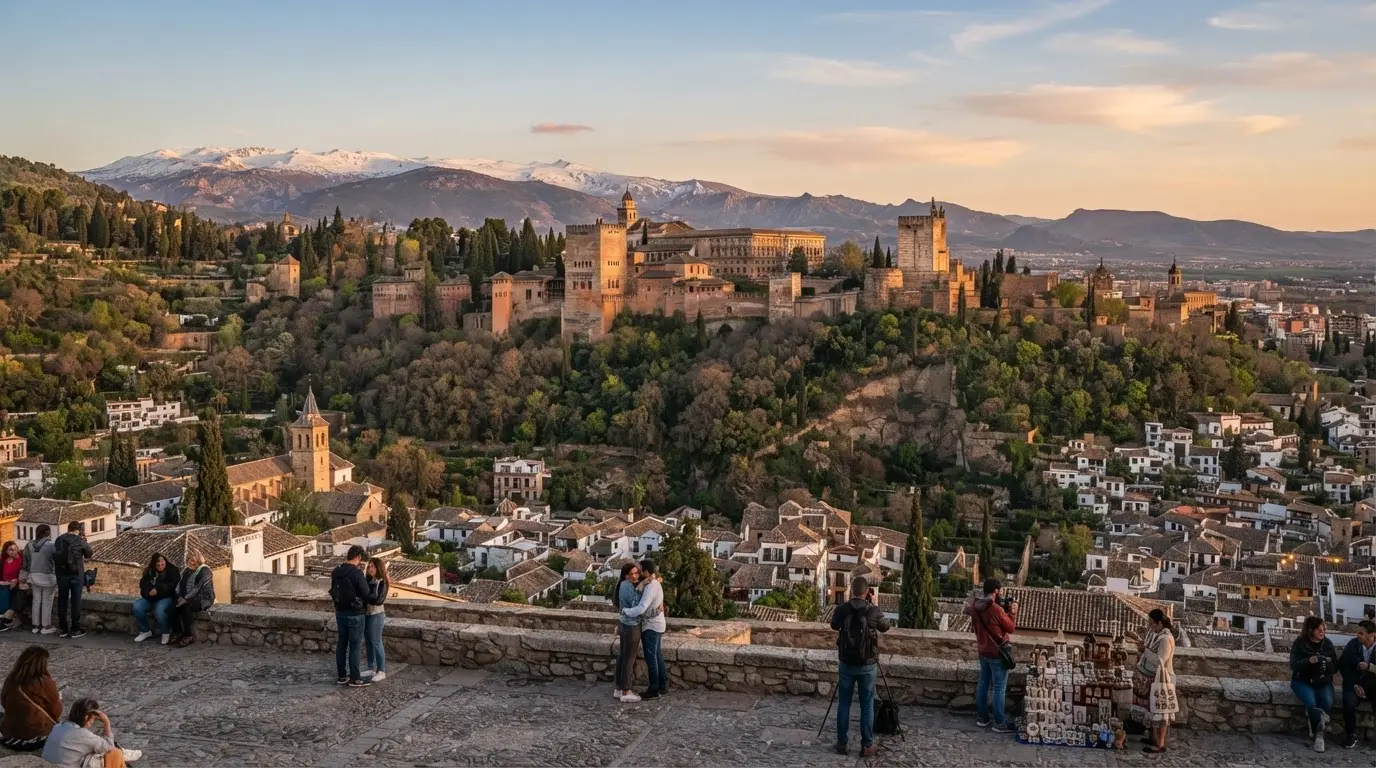
Wide-angle panoramic view of Granada Spain from Mirador de San Nicolás showing the Alhambra palace complex and Generalife gardens against the snow-capped Sierra Nevada mountains at golden hour, illustrating the interesting facts about Granada Spain

Deep dive · Article

20 Interesting Facts About Granada, Spain

Interesting facts about Granada Spain that guidebooks skip: disputed etymologies, the soldier who saved the Alhambra, and a river buried under Plaza Nueva.

If fried is not your thing, Granada has sweets that skip the pan entirely, such as the cream-filled pionono of Santa Fe. Pair one with a pestiño and you have both ends of the city's sweet shelf: the soft, chilled pastry that regulars buy by the half-dozen, and the old honeyed fritter that convents have kept on their lists for the festivals. A sensible plan for a short stay is one convent stop in the morning, while the hatches are open, and a bakery stop in the afternoon for whatever the season has put in the window.

Frequently asked questions

What are pestinos (pestiños) and torrijas in Granada?

Pestiños are fried dough made with flour, white wine and olive oil, flavoured with citrus peel and anise or sesame, and usually bathed in honey. Torrijas are bread slices soaked in milk or wine, coated in egg, fried and sweetened. Both are Andalusian sweets that Granada's convents and bakeries share with the rest of the region.

Are torrijas and pestiños the same?

No. A torrija is fried bread dipped in egg, soft and custardy inside. A pestiño is a fried flour-and-wine dough, crisp and glazed with honey. They overlap in the calendar around Easter, but torrijas belong to Lent and Holy Week while pestiños stretch from Christmas to Easter.

When are pestiños eaten in Granada?

Across Andalusia they are a Christmas and Easter sweet, and in Granada they are among the most popular Holy Week sweets. Some bakeries sell them all year, and at least one convent has listed them as an all-year sweet.

Where can I buy pestiños in Granada?

Convents are the best-documented source: the Encarnación, Corpus Christi and Visitación houses have all listed them. Stock lists date quickly, so confirm at the convent door, and expect cash only and morning hours.

Are pestiños Moorish?

Possibly in part. Chebakía, a Moroccan Ramadan sweet described as similar to Spanish pestiños with honey, may trace back to Muslim-era Iberia, though its origin is hard to settle, and Sephardic fijuelas are also named as an ancestor. That is an Andalusia-wide story; nothing in the sources ties the pestiño's origin to Granada.

Do Granada convents sell flores fritas?

Granada's provincial list of Holy Week sweets names flores fritas, and the Encarnación convent has listed flores de hojuela for Holy Week. Ask what the convent means by the name before you order.

Which towns near Granada are known for pestiños?

Vélez de Benaudalla on the Costa Tropical, Cájar on the Sierra Nevada side, and Salobreña, which is among the Andalusian towns with its own local version.

Sources

27 references Show
  1. Wikipedia — Torrija (opens in a new tab)

    “El consumo de este plato en España es típico durante la Cuaresma”

  2. Wikipedia — Pestiños (opens in a new tab)

    “The prestiño dates back at least to the 16th century, being mentioned in the book La Lozana Andaluza, which was written in 1528.”

  3. upo.es (opens in a new tab)

    “se sabe que hasta el siglo XVI, los pestiños se freían preferiblemente en manteca de cerdo”

  4. upo.es (opens in a new tab)

    “Los pestiños consisten en una masa elaborada a base de harina de trigo, vino blanco y aceite de oliva que se adereza con cáscara de naranja, limón y semillas de anís o ajonjolí.”

  5. dle.rae.es (opens in a new tab)

    “Rebanada de pan empapada en leche o vino y rebozada con huevo, frita y endulzada.”

  6. infobae.com (opens in a new tab)

    “Granada: Borrachuelos, flores fritas, leche frita, huevos moles, pestiños y roscos fritos.”

  7. librerias.paulinas.es (opens in a new tab)

    “Dulces en Semana Santa: Borrachuelos, flores de hojuela, pestiños y plum cake.”

  8. eldebate.com (opens in a new tab)

    “Son también conocidas como flores fritas o florones, y en algunos pueblos reciben el nombre de flores de Calatrava”

  9. eldebate.com (opens in a new tab)

    “Algunas teorías apuntan a un posible pasado sefardí; otras las integran en el amplio universo de las «frutas de sartén»”

  10. upo.es (opens in a new tab)

    “Esta receta final que ha llegado hasta nuestros días es producto de la fusión de las culturas romana, judía y musulmana que durante tantos años convivieron en Al-Ándalus.”

  11. elgourmetdeandalucia.com (opens in a new tab)

    “Son las fijuelas, masa de harina frita y bañadas en almíbar.”

  12. swissinfo.ch (opens in a new tab)

    “un dulce tradicional parecido a los españoles pestiños con miel que no falta cada día en las mesas de las cenas de ruptura de ayuno”

  13. swissinfo.ch (opens in a new tab)

    “es difícil zanjar su origen, pero cita algunas teorías que barajan que podría provenir de la Península Ibérica”

  14. theobjective.com (opens in a new tab)

    “nos centramos aquí en los términos pestiño (del lat. PISTUS, ‘majado, batido’) y torrija (de torrar)”

  15. theobjective.com (opens in a new tab)

    “prestiño ya lo incluye Elio Antonio de Nebrija en su Diccionario latino-español (1492)”

  16. Wikipedia — Torrija (opens in a new tab)

    “Juan del Encina utiliza «torreja» en un villancico de su Cancionero (1496)”

  17. theobjective.com (opens in a new tab)

    “Habrá que esperar un siglo para encontrar la voz torrija en la codificación lexicográfica”

  18. saborgranada.es (opens in a new tab)

    “Por su parte la presencia judía deja su impronta en las hojuelas fritas, los bizcochos de pasas y en los almíbares, mezcla de miel y azúcar.”

  19. spanishsabores.com (opens in a new tab)

    “eaten across Andalusia during the Christmas and Easter periods, though it can be found in bakeries all year round.”

  20. miriamtouristguide.com (opens in a new tab)

    “En la Semana Santa de Granada los pestiños son uno de los dulces más populares.”

  21. upo.es (opens in a new tab)

    “Es por ello que en nuestra tierra nacieron las torrijas, la leche frita o los pestiños.”

  22. librerias.paulinas.es (opens in a new tab)

    “Dulces todo el año: Pestiños, pastas de té, pastas de Santa Eulalia, pastas de aceite y mantecados (también en Navidad).”

  23. saborgranada.es (opens in a new tab)

    “pestiños de la Encarnación, hojaldre de San Jerónimo”

  24. librerias.paulinas.es (opens in a new tab)

    “En Semana Santa hacen roscos fritos y pestiños.”

  25. saborgranada.es (opens in a new tab)

    “la cazuela mohína de Almuñécar o los pestiños de Vélez de Benaudalla.”

  26. saborgranada.es (opens in a new tab)

    “Camino de las cumbres de Sierra Nevada resaltan los papaviejos de Cenes de La Vega, huesos de Santo de Monachil, pestiños y roscos de Cájar.”

  27. Wikipedia — Pestiños (opens in a new tab)

    “Its form and composition vary from region to region and are different in Medina-Sidonia, Cádiz, Chiclana de la Frontera, Sanlúcar de Barrameda, Rota, Salobreña and other towns in Andalusia.”