The garrison revolt of 20 July
Granada went into the summer of 1936 with a new civil governor. César Torres Martínez had been appointed after his predecessor, Ernesto Vega, was dismissed on 25 June.[1] The military command changed hands too: Brigadier General Miguel Campins took over the garrison on 11 July, nine days before the revolt.[2]
Campins is often assumed to have led the coup. He did not. The officers behind it were Colonel Antonio Muñoz Jiménez, who commanded the Light Artillery Regiment No. 4, and Colonel Basilio León Maestre, who commanded Infantry Regiment No. 2.[3] Together they had about 300 infantry and 180 gunners.[4] It was a small force for a city of this size.
At 17:00 on 20 July, Muñoz led the troops out of their barracks on the edge of the city and towards the centre.[5] Campins was forced to sign the war proclamation, the bando de guerra, that declared martial law.[6] The civil governor, the local Civil Guard commander, the mayor and the president of the provincial deputation were all arrested.[7]
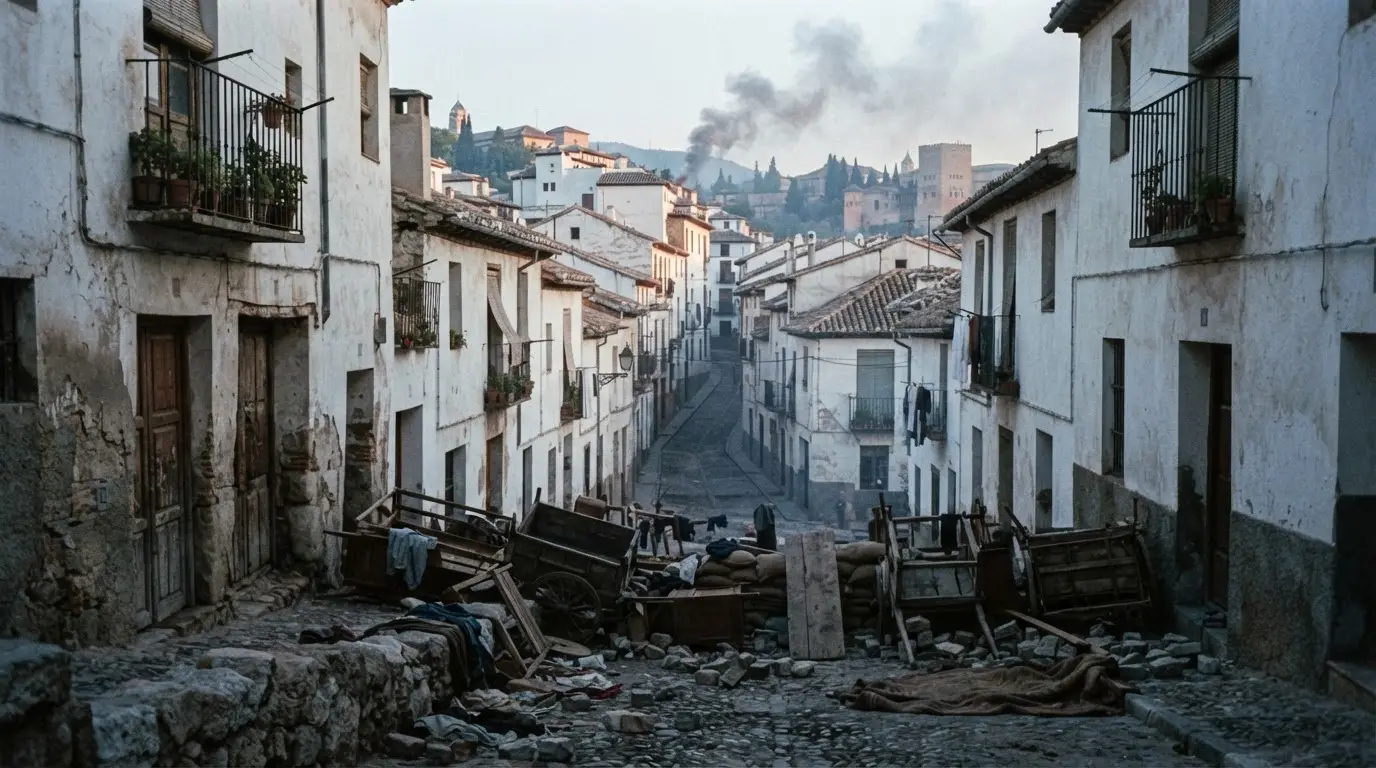
The Albaicín: barricades against artillery
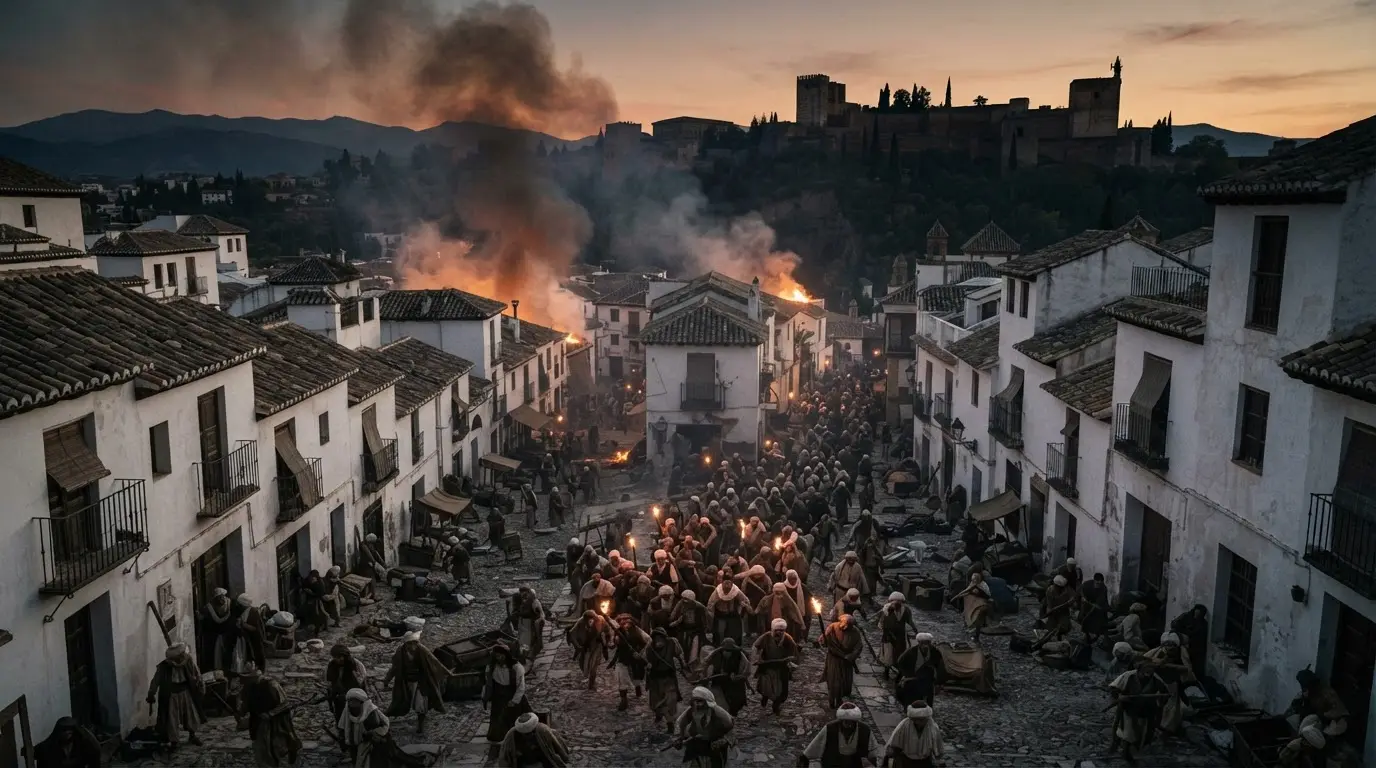
The Albaicín was then a working-class district with a strong anarchist presence, dominated by the CNT and FAI unions.[10] A Spanish academic study of the resistance puts the contrast plainly: the city succumbed quickly, while the district organised an armed defence, with very few resources, behind its barricades.[11]
The defenders closed the access points to the neighbourhood, above all along the Carrera del Darro. At the top of the Cuesta del Chapiz they dug a deep trench.[12] Weapons were scarce; some men had only knives and sharpened spikes.[13] The old walls and gates of the Albaicín were no help against what came next.
Explore · Neighbourhood
Albaicín
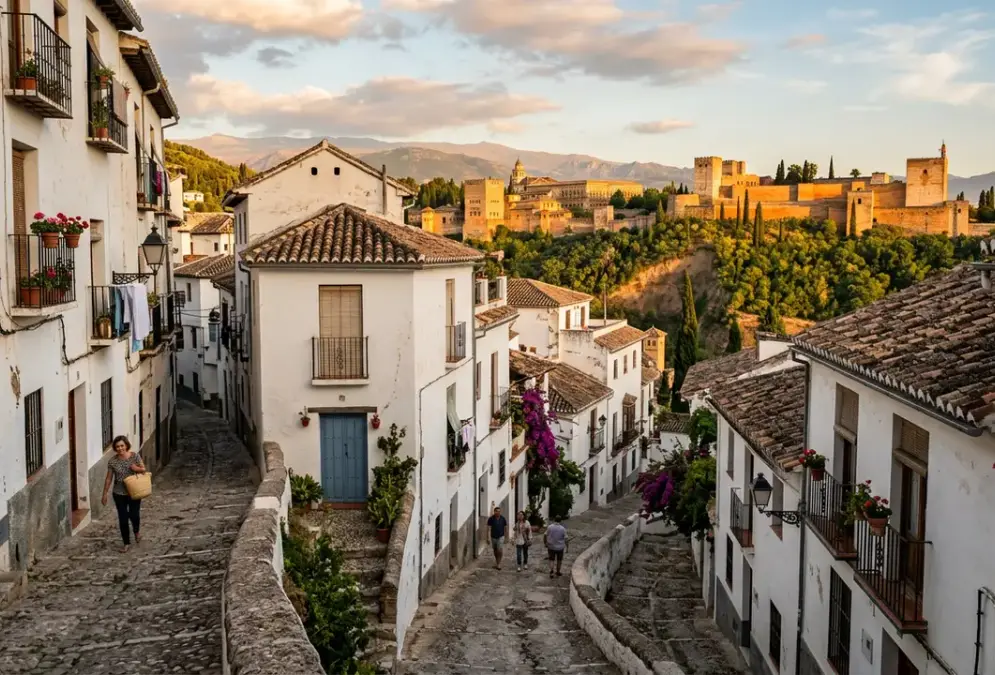
Granada's oldest neighbourhood: the Albaicín holds a UNESCO-listed maze of whitewashed lanes, Moorish cármenes, and the finest Alhambra views in the city.
The rebels put one artillery battery at the church of San Cristóbal, which commands the city, and another in the Alhambra, directly facing the district.[14] From the Mirador de San Nicolás today you can see the Alhambra hill on the far side of the Darro, the direction the guns pointed.
One historian's list of defenders killed on 21 July, cited in the Dialnet study, gives ordinary trades:[15]
- José Fernández Tarifa, cabinetmaker
- Juan Martínez Pérez, water-carrier
- José Fernández Ruano, carpenter
- Manuel Mirasol, bricklayer
- Carmen Romero Bolívar and Francisco Sánchez López, occupations not given
On the morning of 22 July, Radio Granada broadcast an ultimatum. Women and children were given three hours to leave the district and gather at designated points.[16] The shelling resumed afterwards, and NiD 52 fighters captured at the Armilla airbase made several passes over the district, strafing the defenders.[17]
23 July: surrender and a city cut off
On the morning of 23 July the bombardment grew heavier, and soon improvised white flags appeared on balconies and windows.[18] The district surrendered. A good number of the men got away up the Darro valley and through the higher ground towards the Vega.[19] The rebels then ordered every resident out of their homes and out of the district altogether.[20] By nightfall, they held Granada and the country around it.[21]
- 20 July, 17:00
The garrison leaves its barracks
The centre is in rebel hands within hours.
- 22 July, morning
Radio Granada broadcasts an ultimatum
Three hours for women and children to leave the Albaicín.
- 23 July, morning
White flags in the Albaicín
The bombardment intensifies and the district surrenders.
- 23 July, nightfall
Rebels control all of Granada
The city was not yet connected to the rest of the rebel zone. It stayed an island inside Republican territory until mid-August, when African troops under General Varela linked it up.[22] The only sizeable Republican effort to retake it came on 30 July, when a militia column attacked through the Huétor Santillán sector.[23]
The repression: prison, cemetery wall and the count
Commander José Valdés Guzmán became civil governor with responsibility for public order, and from then on was the person chiefly responsible for the repression in the capital.[24] Historians quoted by the Universo Lorca project describe it as a premeditated plan to eliminate the Republican political and union forces.[25]
The provincial prison, built for about 400 people, held more than 2,000.[26] Many detainees were taken to the cemetery and shot, most of them without any case being opened.[27] The cemetery walls and the Barranco de Víznar were the main places where left-wing sympathisers were killed.[28] Assault-guard platoons and volunteers of the Black Squads carried out mass executions at Víznar from July 1936.[29] The poet Federico García Lorca was one of the victims; his case is told in Lorca's last day and the road to Víznar.
The dead included 23 republican-socialist councillors, shot alongside the mayor.[30] Torres Martínez, the governor arrested on 20 July, was an exception: he lived, with a sentence of more than thirty years.[31] General Campins, who signed the proclamation under pressure, was later tried and shot in Seville.[32]
Deep dive · Article
1066 Granada Massacre: When the Jewish Golden Age Ended in a Day
The 1066 Granada massacre killed Joseph ha-Nagid and thousands of the city's Jews in a single day, ending three decades of Jewish power under Samuel ha-Nagid.
The totals are estimates, and every figure here comes through a single English-language summary of the historiography. It reports that August 1936 was the deadliest month, with 572 executed.[33] It gives some 5,000 for the whole war, then states that the true number is not known.[34][35] An earlier estimate of 25,000 rested on one informant who claimed to have seen court records.[36]
Visiting the Barranco de Víznar today
The Barranco de Víznar is a sloping edge of about 10,000 square metres, on a sharp and shady bend of the road between Alfacar and Víznar.[37] It is officially declared a Place of Memory.[37] Access is free and public.[38] It is not a heritage attraction in the usual sense, so go quietly and leave the site as you found it.
Every 19 August, a poetry evening is held there. It runs from midnight into the early hours, and it began in secret in the last years of the dictatorship.[39]
A second site, La Colonia in Víznar, was a prison. A sign that activists hang each year for the march says more than 2,000 victims spent their last hours there, and unknown people tear it down within days.[40] The building itself was demolished in the 1960s and only the mill and stairs remain. In August 2021 the site was still waiting to be designated a place of historical memory.[41] For the wider setting, the Granada history guide places 1936 in the city's longer story. This article has no verified visiting information for the cemetery walls, so it gives none.