What the Lead Books actually were
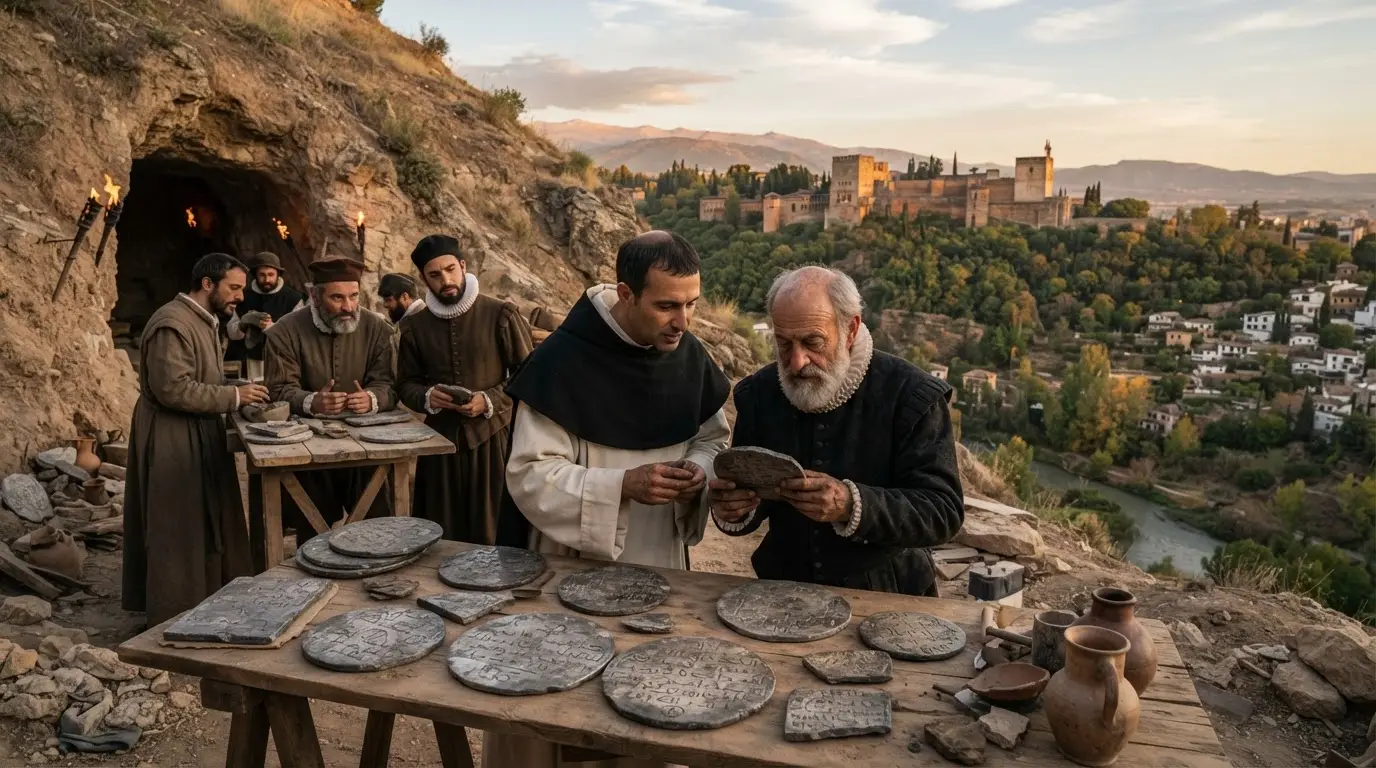
The Lead Books of Sacromonte (Libros Plúmbeos del Sacromonte) are 22 volumes of circular lead leaves, bound with lead wire, inscribed with text in Arabic, Latin, and a mysterious 'Solomonic script' that no one has ever fully deciphered.[1] Nineteen of the original twenty-two survive.
They came out of the Sacromonte caves in stages. The sequence began in 1588, when workers demolishing the Torre Turpiana — a former mosque minaret incorporated into Granada's cathedral complex — found a lead box containing a parchment with an Arabic prophecy attributed to Saint John the Evangelist and alleged relics of Saint Stephen.[1] That single find set the template. Then in 1595, excavations on Sacromonte hill began turning up lead-sealed caves containing burned human remains and more lead tablets.
22 volumes
The tablets made extraordinary claims. They said the bones were those of Saint Caecilius of Elvira and eleven followers, disciples of Saint Peter martyred under Emperor Nero in the first century. The inscribed texts claimed to be prophetic and liturgical teachings recorded by Peter himself, with an Arabic commentary by Saint Caecilius. The Solomonic script, no one could read. The Arabic portions, read by the two translators appointed to the task, said exactly what the Church hoped to hear: that Granada had been a Christian city since apostolic times, long before it became Muslim.
For the Church authorities championing the find, the theological implications were enormous. Granada had been conquered from Muslim rule in 1492, as part of the Reconquista that Ferdinand and Isabella completed that year. Here was proof, supposedly from the first century, that Christianity had preceded Islam on this ground.
Archbishop Castro and the making of a saint's city
Pedro de Castro, Archbishop of Granada from 1589 to 1610, became the lead books' most powerful advocate. He had no reason to doubt and every political reason to believe. A proof of Granada's apostolic Christian heritage would cement the city's spiritual status in a Spain still raw from the expulsion of its Muslim and Jewish populations.
Castro commissioned translations from his two appointed Morisco scholars (more on them shortly), accepted their readings without question, and began construction. The Abadía del Sacromonte rose on the site of the alleged martyrdom, incorporating the cave where the bones had been found into its underground chapel complex.[2] The relics were venerated. Pilgrims came. The caves became a sacred site on the official map of Counter-Reformation Spain.
The Archbishop's faith was, in hindsight, strategically motivated as much as spiritual. The lead books gave Granada a martyrs' heritage comparable to Toledo or Zaragoza. They also gave the city's new Christian identity an unassailable foundation: if Peter himself had preached here, no one could argue that Granada was anything other than an ancient Christian city. The Morisco population, still present in the city, could be framed within this history as the descendants of those early converts.
Explore nearby · Monument
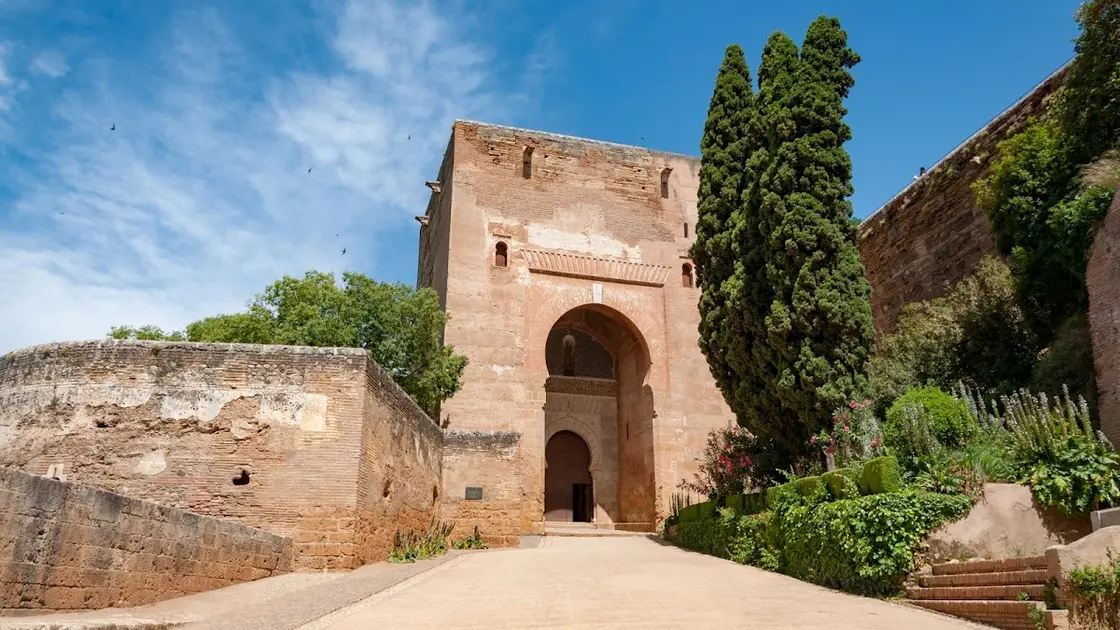
Puerta de la Justicia
Alhambra's main entrance, built by Yusuf I in 1348. A Hand of Fatima on the outer keystone and a Key on the inner encode the Five Pillars and royal power.
Castro was not naive. He sent copies of the tablets to Rome for examination. But he continued construction on the abbey and continued venerating the relics while Rome deliberated. The deliberation took 44 years.
The Abadía del Sacromonte still stands today at the top of the Sacromonte hill. The Santas Cuevas beneath it, the underground cave complex built over where the relics were allegedly found, are accessible on guided tours. The setting is genuine even if the relics were not.
The Moriscos: who made the forgery and why
Modern scholarship identifies two men as the probable architects of the forgery: Miguel de Luna and Alonso del Castillo, both Moriscos, both employed as translators at the court of Philip II.[3]
Alonso del Castillo was a physician and Arabist, born in Granada in the 1520s, who had spent decades translating Arabic manuscripts for the Spanish crown. Miguel de Luna was a decade younger, worked as an interpreter for Philip II, and in 1592 published a fictionalised 'translation' of a supposed ancient Arabic history of the Moorish conquest of Spain — a book now recognised as an outright invention designed to make the Arabic and Islamic past of Spain look compatible with Christian identity.
Both men were Moriscos: the descendants of Muslims who had been forcibly converted to Christianity after 1502, when Ferdinand and Isabella required all Muslims in Castile to choose between baptism and exile. The Moriscos were nominally Christian, but the Spanish Inquisition surveilled them relentlessly, and by the late 16th century, pressure for total assimilation or expulsion was mounting. The Alpujarras rebellion of 1568–1571, when the Morisco community in the mountain villages east of Granada rose against the policy of suppressing Arabic language, dress, and customs, ended in military defeat and mass deportation. The community was scattered across Castile. Their presence in and around the hillside cave quarter is itself a story of post-conquest displacement, documented in the history of the cave houses of Sacromonte they built from the rock above the Darro. The same conditions that produced the forgery also shaped the neighbourhood's food culture: the cave kitchens of those displaced communities gave rise to the tortilla del Sacromonte, a dish whose origins are inseparable from the same post-1492 marginalisation.
Recommended tours
Tours are selected for quality, not commission. We earn a small fee if you book — at no extra cost to you.
The lead books were, scholars now argue, a sophisticated theological defence. By inserting an Arabic-language Christian gospel into the foundation story of Granada — by making Saint Caecilius a commentator who wrote in Arabic, by embedding references to the Virgin Mary in the language of Islam — Luna and Castillo were arguing that Arabic-speaking Christianity was not a contradiction in terms. The forgery claimed that Arabic was the language of Christ's disciples as much as Latin or Greek. If the first bishop of Granada had written in Arabic, the Inquisition could hardly forbid the Moriscos from using their own language.
It was, by any measure, a remarkable attempt. Two men with limited power, facing the apparatus of the Spanish state, used the Church's own obsession with relics and apostolic heritage as a weapon for their community's survival.
The Vatican investigation and the 1682 condemnation
Rome was not persuaded. Within years of the first discoveries, European scholars had raised doubts about the tablets. The Arabic was too medieval, not ancient; the theological content was doctrinally irregular; the Solomonic script was unverifiable by design.
In 1638, Pope Urban VIII suspended public veneration of the relics. The tablets themselves were not physically sent to Rome until 1642, when the Holy Office began its formal examination.[1] Archbishop Castro, by then in his 80s, had died the previous year, still convinced of the tablets' authenticity. The examination in Rome went on for decades — a tribunal of scholars working through twenty-two volumes of circular lead inscribed in a partly invented script.
Pope Innocent XI finally issued his verdict in 1682: both the Turpiana Tower parchment and all 22 of the lead books were condemned as heretical forgeries.[1] The grounds were theological as much as philological: the texts made claims incompatible with Catholic doctrine, and their mix of Arabic, Latin, and unreadable Solomonic script was now understood as deliberate obfuscation rather than apostolic mystery.
By 1682, however, the broader context had already resolved itself in the worst possible way. The Moriscos of Granada had been expelled from Spain entirely between 1609 and 1614, seven years after Archbishop Castro left Granada for Seville. Entire communities were forcibly removed from the country where their families had lived for generations. The forgery, whatever its intentions, had not saved anyone.
The tablets stayed in the Vatican archives for 318 years. In the year 2000, they were returned to the Abbey of Sacromonte, where they can now be seen in the abbey museum.[1] The Vatican condemnation of 1682 has never been reversed.
Christian-Islamic syncretism: what the texts actually claimed
The content of the lead books is strange even by the standards of Counter-Reformation religious controversy. The tablets do not simply claim early Christian history for Granada. They produce a theology in which Arabic and Islam are pre-emptively incorporated into Christianity rather than opposed to it.
The texts present the Virgin Mary issuing prophecies in Arabic. Saint Caecilius writes his commentary in the language of the people who would later call themselves Muslims. Several passages refer to Muhammad by name, not as an opponent but as a figure whose coming was anticipated and whose Arabic language was sacred. The Solomonic script, unreadable to everyone, presumably contained whatever each reader most needed to believe.
This is the key to understanding the forgery's logic. Luna and Castillo were not simply claiming that Granada had a pre-Islamic Christian past. They were claiming that the divide between Christianity and Islam was a later misunderstanding, and that the first Christians of Granada — who wrote in Arabic — were proof that the two traditions were not irreconcilable. A Morisco, forced into Christian baptism but maintaining private Islamic practice, could find in the lead books a theological shelter: the first bishop of Granada himself had blended the two.
Deep dive · Article
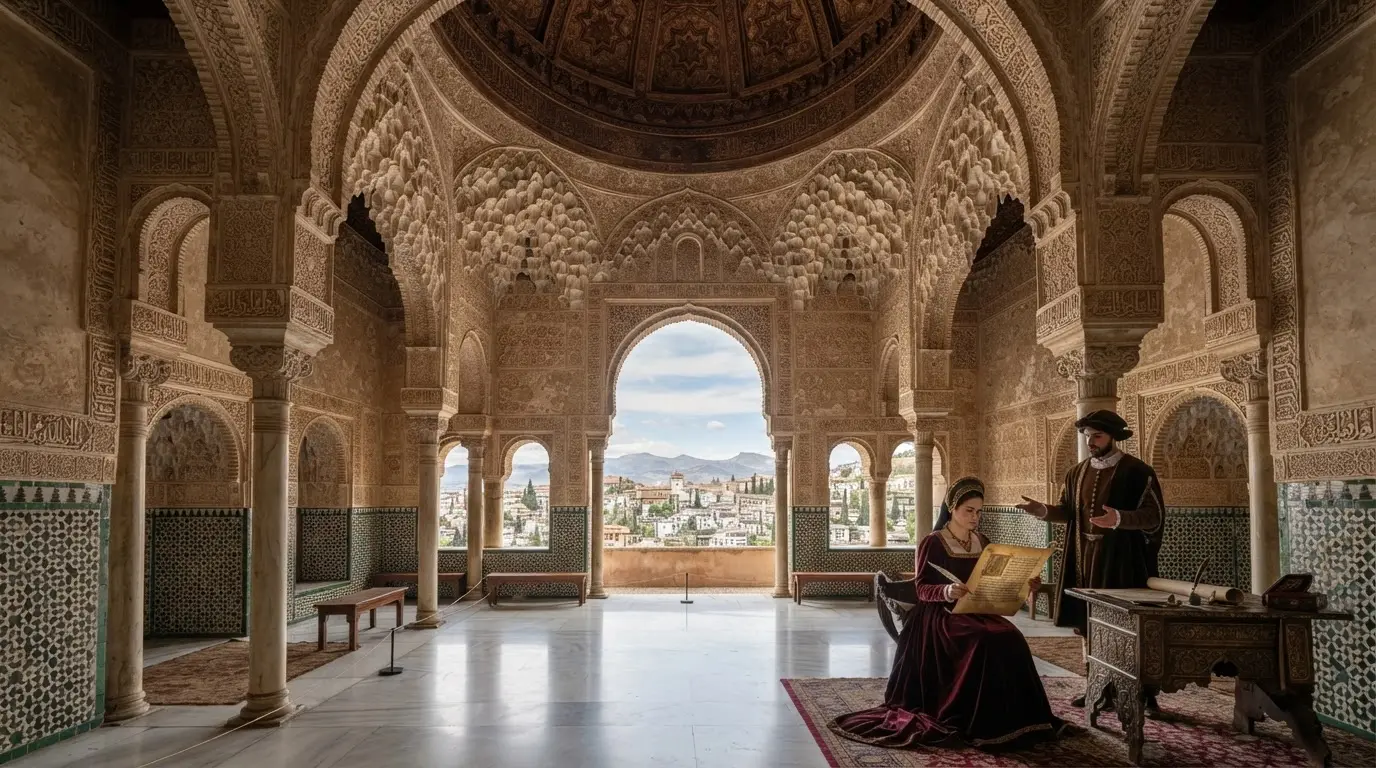
Alhambra Decree 1492: Granada's Jewish Expulsion Explained
The Alhambra Decree (Edicto de Granada) expelled Spain's Jews in 1492. Learn why it happened, what else happened in Spain that year, and where exiles went.
The Vatican condemned this argument as heretical, and it was by Catholic doctrine. But it was also a coherent theological position held by a community that had lived between two worlds for a century and found the forced choice between them intolerable.
Scholars in the 20th and 21st centuries have reread the lead books as a Morisco cultural monument as much as a forgery: the last major literary production of a community that was about to be erased. The library of Alonso del Castillo's Arabic manuscript translations still exists, scattered across Spanish archives. Miguel de Luna's fictionalised history remained in print for two centuries. Both men understood that texts outlast administrations.
Visiting the Abbey of Sacromonte today
The physical legacy of the lead books is the Abadía del Sacromonte itself, which sits at the top of the Sacromonte hill on a road that continues east into the mountains.[2] Construction began under Archbishop Castro in the late 16th century and continued through the 17th. The building is severe Baroque, the stone the same warm ochre as the Alhambra across the valley.
The abbey museum contains the returned lead tablets, displayed in cases with explanatory material covering the discovery, the Vatican investigation, and the modern scholarly consensus on their origin.[2] The tablets are small: circular lead leaves roughly the size of a hand. The inscriptions are dense, intricate, and clearly the work of someone who spent considerable time on the physical fabrication.
The Santas Cuevas beneath the abbey are the main draw for most visitors: the underground cave complex, cut into the Sacromonte conglomerate, with chapels and an altar built over the spot where the relics were found in 1595. Access is guided-only, included in the ticket price.
Practical details:[2]
- Entry: €7 adults, €5 students (aged 13–25 with ID), free under 13
- Opening hours: daily 10:00–13:00 and 15:00–17:00 in winter (28 October–31 March); 10:00–13:00 and 15:30–18:00 in summer (1 April–27 October)
- Getting there: a 25-minute walk up the Camino del Sacromonte from the Albaicín, or bus lines 31/35 from the city centre
- Time needed: allow 90 minutes for abbey, museum, and cave complex
The abbey terrace has one of the less-crowded views of the Alhambra in Granada. Come in the late afternoon when the light sits low on the Torres de la Vela and the Comares Tower turns the colour of old copper. Most visitors have left by then.