
A grandee under watch: why the Tebas were in Granada
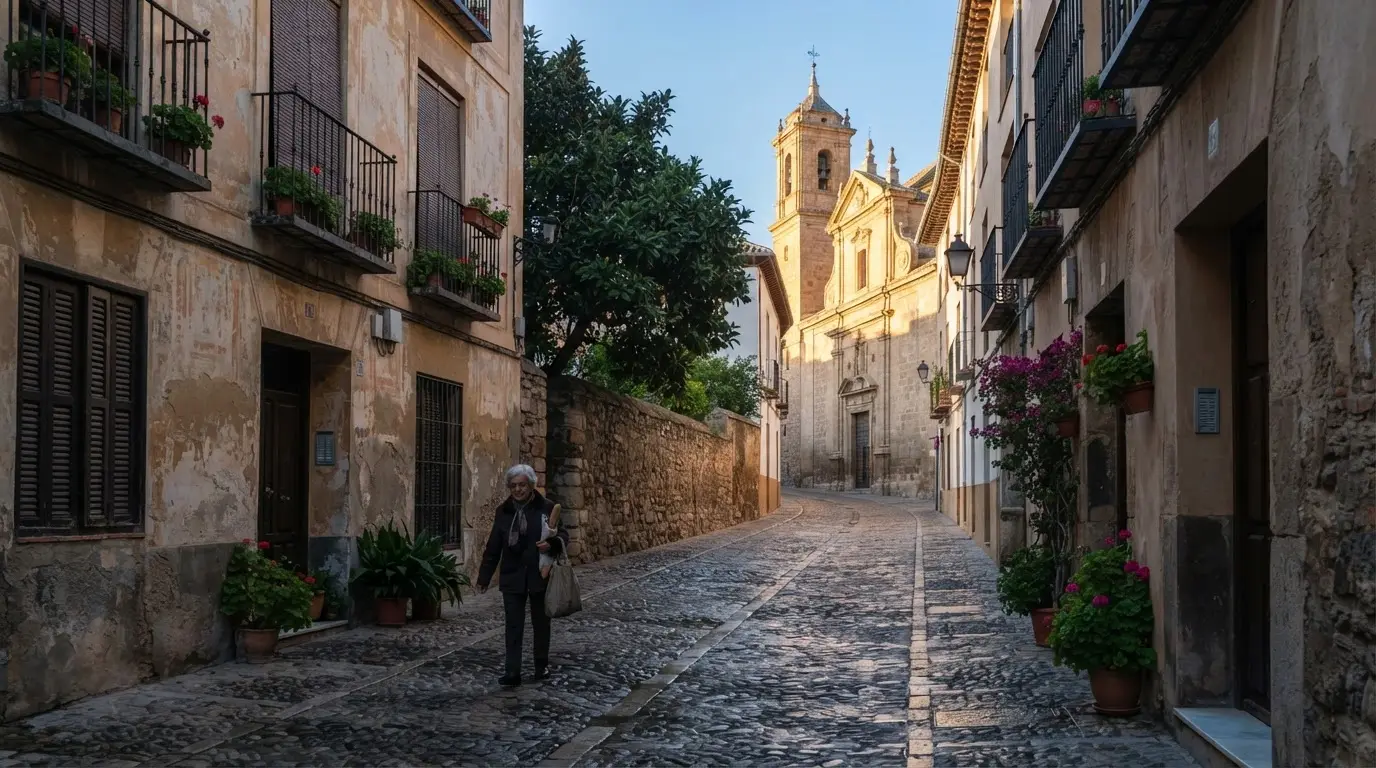
Eugénie's father, Cipriano de Guzmán, held the title of count of Teba and would later become count of Montijo. The Real Academia de la Historia's biographical dictionary calls him one of the most conspicuous afrancesados among the Spanish grandees[3], a nobleman who had sided with the French. He had paid for it in his body: in Napoleon's army he was left lame and blind in the right eye, and he followed Joseph I into exile in France[4].
Back in Spain the label did not wash off. His ties to the liberals got him jailed, and then he was posted to Granada, where he had to submit to police surveillance[5]. Granada was an assigned residence. It was never the family seat.
Her mother, María Manuela Kirkpatrick, was the daughter of a former US consul in Málaga, from a family of Scottish origin[6]. A 2026 Spanish retelling adds a bitter detail: Cipriano's war wounds were never counted as honourable at home, because he had suffered them serving the "intruder king", Joseph Bonaparte[7].
The French occupation that split Spanish nobles like him is its own story, told in Napoleon in Granada and the plot to blow up the Alhambra. Here it is only the reason a count with a lame leg ended up on a Granada street.
Calle de Gracia 12: the house, the plaque, the laurel
The Teba family lived at number 12 on Calle de Gracia from 1823 until 1828[8], in the Magdalena district of the old centre. A 2020 article in the journal Cuadernos de Investigación Histórica is specific about the birth: Eugénie was born at Calle de Gracia 12 on 5 May 1826[9]. Local-history writing agrees on the address, and I take it as solid.
Do not go looking for a Montijo palace. Nothing I could trace documents a named palace in Granada, and the Spanish press retellings that say "palace" are using loose wording. Call it what it was: the home of a man under police surveillance.
Explore · Neighbourhood
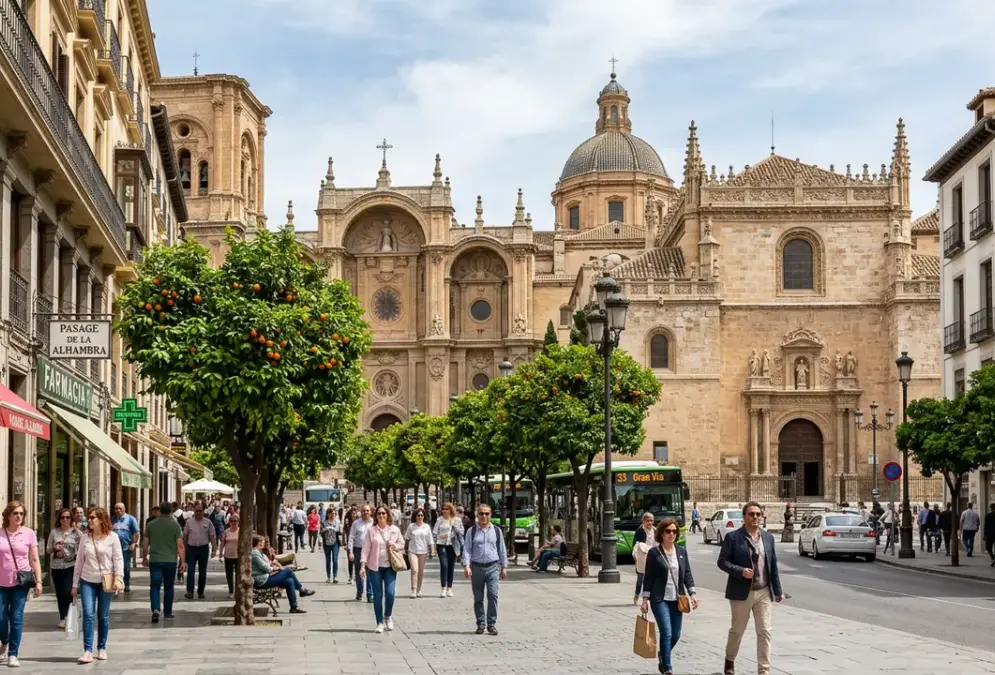
Centro / Sagrario
Granada's Centro Sagrario, the historic city centre, holds the Cathedral, Royal Chapel, Alcaicería bazaar, and Corral del Carbón in one walkable zone.
Only part of the original building survives, and that part is the facade, painted with frescoes and trompe-l'oeil[10]. On it, a city plaque reads, in translation: "In this house was born the illustrious Lady Doña Eugenia de Guzmán y Portocarrero, current empress of the French"[11]. The word current does the dating. The council wrote it while she still reigned, so the plaque is a piece of civic pride from her own lifetime, not a later memorial.
The garden has its own relic. In 1953, for the centenary of her wedding to Napoleon III, a local doctor named Gabriel Sánchez de la Cuesta had a cartouche placed beside what Granadans call the Laurel of the Empress[12]. The house stands in the old historic centre of Granada, and I found no sign it is open to visitors. Expect to read the plaque and photograph the facade from the street, not to go in.
The earthquake legend and what the records allow
Every retelling reaches for the same image. As the countess went into labour the ground shook, and the birth happened with the household in disarray. A Spanish news site in May 2026 still opens its account with the earth trembling in Granada just as the countess was about to give birth in the "palace" of the count of Teba[13].
The empress told it herself. She said to Lady Helena Gleichen that she was born in the middle of an earthquake, and that her mother was carried out of the house and laid under a tree[14]. A first-hand version from the child herself is as good as a legend gets.
Then comes the academic check. The 2020 article consulted the seismic catalogue and found that Granada's earthquake fell on 15 May, so it declines to give the story credit for the birth day[15]. Ten days is a wide gap for a birth and a narrow one for a memory. A quake that month could easily have migrated into the family story.
I would keep the legend and drop the certainty. The plaque on Calle de Gracia says nothing about it; it records only that she was born in the house.
From Madrid to the throne, and two returns
The family left Granada in 1828[16]. Eugénie was about two, so whatever she knew of the city came by family telling, not memory.
The second daughter of a disgraced Bonapartist count became, by marriage, a Bonaparte's wife. She married Napoleon III on 30 January 1853 and was Empress of the French until his overthrow on 4 September 1870[17], a reign of a little over seventeen and a half years. The irony is hard to miss: Spain had treated her father as a collaborator with the Bonapartes, and she ended up sharing a throne with one.
She came back to Granada only twice, in 1877 and 1896[18]. Both trips came after the Empire had fallen. Details of the visits circulate on local-history sites, including claims about an Alhambra guestbook signature and a hotel stay, but I could not tie them to any Alhambra record, so I leave them out. Whether she climbed to the Alhambra at all is a question the documents I have do not answer.
Finding Eugénie in Granada today
Four traces of her remain in the city, and three of them fit into an afternoon on foot:
- The birth-house facade on Calle de Gracia, with its frescoes, trompe-l'oeil and plaque.
- Calle Emperatriz Eugenia, 393 metres long, running from the Plaza del Gran Capitán to the Camino de Ronda[19].
- A bronze statue of her by Miguel Barranco López on the Avenida de la Constitución[20].
- A bibliographic exhibition at the Biblioteca Provincial de Granada titled Eugenia de Montijo, la emperatriz que nació en Granada[21]. Ask the library whether anything is currently on show.
Granada's own spelling is telling. The plaque, the street and the library all say Eugenia, the Spanish form, not the French Eugénie. The city claims her as a granadina, a native, and says so on its walls.
Deep dive · Article
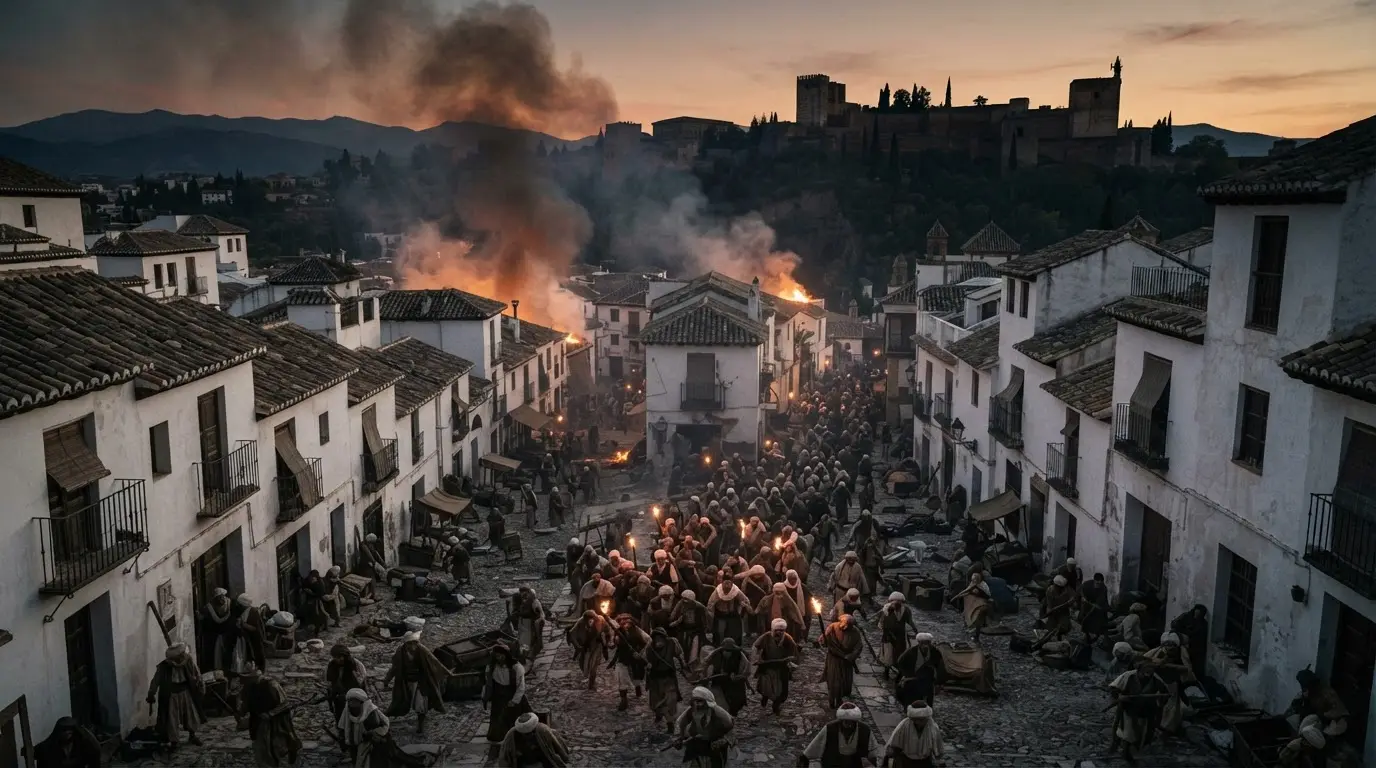
1066 Granada Massacre: When the Jewish Golden Age Ended in a Day
The 1066 Granada massacre killed Joseph ha-Nagid and thousands of the city's Jews in a single day, ending three decades of Jewish power under Samuel ha-Nagid.
The bicentenary of her birth fell on 5 May 2026. I found no official Granada programme for it, so do not plan a trip around one.
Recommended tours
Tours are selected for quality, not commission. We earn a small fee if you book — at no extra cost to you.




As a visit this is a short detour inside the centre, not a destination. Fold it into the historic centre walk, add Granada Cathedral if you have the time, and keep your expectations honest. A birth, a plaque, a legend and a street name: the empress who ran a court did not grow up here.