Seven years resident in Granada. Specialist in Nasrid architecture, Al-Andalus history, and Andalusian walking routes.
Updated Published
Jump to a section
⌄
Which viewpoint suits you
Granada has four main miradores in the Albaicín, plus two views from outside it: the Paseo de los Tristes and Torres Bermejas. They differ less in what they show than in what it costs you to get there. Pick by effort and crowd tolerance first, then by view.
If you are
Go to
Why
A first-timer with one hour
San Nicolás
The famous view, closest to the bus stop
Limited mobility
Paseo de los Tristes (flat), or San Cristóbal (check the route)
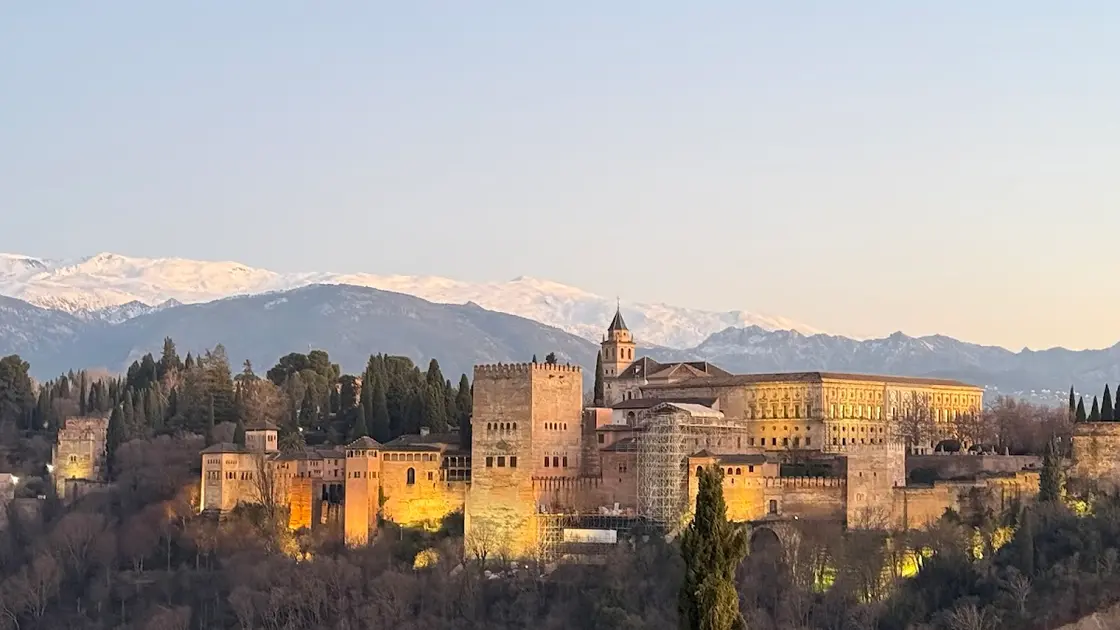
The terrace in front of the Church of San Nicolás, at the top of the Albaicín, shows the whole Alhambra complex with the Sierra Nevada behind it. It is free, open at all hours and one of the most visited spots in Andalusia. Crowds build through the afternoon, peak around sunset and thin out after dark.
Come early or late, and expect vendors and street musicians in between. The Mirador de San Nicolás page has the detail on the terrace itself.
Access routes
On foot from Plaza Nueva allow roughly 15 to 25 minutes uphill through steep, cobbled Albaicín lanes. Bus C31 runs from Plaza Nueva to Plaza San Nicolás and cuts the walk to a few minutes. Taxis can reach the lower Albaicín but not the last pedestrian stretch. Wear shoes with grip.
Mirador de San Miguel Alto: the long climb
The city tourism office describes San Miguel Alto as the highest point in the Albaicín. It sits above San Nicolás, up a steep winding path (allow roughly 20 minutes). From the top you see the Alhambra and Generalife, the Sacromonte hills, the Albaicín rooftops, the Vega plain and, on clear days, the Sierra Nevada.
It is much quieter than San Nicolás, because tour groups rarely make the extra climb. The cost is the approach: steep, exposed, no shade, no water. In summer, go in the morning and bring at least 1.5 litres.
A path on the far side of the ridge leads down toward Sacromonte, which makes a long loop back to the centre via the Camino del Sacromonte and the Carrera del Darro. Allow a good half day with stops.
Mirador de San Cristóbal: the easier option
San Cristóbal sits in the upper Albaicín beside the Church of San Cristóbal. It has an Alhambra view and far fewer visitors than San Nicolás. The Albaicín's own rooftops and whitewashed walls fill the foreground, so the Alhambra looks like part of the neighbourhood rather than a postcard.
It is reported as one of the few Albaicín viewpoints reachable without the worst of the cobblestone slopes, and so a reasonable choice for wheelchair users. I could not find an accessibility authority that confirms this, so check the approach before you rely on it.
Crowds stay moderate all day. Locals use it as a neighbourhood square, and early in the morning it is close to empty.
Mirador de la Lona: the city view
La Lona is on the Carril de la Lona in the upper Albaicín. The tourism office describes a panoramic view of the historical centre and the modern city. The Alhambra is not the subject here. If you have already seen the postcard from San Nicolás, this is the view that shows Granada as a living city.
Expect a steep uphill walk from Plaza Nueva, or take the bus and walk the last stretch. I could not confirm that there is a bar or any other facility on site, so carry water. For lens and exposure advice, see Granada photography spots.
Viewpoints outside the Albaicín
Torres Bermejas: looking away from the Alhambra
The Red Towers stand on the Mauror hill, facing the Alhambra rather than on it. From here you look back at the Alhambra and over the Realejo and the modern city, the inverse of the San Nicolás view.
The Patronato lists a free visit on Saturdays and Sundays only: 08:30 to 20:00 from 1 April to 14 October, 08:30 to 18:00 from 15 October to 31 March. Check tickets.alhambra-patronato.es before you go. You can approach from the Realejo, or from above via the Puerta de las Granadas. The free Alhambra exterior guide covers the free routes.
Paseo de los Tristes: looking up
Officially the Paseo del Padre Manjón, this promenade runs along the Darro at the foot of the hill. You look up at the Alhambra's walls and towers from the gorge floor. It is flat, fully accessible and lined with café terraces, the only spot on this list where you can sit with food and drink under the Alhambra. The Paseo de los Tristes guide has the history and the best terraces.
For more places away from the crowds, the hidden gems of Granada guide has walking directions.
Getting there by bus
The municipal operator's minibuses are the practical way to shorten the Albaicín climb.
C31: circular from Plaza Nueva along the Carrera del Darro to Plaza San Nicolás. C31 and C32 both serve San Nicolás.
C32: circular linking the Alhambra and the Albaicín from Plaza Nueva.
C30: centre to the Alhambra ticket offices, the ascent line if you plan to approach Torres Bermejas from the hill.
Check the operator's route map for the stop nearest La Lona; the last stretch to San Miguel Alto and San Cristóbal is on foot. Timetables and fares change, so confirm the current single fare with the operator before you go.
Sunset when San Nicolás is packed
San Nicolás at sunset is a festival, which is great if you want one and a trial if you do not. Three alternatives:
La Lona: a city view rather than an Alhambra view, with far fewer people.
San Cristóbal: a moderate crowd and a gentler walk.
San Miguel Alto: go up early and accept the descent after dark, which means checking the path and bringing a light.
Easy: Paseo de los Tristes, then Torres Bermejas on the way down through the Bosque de la Alhambra.
Moderate: bus C31 to San Nicolás, then walk to San Cristóbal or La Lona.
Hard: San Nicolás, then the climb to San Miguel Alto, with the Sacromonte loop back if your legs allow.
If you only have time for two, take the Paseo de los Tristes in the morning and San Nicolás before 09:00 or after 21:00. Both are free and show the Alhambra from opposite angles.
Reporter notebook
Insider tips
Practical observations gathered the way a local journalist would keep them: short, specific, and more useful than brochure copy.
Crowd tip
San Nicolás at 07:30 versus 19:00: two different places
At 07:30 the terrace holds perhaps a dozen people and the Sierra Nevada is usually clear before haze builds. At 19:00 the same space holds hundreds, several musicians competing for attention and vendors selling cold drinks. Both have their appeal, but they are not interchangeable. If you want the view rather than the crowd looking at the view, go early.
Photo spot
San Miguel Alto is worth it only if you bring water
There is no café, no water and no shade at the top, and the path from the upper Albaicín is steep and exposed. In summer, make it a morning climb and carry at least 1.5 litres. In return you get the Alhambra, the Generalife gardens, the Sacromonte hills, the Vega plain and, on clear days, the Sierra Nevada in a single sweep.
Itinerary tip
Pair one hard climb with easy stops
Do not stack two steep ascents in one afternoon. Start with the flat Paseo de los Tristes, add one climb (San Nicolás or San Miguel Alto), and finish on the descent at Torres Bermejas or a terrace. For more routes, see our best walks in Granada guide.
Frequently asked questions
What is the best viewpoint in Granada?
It depends on what you are trying to avoid. Mirador de San Nicolás has the view everyone has seen on a postcard, and the crowds to match. San Miguel Alto, the highest point in the Albaicín, rewards a long climb with a wide panorama and few people. San Cristóbal is the easier, quieter pick. Mirador de la Lona looks over the historic centre and the modern city instead of the Alhambra. For the San Nicolás detail page, see Mirador de San Nicolás.
Which Granada viewpoint is the least crowded?
San Miguel Alto and San Cristóbal. Tour groups rarely make the extra climb to San Miguel Alto, and San Cristóbal is used as much by neighbours as by visitors. San Nicolás is the one to time carefully: it is quiet in the early morning and packed around sunset.
How do I get to Mirador San Miguel Alto?
It is a steep walk above Mirador San Nicolás; allow roughly 20 minutes from there, and more from Plaza Nueva through the Albaicín lanes. Bus C31 takes you to Plaza San Nicolás, and you walk the rest. There is no café or water at the top, so bring your own. A taxi can reach the lower approaches, but the last stretch is on foot.
Is the Paseo de los Tristes a viewpoint?
Not in the elevated sense. It is a riverside promenade along the Darro below the Alhambra hill, and you look up at the walls and towers from the gorge floor rather than across at them. It works as a complement to the miradores, and it is the only one with café terraces. The Paseo de los Tristes guide covers it in full.
Is there a wheelchair-accessible viewpoint in Granada?
The Paseo de los Tristes is flat. Of the Albaicín miradores, San Cristóbal is the one reported to avoid the worst cobblestone slopes, but I could not find an accessibility authority that confirms the route, so check it before you commit. San Nicolás, La Lona and San Miguel Alto all involve steep climbs.
Can I combine several viewpoints in one day?
Yes, but the Albaicín's slopes make back-to-back climbs hard in summer heat. The easiest approach is to group them by effort: flat and short first, then one big climb. The routes by effort at the end of the comparison section lay this out. For photographing them, see the Granada photography spots guide.
Recommended Tours & Activities
Tours are selected for quality, not commission. We earn a small fee if you book — at no extra cost to you.