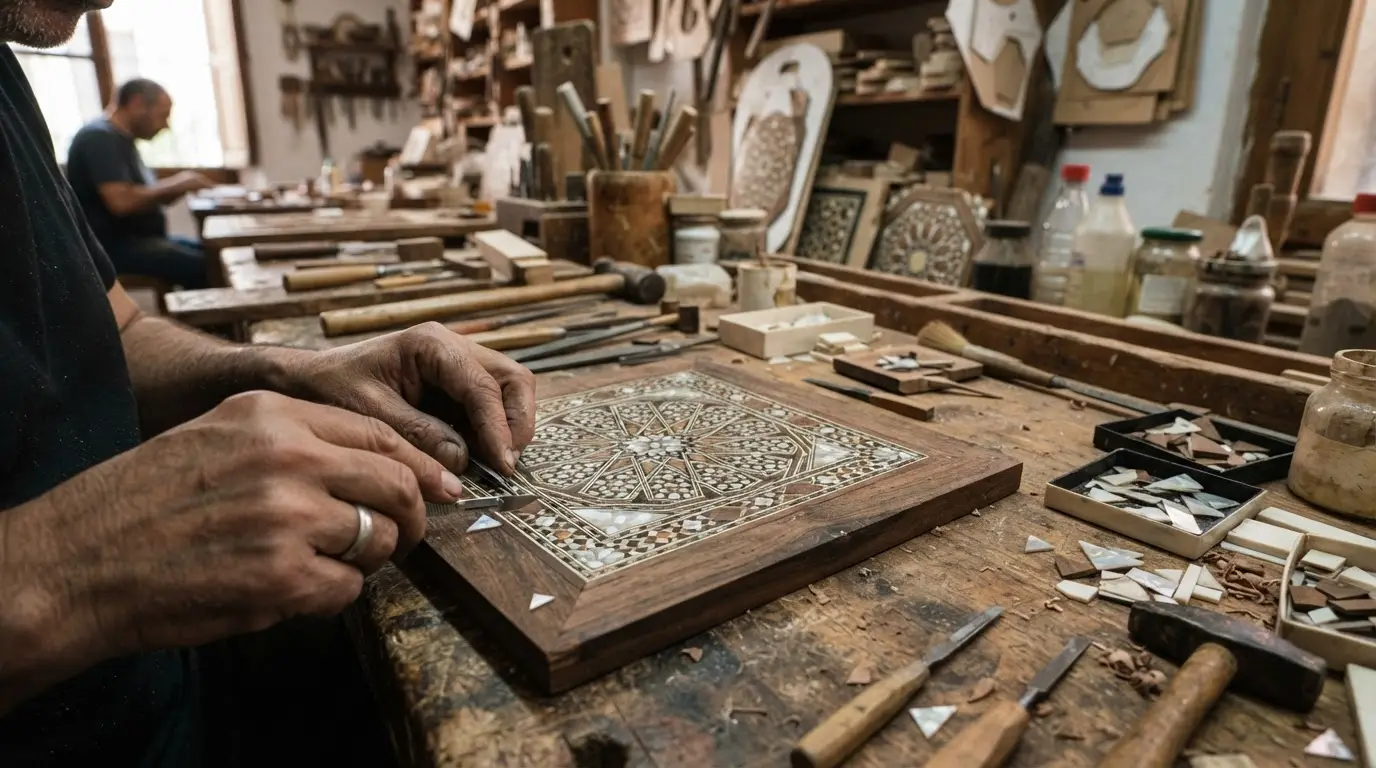

What taracea is: the technique explained
The clearest way to understand taracea is by contrast with what it looks like it is. A finished piece, a box lid or a backgammon board, shows an intricate geometric pattern of interlocking stars built from fragments of wood, bone, and mother-of-pearl. Your first instinct is to read it as surface decoration, something painted or printed onto wood. It is not. Each element of the pattern is a separate physical piece, fitted individually into a carved recess in a wooden base. The distinction matters because it is what separates genuine taracea from the mass-produced printed copies that dominate most tourist shops.
The Spanish term for the core process is embutido: inserting. Craftsmen prepare long rods of material, wooden cylinders in contrasting species, strips of bone, sections of nacre shell, assembled and glued lengthwise to produce a specific geometric cross-section. When that rod is sliced transversally, each cut yields an identical star-shaped wafer. The shape of the wafer is determined entirely by the architecture of the rod. Getting the rod geometry right, so that the cross-section is clean, the angles are exact, and the pattern holds through every slice, is where the years of training go.
Once the wafers are sliced, the craftsman carves corresponding recesses into the wooden base, presses the wafers in with hot rabbit-skin glue (cola de conejo), and applies pressure while the glue sets. Machine sanding levels the surface and exposes the complete pattern. The result is flush with the base: no raised elements, no grout lines visible to the eye, just the geometry emerging from the surface like something the wood contained all along.
Hundreds of tiles
Materials vary by quality tier. The base is typically walnut, mahogany, or poplar. Inlay pieces use cedar (cedro), rosewood (palo de rosa), ebony, and walnut for colour contrast. For white elements, workshops use mother-of-pearl (nácar) or bull bone (hueso de toro). Nacre has an iridescent sheen that shifts with light angle; bone gleams white but matte. Historically, ivory and tortoiseshell appeared in the finest pieces; both have been replaced by synthetic alternatives under conservation law. The final coat is shellac (goma laca) on furniture, synthetic varnish on smaller pieces.
The quality test is practical. Tilt the piece in light. Genuine taracea shows each inlay element catching light at a different angle, because wood, nacre, and bone have different refractive surfaces. A printed reproduction looks uniformly flat regardless of angle, because it is a single photographic layer over plain wood. Run a fingernail across the surface: authentic inlay has micro-ridges at each join; a printed fake is perfectly smooth. A genuine workshop stamps every piece on the underside.
Where the craft came from: Damascus to the Nasrid Kingdom
The word intarsia, the Italian and broader European term for surface wood inlay, almost certainly derives from the Arabic tarsi (the act of inlaying).[1] That etymological line traces to the same Islamic craft tradition that produced taracea, and the transmission route, while not always precisely documented, runs from Syria westward through North Africa to the Iberian Peninsula.
The earliest large-scale Islamic inlay work appears in Damascus, where the Umayyad Mosque (built 705 CE under Caliph al-Walid I) was among the first Islamic structures to incorporate inlaid decoration on a monumental scale, initially executed with Byzantine craftsmen.[2] The Arabic tradition of geometric inlay was thus already a synthesis from the beginning: Byzantine technical knowledge applied to Islamic geometric programmes. That synthesis moved with the Umayyad Caliphate. When Abd al-Rahman I established the Umayyad emirate in Córdoba in 756 CE, he carried the court arts of Damascus with him, and the craft of inlay came along.
The technique reached what historians consider its artistic peak under the Nasrid Kingdom of Granada (1230–1492), the last Muslim polity in the Iberian Peninsula. Granada was not a diminished kingdom in retreat. At its 14th-century height it was one of the most densely populated cities on the peninsula, with a functioning university, an extensive silk trade, and workshops producing goods exported throughout the Mediterranean. Taracea was one of several craft traditions the Nasrid court supported directly:
- Zellige tilework
- Yesería plasterwork
- Silk weaving
All three flourished alongside taracea as expressions of the same Nasrid aesthetic programme.
After 1492, when Boabdil surrendered the city to Ferdinand and Isabella, the craftsmen who remained adapted rather than disappeared. Nasrid geometric patterns gave way progressively to Renaissance and then Baroque motifs. A 19th-century Orientalist revival, when European collectors sought Moorish decorative objects, brought renewed demand and briefly expanded production. The craft contracted again through the 20th century as machine-made imports undercut handmade prices. Granada is now the only place in Spain where taracea is still produced by hand.[3]
The Alhambra connection: ataujería versus taracea
The most common misunderstanding in any taracea conversation concerns the Comares Tower. Every account of Nasrid woodwork eventually arrives at the Hall of Ambassadors (Salón de los Embajadores) and its famous cedar ceiling. Some accounts call it taracea. This is worth correcting precisely, because the distinction illuminates what taracea actually is.
The Comares Hall ceiling is ataujería (also called artesonado), not taracea. The two techniques come from the same geometric vocabulary and the same Nasrid craft lineage. They look related because they are related. But the process is entirely different. Taracea is embutido: pieces inserted INTO a surface. Ataujería is ASSEMBLY: separate interlocking wooden elements joined together to form a structural lattice. In the Comares ceiling, traditional sources record approximately 8,017 interlocking pieces of cedar[4] arranged in seven concentric layers, each a different shade, producing a dome of twelve-sided and sixteen-pointed stars. The assembled elements hold each other in place through geometry. There is no flat surface with pieces pressed into it. The ceiling is the pieces.
Built under Sultan Yusuf I (reigned 1333–1354), the ceiling is a cosmological map. The seven cedar layers represent the Seven Heavens of Islamic Paradise. The central muqarnas cube at the apex is the Throne of God in the eighth heaven. Four diagonal structures reaching toward the cardinal walls represent the four rivers of paradise, which the Quran describes as flowing with water, milk, honey, and wine.[5] The sultan's throne sat at the centre of this cosmology: receiving foreign ambassadors directly beneath the Throne of God was a statement about the nature of Nasrid authority.
Recommended tours
Tours are selected for quality, not commission. We earn a small fee if you book — at no extra cost to you.
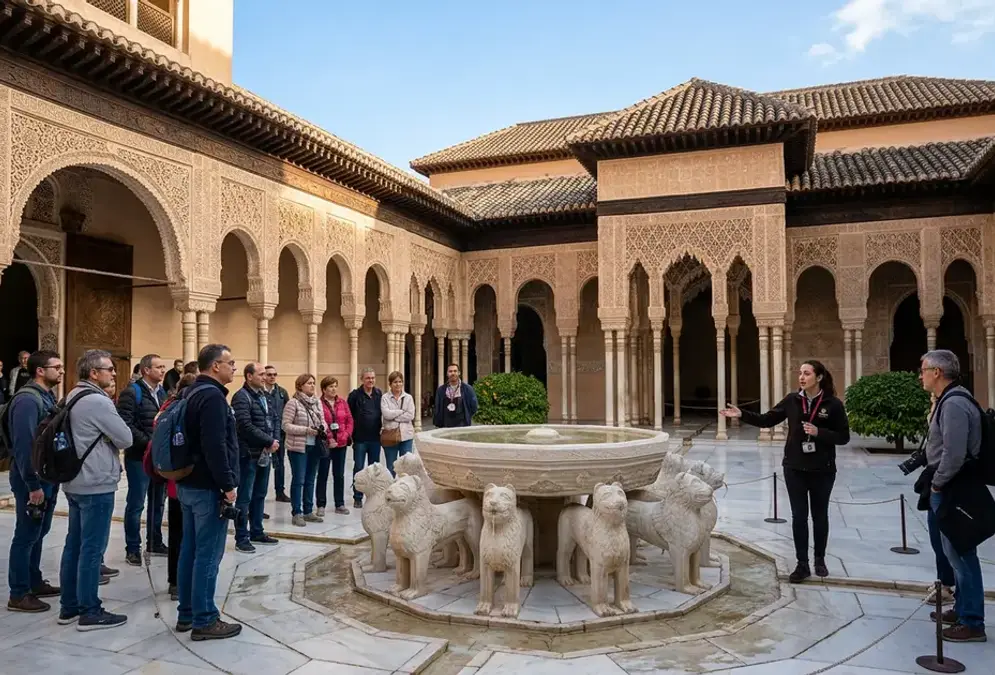
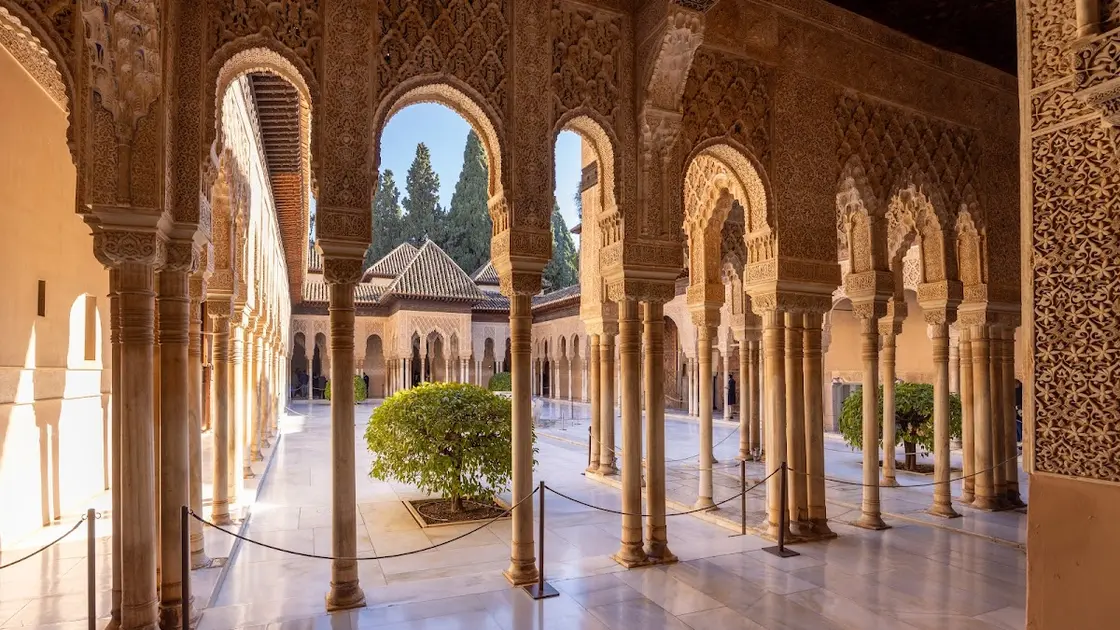
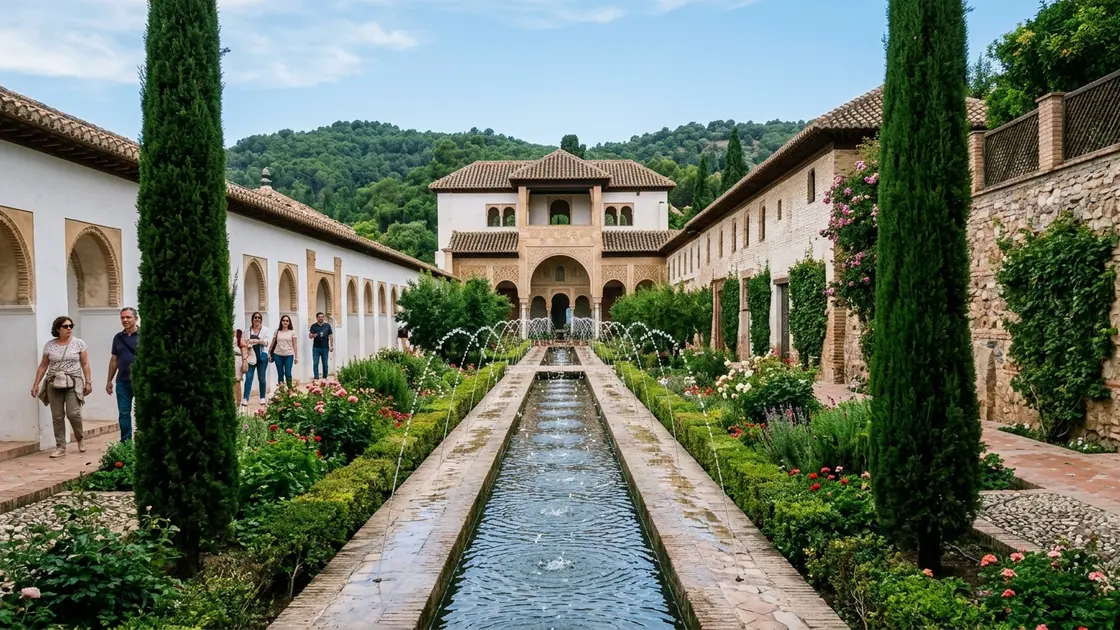
The ceiling's painted stars were originally coloured to simulate nacre, bone, and silver, the precise materials used in actual taracea inlay. That is not coincidence. Both crafts drew from the same Islamic geometric art vocabulary, the same star polygons, the same mathematical programme. The craftsmen who made taracea boxes and the craftsmen who assembled ataujería ceilings were working in the same tradition, toward the same geometric ideal, through different processes. Calling the Comares ceiling taracea collapses a meaningful distinction. Calling it unrelated to taracea misses the shared language entirely. The relationship is lineage, not identity.
Explore nearby · Monument
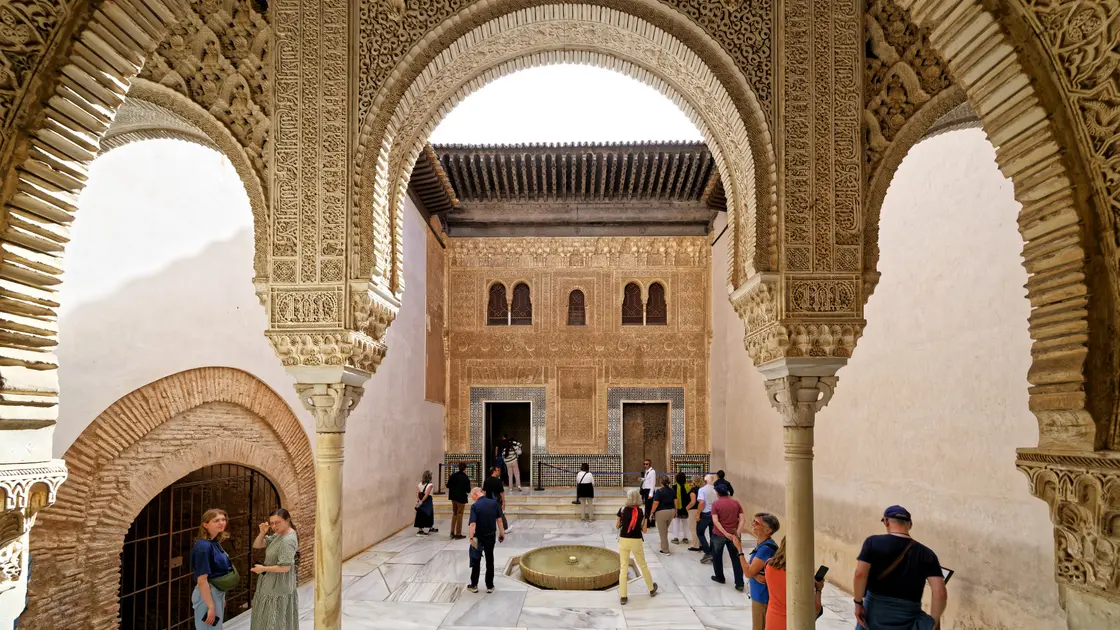
Alhambra
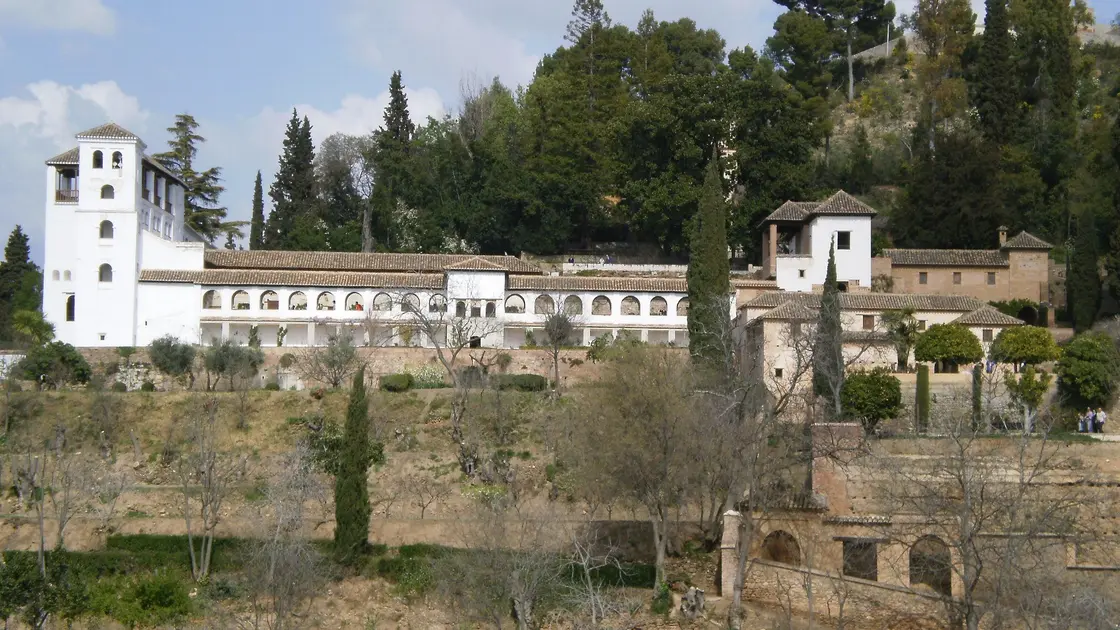
The Alhambra is Granada's UNESCO fortress-palace: Nasrid Palaces, Alcazaba and Generalife gardens. Tickets sell out weeks ahead; book via the Patronato site.
The geometry: Islamic aniconism and the mathematics of stars
Taracea patterns are not decorative choices. They are mathematical programmes derived from a specific principle of Islamic visual culture: the prohibition on depicting living beings in sacred or ceremonially significant contexts. Where European medieval craftsmen could fill a ceiling with biblical figures, Nasrid craftsmen were directed toward abstraction. The result was not a limitation. It was a forcing function for extraordinary mathematical sophistication.
The design vocabulary of taracea, ataujería, zellige tilework, and yesería plasterwork in the Alhambra is unified. All four draw from the same geometric alphabet:
- Octograma (eight-pointed star), formed by overlapping two squares at 45 degrees
- Twelve- and sixteen-pointed stars that carry the most complex patterns
- Hexagons, squares, and triangles filling the interstices between star forms
Each star pattern tiles a surface exactly, with no gaps and no residue, because the underlying geometry demands it.
The practical consequence for the taracea craftsman is that every dimension of every rod is mathematically determined before cutting begins. The angle of every face, the proportions of each element, the thickness of each layer have to produce the intended cross-section when sliced. A slight error in rod geometry does not produce a slightly imperfect pattern; it produces a pattern that fails to close. This is why genuine taracea requires years of training and why the rod-building stage is where master craftsmen concentrate their attention.
This shared geometric language explains why the Alhambra reads as unified despite being built over 150 years by different sultans with different architects. The same Islamic geometric patterns appear in the floor tiles, the dado mosaics, the wall stucco, the wooden ceilings, and the smaller decorative objects. A taracea box from a Granada workshop uses the same mathematical programme as the Comares ceiling 30 metres above the floor. The craft is not a smaller version of the architecture. Both are expressions of the same geometric system.
For a detailed guide to how muqarnas, zellige, and yesería work in the Alhambra's interior, the Nasrid architecture muqarnas guide covers the three-zone composition in the palaces room by room.
A craft surviving on skill: the workshops still making it
Multiple sources describe taracea as en peligro de extinción, a craft in danger of extinction.[6] The description is accurate. The skill requires three to five years of apprenticeship before a craftsman can produce work of consistent quality. The materials cost more than printed alternatives. The time required per piece is measured in days for small boxes and months for furniture. Against machine-made imports selling at a fraction of the price, the economics are difficult.
The workshops that survive do so through reputation and through the tourist market that values the genuine article. The Laguna family workshop on Calle Real de la Alhambra, the main road running through the Alhambra complex, represents four generations of continuous production and is among the most cited active operations in Granada. Artesanía González on Cuesta de Gomérez, the cobbled lane climbing from Plaza Nueva to the Alhambra gates, is another confirmed working workshop on the approach that visitors walk daily. Artesanía Beas, noted for Alhambra palace scenes assembled from bull bone, and Taracea Artesanía del Arbol in the city centre are additional active producers.
The geography matters for buyers. The stalls of Calderería Nueva in the Albaicín sell Moroccan and Chinese imports, not handmade Granada taracea. Alcaicería stalls are a starting point for understanding the range, not a destination for genuine craft. The workshops where pieces are actually made are on Cuesta de Gomérez, on Calle Real de la Alhambra, and in the streets immediately around the Alhambra complex.
Deep dive · Article
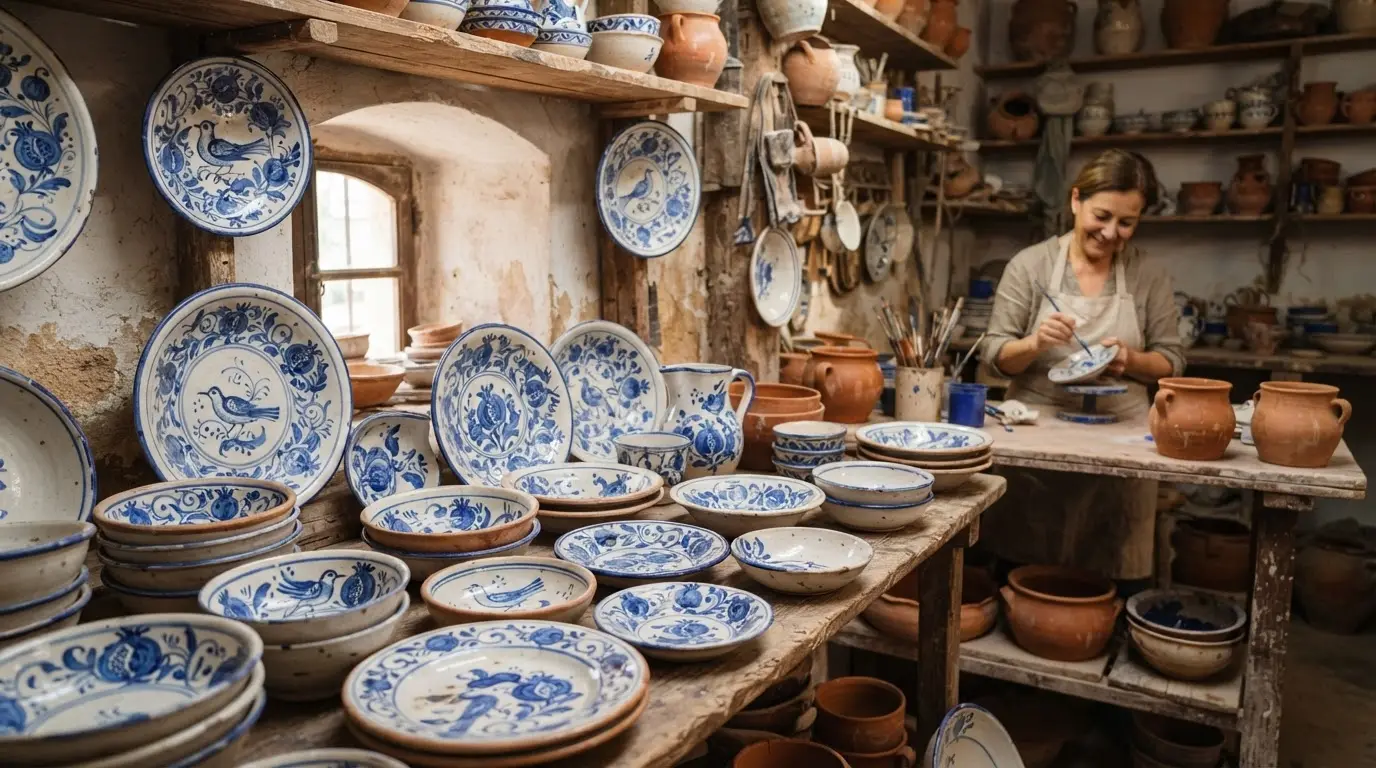
Fajalauza ceramics: Granada's 500-year pottery tradition
Fajalauza is Granada's 500-year pottery tradition: cobalt blue, pomegranate motifs, and one Albaicín workshop still hand-painting each piece since 1517.
Prices reflect labour. A small decorative box from a genuine workshop is not cheap; handmade work commands a significant premium over printed alternatives. Chess sets and backgammon boards are priced considerably higher again. Elaborate writing bureaux with secret compartments can take eighteen months to complete and are priced accordingly. A piece from any of the named workshops at a tourist-souvenir price should prompt immediate scepticism.
For the full comparison across craft types, including leather, Fajalauza ceramics, and guitars, the Granada artisan crafts guide covers the whole workshop trail with addresses and a practical authentication checklist.
What survives: heritage, heritage status, and the Museo de la Alhambra
Taracea has no specific UNESCO Intangible Cultural Heritage listing as a standalone craft. The Alhambra complex itself, which contains the greatest surviving collection of Nasrid geometric woodwork, is a UNESCO World Heritage Site (inscribed 1984, expanded 1994 to include the Albaicín), but that designation covers the built monuments, not the living craft traditions they express. Multiple sources describe taracea as part of Granada's patrimonio artesanal and include it in Junta de Andalucía craft registers, but no specific national protection designation was confirmed by available sources.
The most useful resource for visitors wanting to calibrate quality is the Museo de la Alhambra, inside the Carlos V Palace within the Alhambra complex. The museum holds historic taracea panels, Nasrid-period furniture, and architectural woodwork from the 13th to 15th centuries. Spending thirty minutes there before the workshop trail gives a fixed reference point: you will understand what the geometric patterns look like when the craft is operating at full technical range, and the gap between that and the tourist-grade imports in the Alcaicería becomes immediately apparent.
The Arab Baths (Baños del Bañuelo) near the Darro River and the Madraza on Calle Zacatín, both of which have survived largely intact from the Nasrid period, carry different surface decoration traditions but the same geometric vocabulary. The taracea craftsmen and the architects who built those spaces were drawing from a common mathematical tradition. Understanding one illuminates the other.
What remains is small in scale: a handful of workshops, a few master craftsmen, apprentices who may or may not continue the tradition. The craft has survived every disruption since 1492, the Reconquista, the Morisco expulsions, industrialisation, and the import economy, by remaining recognisably itself. A piece made in a Granada workshop today uses the same rabbit-skin glue, the same geometric rod system, the same star patterns as pieces made under the Nasrid sultans. That continuity is what the price pays for.