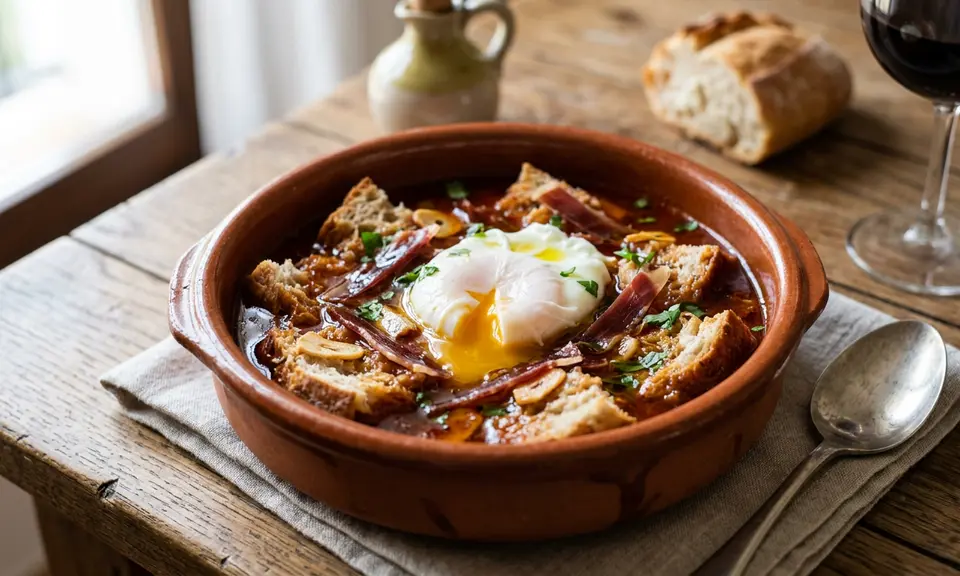
Most garlic soups in Spain are mild, brothish things. Granada's version is not. Sopa de ajo granadina starts where other versions stop: the pimentón goes in generous, the garlic comes from a full head, and the bread is torn and left to absorb rather than blended smooth. The result is dark, earthy, and filling in a way that makes sense when you think about who invented it.
This was medieval peasant food, made from whatever sat in the kitchen at the end of the week: pan duro (stale bread, which has no other use), garlic from the store, paprika from the drying strings above the door, olive oil, and water or cheap stock. A raw egg stirred in at the end, thickening slightly in the residual heat. Cheap, sustaining, and good in the cold.
The Granada difference
Sopa de ajo goes by different names across the country. In Castile, where the most famous version originates, it's usually called sopa castellana: lighter in colour, often made with chicken stock, a whole poached egg placed on top. Granada's version diverges in two respects worth knowing.
First, the pimentón. Granada uses both pimentón dulce (sweet paprika) and sometimes pimentón ahumado (smoked) in a heavier hand than anywhere north of the Sierra Nevada. The soup comes out deep terracotta, and the smokiness sits under everything else. Second, the egg. Rather than a poached egg resting intact on the surface, the Granada method stirs a raw egg directly into the hot soup just before serving. It sets in threads and wisps, thickening the broth without dominating it.
Optional additions — the PGI-protected mountain ham cut into thin strips, or a few slices of chorizo — go in during the frying stage, before the bread and water. Either one deepens the fat in the base. Without them, the soup is vegetarian; with them, it's a main course.
Where to eat it
Sopa de ajo is a winter dish and most bars and traditional restaurants in Granada treat it that way. From October through March, it appears on pizarras (chalkboard menus) across Centro and the historic hillside quarter. In summer, most kitchens drop it.
The bars around Mercado San Agustín, off Calle Pescadería, serve it as a cheap lunch plate, usually appearing as an early option on the fixed-price menú del día. In the Albaicín, the smaller family-run tabernas on Calle Elvira and around the lower end of the neighbourhood keep it on through the cold months. Ask for sopa de ajo and you'll know quickly whether you're in the right kind of place: a bar that doesn't make it in January is unlikely to be cooking much traditionally.
Avoid anywhere calling it "sopa castellana" with an elevated price. That framing usually signals a tourist-adjusted version. The real thing costs two or three euros as a tapa or around five as a ración.
How it's made
The process is forgiving and fast, which is part of the point. A wide clay cazuela or deep pan, olive oil heated until it shimmers, 6–8 peeled garlic cloves fried until golden (not brown — brown turns bitter). Add the pimentón off the heat for a few seconds, stir fast, then pour in water or chicken stock immediately before it scorches. Torn stale bread goes in next, enough to soak up the liquid without turning it to paste. Salt and a bay leaf, then fifteen minutes at a low simmer.
Just before serving, a raw egg is stirred in directly and the heat cut. The egg sets in the residual warmth over about ninety seconds. The result should be thick without being solid, dark red-brown, with visible pieces of softened bread.
Paired with migas granadinas, both dishes draw from the same pantry logic: stale bread as substance, pork fat or olive oil as the cooking medium, paprika for colour and depth. Together they map out what Granada's working population ate through the winter for several centuries.
History and the paprika thread
Pimentón arrived in Spain via the New World in the late 15th century and spread through Extremadura and then south into Andalusia over the following decades. Granada, which had maintained distinct culinary traditions from the Moorish period, absorbed the spice into dishes that already used garlic and olive oil heavily. The garlic soup is one of several Granada dishes where you can trace this layering: a medieval Iberian base (bread, garlic, oil) absorbing a post-Columbian addition (paprika) so thoroughly that the two are now inseparable.
Espinacas con garbanzos follows the same pattern: an old chickpea base, Moorish spice tradition, and later paprika. The sopa de ajo is a simpler version of that logic, requiring less time and fewer ingredients.
Practical notes
If you order sopa de ajo and it arrives pale and thin, the kitchen cut the paprika. It's not a bad soup, but it's not the Granada version. A proper bowl should be dark enough that you can't see the bottom of the cazuela.
The dish pairs with a dry Manzanilla from Sanlúcar de Barrameda or a light Rioja tinto served at room temperature. Beer also works, though the smokiness in the broth tends to flatten lager.
On the same cold-weather chalkboard, sopa de ajo granadina often sits next to choto al ajillo, Granada's braised kid goat, both built around the same generous hand with garlic.