Morcilla de Granada has nothing in common with the rice-stuffed sausages of Castile. The Granadan version is darker, denser, and laced with warm spices — cinnamon, cloves, cumin — that survived the end of Al-Andalus and got absorbed into the mountain charcuterie tradition that grew up after 1492. The aromatic sweetness you taste is not sugar; it is cinnamon and cloves in a pork-and-blood base, a combination that has no northern equivalent.
The base is pork belly, jowl, and fat, combined with blood and onions. Paprika and oregano go in alongside the warm spices. In the Alpujarras villages south of the Sierra Nevada, where production is most traditional, many butchers add pine nuts (piñones) or toasted almonds — a nut inclusion that has no equivalent in northern Spanish charcuterie. The warmth in the flavour is aromatic rather than sweet in the sugary sense; the cinnamon registers before the blood does.
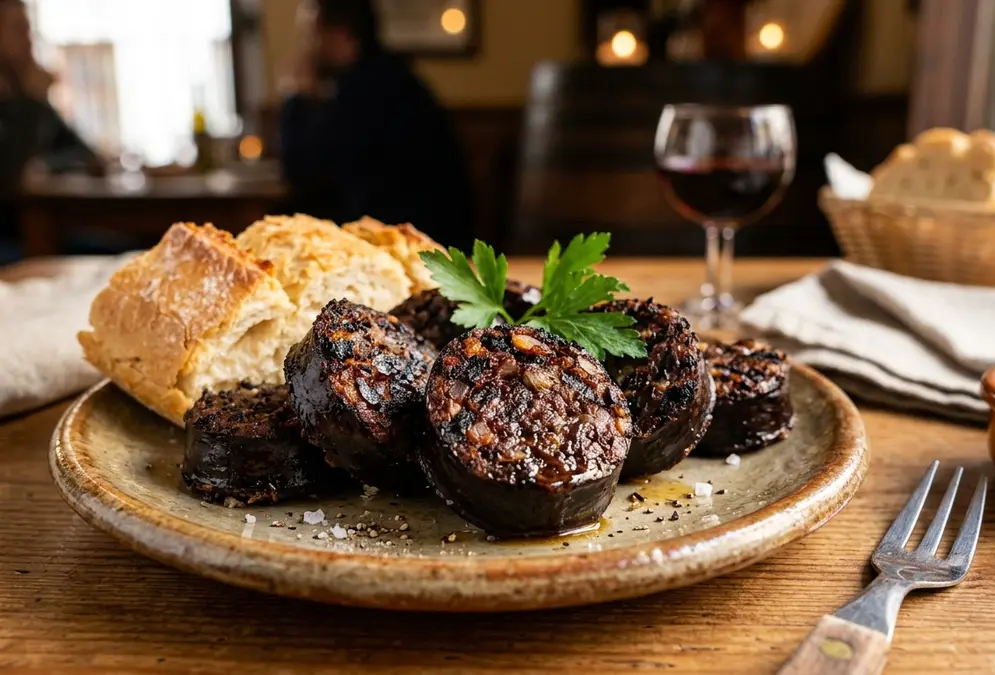
The texture is firm and finely ground. Unlike some rustic blood sausages, morcilla de Granada slices cleanly. Cooked on a griddle until the cut edges crisp up, the outside contracts slightly and browns; the interior stays dense and deeply coloured.
Where and how to eat it
Morcilla de Granada arrives as a tapa: three or four slices on a small plate, sometimes on toast, often alongside bread to soak up the rendered fat. In many traditional bars in the city centre, ordering a beer or a glass of wine brings a free tapa, and morcilla is one of the staples that rotates through the offering. You rarely choose it — it appears.
The Mercado de San Agustín, near the Cathedral on Gran Vía, has stalls and tapas bars where you can eat it standing at a counter any morning from eight onwards. The market is open Sunday to Friday until midnight and Saturday until 1am, making it one of the few places in the city where you can get serious local food at genuinely odd hours. The Alcaicería area, the old silk market quarter just off Plaza Bib-Rambla, has a handful of traditional tapas bars that serve it alongside jamón and chorizo.
Morcilla is the component of plato alpujarreño that divides people most cleanly. The platter combines it with mountain-cured Trevélez ham, chorizo, fried eggs, and potatoes cooked in olive oil — and the morcilla, with its spice profile, sits apart from the other ingredients rather than blending in. That contrast is the point. Order plato alpujarreño in a bar in Capileira or Pampaneira and the morcilla will be from a local producer; in Granada city, quality varies.
Origins in the Alpujarras
The Alpujarras are the mountain villages running along the southern slopes of the Sierra Nevada, between 900 and 1,600 metres above sea level. After 1492, when Granada fell to the Catholic Monarchs, the Moorish population that remained was pushed into these mountains. The spice patterns they brought with them into the sierra never entirely disappeared — they got absorbed into the charcuterie tradition that developed around pig farming at altitude.
Production is still concentrated in the villages and in the butcher workshops around Guadix, a town on the plain northeast of Granada that has its own morcilla tradition. Morcilla de Guadix is a close relative — same warm spice base, similar nut inclusion. The differences are subtle and argued about by people from each place.
For the full context of this sausage in its landscape — the white villages, the terraced hillsides, the cold air coming off the peaks — the day trip to the Alpujarras is worth making. You can buy morcilla directly from producers in Trevélez or Capileira and carry it home. That version, eaten the same day it was made, is a different thing from what you get at a city tapas bar.
Prices and the free-tapa system
Morcilla de Granada sits inside Granada's free-tapa culture. The city operates on a system where many bars bring a small plate automatically with each drink — no order needed, no extra charge. Morcilla appears on these plates throughout the day, from morning until late. In the centre and around the cathedral, you can eat it well for the cost of two or three beers. Expect to pay €2–4 if you order it separately as a tapa; as part of a plato alpujarreño, it is folded into the price of a €10–14 main course.
After a plate of morcilla, the same Albaicín bakeries and convent tornos that turn out dulces de convento are the traditional way to finish the meal on a sweet note.