First-time visitor guide
Granada's 9 essential sights
Alhambra tickets, the Albaicín at sunset, free tapas, and eight more reasons first-timers fall for Granada. What to see, in what order, and what the tourist board won't tell you.

Written by
James Walker Seven years resident in Granada. Specialist in Nasrid architecture, Al-Andalus history, and Andalusian walking routes.
Published
Granada has one sight that sells the city to the world: the Alhambra. And eight more that explain why people who came for a weekend end up staying a week. The free tapas alone rewire your understanding of what a city owes its visitors. The Albaicín, the best-preserved medieval Moorish quarter in Spain, requires no ticket and no tour. Sacromonte's caves are carved into the hill above the Darro river and still inhabited. You need to know where to go and, more importantly, when.
This guide covers nine sights in priority order for a first visit: prices, hours, booking requirements, and the specific things worth knowing that the official descriptions leave out. The Alhambra needs six to eight weeks' notice. The Corral del Carbón needs nothing but two minutes off the main street.
Jump to a section
1. Alhambra & Generalife
€22.27 · Monumental complex day ticket · Open daily (closed 25 Dec, 1 Jan) · Allow 3–4 hours
Book 6–8 weeks ahead — no exceptions in summer
Alhambra tickets sell out weeks in advance from April through October. The only official booking platform is tickets.alhambra-patronato.es. You must choose a timed entry slot for the Nasrid Palaces at purchase. Collect your ticket at least one hour before your slot — latecomers are not admitted. See the full Alhambra tickets guide for every option including same-day and night tours.
The €22.27 Monumental Complex ticket covers the Nasrid Palaces, the Generalife gardens, the Alcazaba fortress, and the Palace of Charles V. If the main complex is sold out, the Gardens-and-Generalife-only ticket (€12.73) covers the 13th-century royal summer retreat but not the palace interiors.
Summer hours run 08:30–20:00. Winter hours (15 October–31 March) are 08:30–18:00. Night tours of the Nasrid Palaces run Friday and Saturday in winter, Tuesday through Saturday in summer: same interiors, different light, a fraction of the crowd.
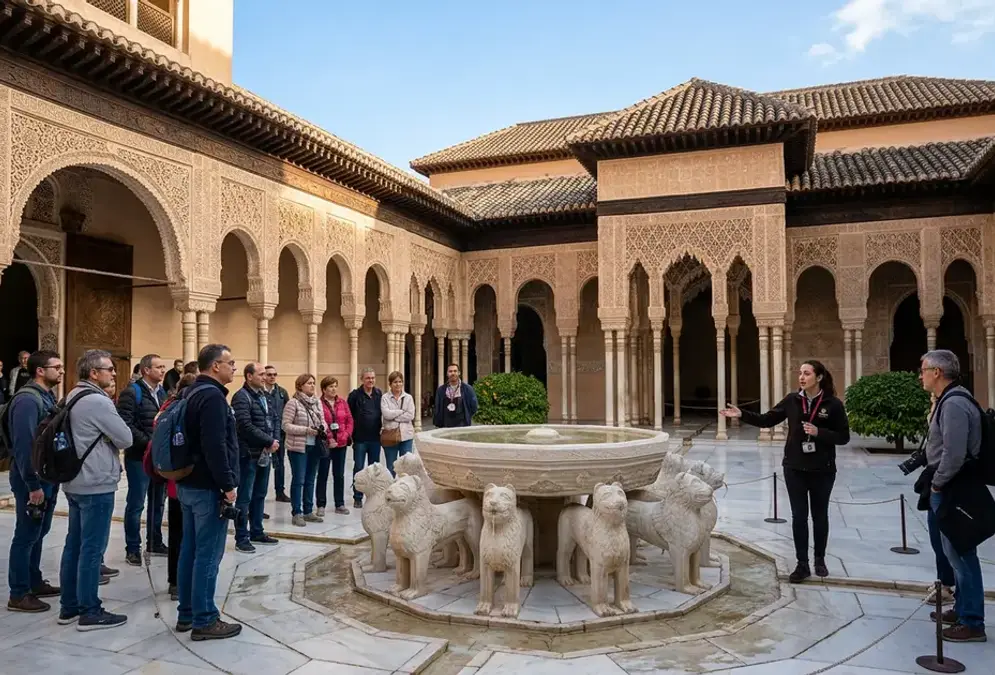
Inside the Nasrid Palaces, the Patio de los Leones (Court of the Lions) is the photograph everyone takes: 124 marble columns around a central fountain, each capital hand-carved. The Patio de la Acequia in the Generalife is a long reflecting pool flanked by fountains and hedged in box, where Nasrid rulers came for air and privacy. On the terrace above, the Sierra Nevada holds snow through late spring.
If daytime Nasrid Palaces slots are sold out, check the evening night tour (€12.73). The same interiors, half the people, different light. Book the tour the moment you see day tickets are gone — it sells faster than people expect.
2. Mirador de San Nicolás
Free · Open at all hours · Allow 30–45 minutes
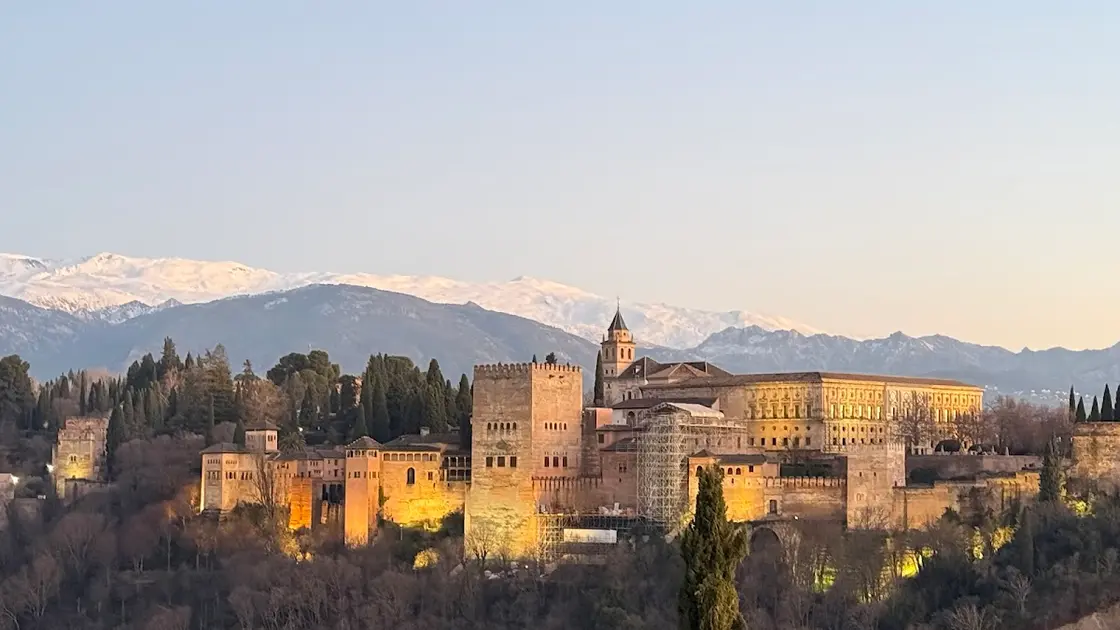
The Albaicín's hilltop terrace puts the Alhambra at eye level, the Sierra Nevada directly behind it, and the whole of the Darro gorge in between. This is the view that appears in every Granada photograph, and it earns its reputation. Come at sunset when the Nasrid towers go copper against the snow, but arrive 45 minutes early. The crowd triples in the last 20 minutes of golden hour and space at the railing disappears.
The mosque garden at the Mezquita Mayor de Granada, immediately adjacent to the mirador, offers a slightly elevated angle with less competition for space. It is the less-obvious position and gives a cleaner frame on the Alhambra's eastern towers.
Return just after sunrise when the plaza is almost empty. Morning light on the Alhambra reads warmer and softer than the afternoon version most visitors see. If your schedule allows one morning with nothing else planned, spend it here.
Getting there: climb Cuesta del Chapiz from the Paseo de los Tristes, or take the C31 minibus from Plaza Nueva (runs every 15–20 minutes). The walk from Plaza Nueva takes about 25 minutes up through the Albaicín lanes.
3. Albaicín neighbourhood walk
Free · Self-guided · Allow 1.5–2.5 hours
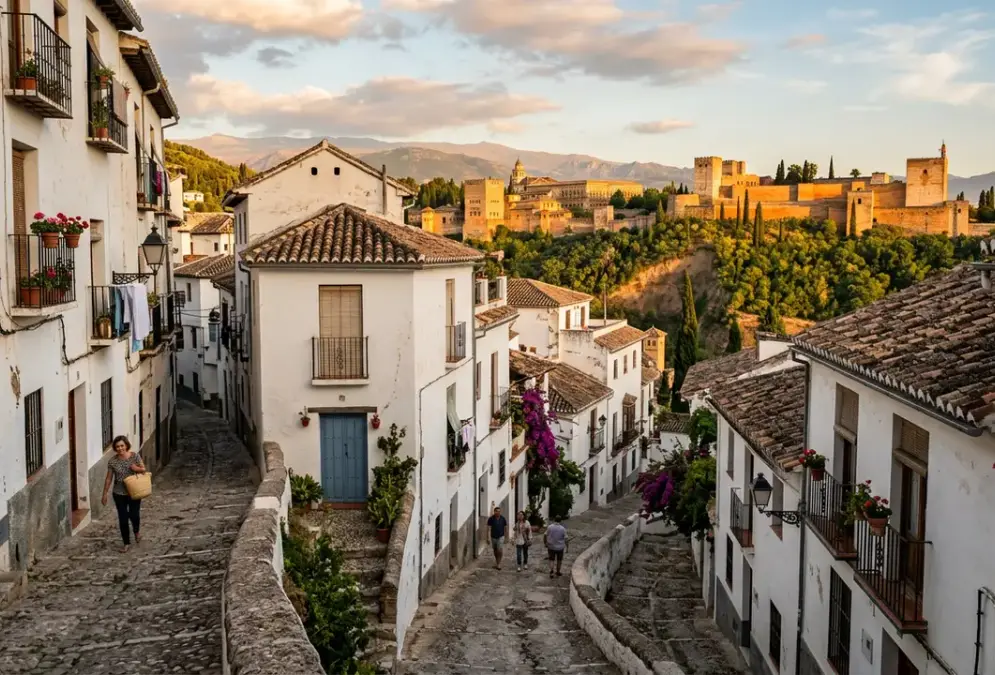
Granada's ancient Moorish quarter climbs the hill north of Plaza Nueva in a tangle of whitewashed lanes, Arab water cisterns (aljibes), and hidden carmen gardens behind high walls. The street plan dates to the 11th-century Zirid city, and the neighbourhood preserves it almost intact. It is a UNESCO World Heritage Site alongside the Alhambra, and unlike the Alhambra, it requires no ticket and no booking.
The standard route: Plaza Nueva → Calle Calderería Nueva → Placeta de San Gregorio → Calle del Agua → Plaza Larga → Mirador de San Nicolás. Calle Calderería Nueva is the street of teterías (Moroccan tea houses). Mint tea with pastries costs €3–5 and gives you a calm courtyard interior mid-walk. Do not skip it; the contrast with the lanes outside is sharp.
The Puerta de las Pesas arch near Plaza Larga is what remains of the medieval city gate. Most visitors walk past it without recognising it. The inscription above the arch dates to the 11th century.
For a complete street-by-street account of the quarter, the Albaicín guide covers the neighbourhood in detail including the best entry points and how to avoid the steepest climbs.
4. Sacromonte cave district
Free to walk · Zambra shows €25–€35 · Museum €5 · Allow 1 hour walk + 1.5 hours for a show
The hill above the Darro river is riddled with soft volcanic rock that Granada's gitano community has hollowed into homes for centuries. Sacromonte's cave dwellings are not a museum reconstruction. They are lived in. The hillside smells of woodsmoke in winter and wild herbs in spring. Walk the Camino del Sacromonte at dusk with the Alhambra lit to the south and cave facades warm against the fading sky: it is one of those Granada views that doesn't make it onto postcards but stays with you.
The neighbourhood is the birthplace of zambra, a percussion-driven, intimate style of flamenco unique to Granada's gitano caves, with a North African rhythmic ancestry that sets it apart from the tablao flamenco of Seville and Jerez. Shows run in actual cave venues seating 30–50 people, typically starting at 21:30 or 22:00. Prices run €25–€35 per person; book 1–2 days ahead in summer.
The venues further up the hill (Venta El Gallo, Cueva de la Rocío) tend to run smaller and more focused shows than the large commercial caves near the bottom of the path. Worth the extra 10 minutes' walk.
The Museo Cuevas del Sacromonte (€5, Tue–Sun) provides context on the cave-dwelling tradition and the gitano community's history on this hill. Open 10:00–14:00 and 17:00–21:00 in summer (17:00–19:00 in winter). For the full neighbourhood account, the Sacromonte guide covers routes, show bookings, and the museum in detail.
5. Granada Cathedral & Royal Chapel
Cathedral €10 / Royal Chapel €7 · Sold separately but adjacent · Allow 1.5 hours combined
The Cathedral of Granada is the first Renaissance cathedral built in Spain, begun in 1523 on the foundations of the city's Great Mosque. The interior is vast and cold in the deliberate way Renaissance architects used to signal power: grey stone columns, clerestory light, the scale calibrated to make you feel small. Come in the morning when the light hits the nave from the east.
Immediately adjacent, the Royal Chapel holds the tombs of Ferdinand and Isabella, the Catholic Monarchs who ended the Reconquista in Granada in 1492 and commissioned Columbus's voyage. The chapel's sacristy contains Isabella's personal art collection: 15 paintings she owned during her lifetime, including works attributed to Roger van der Weyden and Hans Memling. This room is consistently the most overlooked part of the visit.
Cathedral hours: Mon–Sat 10:00–18:15, Sun 15:00–17:45. Royal Chapel hours: Mon–Sat 10:00–18:30, Sun and holidays 11:00–18:00. Both are closed Good Friday, 25 December, and 1 January. The Royal Chapel offers free entry on Wednesdays 15:00–18:30 with prior reservation; book via capillarealgranada.com.
The audio guide included in the Royal Chapel ticket is genuinely useful on the sacristy paintings. Budget an extra 15 minutes there. The exterior of the Royal Chapel, seen from Plaza de Alonso Cano, has a plateresque carved portal that most visitors photograph from the inside approach and miss from outside.
The Royal Chapel guide covers both monuments in full including the sacristy art inventory.
6. Free tapas culture
€2–€3.50 per drink (food is free) · Lunch 13:00–16:00 · Evening 20:00–23:00
Granada is one of the last major Spanish cities where ordering a drink automatically brings a free tapa. Not olives. A plate, often hot, often substantial, changed with each round and chosen by the bar. The custom has disappeared almost everywhere else in Spain. Here it persists because enough bars still compete on tapa quality, not just drink prices. It is genuinely how locals eat lunch and dinner.
The mechanics: order a beer (caña), wine, or soft drink. A plate arrives unsolicited. Order another round, a different plate arrives. Three rounds each at two bars, spending €8–10 per person at each stop, covers a full evening of food. You do not choose the tapa. That is the custom: the bar decides what they are proud of that day.
Calle Navas and the streets around Plaza Nueva are the busiest zones, good for the atmosphere, though portion sizes can be modest at the most tourist-facing bars. Cross south into the Realejo (the old Jewish quarter) for a more local crowd, older clientele, and tapas that lean toward stew and fried fish over the standard jamón and chips. Bar competition in Realejo is fiercer and the portions show it.
The free tapas guide maps the best bars by neighbourhood, and the best tapas bars list picks the addresses worth crossing town for.
7. Hammam Al Ándalus
From €35 · 1.5-hour sessions · Daily 10:00–00:00 · Book ahead at granada.hammamalandalus.com
Beneath the Albaicín, steps from Plaza Nueva, the Hammam Al Ándalus is a reconstructed Arab bath complex built into the medieval street level. Horseshoe arches. Star-patterned skylights that cast moving light across the water. Three thermal pools (cold, warm, hot) in a sequence that follows the traditional hammam circuit of Nasrid Granada. It is the closest Granada comes to an experiential link with the medieval city rather than a visual one.
The baths-only session runs 1.5 hours (from €35). Massage add-ons start at €49 for 15 minutes. Sessions run every 2 hours from 10:00; the last session begins at 22:30. Mobile phones are not permitted inside.
Book the 10:00 or 12:00 morning session. These are consistently the least crowded. Friday and Saturday evenings attract larger groups and the atmosphere shifts accordingly. The hammam is adults-only. Book 1–2 weeks ahead in low season, 3–4 weeks in summer.
Address: Calle Santa Ana, 16. The arched entrance corridor makes a strong exterior photograph even if you are not visiting. The hammam guide covers session types, what to bring, and how it compares to the Albaicín's medieval Bañuelo baths.
8. Alcaicería silk market
Free entry · Daily 09:30–21:00 (fewer stalls Sunday morning) · Allow 20–40 minutes
Granada's former Arab silk exchange, once the largest market of its kind in al-Andalus, burned down in 1843 and was rebuilt in the 19th century. The current market is a reconstruction, not the original. That said, the atmosphere works: tight covered lanes, overhead lanterns, leather workshops, spice stalls, and ceramics. It sits between the Cathedral and Bib-Rambla square, five minutes from both.
Prices are not fixed. Negotiation is expected for anything beyond €10. Starting at 60–70% of the asking price is reasonable for larger purchases.
The item worth buying: Fajalauza pottery. Recognised by the blue and green floral motifs on a white ground, Fajalauza is a ceramic tradition specific to Granada's Albaicín neighbourhood, produced since the 16th century. Pieces from actual Fajalauza workshops look different from the mass-produced Moroccan imports that fill most of the stalls: the glaze is matte rather than glossy and the blue reads darker. Ask where it was made. The market also sells good linen and leather at fair prices if you negotiate.
The best photograph: stand at the north end of the main covered lane in late afternoon, shooting south with the lanterns lit. The low sun catches the coloured glass and the lane compresses nicely.
9. Corral del Carbón
Free · Mon–Fri approx. 09:00–20:00 · Allow 15–25 minutes
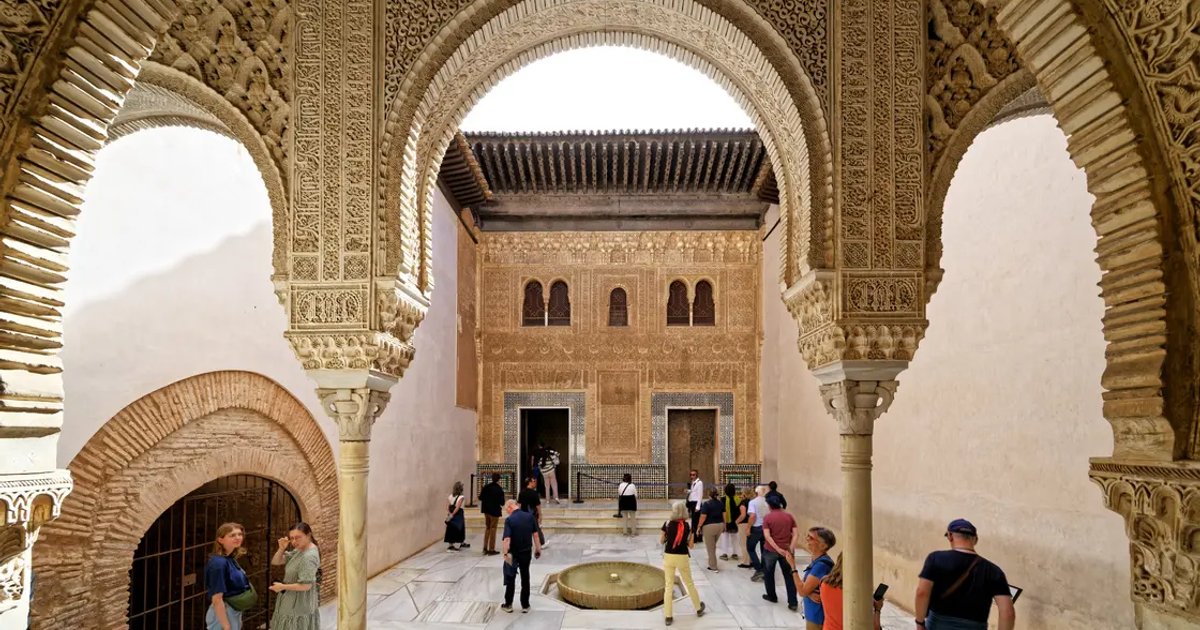
Two minutes from the Cathedral, through an entrance most people walk past without a second look, is the only surviving Nasrid caravanserai in Spain. Built in the 14th century as a merchants' inn and warehouse on the trade route through Granada, the Corral del Carbón has a triple horseshoe arched entrance and a galleried interior courtyard that is among the finest Nasrid civic architecture outside the Alhambra. It now houses a tourist office and hosts occasional cultural events.
Almost no tourists stop here. The Alhambra gets the crowds; the Corral gets the light. Come mid-morning on a weekday when the sun falls directly down through the open courtyard from above. Stand at the far end of the courtyard and look back at the entrance: the three horseshoe arches layer over each other in perspective and the courtyard walls provide clean, uncluttered negative space.
It costs nothing. It requires no booking. It is 2 minutes from the Cathedral and almost empty. This is the Granada that rewards people who pay attention.
Frequently asked questions
How far in advance should I book Alhambra tickets?
Book 6–8 weeks ahead for summer visits (July–August) and during Easter week. Tickets go on sale up to 3 months before your visit date on the official site (tickets.alhambra-patronato.es). Popular dates frequently sell out weeks ahead. If daytime slots are gone, check the night tour for the Nasrid Palaces (€12.73): the same interiors, smaller crowds, and dramatic lighting.
Do I really get a free tapa with every drink in Granada?
Yes. Granada is one of the few remaining Spanish cities where a free tapa accompanies every drink order. The tapa is chosen by the bar, not the customer, and changes with each round. Quality and size vary; bars in the Realejo neighbourhood and around Calle Navas are known for generous portions. See the full tapas guide for the best addresses.
Is the Albaicín safe to walk at night?
The Albaicín is generally safe for tourists at night, particularly on the main routes to Mirador de San Nicolás. The mirador itself stays busy until late with vendors and visitors. Side streets higher up the hill are quieter after 22:00; standard urban precautions apply.
Can I visit the Alhambra without booking in advance?
In theory, a limited number of same-day tickets are available at the ticket office from 07:30. In practice, these sell out immediately in peak season (April–October). Do not rely on walk-up tickets in summer. In November–February you have a reasonable chance of walk-up entry mid-week, but the Alhambra tickets guide covers your options in full.
What is zambra flamenco and how does it differ from regular flamenco?
Zambra is a flamenco style unique to Granada's gitano cave community in Sacromonte. It is more intimate and percussion-driven than the tablao flamenco of Seville or Jerez, with a stronger North African influence in its rhythmic patterns. Shows run in actual cave venues, typically seating 30–50 people, usually starting at 21:30 or 22:00. Prices run €25–€35 per person.
Is the Hammam Al Ándalus worth the price?
For most visitors, yes. The 1.5-hour circuit (from €35) gives you horseshoe arches, star-patterned skylights, and three thermal pools in a historically faithful setting. It contrasts well with the monument-heavy rest of the day. Morning sessions (10:00 or 12:00) are less crowded than evenings. Book at granada.hammamalandalus.com.
How long do I need in Granada to see the main highlights?
Two full days covers the essentials: Alhambra (half-day morning), afternoon Albaicín walk and Mirador de San Nicolás at sunset, tapas dinner. Day two: Cathedral and Royal Chapel (morning), Alcaicería and Corral del Carbón (mid-morning), Sacromonte walk and hammam (afternoon and evening). A third day allows for a zambra flamenco show and more relaxed pacing.
Recommended Tours & Activities
Tours are selected for quality, not commission. We earn a small fee if you book — at no extra cost to you.
Best Seller
Top Rated
Alhambra & Nasrid Palaces Skip-the-Line Guided Tour
Skip the queue and explore the full Alhambra complex — Nasrid Palaces, Alcazaba fortress, and Generalife gardens — with a licensed local guide.
Skip the line 3 hours
€45
4.7 (23,651 reviews)
Reserve Your Spot
✓ Verified GetYourGuide reviews
Books up weeks ahead in peak season
Albaicín & Sacromonte Walking Tour with Flamenco Show
Guided walk through UNESCO World Heritage neighbourhoods — the whitewashed Albaicín and Sacromonte cave district — followed by a live zambra flamenco performance.
3 hours
€39
4.8 (1,750 reviews)
Reserve Your Spot
✓ Verified GetYourGuide reviews
Flamenco Show at Jardines de Zoraya, Albaicin
Live flamenco at Jardines de Zoraya in the Albaicin, an intimate tablao where the dancers perform an arm's length from the front row.
1 hour
€25
4.7 (1,529 reviews)
Reserve Your Spot
✓ Verified GetYourGuide reviews