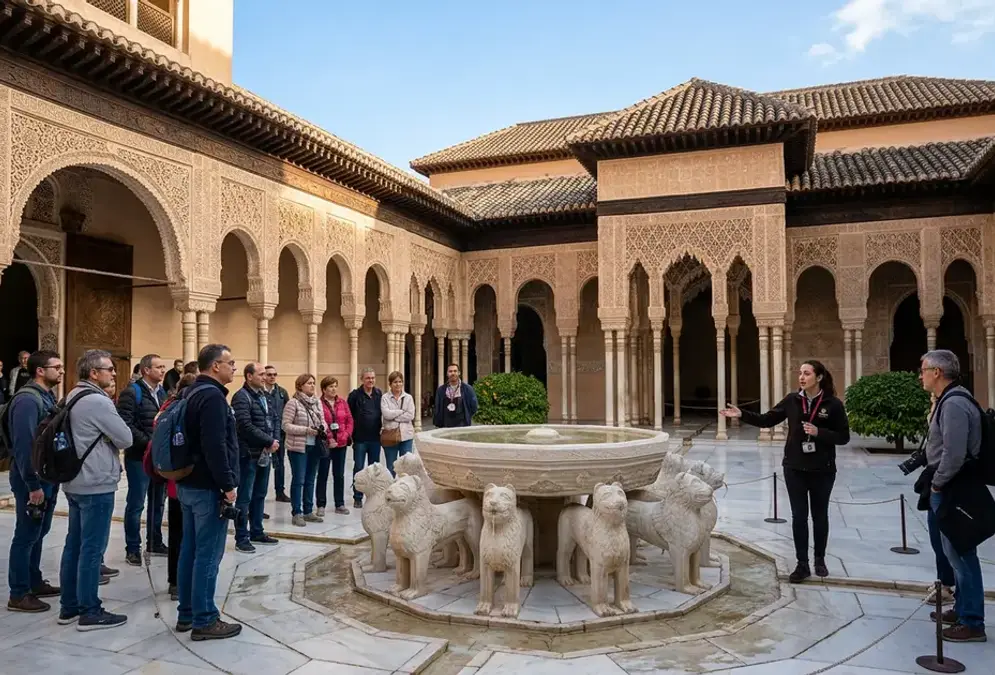
A civil ceremony inside the Alhambra. A carmen garden on the Albaicín hillside. The Parador — the only hotel inside the palace walls. Granada has wedding venues that exist nowhere else.
Seven years resident in Granada. Specialist in Nasrid architecture, Al-Andalus history, and Andalusian walking routes.
Updated Published
Most couples considering a destination wedding picture Tuscany or Santorini. Fewer think of Granada, which means less competition for the venues that matter. A civil ceremony inside the Alhambra requires 18 months of planning and €3,000–5,000 in venue fees — but it takes place in a 13th-century Nasrid palace, and there is nowhere else in Europe where that sentence is true.
The city also offers something more achievable: carmen houses. These walled garden estates on the Albaicín hillside and below the Alhambra walls have been the setting for Granada's most important celebrations since the Moorish period. Some are privately owned and rentable. The city-owned Carmen de los Mártires costs around €1,500. Carmen de los Chapiteles, 80 metres below the Generalife, has the Alhambra framed behind the ceremony site.
This guide covers every serious venue option, what each costs, the legal process for foreign couples, and the booking timelines that actually reflect how hard these venues are to secure. Once the venue is booked, our guide to Granada for couples is a good source of ideas for the days either side of the ceremony.
Granada wedding: at a glance
Alhambra booking
18 months ahead
Alhambra venue fee
€3,000–5,000
Carmen de los Mártires
~€1,500
Legal process time
3–6 months
Peak months
June, Sept–Oct
Mid-range total
€12,000–20,000
Jump to a section
⌄
Why Granada for a destination wedding
Granada has three things that comparable Andalusian cities do not. The Alhambra: a 13th-century palace complex that the Spanish government permits for civil ceremonies, in small numbers, with long lead times. A specific vernacular architecture — the carmen — that provides intimate walled-garden settings impossible to replicate elsewhere. And the Parador de Granada, the only hotel physically inside the Alhambra walls, which operates as both ceremony venue and guest accommodation in the same building.
The city itself is compact enough that wedding guests can walk between ceremony, cocktail hour, and reception without transport logistics. The Albaicín is ten minutes from the Alhambra on foot. Paseo de los Tristes — the riverside promenade below the palace walls — works as a cocktail location without any booking at all. Late June evenings stay light until 10pm.
The honest caveat: Granada weddings require more lead time and more paperwork than comparable venues in France or Italy, particularly for non-Spanish couples. The legal process alone takes 3–6 months. The Alhambra ceremony calendar is controlled by a single administrative body (the Patronato de la Alhambra), and it does not operate a public enquiry system. Most of the couples who pull this off use a Granada-based planner as the primary point of contact with both the Patronato and the Registro Civil.
The Alhambra ceremony
Civil ceremonies in a 13th-century Nasrid palace. Extremely limited permits. Requires 18 months planning and a planner with Patronato contacts.
Carmen house estates
Walled garden villas on the Albaicín and Alhambra hillsides. City-owned options from €1,500. Private rentals €2,000–5,000 per day.
Compact geography
Ceremony, cocktail hour, and reception within 15 minutes' walk. Guests experience the city as part of the event, not just a backdrop.
Alhambra civil ceremonies
Civil weddings inside the Alhambra are administered by the Patronato de la Alhambra y Generalife, the government body that manages the complex. The number of ceremonies per year is tightly limited — this is a UNESCO World Heritage Site that receives over 2 million visitors annually, and the Patronato balances private events against the site's preservation obligations. Permits are not publicly advertised; they are allocated through an application process that your planner initiates with the Patronato directly.
The venue fee runs €3,000–5,000 and covers access to the ceremony space; catering, decoration, and any other services are arranged separately. The Patronato specifies which areas of the complex can be used for ceremonies (generally the palace gardens and terraces adjacent to the Nasrid Palaces, not the interior rooms), and rules on decoration — no permanent fixtures, no open flames near the walls — are strict. Expect the ceremony itself to last 30–45 minutes with the space secured for a total of 2–3 hours.
Booking timeline: plan for 18 months between first enquiry and ceremony date. Twelve months is the absolute minimum and leaves little room for date flexibility. June and September dates go first.
If the civil ceremony inside the complex is not possible, the grounds around the Generalife gardens and the adjacent terraces below the palace walls offer symbolic ceremony locations with the same visual impact. Some planners route the civil paperwork through the Registro Civil separately and hold the wedding celebration as a symbolic event on Alhambra grounds — the guests see the same thing.
Alhambra ceremony logistics
Enquire through a Granada-based wedding planner (not direct to the Patronato as a first step — they will route you back to a planner anyway). Your ceremony date needs to be confirmed before you book guest accommodation, since the Alhambra's calendar is fixed and guest hotels book up quickly for June/September. The Patronato website (alhambra-patronato.es) lists general event enquiry contacts.
Carmen houses
A carmen is a walled garden estate, a building type specific to Granada. The name likely derives from the Arabic karm (vineyard). The classic carmen sits on the hillsides of the Albaicín or the slopes below the Alhambra: whitewashed walls, a single gate onto a narrow street, and inside a private world of fountains, hedges, rose gardens, and terraced views over the city. They were the summer houses of Granada's Moorish elite, then its Christian successors, then its bourgeoisie. Some have been weddings venues for decades.
Carmen weddings suit smaller parties — most properties seat 60–120 comfortably for dinner, a few up to 200 for standing receptions. What they offer is intimacy and exclusivity: your wedding is the only event at the property that day, the garden is yours entirely, and from most of them the Alhambra towers are visible above the walls.
Carmen de los Mártires
City-owned property on the Alhambra hill, five minutes below the palace gates. The best-value serious wedding venue in Granada at around €1,500 for a full-day booking. The grounds include a French parterre garden, a lake area, and an esplanade suitable for dinner seating. Capacity for reception-style events runs close to 200 people. Ground-floor salons serve for civil ceremony signing. The city's tourism and events office handles bookings; June and September fill 8–12 months ahead.
A private carmen 80 metres below the Generalife gardens. The ceremony terrace looks directly up at the Alhambra towers, which makes it the most photographically obvious choice among Granada's carmen venues. The property is privately managed; pricing is in the €2,000–4,000 range for venue hire. It suits smaller weddings (up to 80–100 guests for a seated dinner) and is particularly popular for the afternoon ceremony + golden-hour photographs combination — the Alhambra light is best between 7pm and 9pm in summer.
Carmen de Cortes
In the heart of the Albaicín quarter, with what many planners describe as the clearest sightline to the full Alhambra complex of any carmen property. Better suited to elopements, vow renewals, and small weddings (under 40 guests) than large receptions. The narrow Albaicín lanes around the property limit guest transport and catering delivery; this is part of the charm and part of the constraint.
Private vs city-owned carmen
City-owned properties (Carmen de los Mártires) cost less but have more bureaucratic booking processes and fewer customisation options. Private carmenes cost more but give the couple more control over suppliers, set-up time, and decoration. If budget is tight, Carmen de los Mártires is the correct choice. If visual impact is the priority and the guest list is under 100, Carmen de los Chapiteles is worth the price difference.
Historic hotels
Two hotels in Granada justify serious consideration as wedding venues beyond just guest accommodation.
The Parador sits inside the Alhambra walls, occupying a 15th-century convent built by the Catholic Monarchs over the ruins of a Nasrid palace. It is the highest-prestige wedding venue in Granada and, by the measure of setting, one of the most extraordinary in Spain. The cloistered courtyard works for ceremony; the dining rooms seat up to 120 guests. Guest rooms face either the garden or the Alhambra towers. The wedding coordination team is in-house.
Pricing runs considerably higher than the carmen alternatives. Budget a minimum of €20,000 for the venue and catering alone before external suppliers. The advantage — that your guests sleep inside the Alhambra grounds and walk to both ceremony and reception without leaving the complex — is real and impossible to replicate.
A contemporary four-star property in the city centre with event spaces for larger weddings (up to 200–250 guests). Less character than the Parador or a carmen, but more practical for large parties: modern catering facilities, flexible room configurations, on-site accommodation for the majority of guests. A reasonable choice when the priority is guest logistics over historical atmosphere.
Legal requirements for foreign couples
Getting legally married in Spain as a foreign national requires navigating the Spanish civil registration system. The process takes 3–6 months and involves document gathering, translation, and filing — all before the ceremony date. Some couples complete the legal marriage in their home country and hold a symbolic ceremony in Granada; that route avoids the Spanish bureaucracy entirely and is increasingly common among destination wedding couples.
Apostilled documents
Both partners must provide passports and birth certificates certified with an apostille under The Hague Convention (1961). This is the international seal that Spanish authorities accept as proof of authenticity. The apostille is issued by the relevant national authority in your home country — in the UK, this is the Foreign, Commonwealth and Development Office (FCDO); in the US, the state Secretary of State's office. Allow 2–4 weeks for apostille processing.
Sworn Spanish translation
All apostilled documents must be translated into Spanish by a traductor jurado (sworn translator) — a translator registered with Spain's Ministry of Foreign Affairs. Your Spanish wedding planner can recommend one. Standard turnaround is 3–5 working days. The translator's stamp and signature are what the Registro Civil accepts; unofficial translations are rejected.
Registro Civil (Civil Registry) process
The translated documents go to the Granada Registro Civil (Calle Duquesa de Parcent) to initiate the expediente matrimonial (matrimonial file). A Registro Civil examiner reviews your documents and both partners must attend an appointment in person or through a legal representative (apoderado). Once approved — which typically takes 2–4 months after submission — the Registro Civil issues a licence for the civil ceremony to proceed. The ceremony itself is officiated by a civil registrar or judge.
Start the paperwork before booking the venue
The temptation is to secure a venue first, then sort the paperwork. Reverse this: confirm your document timeline and Registro Civil appointment before paying any venue deposit. If delays push your Registro Civil approval past your ceremony date, you have a venue but no legal marriage. Planners familiar with the process will tell you the same thing.
Costs and what to budget
A mid-range Granada wedding for 60–80 guests typically comes in between €12,000 and €20,000. That range covers the ceremony venue, catering, photographs, flowers, music, and a planner — but not guest accommodation or travel. Here is how the budget breaks down.
Venue hire
Carmen de los Mártires ~€1,500 / private carmen €2,000–5,000 / Parador €8,000+
Catering
€60–120 per person, including drinks. 80 guests at €80 = €6,400.
Photography
€1,500–3,000 for a local wedding photographer. Golden-hour shoots on carmen terraces are standard.
Flowers and decoration
€1,500–3,000. Carmen gardens already provide significant visual structure; floral decoration can be restrained.
Music
€800–1,500 for a flamenco duo or string quartet for the ceremony. Live music for the reception runs higher.
Wedding planner
€1,500–3,500. For Alhambra ceremonies or complex legal requirements, a local planner is not optional.
For comparison: a Tuscany wedding at a comparable venue and guest count typically runs €18,000–30,000. The Granada figure is lower partly because local catering and service costs are below Italian equivalents, and partly because the city-owned venues (Carmen de los Mártires, some municipal spaces) have no commercial margin built in.
When to marry in Granada
June, September, and October are the months most professional Granada planners recommend. June gives long evenings (sunset after 9:30pm), stable dry weather, and temperatures that are warm without being punishing — 26–30°C during the day drops to 18–20°C in the evening, which is ideal for an outdoor reception. September is the compromise choice: slightly cooler, fewer tourists competing for hotel rooms, and the light in the evenings has a quality that photographers notice — the low autumn sun on the Alhambra stone in late afternoon is different from summer.
July and August are hot. Daytime temperatures reach 35–40°C; outdoor ceremonies before 7pm are uncomfortable for guests. Evening receptions work, and both the Alhambra and most carmen gardens provide shade, but it requires careful scheduling. If your guests are flying from northern Europe or North America, August heat will be the first thing they mention in feedback.
April and May are underused. The city is cooler (18–22°C), the Generalife gardens are in full rose bloom, and hotel prices are lower than peak summer. The risk is rain — April in Granada gets 8–10 rain days per month on average. Most carmen and hotel venues have covered backup spaces, but the open-air ceremony you planned may move under a canopy.
Reporter notebook
What couples who've planned this know
Practical observations gathered the way a local journalist would keep them: short, specific, and more useful than brochure copy.
Booking tip
The Alhambra calendar books on relationships, not on waiting lists
The Patronato de la Alhambra does not run a public wedding enquiry system. Securing an Alhambra civil ceremony almost always requires a Granada-based wedding planner with an established Patronato contact. Ask any planner at initial consultation whether they have confirmed Alhambra ceremonies on their recent portfolio. If they hedge, keep looking. Give yourself 18 months minimum from first enquiry to ceremony date — 12 months is cutting it close for popular months.
Money tip
Carmen de los Mártires is city-owned — a fraction of the private carmen price
Carmen de los Mártires sits on the Alhambra hill, five minutes' walk below the palace gates. As a city-owned property, it rents at around €1,500 — roughly one-third of what a private carmen charges. The grounds include a French garden, esplanade for dinner seating, and an upper terrace. Capacity runs to 200 for a standing reception. The city tourism office handles bookings; enquire early as the venue sells out June and September 8–12 months ahead.
Local custom
A symbolic ceremony bypasses the paperwork — most guests cannot tell the difference
If completing the Spanish Registro Civil process (3–6 months of apostilled documents, sworn translations, official filings) sounds like a second job, consider marrying legally at home and holding a symbolic ceremony in Granada. A local celebrant, a carmen garden, and a well-chosen August evening: your guests experience the same thing either way. Photography is identical. The only difference is that the Granada marriage itself has no legal standing — which matters to you but is invisible to everyone watching.
Frequently asked questions
Can you get married at the Alhambra?
Yes, but the permits are extremely limited. Civil ceremonies inside the Alhambra require booking 1–2 years in advance, and the venue fee alone runs €3,000–5,000. The Patronato de la Alhambra controls the calendar and does not operate a public waiting list. Most couples go through a Granada-based wedding planner with established Patronato contacts. If the civil ceremony itself cannot be secured, symbolic ceremonies and private photo sessions in the surrounding gardens remain possible — and are often visually identical to guests.
What is a carmen house and why do couples choose them?
A carmen is a traditional Granada estate: a whitewashed villa with enclosed garden walls, typically on the hillsides of the Albaicín or at the foot of the Alhambra. The garden walls block street noise; inside you find fountains, cypress trees, and in some properties a direct sightline to the Alhambra towers. Carmen de los Mártires (city-owned, around €1,500) and Carmen de los Chapiteles (80 metres below the Generalife, with Alhambra views from the ceremony site) are the two most-booked. Private carmen rentals run €2,000–5,000 per day.
What documents do foreign couples need to marry in Granada?
Both partners need apostilled identity documents — passports and birth certificates, certified by the issuing country under The Hague Convention. These must be translated into Spanish by a sworn translator (traductor jurado). You then apply to the Granada Registro Civil (Civil Registry) to begin the matrimonial file (expediente matrimonial). Processing takes 3–6 months. Some couples complete the civil ceremony in their home country and hold a symbolic ceremony in Granada to sidestep the Spanish process entirely; that option is faster but the marriage itself is not registered in Spain.
What does a mid-range Granada wedding actually cost?
For a wedding of 60–80 guests: venue €1,500–5,000, catering €60–120 per person (€4,800–9,600 for 80 guests), flowers and decoration €1,500–3,000, photographer €1,500–3,000, music €800–1,500, planner fees €1,500–3,500. Total lands between €12,000 and €20,000. That is comparable to a mid-range UK or US wedding, but the setting — a restored carmen with Alhambra views — is not comparable to anything those countries offer at the same price.
Is the Parador de Granada available for weddings?
Yes. The Parador de Granada, a 15th-century convent inside the Alhambra walls, is the highest-prestige venue in the city. It has its own wedding coordinator and can accommodate ceremonies in the cloistered garden and receptions in the historic dining rooms. The price tier is well above other venues; budget a minimum of €20,000 for a modest celebration before catering. The advantage: your guests spend the ceremony inside the Alhambra grounds, which no other hotel in Granada can offer.
What is the best month to get married in Granada?
June, September, and October are the most popular months among couples planning Granada weddings. June offers long evenings, warm temperatures (26–30°C), and low rain probability. September is cooler after August heat and the light in the evenings is exceptional. October drops to 20–24°C, which makes outdoor receptions comfortable, and tourist crowds thin out. July and August are hot (35–40°C during the day); outdoor ceremonies in full sun are uncomfortable, though the Alhambra grounds provide shade. April and May work well if the ceremony is in the late afternoon.
Recommended Tours & Activities
Tours are selected for quality, not commission. We earn a small fee if you book — at no extra cost to you.