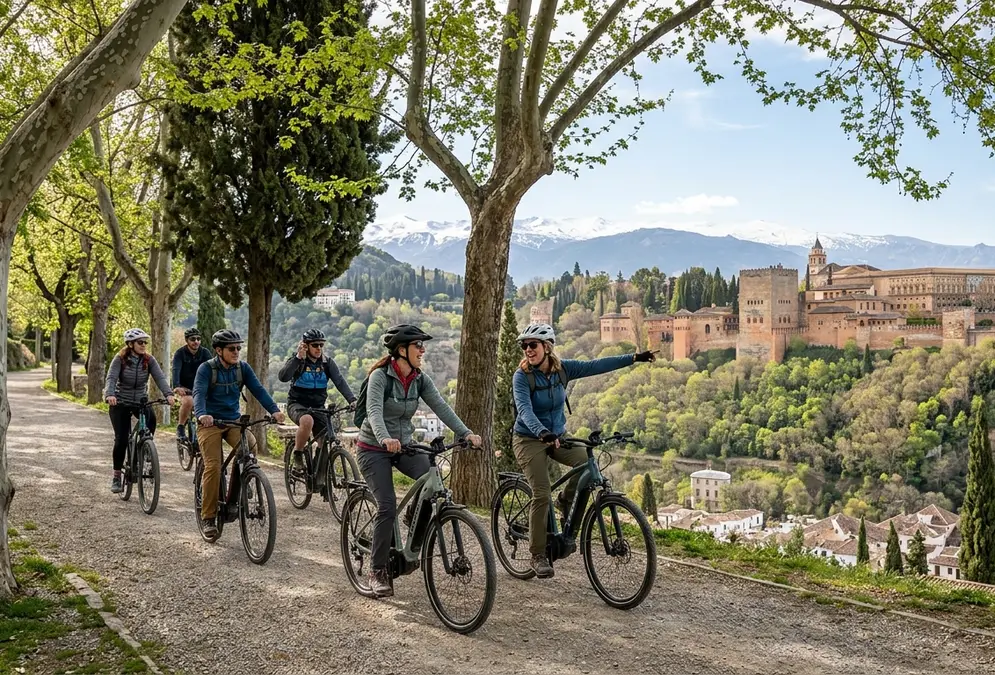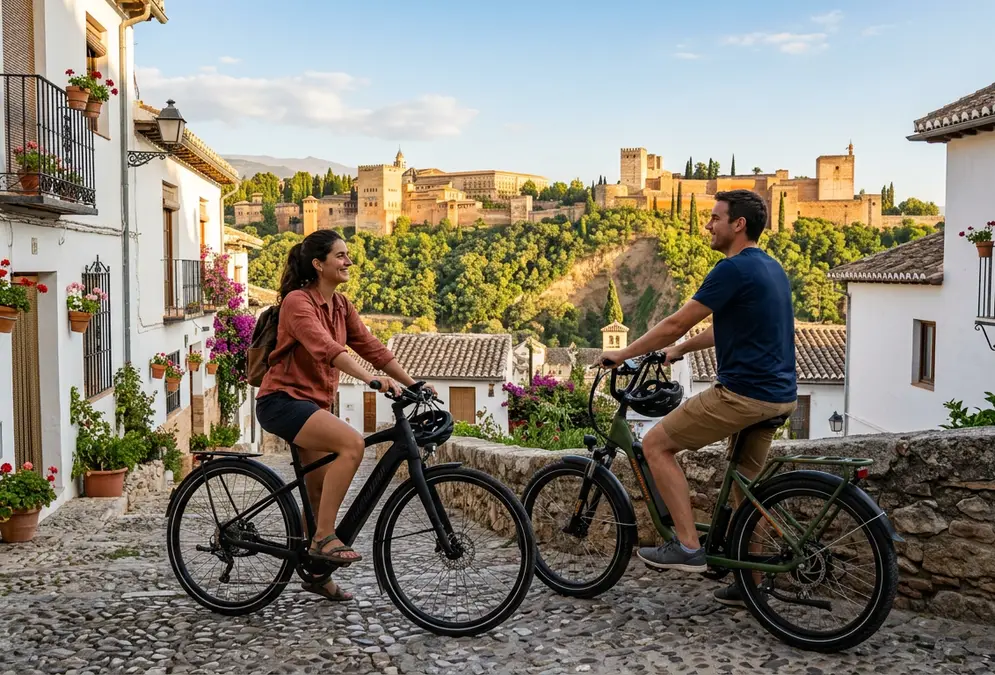
The Albaicín and Sacromonte sit on two adjacent hillsides above the Darro, and the gradients that make them beautiful on a postcard are the same ones that defeat most visitors by midmorning. The streets climbing toward Mirador de San Nicolás hit 15–20% in places. The cobblestones are uneven. In July, the walls reflect the heat back at you. An e-bike changes what's possible: the motor handles the ascent, you arrive at the viewpoint dry, and the guide can take you past the landmarks a solo walker would miss entirely.
Why two neighbourhoods need three hours
The Albaicín and Sacromonte look close on a map but they're distinct in character and separated by a ridge that's awkward to cross on foot. The Albaicín is the city's Moorish quarter, designated a UNESCO World Heritage Site in 1994, with narrow lanes laid out in the 11th century under the Zirid dynasty and expanded by the Nasrid sultans into a neighbourhood of 100,000 people by the 14th. Sacromonte is something else entirely: a Romani settlement established in the 16th century after the 1492 Christian conquest, where generations of families dug cave dwellings, called cuevas, into the white rock of the hillside. The caves are still occupied. Flamenco has been performed inside them for five centuries.
A three-hour e-bike tour covers both, with time to stop properly at each. Two hours would rush the detours that make the difference: Plaza Larga, the Renaissance landmark of Casa del Chapiz, the Sacromonte Abbey on the hill above the caves.
What the route covers
Most tours pick up the route at Plaza Nueva and enter the Albaicín from the south, climbing through Paseo de los Tristes. The first significant pause is Plaza Larga, the quarter's old market square, which reads more like a neighbourhood piazza than a tourist stop. From there the route pushes uphill to the Mirador viewpoint, the viewpoint that frames Granada's Nasrid citadel directly across the valley at eye level with the Sierra Nevada behind it.
The second mirador is less known. Mirador de San Miguel Alto sits higher than San Nicolás and offers a panoramic sweep over the whole city: the Alhambra, the Vega plain to the west, and on a clear day the Sierra Nevada to the southeast. The crowds that pack San Nicolás at golden hour don't usually make it this far.
From there the route drops east into Sacromonte. The cuevas cut into the hillside are not a museum recreation — the white-rock cave fronts are the actual homes and performance spaces where zambra flamenco has been danced since the 16th century. The guide gives context that the facades alone don't provide: the history of the Romani community, the pre-1492 layers underneath, why the caves stayed occupied while the city around them changed. The Sacromonte Abbey, visible from the ridge above, closes the loop before the descent back to the city centre.
The e-bike case
Sacromonte's main track, the Camino del Sacromonte, climbs at 12–15% for nearly a kilometre. The streets around Plaza Larga in the Albaicín are steeper still. On a standard bicycle, both sections require dismounting and pushing. On an e-bike with pedal assist, you stay on the saddle, maintain a conversational pace with your guide, and arrive at each stop composed rather than sweating. The wider tyres on tour e-bikes handle cobblestones and uneven surfaces without the jarring that would make the same route uncomfortable on a road bike.
No prior cycling experience is required. The motor removes the fitness barrier entirely. The same tour suits a 65-year-old who hasn't cycled in years and a fit 25-year-old who wants to cover more ground in less time. Minimum age is typically 12 years old. Not suitable for visitors with mobility impairments: the terrain involves cobblestones, slopes, and steps in the cave district.
What's included and what to bring
The tour price (from €45 for a standard three-hour group tour) includes the e-bike, a safety helmet, and a knowledgeable local guide. Groups are typically 6–10 people. The tour is conducted in English and Spanish; some operators offer French and German.
Wear closed-toe shoes with grip. Wet cobblestones are slippery and sandals are not safe. A light layer is worth carrying for Sacromonte: the ridge elevation is 3–5°C cooler than the city centre, and the descent back can be cold in spring or autumn. Bring water. Despite the motor assistance, you're still on a bicycle in an Andalusian hill neighbourhood, and the guide's pace doesn't account for dehydration.
Arrive 15 minutes early. The pre-tour briefing covers bike adjustment and safety controls and is not optional.
Booking and practicalities
The easiest route to book is through GetYourGuide (tour ID 430290), which handles the reservation, confirmation, and cancellation policy in one step. The local operator, Play Granada, also takes direct bookings and has run this circuit since 2003. Either way, reserve at least 24 hours ahead; morning slots in spring and autumn go quickly. Multiple daily departures mean scheduling is flexible, but the guide confirms exact times at booking.
For visitors who want to explore these neighbourhoods on foot instead, the Albaicín walking tour covers the quarter's history at a slower pace with more time inside the lanes. The e-bike tour covers more ground; the walking tour goes deeper into individual streets. They're different experiences of the same hill. Cyclists who prefer a self-guided ride rather than a guided tour can find rental options and independent route ideas in the cycling in Granada guide.